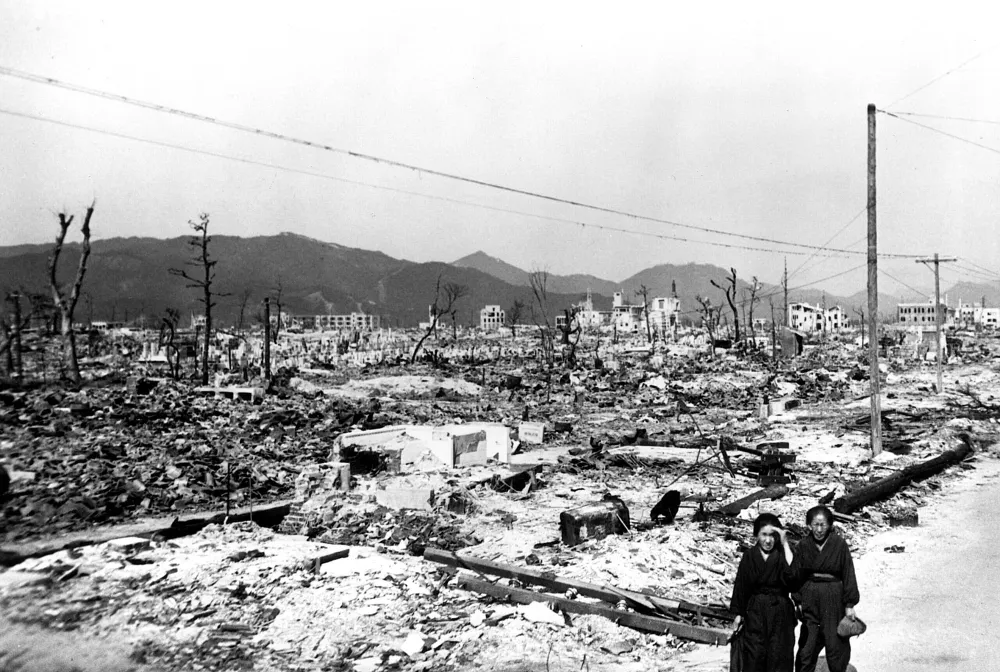
July 23—At fifteen minutes past eight on the morning of August 6, 1945, a human being sat on the stone steps of a bank in Hiroshima, waiting for it to open. Then came the flash. The heat of it—thousands of degrees in an instant—bleached the stone white around the place where they sat, and left behind only a dark silhouette: a shadow with no body, burned into the steps, which visitors to the Hiroshima Peace Memorial Museum can stand before today. A wristwatch recovered from the ruins stopped forever at 8:15. Eighty-one years later, we do not know that person’s name. We know only that he or she was one of us—a human being, running an errand on a Monday morning—and that in the last instant of life that individual became a warning for every following generation.
Hear that warning now, because August is coming again—and the men who should be heeding it are “inching,” in the words of Gen. (ret.) Harald Kujat, the former chairman of NATO’s own Military Committee, “day by day towards the point of no return,” in “a situation comparable to August 1914.” Kujat states plainly what every relevant expert states: There is no such thing as a small nuclear war. As Annie Jacobsen, author of the 2024 bestselling book Nuclear War: A Scenario, put it this week, everyone in the Pentagon who has gamed it knows that nuclear war, however it begins, “only ends in one way, and that is total apocalyptic annihilation.” Kujat’s own estimate: a nuclear winter of fifty years. Understand what that means. Hiroshima everywhere, followed by the cold and the dark and the failed harvests, until there is no one left to stand before the shadow on the steps.
We are dangerously close. Last night the United States flew its twelfth consecutive night of strikes against Iran, and President Donald Trump—who says of that nation of 90 million people, “we’re not finished at all”—has publicly marked for destruction a mountain that experts say no conventional weapon on Earth can reach, leaving unspoken the one instrument that could. In Israel, the discussion has left the basement: A nuclear strategist with decades of expertise openly urges trading nuclear ambiguity for “selective nuclear disclosure,” while a retired Israeli admiral prescribes regime change in Tehran. The U.S. Congress, given its first chance to stop the war since Trump announced it had resumed, produced a caricature of itself: the House passed the resolution that binds no one, and the Senate killed—by two votes—the one that would bind the President. The same Congress just passed, 216-212 in the House, the merger of the U.S. and Israeli war machines in Section 219 of the fiscal year 2027 National Defense Authorization Act that Col. Lawrence Wilkerson calls the legalization of Israeli spy Jonathan Pollard’s treason. And the bill for all of it is arriving: oil above $100 per barrel, gasoline over $4 per gallon, a tenth of the world’s wheat exports halted, fertilizer markets broken until 2028—famine, the quiet version of nuclear winter, already stalking the 250 million people who were hungry before the first missile flew. Even the U.S. Secret Service now warns that it is “just a matter of time” for the drone warfare Washington fed abroad to come home.
But nothing in this is fated. When the world last stood this close to doom, in the missile crisis of the early 1980s, hundreds of thousands of ordinary people filled the streets of Europe and America, and their governments—who had also seemed deaf—produced the Intermediate-Range Nuclear Forces (INF) Treaty. The voices are assembling again. Kujat and Wilkerson speak from within the military institutions themselves. The eleven nations of ASEAN, 700 million people, have demanded that the war stop. Pope Leo XIV, in his new book Disarmed and Disarming, counts 103 states at war, calls the resort to war after Hiroshima and Nagasaki “an adventure with no return,” and warns that a world where machines decide to bomb the defenseless “would be truly frightening.” Even at the bottom of the U.S.-Russia relationship, both U.S. Secretary of State Marco Rubio and Russian Foreign Minister Sergey Lavrov agreed this week in Manila that cooperation in space, and the renewal of cultural ties, must continue—two doors neither side will close. And twenty American farm leaders just joined hands with Mexico’s farmers across a border the geopoliticians call a fault line, to unite in a common cause.
The raw material for a mass movement exists. Will you supply the decision to act? On Friday, July 31, EIR and the International Peace Coalition will convene the Emergency Roundtable, “Solve the Immigration Crisis with Development: What You Need To Know About the Strategic Significance of Pope Leo’s Encyclical”—an event where the war danger, the famine, and the flight of the desperate will be addressed at their common root, and where the alternative—development, the right of every human being to stay and build a future at home—will be put on the world’s table. Bring someone. Bring ten. The person on the steps of that bank in Hiroshima had no warning. We have every warning that heaven and human reason can send. Let it be said of this August that the shadow spoke—and this time, we listened.
EIR July 31 Roundtable
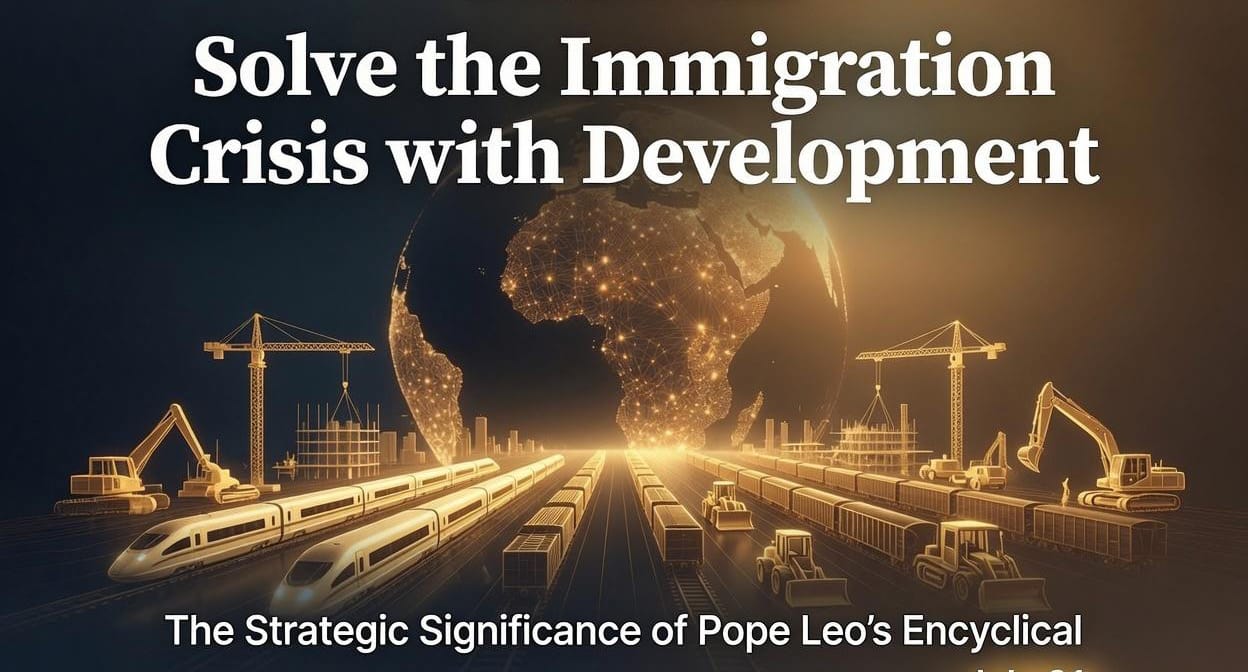
The EIR Roundtable Dialogue July 31, 2026, will begin at 11:00 am (EDT), 17:00 (CET), streamed live in English on YouTube, and in Spanish, German and French simultaneous interpretation on Zoom. Expert speakers will participate in two panels: I) Pope Leo XIV and the Dialogue of Civilizations; II) Development Drive Means Billions of New Jobs, No Refugees, No War. The international deliberations will concern the urgent interventions we can make given the combination of the current extremely dangerous world situation, the hopeful flanks coming from the Global Majority, and in particular, from the new encyclical Magnifica Humanitas by Pope Leo XIV.
The video for the event can be found at EIR.news.