Panel I: 11 a.m.- 1 p.m. EDT
Panel II: 1:30 p.m. - 3:30 p.m. EDT
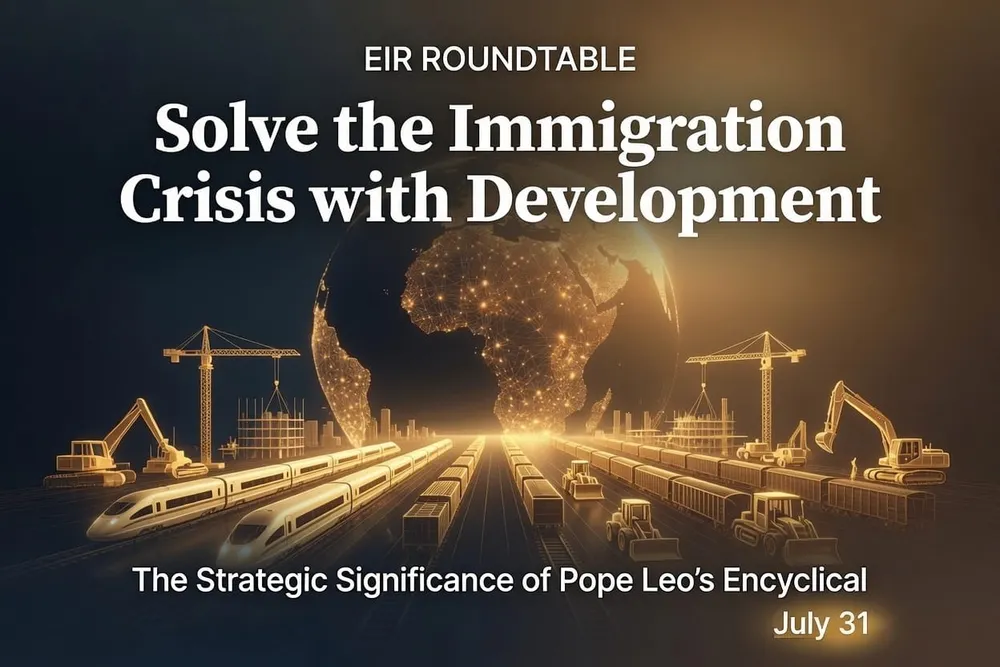
On Friday, July 31, beginning at 11 a.m. ET, EIR is holding an online roundtable seminar on the strategic issue of the immigration crisis and what must be done about it. It will be streamed live in English on YouTube, and Spanish, German and French simultaneous interpretation will be provided on Zoom.
Passcode:850621
Phone one-tap:
+13092053325,,83910952588# US
+13126266799,,83910952588# US (Chicago)
Announced Partial Speakers List for EIR Roundtable
Panel 1: A Dialogue of Civilizations: Development or World War III
Moderator: Dennis Speed
1) Helga Zepp-LaRouche (Germany): Editor-in-Chief, EIR
2) Liu Chang (China): spokesman for the Embassy of China in the U.S
3) Rostam Adabinia (Iran): Minister Counselor, embassy of Iran in Mexico
4) Izzeldin Abuelaish (Palestine): doctor, professor, author, and peace advocate
5) Richard Falk (U.S.): professor emeritus of international law, Princeton University
6) Rémi Lebrun (France): Schiller Institute
7) Fr. Harry Bury, Twin Cities Nonviolent, Author. Member of U.S. Catholic Priests Association
8) Jack Gilroy (U.S.): member Veterans for Peace, Pax Christi
9) Daisuke Kotegawa (Japan): former Executive Director for Japan, IMF
Q&A
Panel 2: Solving the Migrant Crisis: Does Mankind Have the Moral Fitness to Survive?
Moderator: Anastasia Battle
1) Dennis Small (U.S.): EIR Ibero-America director
2) Mário Maurici (Brazil): Member and First Secretary of the São Paulo State Legislature
3) Donald Ramotar (Guyana): former President of Guyana
4) María de los Ángeles Huerta (Mexico): former congresswoman
5) Diane Sare (U.S.): independent candidate for President of the United States
6) SEM Youssouf Abassalah, Ambassador of Chad in Germany
7) Timothy Ninsiima (Uganda): youth leader
8) Claudio Celani (Italy): co-editor, EIR Strategic Alert Service
9) Adama Coulibaly (Burkina Faso): former Chief of Staff to the Min. of Communication
Q&A
EIR has issued the following invitation to its July 31 Emergency Roundtable Dialogue.
As the Iran and Ukraine wars fester and threaten to escalate into nuclear World War III, it has become clear that, if humanity is to survive, we will have to discover and implement a way to achieve a durable peace for all, based on development for all, security for all, and above all human dignity for all. In the last two months, a new strategic factor has come into play which brings that opportunity a lot closer.
Pope Leo XIV’s recent week-long trip to Spain, combined with his May 15 first encyclical, Magnifica Humanitas, has issued a call for humanity to act as one in its common purpose of seeking peace and development for all nations by ending colonialism in all its forms once and for all; he has grounded that call to action in a concept of Man’s essential dignity ("The desire for goodness, beauty and truth is rooted in the very DNA of humanity"); and he has specifically applied this approach to the horrendous problem of global forced migration that affects hundreds of millions of desperate migrants—and the countries that receive them: “We are speaking, above all, of people created in the image and likeness of God, rather than of legal categories or problems to be managed.”
In so doing, the Pope has followed through on his earlier commitment to the Coincidence of Opposites method of the XV century Cardinal Nicholas of Cusa, and he has also spoken not only for Catholics, but for many billions more of other faiths who share this outlook. He has introduced a principle which, if spread and applied globally, can play a major role in the construction of a new international security and development architecture.
As EIR Editor-in-Chief Helga Zepp-LaRouche wrote in a June 17 statement about the Pope’s encyclical:
“Of all the important and urgent speeches delivered recently by politicians and experts from many countries with the aim of preventing the strategic situation from escalating into a catastrophe that would wipe out the human race, Pope Leo XIV’s intervention—with his encyclical Magnifica Humanitas and the addresses he delivered during his recent trip to Spain—is, in my best judgment, by far the most important. When historians later examine the question of what—hopefully—proved to be the decisive factor in bringing Western civilization, in the midst of a deep spiritual and cultural crisis, to change course, they will come upon the role played by the Pope, and the willingness of a sufficiently large number of believers and people of good will to take his words to heart and bring about a change in policy…
“At the same time, he indicates the way out of the crisis, which is within reach, namely, that people summon up the highest ideal of the Christian view of humanity, and put it into practice…
“Among the various aspects of these [failed Western] policies, all of which are building blocks of the new Tower of Babel, are the idolatry of profit at the expense of the poorest, the financial interests that fuel tensions and conflicts to keep the war industry up and running, and support for modern forms of slavery.”
Zepp-LaRouche then quoted the Pope’s encyclical Magnifica Humanitas:
“81. A litmus test for social justice today is the treatment of migrants, refugees and those forced to move due to poverty, violence, climate change and environmental disasters… It means promoting the right to remain in one’s homeland in peace and security by addressing the root causes that force people to migrate, including those linked to economic injustices and the climate crisis. When these rights are respected, migration can become an opportunity for encounter and mutual enrichment among peoples.”
Zepp-LaRouche insisted: “Instead of clinging to an inhuman neo-colonialist mindset, the governments of Europe and the U.S. are called upon to immediately commit to international cooperation aimed at completely eradicating poverty and underdevelopment in all nations on this planet.”
These tasks are both immediate and achievable. Zepp-LaRouche stated in a June 17 webcast: “The continent of Africa will have 2.5 billion people by the year 2050. And that means that if you want to deal with the migration crisis in a human way, we have to create 1 billion new productive jobs in the next 25 years. And that would be a totally welcomed reversal of the present policy. It would at the same time also help the European governments and countries to get out of the economic crisis by having a tripartite cooperation with the BRICS countries.
“And for the United States, the same thing is valid. If you look at the migration crisis at the U.S.-Mexican border, it’s definitely the same approach which the United States should take in respect to the so-called Western Hemisphere. By joining hands with China, rather than trying to drive China out of Latin America, they should join and build things like the Chancay port, which is already built in Peru, but connect it to a bi-oceanic railway from the Atlantic to the Pacific. And in that way connect that with other great infrastructure projects. That would eliminate the root causes for the migrant problem in Latin America as well.”
The combination of the extremely dangerous global situation and this new hopeful strategic flank, require full deliberation by leading international thinkers. That is the purpose of the upcoming July 31 EIR Roundtable Dialogue, which will consist of two panels: A) Pope Leo and the Dialogue of Civilizations; B) Development Drive Means Billions of New Jobs, No Refugees, No War.
The roundtable will begin at 11 a.m. ET on Friday July 31, and it will be streamed live in English on YouTube, and in Spanish, German and French simultaneous interpretation on Zoom. Further details, including a speakers list, will be forthcoming.
