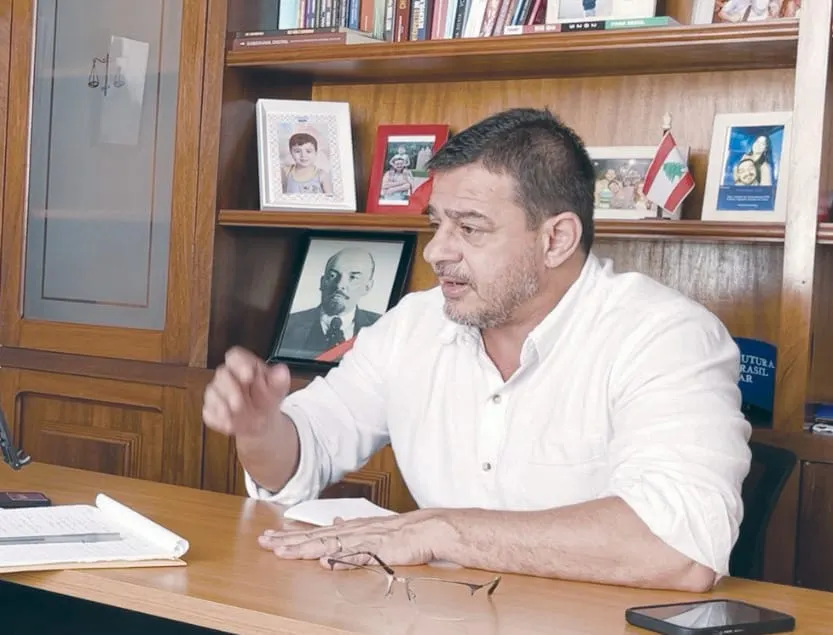
The following is an edited transcript, translated from the original Portuguese, of the July 22, 2026 EIR interview with Professor Elias Jabbour. Mr. Jabbour is a geographer, professor at the State University of Rio de Janeiro (UERJ), researcher, and writer, recognized for his studies on China’s economic development and for formulating the theory of the New Project-Based Economy. He served as president of the Pereira Passos Institute (IPP), Rio de Janeiro’s official municipal agency for urban planning, cartography, and statistical research, from 2024 to 2026, and worked as a senior advisor to the presidency of the BRICS’s New Development Bank (NDB) in Shanghai. A member of the Communist Party of Brazil (PCdoB), he also served as an economic advisor to the presidency of the national Chamber of Deputies and is the author of seminal works on political economy, socialism, and the Chinese model of development. He is currently a candidate for federal deputy (lower house of the Brazilian Congress) for the PCdoB in Rio de Janeiro, advocating for a national development project, the reindustrialization of Brazil, the strengthening of the state as a driver of economic growth, national sovereignty, and increased investment in science, technology, and infrastructure. The elections are Oct. 4, 2026.
The interview was conducted in Brazil by EIR correspondent Tim Rush. Subheads have been added.
Tim Rush: Good morning, Mr. Elias Jabbour. It’s a great pleasure to speak with you today. EIR is honored to have the opportunity to explore some topics with you.
To begin with, we know you have extensive experience regarding the relationship between Brazil and China. Around the world, we see a conflict, a major difference between two systems. First, the trans-Atlantic neoliberal system, which is truly on the verge of collapse. It has some $2.4 quadrillion in debt, mostly in the form of financial derivatives, which is unpayable. So, from our perspective, the wars ravaging the world are not causing economic problems; rather, the collapse of this system is what triggers these wars. So, how do you see Brazil’s role? Especially, since Brazil obviously belongs to an axis in the Western Hemisphere, alongside the United States, but also with the BRICS and the Belt and Road Initiative, which involves a close relationship with China. What role can and should Brazil play at this moment?
Prof. Elias Jabbour: Traditionally, Brazil can be viewed, from a political standpoint, as part of the West. But as Brazil has asserted itself as a sovereign and independent country—a country that developed very rapidly starting in the second half of the last century—it has increasingly identified itself as part of the periphery of capitalism, a Third World nation, and today Brazil sees itself as part of the Global South. Within the Global South, it is part of the BRICS.
Personally, I believe that Brazil’s role in a new world that may emerge, is to be one of the poles of a so-called multipolar world. In other words, there is Asia with China, there is Asia with India, and there is a Europe and an Asia with Russia, spanning the two regions. Europe itself is a multipolar pole; there is currently an African bloc in the process of consolidation; and, of course, the United States.
So, Brazil’s place in the world is to be one of the poles of this multipolar world that is emerging today.
Rush: The relationship with China has several aspects. One aspect that we see as very important is the construction of a Bioceanic Railway [across South America—ed.], which would connect the large Port of Chancay on the Pacific coast in Peru—built with China’s help—to Ilhéus in Brazil, or the Port of Santos; it doesn’t matter which, but it could be a very important demonstration of Latin America’s continental integration. And there could also be development corridors on either side—not only for the export of agricultural products, but also for new cities and new economic activity in a variety of forms.
What do you think of this project? Does it have momentum? Can it be realized?
Jabbour: Honestly, I think it’s very difficult. Because today, for example, the Brazilian bureaucracy—which would allow a railroad like this to be built, a route like this to be built—prevents such a project from being completed in less than 20 years.
I think that’s one point. The second point is that this railroad—or these bioceanic routes—as an end in itself, that is, to consolidate South America as a supplier of commodities to China, is not a good deal for South America. Why?
Because South America needs to reindustrialize, starting with Brazil. What would be much more interesting, actually, is to have the biooceanic projects—I don’t see any problem with that—but also construction, in sovereign partnerships with China, such that the region as a whole and each country in particular could see the potential that China could offer each country, and the construction of infrastructure that would connect Latin America internally—that is, unify Latin America’s internal market—through highways and railroads linking domestic markets, rather than consolidating South America as a commodity export corridor to China. In my opinion, that’s not in our interest. As much as I may be sympathetic toward China, or the Chinese dynamic and so on, I don’t think this is good for our interests.
Rush: During your years in China, with the BRICS New Development Bank, there has been a major debate within BRICS about how to decouple from the dollar in light of potential sanctions, and these massive U.S. tariffs, etc. I remember that last year, precisely when President Donald Trump imposed the first round of large-scale tariffs against Brazil, Brazil signed an MoU—a memorandum of understanding—with China for engineering studies for this bioceanic project. It could possibly be a way to overcome the polarization on the continent, given the new conservative government in Peru. There is great enthusiasm among the people of Peru for the Chancay Port; it is a source of pride for all Peruvians.
So, it would be something like this that could—instead of what U.S. Secretary of State Marco Rubio, President Trump, and others want in terms of polarizing the entire continent; a conservative government, like Peruvian President Keiko Fujimori’s, and a more left-leaning government, like Brazilian President Luiz Inácio Lula da Silva’s, could create room for a flank against the plan to drive the Chinese out of the continent and exacerbate polarization.
China Will Not Be Driven Out of Latin America
Jabbour: It’s very difficult. For example, no matter how much the United States wants it, or Marco Rubio wants it, or Trump wants it—to drive China out of Latin America—it’s an impossible task. Why? First, the only country in the world with the institutions, financing capacity, and investment resources to operate here in Latin America is China.
Second, the United States has no real connection to Latin America. The United States has no way of bringing production chains here; it cannot establish older-generation semiconductor factories here, nor can it bring artificial intelligence know-how here, because the U.S. model of artificial intelligence is one that seeks to maintain what I call a “technology scarcity”—unlike China’s system, which is an open system. The Americans lack the capacity to invest a trillion dollars in infrastructure; in other words, Latin America’s dependence on China is a reality that can no longer be reversed.
The question I raise is whether Latin America will be able to take advantage of the opportunities China offers the region for our development. And what opportunities does China offer? Two opportunities.
One that I don’t think is the best, is that of being a recipient of the commodities produced by Latin America. But China may also pursue the opportunity of building infrastructure outside its own territory. And in this case, the New Silk Road is an alternative.
It depends on how each country chooses to engage with China. For example, Brazil, as the standard-bearer for Latin America, is resigning itself to the condition of being one of the largest providers of raw materials to China. Not so in Africa.
There are African countries—such as Zimbabwe, a country I got to know when I was at the BRICS Bank—that do not want to be mere exporters of lithium and raw materials to China. They want to compel the Chinese to add value to the lithium right in Zimbabwe. Like Zimbabwe, other countries share this same perception of China’s role.
So, one case I think is interesting for us to observe is the difference between Africa and Latin America in their perception of relations with China, which I think is important. Africa is far ahead of Latin America in terms of awareness and, for example, the centrality of developing its own productive capacity, rather than merely being an exporter of raw materials to China.
Rush: If I’m not mistaken, the Chinese are setting up a steel mill in Zimbabwe, for example.
In terms of how to break away from the current dollar, our perspective is that this is not a U.S. dollar. It is a dollar controlled by the financial elites of London and Wall Street, which actually runs counter to the United States’ own interests.
But obviously, it is a very aggressive dollar, a very harmful instrument in terms of trying to hinder the development of the Global South. So, there are some proposals to create a currency among the BRICS countries. We don’t really see the idea of replacing national currencies as a good one. That would be very bad, like the euro, because that severely undermines national sovereignty. Rather, some mechanism capable of issuing credit for major projects, such as in Africa—bringing water from the Congo River to Lake Chad, or building the large Inga dams in the Democratic Republic of the Congo. And other major projects. So, the issue is, in our view, that it would be a mistake to peg this new investment currency to the dollar. Converting it to the dollar would open the door to speculation, and the entire current system is so short-term that it’s impossible to launch projects that take 5, 10, or 20 years to develop.
So, the question for you is: How do you view the current debate within BRICS regarding the creation of such a mechanism to channel long-term credit toward these positive purposes?
Escaping the Dollar System
Jabbour: I think there is what I call a concept that manifests itself in the here and now. What does that mean? There is no predefined checklist of what must be done to move beyond the dollar and usher in a new international monetary order. There is no checklist; there is no ready-made path for this. What is happening is that mechanisms are emerging as the dollar consolidates its position as a weapon of mass destruction. So, for example, at the BRICS Bank, we raised the horizon of the areas we were working on.
For instance, the percentage of the bank’s funding allocated to projects in local currencies is currently 30%, while the remaining 70% is in dollars. So, the bank’s trend is to try to reduce its dependence on the dollar, but it’s very difficult, because the bank is still within the dollar system.
Rush: You mean the bank’s capital?
Jabbour: Yes. So, the bank is currently a hostage to the dollar system. But what’s happening? There are local payment systems, such as those in Asia today—between China and ten other Asian countries—where a common unit of account already exists among these countries, and they’re already moving away from the dollar.
China has been using its own currency to finance projects, mainly in the Middle East. So, for example, petrodollars and their decline due to the Iran War—this explains both the artificial intelligence bubble in the U.S. and the fact that Palantir is having to halt its activities in the military-industrial complex in order to finance itself. So, China is already positioning itself, as a country, to replace the U.S. in the Middle East.
And China also tends to start doing business with the Global South to gain more footholds. So, this is already happening.
Does that mean de-dollarization in the short term? No. Does that mean de-dollarization in the medium term? No. But does it mean de-dollarization in the long term? In the long term, yes. Not least because there’s already a political factor at play: The U.S. is still the military superpower. That’s undeniable. There won’t be a replacement of the dollar with a basket of currencies in international finance without a major war in which the U.S. accepts the reality of losing its hegemony—of ceasing to be the owner of the international reserve currency. In fact, the only condition Trump imposes on the rest of the world is that the dollar remains the international reserve currency.
This is the only condition Trump imposes on the rest of the world for a smooth decline of the U.S. But what I think, what I’ve been seeing, is basically this. A path is being followed—without a prioritized checklist. The dollar’s greatest enemy is the U.S. itself.
So much so that the dollar has been depreciating against gold in recent years, because the U.S. is no longer a trustworthy country.
Rush: And the issue of floating currencies is a huge problem. You have to fix the value in order to plan.
Jabbour: Exactly.
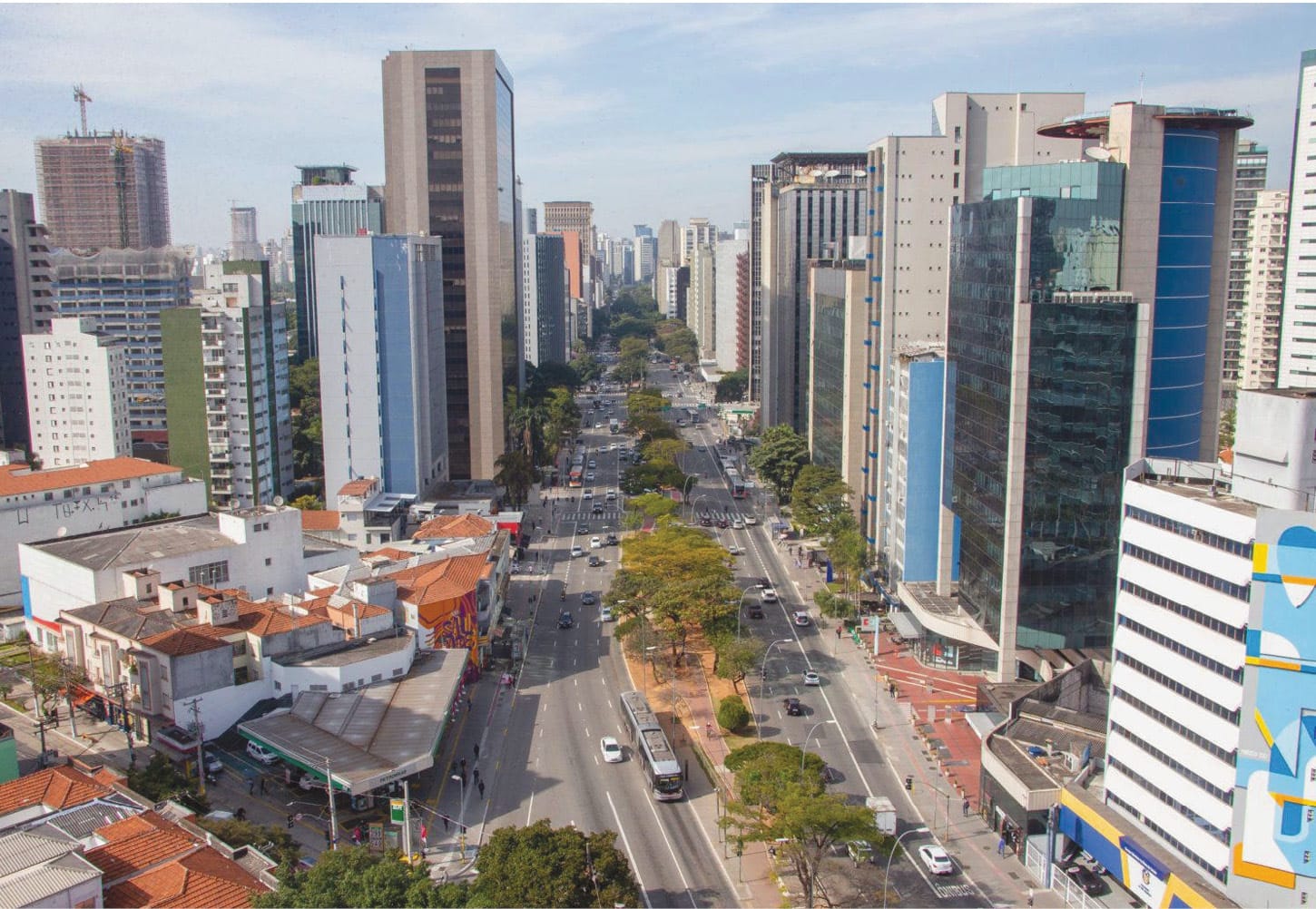
Rush: Now, Putin—Russian President Vladimir Putin—said two years ago at the BRICS meeting in Kazan that he wanted to create investment platforms, for grains, I think, and other projects, as a way to get around the problem of creating a new currency mechanism on its own. I think the Indians were a bit hesitant about a new currency—not to replace national currencies, but to channel resources. How do you view the possibility of mobilizing sufficient resources within Brazil, given the Faria Lima [Brazil’s equivalent of Wall Street, named for a street in São Paulo with a concentration of financial institutions—ed.] issue, among all the other problems?
We have Wall Street; you have Faria Lima. Does the BNDES [National Bank for Economic and Social Development] have financial resources capable of actually launching a project like the one you intend to carry out—one of reindustrialization?
Brazil Must ‘Definancialize’ Itself
Jabbour: I think the problem is political, not technical. Because the technical solution for how to bring about a different development dynamic, independent of Faria Lima, already exists. If we bring together ten economics professors and development experts—heterodox, anti-liberal ones—we’ll have a ready-made blueprint for how to make this country grow and definancialize itself.
The big issue is definancializing ourselves. Brazil is a highly financialized economy. So, the challenge is political. This challenge is reflected, first and foremost, in Lula’s reelection this year. It is essential that Lula be reelected, not least because Brazil is facing a threat that I would call neocolonial, and Flávio Bolsonaro [Lula’s principal opponent—ed.] represents a threat to our civilizational project.
So, Lula’s reelection would be essential for Brazil to continue dreaming of existing as a civilizational project. And alongside that, what do I see? I see the possibility—following Lula’s reelection, this fourth reelection—that the Brazilian left will reach a higher level of consciousness and begin to envision this country in terms of long-term national projects, based on massive reindustrialization.
And then the role of Faria Lima will be called into question. The role of certain interests will be called into question. So, I still make Lula’s victory in the October elections contingent on these developments that you’ve presented to me here as possibilities.

Rush: I know you released a political manifesto recently. Could you summarize that manifesto a bit? Because it obviously has to do with your candidacy, but from my perspective, it encompasses a collaboration far broader than a single party; it’s really about bringing together enough forces to move the country forward.
Jabbour: That’s the spirit of it. The spirit is that of a pre-candidacy manifesto for a federal deputy that aims to shake up the Brazilian public debate around major issues, the main one being that this country needs to reorganize itself as a national project—and more than that, to reorganize itself as a national project that fights for its reindustrialization.
China is set to invest one trillion dollars by 2030 in artificial intelligence. Brazil will invest 28 billion reals this year—that’s $5 billion dollars—which means the gap between Brazil and the countries competing in the Fourth Industrial Revolution is very wide, and is tending to increase. In addition, Brazil has lost tens of millions of industrial jobs over the past 40 years, which has led to a breakdown in our country’s social fabric. So, we have identified—and the manifesto is a summary of this—that only the reindustrialization of Brazil can restore our place in the world and in our own eyes.
Today, Brazil only creates jobs paying one minimum wage or one-and-a-half minimum wages—accounting for 90% of the jobs created. Yet for people in Brazil to have hope for the future, we must create jobs paying three to four minimum wages, so that they can have hope for their future and achieve social mobility.
Fascism Feeds on Lack of Hope
That hope exists in Brazil. And fascism in Brazil—just like Trump in the U.S.—feeds on a lack of hope. And hope will only exist through social mobility. Economic theory tells us that social mobility is only possible through industrialization. There is an advanced industrialization project underway in several sectors: defense, the healthcare industry, petrochemicals, and biodiversity. Brazil has enormous potential to reclaim its position as the 5th, 6th, or 7th largest industrial economy on the planet. Now, that depends a great deal on Brazil’s political capacity to unite around this goal. It’s still very limited today, but it could be greater tomorrow, depending on international pressures.
In other words, Brazil is a target of the U.S. today. And that has led President Lula, for example, to think in terms of a defense-industrial complex. So, I have hope in that regard. And the manifesto is a bit—It’s a political tool for the pre-candidacy to communicate with the country. The Brazilian left doesn’t just work on small issues. Yes, big issues. Exactly.
Rush: This optimism is fundamental. We’ve suffered from tremendous pessimism in the United States due to 50 years of deindustrialization; you’ve been through the same thing here over the past 10 years.
Jabbour: No, here in Brazil, 40 years.
Rush: 40 years? Oh, right. Since the neoliberalism of Fernando Henrique Cardoso [Brazilian President, 1995-2003], and so on.
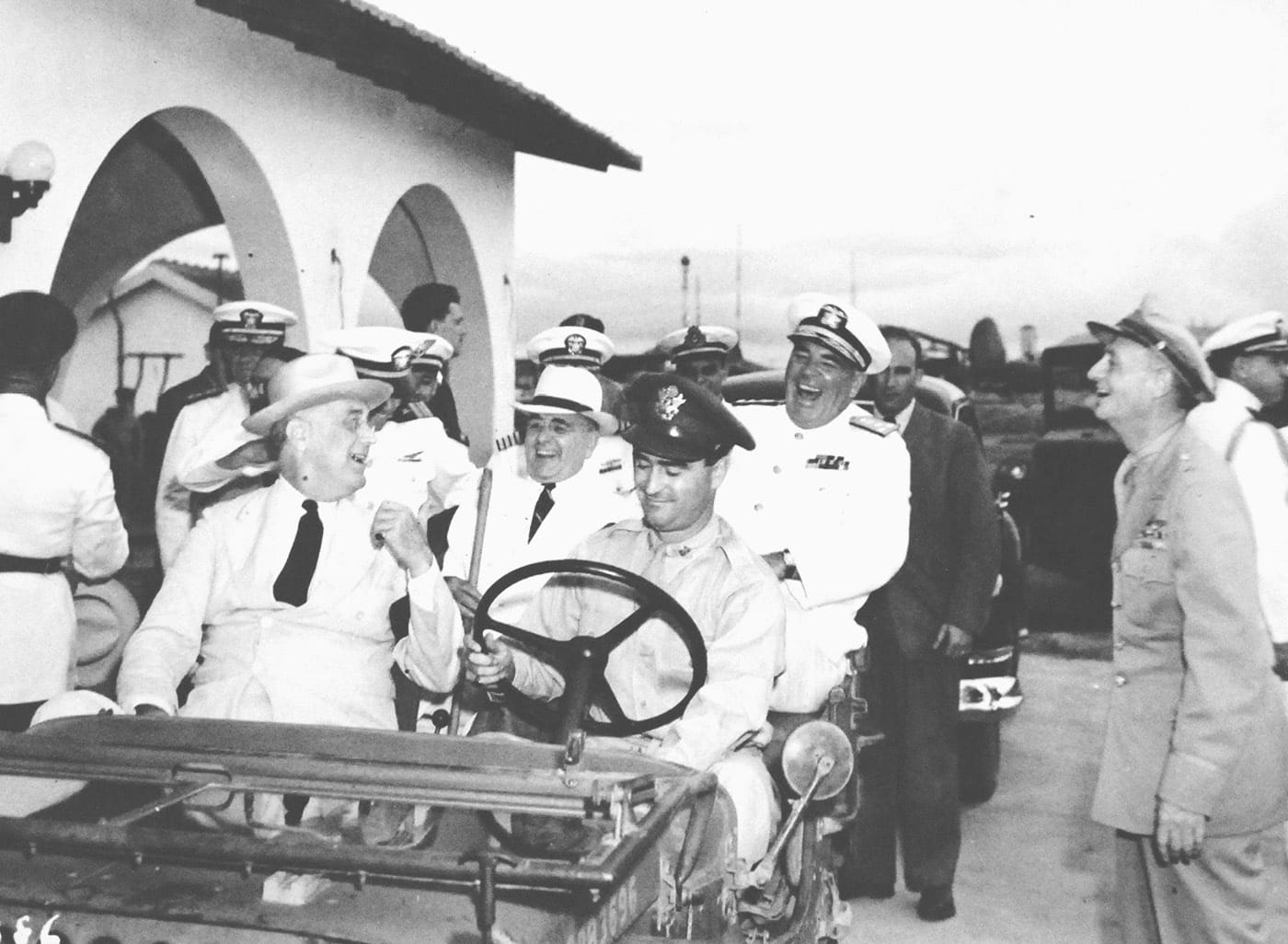
So, the relationship between Franklin D. Roosevelt and Brazilian President Getúlio Vargas—we see it as a very important point of reference for both countries to pick up again the policies we previously had, but we have to renew them simultaneously, and in this way, we can forge new positive and productive relationships, so to speak. Is there anything you’d like to add now—a few closing words, if you have any?
Jabbour: I think you mentioned Franklin Delano Roosevelt, who I believe was one of the great statesmen of the 20th Century. And for several reasons. First, the best-known one is the New Deal, which marked the beginning of the Keynesian concept around the world. Roosevelt talked a lot with John Maynard Keynes. But today, when I think of Roosevelt, I don’t think only of the New Deal or of the man who, along with Stalin and Churchill, for example, defeated Nazism.
In fact, Stalin had the highest regard for Roosevelt. The two were friends, and Stalin was very fond of Roosevelt. I think that Roosevelt, early in his Presidency, faced and defeated a Nazi coup within the United States.
Rush: Yes, in 1935.
Jabbour: So, I think this should be an inspiration for Brazil. Because if the United States managed to defeat an attempted Nazi coup in the 1930s, Brazil can also strive daily to defeat the attempt to transform fascism in Brazil into a political state.
So, I believe that democrats, patriots, and humanists in general should look to Roosevelt as a great role model—the hero of World War II, the hero who pulled the United States out of the 1929 crisis, but above all, the man who confronted and defeated a Nazi coup in 1935. I think Roosevelt is one of the greatest figures of all time, without a doubt.
Rush: I want to thank you very much for this opportunity to talk with you. It’s been a great pleasure.