
Telling Tall Tales—“Uyghur Genocide” as a Political Stratagem
by Barry Sautman
Brill, 460 pp, $160 hardback; PDF download free
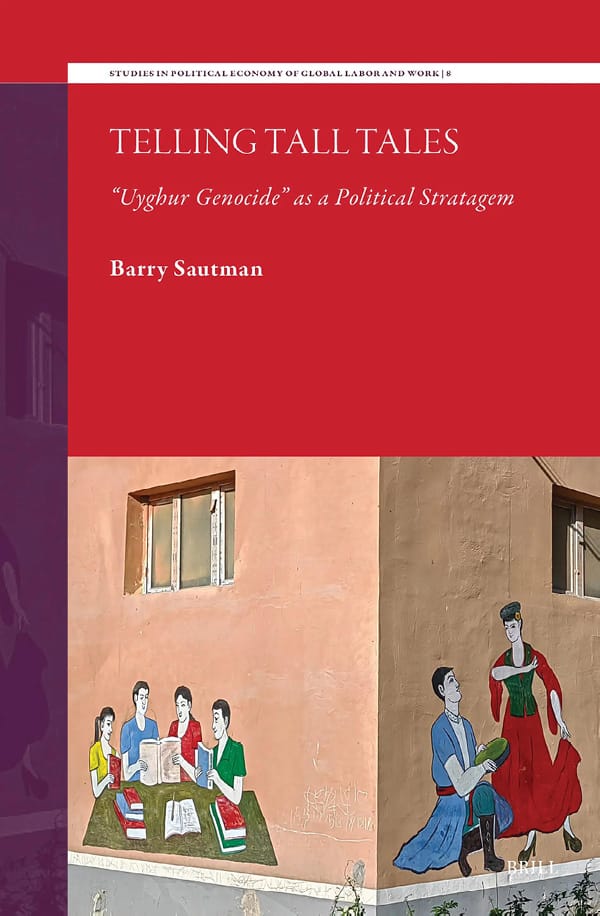
July 31—Western media coverage is full of horror stories about the alleged repressive treatment by the Chinese leadership of Muslim Uyghurs in the western Chinese province of Xinjiang. It is rife with allegations, speculation, and accusations. But does anyone really know anything about the actual situation, and are they aware of where this slander originates, whether there are evidentiary sources for it, and what purpose it truly serves?
The book Telling Tall Tales by Barry Sautman fulfills several of these purposes: It provides an inventory of the institutions and individuals who have promoted anti-China rhetoric, particularly regarding alleged human rights violations or even genocide in Xinjiang. Furthermore, it contains a legal assessment of the relevant international law against the backdrop of relevant UN conventions. Readers will find a meticulously researched 460-page compendium with hundreds of footnotes and an extensive bibliography to help them understand this highly polarizing issue. Sautman and his collaborators have been genuinely diligent here. Federal agencies, such as those responsible for civic education, and other relevant institutions should pick up the book for public enlightenment, as should the review sections of major newspapers. It was published in the series Studies in Political Economy of Global Labor and Work and is the result of an international group of researchers from the U.S.A., India, the Netherlands, South Africa, and China.
‘Cultural Genocide’?
The very broadly conceived first part deals less with China and Xinjiang, and more with contextualizing the concept of “genocide” and the historical appropriation of this highly politically charged term regarding numerous human rights violations in all regions of the world. Regarding the Chinese region of Xinjiang, the spokespersons of the genocide narrative typically do not claim that mass killings or intentional extermination of Muslim Uyghurs in Xinjiang are taking place—even for uninformed observers, these extreme allegations have proven completely untenable. Anti-China hawks now speak of “cultural genocide,” an allegedly enforced suppression of birth rates among minorities of Muslim origin. But there is no international legal or criminal law term for this. Terms like “internment” or “re-education” serve to conjure up the worst images. Yet much is based on hearsay, assertions, and extrapolations without real facts being demonstrably proven. According to the author’s argumentation, this is shown primarily in the aspect of allegedly suppressed birth rates. China is known for its long-standing One Child Policy, which, however, was enforced much more strictly among majority Han Chinese than among ethnic minorities. Birth rates among the Uyghurs rose and continue to rise and the population could reach 15 million according to statistical projections by 2040. There are no restrictions on this by the Chinese government. The author primarily uses extensive demographic statistics to refute allegations of demographic genocide, strict birth control, or even sterilization.
Funded by the U.S. Congress
Likewise, the alleged massive transfer of children from Muslim families to boarding schools or to other families neither occurred in this form nor does it correspond to the claim of cultural oppression or the criteria for genocide. The author clearly shows that large-scale assimilation and cultural displacement were omnipresent in Western cultures. For example, Native American children were subjected to forced cultural assimilation in their communities. Similar practices occurred in Australia, Canada, and Europe, sometimes with horrendous consequences. The book analyzes these topics factually, whereby the propagandistic exaggeration on the part of anti-China circles in the relevant media and political spheres stands out conspicuously. Circles such as the Inter-Parliamentary Alliance on China (IPAC), conservative Members of Parliament from Great Britain, the self-styled Xinjiang expert Adrian Zenz from the ultra-right Victims of Communism Memorial Foundation (VOC)—who is alleged to have stayed in Xinjiang for one week in 2007 and has never entered the region since—as well as the heavily U.S. Congress-funded exile organizations of the Uyghurs, such as the World Uyghur Congress (WUC) or the Uyghur Human Rights Project, are extensively listed. All profit from apparent “Western liberal guilt” over the alleged oppression of the Uyghurs. Pro-Uyghur alliances, however, are found almost exclusively in the U.S.A., Great Britain, Europe, and Australia, but interestingly, hardly any exist in Muslim countries. This is quite strange.
But what about these “serious” reports from high-ranking official bodies, such as the UN High Commissioner for Human Rights? Sautman’s book devotes considerable space to this topic. High Commissioner Michelle Bachelet published a widely cited report on Xinjiang before leaving office in late August 2022, but it was based on a compilation from the Uyghur Human Rights Project—an organization that is largely financed by the National Endowment for Democracy (NED). This is an organization created by the U.S. Congress, which, according to its founder, Allen Weinstein, is a kind of uncloaked CIA. The seemingly incalculable and supposedly independent wealth of human rights organizations dealing with Xinjiang all received substantial sums through the NED to smear China in public with countless unproven allegations. The World Uyghur Congress, based in Washington, D.C., and Munich, for example, receives between 5 and 6 million U.S. dollars annually in support from the NED, according to the author. Politicians and journalists uncritically adopt its reports as facts. According to Sautman, the overall conclusion is clear: Allegations of genocide in Xinjiang are based on ideological prejudices rather than solid evidence. This is part of a strategy to isolate and weaken China. Thus, most government-funded Uyghur migrant organizations, whether consciously or unconsciously, fulfill the geopolitical goals of their powerful Western string-pullers.
Fight Against Terror
Moreover, a wave of brutal extremism swept through Xinjiang, a fact that is often overlooked or downplayed in Western narratives. In 2009, extremist massacres occurred in the Uyghur city of Urumqi, resulting in hundreds of deaths. Militant groups linked to al-Qaeda and the Islamic State spread throughout Xinjiang. The number of attacks peaked between 2010 and 2014, resulting in the deaths of several thousand people in terrorist attacks. In response, the police presence in the region was massively increased. There were almost 13,000 arrests. The author points out that, if one compares this with Western methods and their global War on Terror, China’s approach to terrorism appears quite moderate.
The deployment of security forces provided the West with the imagery it needed to claim that religious minorities were being oppressed, and countless self-styled Western experts suddenly began reporting internment, surveillance, and forced labor. According to the author, there is a kind of “information-industrial complex” in the Western media landscape that must constantly repeat—and increasingly escalate—the allegations of genocide and human rights violations in Xinjiang. This goes hand in hand with sanction mechanisms that punish tens of thousands of persons and institutions for alleged “human rights violations.” Essentially, these measures target everyone and anyone who even slightly questions the Western narrative of superiority and expansionist claim of liberal democracies.
Xinjiang’s Economy Improves
According to the author, the economic reality in Xinjiang looks completely different from what the Western narrative claims. To illustrate this point, he provides detailed presentations of positive economic developments. For example, life expectancy in Xinjiang increased from 63 to 75 years between 1990 and 2024. This figure is even above the global average. Population density has remained stable, and there are no signs of expulsions or deportations, which are typical indicators of genocide. In 2022 alone, per capita income rose by more than 12%, as measures to combat poverty in rural regions of Xinjiang intensified. In recent years, infrastructure has expanded greatly through almost $150 billion in investments. What the West calls “re-education camps” were or are predominantly training institutions, where less-educated rural populations could acquire skills and gain opportunities for the job market. Most people could go home on weekends from these education centers, which contradicts the claim of internment. Moreover, cotton agriculture in Xinjiang is over 90% mechanized, so the type of slavery characteristic of Western colonial systems cannot exist there. These facts are all described in this extensive study, based on substantial data. Therefore, it is up to the unbiased reader to engage with these facts rather than unquestioningly believing the narrative of the “human rights–industrial complex.”
Orwellian Manipulation?
Telling Tall Tales is an extensively researched compendium with contextual reporting that completely turns the daily regurgitated narrative of Chinese oppression in Xinjiang upside down. It reveals the individuals and networks, as well as their financing and interactions, that created and maintain this complex narrative. Notably, American, Canadian, and British “experts” will speak in media and government-funded publications, calling China a human rights violator and the West’s greatest security threat, yet provide no evidentiary basis. As Sautman demonstrates, this resembles an Orwellian manipulation. As a countermeasure, the author wishes for a public discussion of the facts and data to correct the stereotypical image. He hopes that rational arguments and facts can diminish political bias.
This short book review can hardly do justice to the attention to detail, systematic critique of Western narratives, and wealth of literature, footnotes, and other references Sautman’s book provides. However, this much can be said: Reading through this study, which was apparently produced with great effort and accuracy, is worthwhile, even if you read only select chapters. Its focus is not on pitting one statement against another, but rather on providing an overview of the predominantly Anglo-American, government-funded networks involved and of their methodology. Readers will gain the ability to judge one of the most controversial geopolitical debates instead of relying on pre-formed, repeated clichés. This alone justifies reading the book—including, or perhaps especially for readers critical of China.
