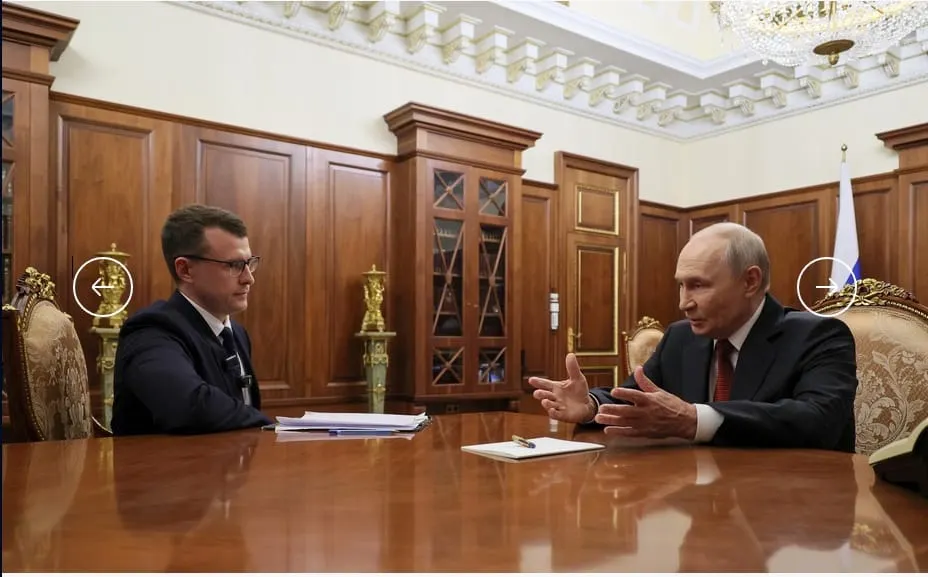
Following the United Russia party congress, President Vladimir Putin today recorded a sit-down interview at the Kremlin with Pavel Zarubin, the Kremlin pool reporter from state television who hosts the Sunday night program “Moscow. Kremlin. Putin.” Both the Kremlin and Zarubin then posted on Telegram a segment of the interview in which Putin gave a somber and emphatic explanation of why Russia has sharply intensified its aerial bombardment of targets in Ukraine. The whole interview will be in the Kremlin’s English transcript, which is not yet complete; our report, below, includes machine translation from the complete Russian transcript of its later parts.
Zarubin noted the public response, in Russia, Ukraine, and the West, to “the fact that Russia has sharply increased both the power and the number of strikes against Kiev and other Ukrainian cities and ports.” He asked Putin to say if they are shifting the military situation overall, and, in a follow-up, why they are being done just now.
Putin replied that the strikes are effective because they “hinders the possibility of delivering equipment and ammunition, and rotating personnel on the line of engagement. This disrupts the ability of defence industry enterprises to improve weapons, and this improvement is happening with the direct participation, not just with the support, but with direct participation of Western sponsors, and, of course, this has the most direct and positive effect on the conduct of warfare in terms of achieving military results.” As for the timing, Putin elaborated that “it is, of course, the result of yet another adventure by the Kiev regime and its Western handlers who have planned to inflict yet another ‘strategic defeat’ on Russia – this time, as is known, within 40 days and through massive missile and UAV strikes against our civilian facilities and logistics. A goal was publicly stated to destroy entire sectors of our country’s economy, undermine the unity of our people, and weaken the cohesion of Russian society. The overall goal is to bring Russia to collapse, something they have long dreamed of and constantly talk about.”
He continued, “As is known, this 40-day period expired on August 5. And thus, the question arises: What is the outcome? Strikes against civilian, essentially unprotected facilities, and, most importantly, against civilians, evidently cause economic damage to our country and lead to losses. And [the] loss of every person — I want to underscore this — is always a tragedy: for the family, for loved ones, and for the entire country. We know well that the Nazis during the Great Patriotic War and World War II, and neo‑Nazis today, felt and, apparently, still feel a special satisfaction, a pleasure as they commit such crimes…. Yet the final result turned out to be exactly the opposite of what the enemy had expected.”
He later said, of this 40-day effort by Kiev: “No turning point in the confrontation with Russia could have occurred, and none occurred. The Kiev regime and its masters cannot obtain, have not obtained, and never will obtain any advantage.”
He laid out Russia’s position:
“The Kiev regime set itself the goal of inflicting damage on our economy. And what did it do? It opened this Pandora’s box itself. Very well — receive your answer, in your most sensitive economic sectors, which frankly are already at their last gasp. This, incidentally, also concerns agricultural production, from the export of whose products the Kiev regime derives its principal revenues.”
On logistics: “You want to disrupt our logistics? Well then, the response will not be long in coming. Receive it. And the actions of the Russian army are, of course, far more painful and far more destructive. I have said repeatedly: there will always be a response.”
The retaliation has brought Kiev’s situation “in a number of the most important areas to a critical level,” he said. “That is precisely why the Kiev authorities today, through mediators whose opinion we certainly respect, are trying to find a way out of the situation that has taken shape for them — which they themselves, I want to emphasize, themselves provoked.”
But Putin showed no patience for Kiev, which terminated negotiations one year ago. He added, “The proposals conveyed to us are at times, I would say, of an exotic character, and are unacceptable. We are always ready for dialogue about peace, but only on the basis of the realities taking shape on the ground.” Pressed on what “exotic” meant, Putin declined to say, saying it was inappropriate to discuss overtures.