
The following is an edited transcript of remarks by Dennis Small to Panel 2 of the Sept. 4, 2026 EIR-IPC Roundtable, “An Alternative to War and Looting in the Americas.” Mr. Small is the Ibero-American Editor of EIR magazine. Subheads have been added. The video is available here.
In 1982, I was in Brazil, and I had the opportunity to visit the Carajás iron mine in its beginning stages of development, and it’s one of the largest iron ore deposits in the entire world. And the options available to Brazil at that point clearly went in two different directions. Either Carajás could be exploited for its mineral, its iron ore content, which is extremely high in purity; taken by rail to the coast, to the port of San Luis; and exported abroad to make money, to then pay off the Brazilian foreign debt—which is never-ending and would always be growing and growing. Or that iron ore could be used as the beginning of an industrialization process for Brazil.
Two completely different approaches to how you deal with an economy and how you deal with infrastructure.
During that same trip, I had the interesting occasion of interviewing the then Planning Minister of Brazil, Delfim Netto, who was a Wall Street favorite, if ever there was one, and a City of London favorite. And one of the things he told EIR in that interview, and I quote: “We are directing investments towards increasing exports.” So, there’s no clearer statement possible of what was actually the British system of colonial looting than what he said.
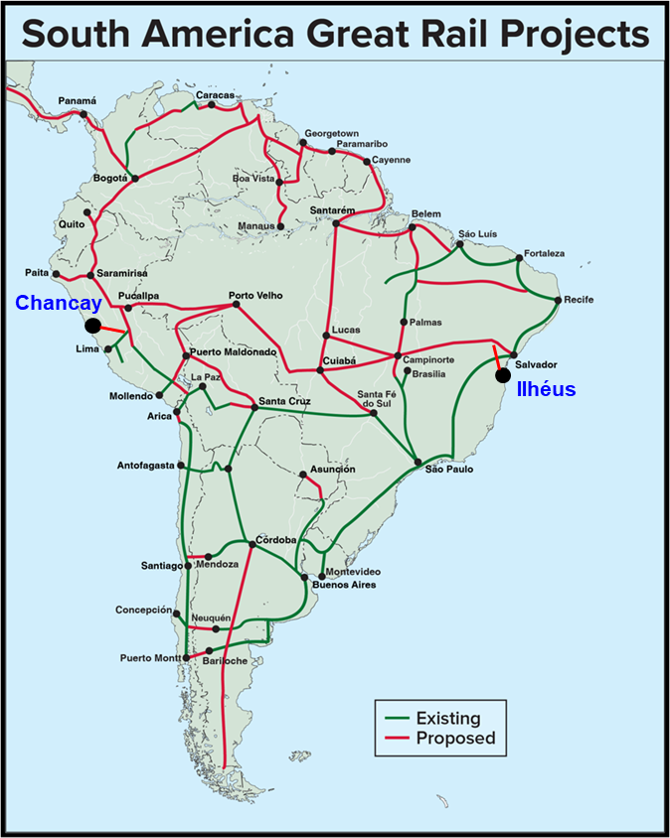
I mention this by way of introduction because, in discussing the Bi-Oceanic Rail Corridor connecting the Pacific and Atlantic coasts of South America, we face the same issue. One of the major routes, which we will discuss today, is from the Atlantic coast of Brazil, the Port of Ilhéus or possibly Santos, going across Brazil, crossing the Amazon, the Andes, and then going to the Port of Chancay in Peru. Although I should say there are other possible routes, all of which are very good: one going further to the south, which would include Paraguay and Bolivia and other countries. All are needed.
But that rail corridor, the idea of a bi-oceanic corridor connected to the Chancay Port, there are reservations that some people have about this, and it’s understandable. The reservation is: Well, if this is simply designed to facilitate exports, to make foreign exchange, to pay the debt, to keep exporting, then what’s the point? Why have that kind of project? And that is one way that this could conceivably evolve. Or, and this is our proposal, the Bi-Oceanic Corridor would actually be a highway to the future, a highway to the kind of world development that’s needed.
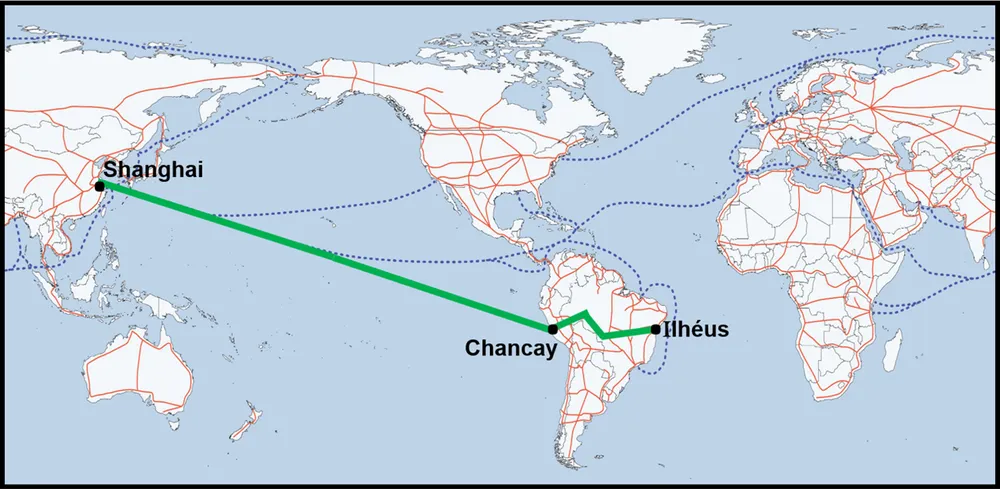
This map [Figure 1] here is the World Land-Bridge as designed by Mr. LaRouche and Mrs. Zepp-LaRouche, showing a worldwide network, an interconnected network of development corridors. And in particular, it shows the Chancay route to Shanghai in China, which takes only 23 days and 17,500 kilometers—far faster than earlier routes, which had to stop in Long Beach, California, or somewhere else. And then you can see the Bi-Oceanic Corridor route, roughly drawn out between the Port of Ilhéus and Chancay, to begin the opening up of the industrialization of the continent.
A Single Policy for Development Projects To Succeed
Now, there’s always been a single policy involved to make such development projects work; a policy which has three examples which I want to refer to briefly, just so that people get an idea that there’s some history to this kind of approach.
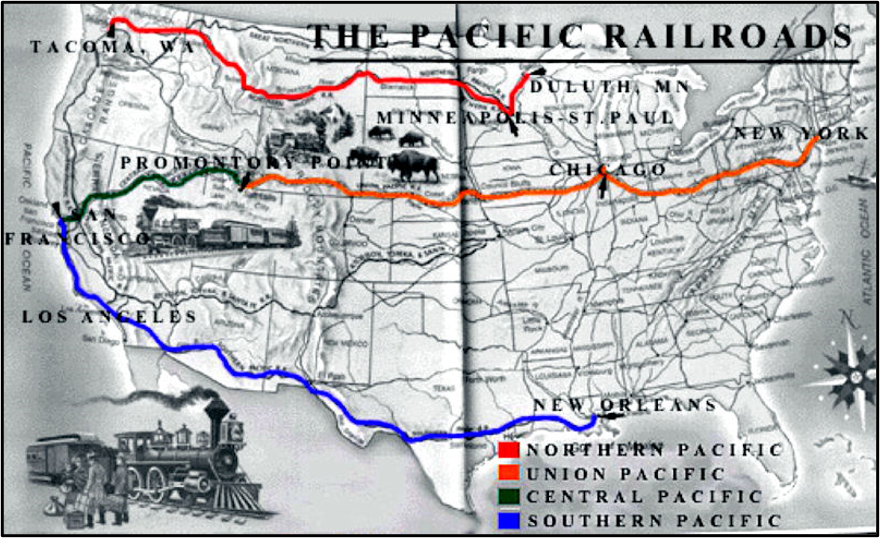
The first example is what happened in the United States in the middle of the 19th Century. That was the building of the Transcontinental Railroad on the initiative of President Lincoln. Now, what that rail route looked like can be seen in Figure 2. It was finally completed in 1869 at Promontory Point in Utah, right here where the black and the orange lines meet. It cost $64 million at the time. It stretched a distance of 5,175 kilometers across the continent. And nowadays, you can get from San Francisco to New York on this rail route on not-very-fast trains in something like three to four days. This example addresses in part some of the issues that came up in the last panel’s discussion about whether or not the United States is hopeless. If we’re a lost cause here in the United States, does the world just go about its business and try to do things without the United States? This, as Helga Zepp-LaRouche just made painfully clear, means that we will probably end up in thermonuclear war.
It is our profound belief, knowing what LaRouche and others presented about the real history of the United States, that the United States is not hopeless. And I think what Lincoln did showed this, under the orientation of his top economic advisor and expert, Henry Carey, who lived from 1793 to 1879. He is the one who proposed the whole idea of railroads. He proposed the same for Germany and for Russia. “We should girdle the entire world in rail networks,” he said. And he is the one who famously, in an 1851 document called The Harmony of Interests, presented the idea that there is an American System of political economy going back to Hamilton, which is completely different than the British free trade model that Delfim Netto expressed to us in 1982.
I’d like to read you a rather famous and very important quote from Carey, from his 1851 pamphlet called The Harmony of Interests. He said the following:
Two systems are before the world…. One looks to underworking the Hindoo, and sinking the rest of the world to his level; the other to raising the standard of man throughout the world to our level. One looks to pauperism, ignorance, depopulation, and barbarism; the other to increasing wealth, comfort, intelligence, combination of action, and civilization. One looks toward universal war; the other toward universal peace. One is the English system; the other we may be proud to call the American system, for it is the only one ever devised, the tendency of which was that of elevating while equalizing the condition of man throughout the world.
If that sounds familiar today, well, it’s because we are still facing that battle between those two systems. So, that’s one example of this kind of approach to development in the common interest of all of mankind.
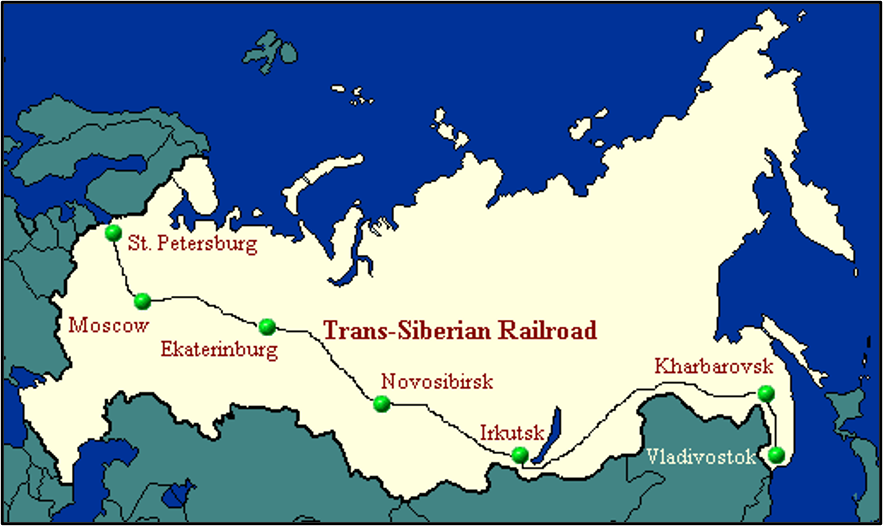
Another one, not in the 19th Century, but at the beginning of the 20th Century, is what happened in Russia in 1905 with the inauguration of the Trans-Siberian Railroad [Figure 3]. This was done under the direction of Count Sergei Witte, who was the finance minister under the Alexander III government, which came to power in 1892. Witte was a follower, among other things, of the German economist Friedrich List, who in turn was closely related to the same Henry Carey, who we just heard from a moment ago. And this was a railroad, once it was built, which was 9,250 kilometers in length, going from Moscow to Vladivostok, taking seven days today to get across.
Here’s what Count Witte said about this kind of approach—and keep in mind what I just read you from Henry Carey. Witte said:
The railroad exerts a civilizing influence as a theoretical and practical school, where it does not so much adjust itself to the local conditions, but rather where the local conditions adjust themselves to the needs of the railroad. Even if it meets on its route an absolutely barbarous people, it will in a short time raise them to the necessary level of culture.
So, again we have the role of railways as that which can play a broad civilizing role by introducing development throughout the region.
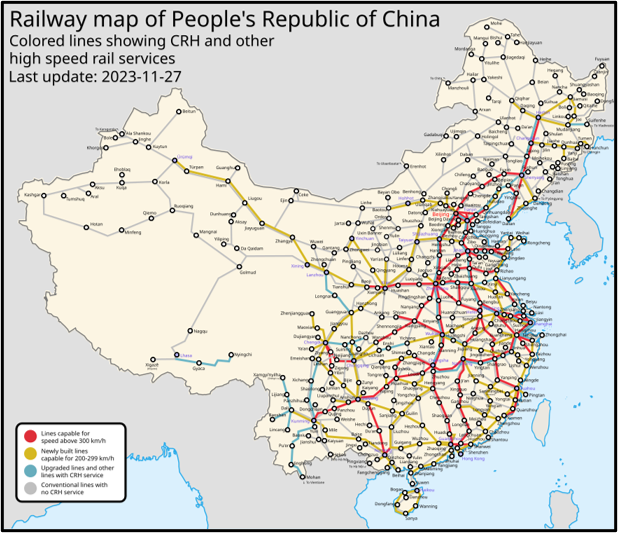
A third example, this one from the 21st Century—we looked at the 19th, the 20th, and now the 21st Century—is what China has done. And, by the way, this is an old map of China, from 2023 [Figure 4]. What China has done with high-speed rail in the intervening years since then has been to increase it even more. There are now 50,000 kilometers of high-speed rail in China. Compare that to the 9,000 kilometers of the Trans-Siberian and the 5,000 kilometers of the Transcontinental Railroad in the United States. This is because the policy that the Xi Jinping government has adopted has in fact totally rejected the British colonial system and adopted a version, with Chinese characteristics, of the American System, with different names of course, but the American System of Hamilton, Carey, List, Witte, and others. This is what has happened in China to date.
Implications of the Bi-Oceanic Railroad
Now, with this in mind, let’s revisit the question of our proposal around the Bi-Oceanic Railroad. The Bi-Oceanic Railroad would cover a distance of about 6,500 kilometers across South America from Ilhéus to the Port of Chancay. It would take somewhere in the range of one decade to actually build. That is, of course, if the Chinese were involved as they were in building the Port of Chancay; they would also have to be involved in this railroad, because Americans don’t know how to build railroads anymore. We don’t have high-speed rail. We have zero kilometers of high-speed rail in the United States.
The estimated costs of the Bi-Oceanic Railroad would be perhaps $80 billion, or a bit higher, depending. It’s estimated that it would create one million direct jobs to build it. And, of course, many, many more productive jobs would be generated as its actual impact begins to take shape.
The crucial importance of the Bi-Oceanic Corridor is, of course, not just the idea of getting from point A to point B, but, as LaRouche said in the video clip you heard earlier, development corridors, 50 to 100 kilometers on each side, with fiber optics, with high-level industries, with advanced technologies, with nuclear energy, with advanced agricultural programs in the region to increase output with major technological inputs, with emphasis not only on nuclear energy, but the development of space technologies as well. And this kind of operation is exactly what the Ilhéus to Chancay Bi-Oceanic Corridor would open up.
On this map [Figure 5], the lines that are green are lines that currently exist. The red ones are the ones that we still have to build. Now, this gives you another idea of what this corridor would actually look like, because we have to not only have rail corridors, we have to have high-speed rail. Now, it turns out that if you simply took the bother of building high-speed rail connections between Shanghai up through Russia, across the Bering Strait Tunnel (which has been under active discussion between China and Russia and raised in certain quarters in the United States), following down through Alaska, Canada, the United States, Mexico, Central America, through the Darien Gap and down to Chancay, that distance is a bit longer (it is 19,000 kilometers, compared to 17,500 kilometers of the maritime route). But with high-speed rail, which is absolutely doable, the trip would take three to four days, as compared to 23 days across the Pacific Ocean. Now, not all cargo should go by high-speed rail, but a lot should, for sure, including passengers, high-value cargo, and so on and so forth. So, it’s this kind of approach that’s required under these circumstances.
Subsuming the Biosphere with the Noösphere
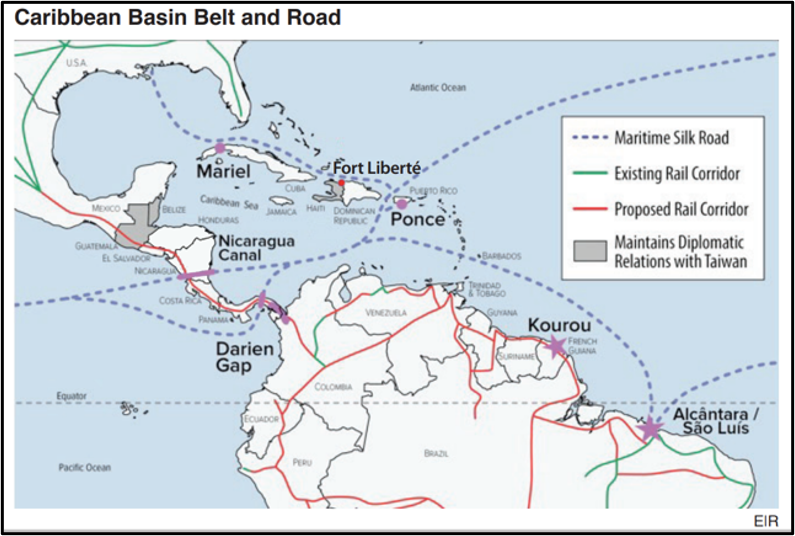
This map [Figure 6] shows the Caribbean Basin area and development programs related to it. I’m pointing out two things here. One is the Alcântara Space Center in Brazil, which has become somewhat dysfunctional in recent years, but was, and must again become, a major center for high-level technology and space science for the benefit of the population of the entire region. Because the important point here is not just to build railroads or even high-speed railroads, but to take on the central task, as Vladimir Vernadsky would say, of putting the biosphere under the tutelage of the noösphere. That is to say, mankind and our creative capabilities have to take the existing biosphere under its wing to help develop it, not to destroy it, but to make it better. And space sciences are an absolutely central part of this.
So, what’s required, therefore, if you think about this properly from this standpoint of LaRouche’s economics, is that you’re certainly not looking for an export-oriented debt-paying model. But you’re also not looking for “value-added.” This is a common idea: “Well, let’s not just export raw materials; let’s add some value.” And that’s laudable, because value should be added. But that’s a GDP or monetary measure of the economy. What has to be added is technology. We need a technology-added model, because we have to induce shifts of technological platforms across the entire region of the Global South.
Let me conclude with an idea that I think takes us to the proper level to consider what we are discussing in terms of the South American Bi-Oceanic Corridor and world development generally. According to recent discoveries with the Hubble telescope, it is estimated that there are approximately 2 trillion galaxies in the observable universe. And I emphasize the word observable—what we have so far observed. It doesn’t mean that’s all there is. It’s not the end of the story. It’s the observable universe that has 2 trillion galaxies. For those of you who like arithmetic, that’s 2 times 10 to the 12th power. So, a 2 with 12 zeros.
It’s also estimated, based on Hubble, that there are an average of hundreds of billions of stars in each one of these galaxies. So we’re talking about something which is actually 4 times 10 to the 23rd power stars in the observable universe! Now, that compares very favorably to the mere $2.4 quadrillion in financial aggregates today, in every imaginable way. That’s only a 2 with 15 zeros. We’re talking about 4 times 10 to the 23rd stars in the observable universe.
But that’s not the end of the story because we—as mankind—have just launched a new telescope, the Nancy Grace Roman Space Telescope, which will outdo Hubble and will have 100 times the power to detect the observable universe. Now, this is almost unimaginable—but it’s not unimaginable. It may be quantifiably unimaginably large. However, here’s the point. We may consider ourselves a tiny speck in this universe, and we are, and you have to look at it that way. We don’t know of any other species like us, but with the immensity of the existing observable universe, we are but a tiny speck.
And cynics would say, well, so what’s the difference if we disappear? Who cares if we let the $2 quadrillion in financial assets destroy us? Who cares if there’s nuclear war? The universe will never know the difference.
False! Because what’s more amazing still than the enormity of this finite but unbounded physical universe, as Einstein said, is man’s mind’s ability to conceptualize it. There is no other species that we know of that can conceptualize our individual microcosm against the macrocosm. There is none that can say, “This is enormous, but we can think about it.” Man’s mind is powerful enough to comprehend the entirety of an unimaginably large universe, finite but unbounded, and it is possessed of the power to continue to do that in an unlimited way, always improving our understanding and power.
That is the power that we must unleash for global economic development. That is the power that can save us from what is now the trajectory of mankind. And that is the real power that can be opened up in the continent of South America by the development of the Bi-Oceanic Corridor along with the Port of Chancay.
Thank you.

