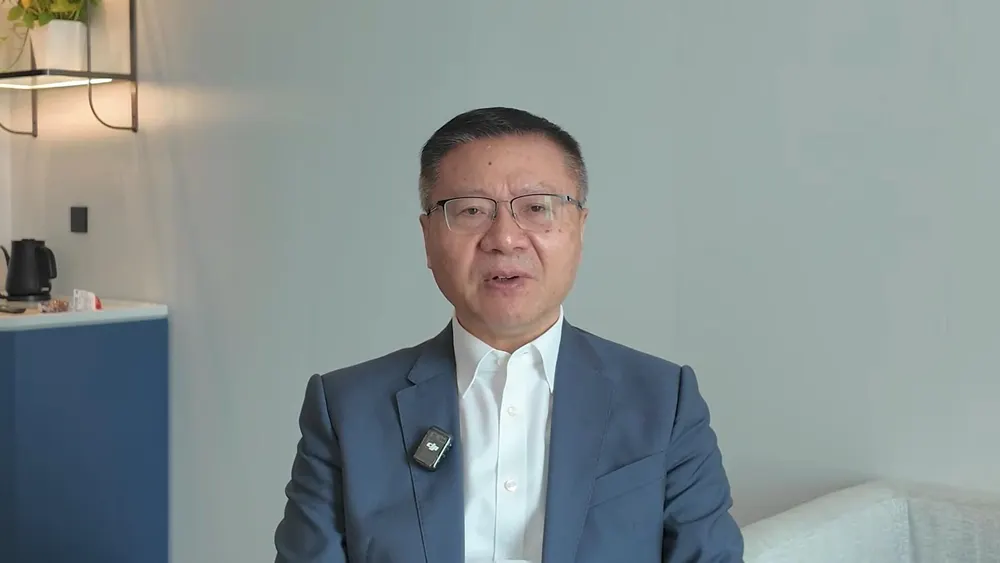
The following is an edited transcript of remarks by Prof. Zhang Weiwei to Panel 1 of the Sept. 4, 2026 EIR-IPC Roundtable, “An Alternative to War and Looting in the Americas.” Mr. Zhang is a professor of international relations at Fudan University in Shanghai. Subheads have been added. The video is available here.
Hello, Madame Helga LaRouche. Hello, everyone. Thank you very much for giving me this opportunity to speak at the Roundtable on “An Alternative to War and Looting in the Americas.” At this moment of history, a time of uncertainty and much chaos, it’s indeed timely and very perceptive to discuss this landmark project, the Bi-Oceanic Rail Corridor linking Peru’s Chancay Port and Brazil’s Ilhéus Port.
I fully endorse the view expressed by Brazilian President Lula in his op-ed in The Washington Post in July this year. He rightly pointed out that Latin America and the Caribbean do not need patrolling warships, aircraft carriers, punitive tariffs, or external geopolitical interference. What the region needs are reliable, equal, and development-oriented partners that can deliver tangible progress for ordinary people. This statement interprets well the core value of the Bi-Oceanic Rail Corridor linking Peru on the Pacific and Brazil on the Atlantic, a landmark project under a joint feasibility study by Brazil, Peru, and China, which I think is an expression of genuine multilateral cooperation and Global South solidarity.
Unlike geopolitical endeavors that serve exclusive bloc interests, this cross-continental railway initiative originates from the legitimate development needs of Latin American countries. For decades, South America’s economic potential has been constrained by insufficient infrastructure and by insufficient logistics channels. Relying excessively on traditional maritime routes only brings high costs and uncertainty to regional commodity trade and industrial connectivity. The proposed Bi-Oceanic Rail Corridor aims to break such structural bottlenecks.
Once implemented, it’s likely that it will greatly enhance the economic potential of Latin America and shorten the transcontinental transport time, lower logistics costs, unlock the huge economic potential of Latin America’s agricultural and mineral resources and other resources, and bring economic benefits and employment opportunities to local communities. This is exactly the people-centered development philosophy that China and other members of the Global South advocate, which means prioritizing real livelihood progress over geopolitical games or considerations.
China’s Development Model, a Valuable Reference
In this connection, China’s development model experience may provide some valuable reference for Latin America. China adheres to a long-term pragmatic and people’s livelihood-centered development model, in which sound infrastructure serves as the cornerstone of development, modernization, and inclusive growth. Indeed, along this model, over the past seven decades, China has overcome unimaginable challenges of all sorts and has now become the world’s largest economy by purchasing power parity. In fact, China became the world’s largest such economy as early as 2014 by purchasing power parity. Now China has the world’s largest industrial and manufacturing capacity and has completely terminated abject poverty in this vast country of 1.4 billion people and created the world’s largest middle class. All this is inseparable from China’s devotion to infrastructure modernization. Today, China has the world’s best available highways, bullet trains, and digital infrastructure, has nearly completed its green transition, and is now in the forefront of the AI revolution.
As a civilizational state and … the world’s longest continuous civilization and a super-large modern state, China has a deep-rooted belief in One Humanity rather than the “at-the-table” or “on-the-menu” philosophy. China believes in peaceful coexistence and win-win cooperation for all nations rather than might is right or zero-sum games, and in the philosophy of unite and prosper rather than that of divide and rule. Over decades of development, China has also helped many developing countries build critical transport, energy, and connectivity facilities by adhering to the principle of equality, mutual benefit, non-interference in each other’s internal affairs, and win-win cooperation. This stands in sharp contrast to Western hegemonic practices.
Outdated Cold War Mentality
Regrettably, while emerging market countries are committed to solidarity and common development, the United States continues to cling to an outdated Cold War mentality, arbitrarily divides the world into spheres of influence, weaponizes economic and trade issues, and politicizes and securitizes infrastructure cooperation and economic exchanges between China and Latin America. Driven by entrenched anti-China bias, the United States labels China-South-South cooperation as geographical or geopolitical expansion, imposes punitive tariffs on countries like Brazil, industries, other economies, and interferes in Latin America’s independent development. This kind of divide-and-rule strategy and zero-sum mindset are a reflection and continuation of this new colonialism or new colonialist mindset. It attempts to maintain regional dominance by suppressing emerging economies, splitting regional unity, and stifling the independent development aspirations of Global South countries.
I think President Lula’s defense of Brazil’s sovereignty and developmental rights represents the collective voice of Latin America and the Global South. Developing countries no longer accept being manipulated by external forces or being reduced to being used as tools for great power competition. The Bi-Oceanic Rail Corridor is more than a transport infrastructure project. It is a powerful symbol of South American integration, mutual assistance, and independent development. It unites rather than divides, delivers development rather than confrontation, and pursues common prosperity and development.
I think we should all work hard to promote this kind of idea and fascinating project in the interests of the Global South. Thank you all.