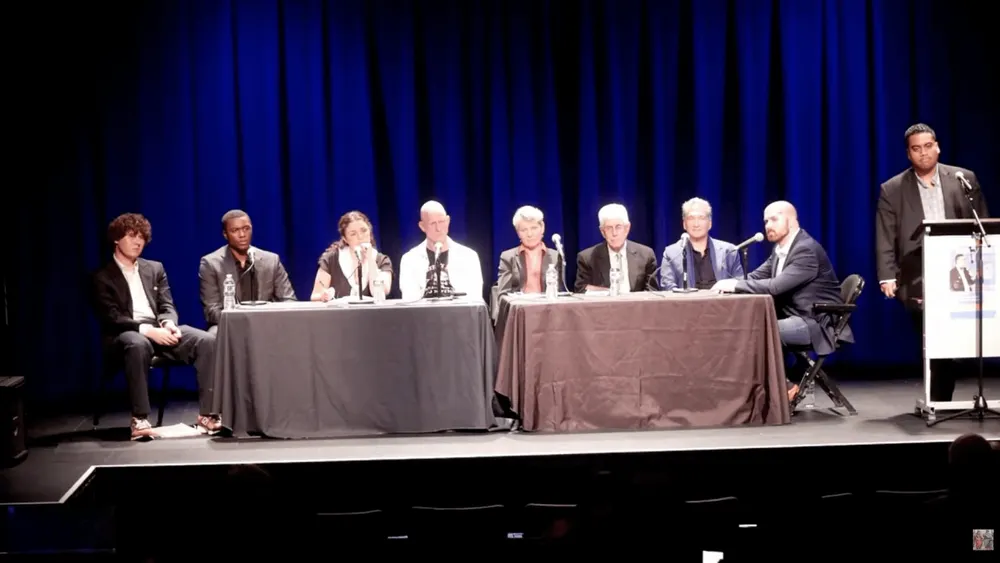
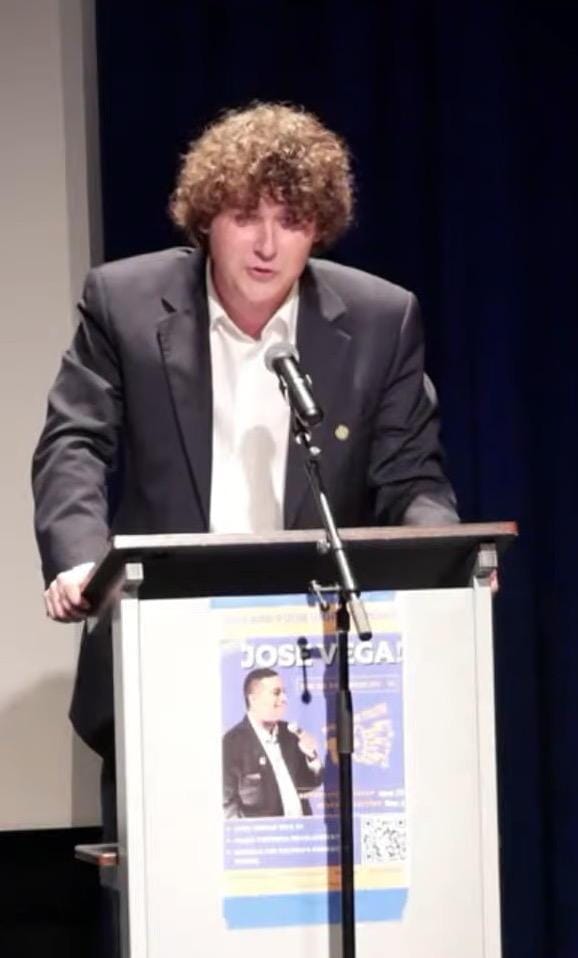
Sept. 18—Independent congressional candidate Jose Vega, running in New York’s 15th Congressional District (The Bronx), hosted a day-long forum at Symphony Space in Manhattan, Sunday, Sept. 13, titled “9/11 (+25): The Endless War Turned on You.” Vega centered the event on the legacy of the post-9/11 surveillance state, in the wake of the 25th anniversary of 9/11. The event connected young activists, social media influencers, and podcasters—all children during the 9/11 period or born later—with intelligence officials and whistleblowers who witnessed the creation of the universal surveillance state and later spoke out against it.
The two-session forum opened with speakers addressing the factors and agencies that had brought the United States so low that such an inside-outside action of mass-violence as the 9/11 attack could take place.
Discussion was intense throughout the day-long event among the speakers—some live, and others by internet—and the 70-person audience. The full event was livestreamed to Vega’s YouTube channel, with the full six-plus-hour dialogue archived.
How Did the U.S. Sink So Low?
Vega was joined in the first panel by Russell Dobular, founder of the Due Dissidence podcast; Paul Gallagher, EIR Economics Editor; Josephine Guilbeau, former U.S. Army officer and intelligence analyst; Diane Sare, independent U.S. presidential candidate for 2028; Brian McGinnis, former U.S. Marine and anti-war activist; and Rex Jones, host of Gray Area Talks.
Vega introduced the panel by explaining his own personal and generational distance from the 9/11 attacks, noting that he had been too young to remember the events of that day. He briefly spoke of the sacrifices made by police officers, firefighters, and other emergency personnel on 9/11. He drew a connection to the tragedy experienced daily by the Palestinians in the Gaza Strip and the West Bank, where private firms such as Palantir—which have gained an increasingly dangerous position within the federal government—provide their technologies to the Israel Defense Forces and the United States for military use in these areas. Vega posed some of the central questions of the event: How much of the 9/11 transformation was deliberate, and what could be done to reverse it? Was the failure to prevent the 9/11 attacks on the nation a genuine mistake on the part of the security/intelligence apparatus of the United States?
How the Country Was Changed
Russell Dobular spoke first. His speech placed 9/11 within a much larger political and cultural story, beginning with the 2000 presidential election between Al Gore and George W. Bush, a contest riddled with dispute, including the Florida recount controversy and the subsequent Supreme Court ruling that Bush had won Florida, securing his electoral victory. Dobular noted that Bush’s election was the “beginning of the end” of everything Americans knew. The cautious but genuine optimism which emerged in the years after the Cold War, leading to the opening of Eastern Europe, military bases closing, a peace dividend, the growth of the “internet economy” and a general expectation that globalization would increasingly benefit broad sections of society, was all but turned into illusion in the years after 9/11, when permanent warfare and universal surveillance instead would dominate. Dobular imagined a different world, in which the optimism of the 1990s had given way to prosperity, where Africa had grown prosperous, and India, South America, and all the rest of the formerly colonized world were connected to each other.
Next, Paul Gallagher spoke of the economic crisis of the United States and the rest of the trans-Atlantic world, and how that crisis could be addressed through the revival of first Treasury Secretary Alexander Hamilton’s national banking system, which Gallagher connected to Lyndon LaRouche’s second of his “Four Laws to Save the U.S.A. Now,” written in 2014.
Gallagher gave a compelling historical account of how Hamilton had brought about the federal government’s assumption of all the debts of the newly independent U.S. states, and had used that newly assumed national debt to issue productive credit for infrastructure and manufacturing. Unlike traditional connotations of a debt for an economy, Hamilton proved that it can actually function to contribute growth to a newly emerging economy, rather than weigh as a financial burden. Gallagher suggested that today’s $40 trillion debt of the United States can be restructured through a new national bank, using long-term Treasury securities and preferred shares. Infrastructure investment, scientific research, and breakthroughs in frontier technologies such as fusion energy can raise productivity to the point of making debt manageable over time, rather than the uncontrolled speculative mess it has become now. Gallagher also made the point that military expenditures represent a significant portion of waste in the economy and could be redirected in the form of a peace dividend to contribute to an actual budget surplus, leading to increased investment in other, more productive areas in the economy.
Sare on LaRouche’s Warning
Diane Sare, running as an independent for the 2028 election, began her speech by reflecting on where she had been during the 9/11 attacks. It was on a busy street corner of Washington, D.C., handing out a broadsheet written by Lyndon LaRouche in August, warning of a future terrorist attack on the United States. As people drove by, a few drivers stopped to say, “Do you know what’s happening? A plane just struck the World Trade Center!”
Sare then read extensively from a document by LaRouche issued four days after the attack, titled “Shoot the Neighbor’s Cat!” LaRouche began that document,
Frankly, the 24-hour brainwashing network, CNN, has gone over the edge. The terror-bombing and mass-killing have pushed CNN, and many others into the state of mind of the man, who, returning home to find his house has been robbed, takes out a shotgun and obliterates the neighbor’s cat. Indeed if his wife had said, “Henry, it’s just the neighbor’s cat,” the maddened fellow would have threatened her, “Don’t get in my way, or I might have to kill you, too!”
The United States has been surprised by a mass-murderous attack from rogue forces deployed from within the U.S.A. itself. Since no foreign power has the ability to do to us what was done this past Tuesday, some rogue element operating within our military-security establishment is the only possible principal author of what has just occurred. That mass-murderous rogue is the burglar, who is presently lurking from within the U.S.A., preparing for his next strike, which he certainly intends to deliver soon.
The statement as a whole served as a broad warning to the U.S. establishment to not respond to the attacks with revenge and fury against foreign nations, contrary to the actions taken by George W. Bush and Dick Cheney in Iraq and Afghanistan.
Sare asked, what is justice? Is it revenge? Is it retribution? Is it right that Israeli Prime Minister Bibi Netanyahu have his toenails pulled out one by one? Though that may cause some people a certain kind of satisfaction, it does not get to the root of what caused such suffering and mass-murder in the first place. She countered this vengeful notion of justice with Rev. Dr. Martin Luther King, Jr.’s demonstration of non-violent, creative, direct action, sharing her own thinking.
You think of someone like Martin Luther King and the injustice of racism in the United States. Was it necessary to round up every single Southern person who had been deputized, who was in the Ku Klux Klan and got deputized to be a police officer on Bloody Sunday and beat people? Was it necessary to find all of the people who had been involved in racism and who had committed hideous crimes against the Black population of the United States? Would that have ended the racism? Would that have ended segregation?
So, then I started thinking about the question of culture, because when you have a system where everybody is involved in the corruption, then you have to change the system. You have to stop participating in the system. That was Martin Luther King’s brilliant insight when he led the Montgomery Bus Boycott, which, by the way, lasted an entire year. I don’t know if everyone realizes; it was news to me when I read his book about it a few years ago. It was an entire year where people had to walk to work or they couldn’t get there, and the city began to make everything illegal. So, they [the boycotters] had Black taxi drivers who would start picking people up, and Montgomery would make that illegal. Then the white women who needed their domestic help to come started organizing carpools, and they tried to figure out how to stop that. But what King described was the incredible dignity of people who were trudging through the mud rather than participating in getting on a bus and being complicit in their own subjugation. And when the people of Montgomery decided that they were no longer going to be complicit in a system which oppressed them, they became capable of taking their destiny in their own hands.
Sare concluded by arguing that a major financial crisis could create a moment in which political transformation becomes possible, and encouraged the audience to become more informed about the policies necessary to solve the economic problem, as Paul Gallagher presented, because then they will know exactly what to do once the financial bubble of the Epstein Class pops. The audience, Sare said, must come to understand the principles by which the young United States went from having a seemingly insurmountable debt, to becoming a major productive center of the planet.
A Veteran’s View
Brian McGinnis, a former U.S. Marine, took a much more autobiographical approach in his speech, in which he spoke about his own participation in the Iraq occupation—itself justified on the basis of 9/11—and how he transformed his own understanding of war by viewing himself from the perspective of the occupied as well as the occupier. As a young Marine serving as a gunner in a light armored vehicle, McGinnis described entering a city amid combat conditions and heightened warnings about potential threats. He recalled seeing a family standing amid rubble and initially viewing them through the lens of his military training—as a possible threat. He fired what he believed would be a warning shot, but mistakenly fired the vehicle’s larger main gun. The round landed in front of the family, throwing up dust and debris but, fortunately, not killing them.
McGinnis concluded by calling on people to overcome apathy, along with their fear of the other, which dehumanizes ordinary people into “just another threat to be dealt with.”
Discussion
Following the speakers’ remarks, the panel then joined for an at times tense discussion period. Rex Jones and Tim Tompkins moderated the discussion. One of the questions asked to the panelists by Jones was about America’s fundamental shift away from the optimism of the President John F. Kennedy years, to pessimism in the years following his assassination. Sare said that before the cultural shift following the deaths of the two Kennedy brothers, Martin Luther King, Jr., and Malcolm X, Americans typically believed that poverty could be eliminated through scientific progress, and that the country had a responsibility to develop much of the world.
In response to a question by Rex Jones regarding the economic trajectory the United States had taken in the post-Kennedy years, Gallagher identified the Nixon administration’s decision in 1971 to end the fixed exchange-rate system and decouple the dollar from gold, as a crucial economic turning point that allowed the “Epstein Class” to take over in its flurry of speculative activities, which destroyed the U.S. industrial base along with other nations’ economies. Gallagher reiterated the solution he had proposed in his speech: that the country needs to return to the policies of productive credit and large-scale infrastructure development rather than relying on financial speculation.
The conversation took a more substantive turn when Josephine Guilbeau spoke, arguing that the structures of colonialism had not simply disappeared but had dramatically changed form, with mass surveillance and the rise of private technology firms like Palantir as examples. She argued that technological progress cannot be regarded in itself as the means to social progress if this legacy of colonialism continues.
In response, Sare argued that while slavery and other injustices cannot be treated separately from the whole subject of American history, the ideas behind the founding of the United States, including the Declaration of Independence and the Federal Constitution, are historical attempts in the path of the universal progress of mankind to establish republican systems of government in place of empire. The Declaration of Independence applies not just to the Founders in their time, but to everyone today. The language in the Constitution about forming “a more perfect union” points to the process in which citizens must engage today in order to resolve the contradictions in their own history.
Some disagreements were not yet settled among the panelists even after lengthy discussion, but the recurring question among them remained how Americans could move beyond traditional political boundaries which have prevented them from recognizing their common interests. In her concluding remarks, Sare spoke about an emergency national economic program for the country, not in terms of simply infrastructure development, but as a matter of national survival.
Jose Vega, in his summary of the first panel, recited the opening words of Friedrich Schiller’s “An Die Freude” (Ode to Joy) in English, and referenced their use by Beethoven in the fourth movement of his Ninth Symphony, which emphasizes that “godly spark” in humanity which the U.S. Declaration of Independence embraces as the “pursuit of Happiness” inherited as a right by everyone. These principles, said Vega, which the great mid-20th-Century German conductor Wilhelm Furtwängler had striven to preserve despite the Nazi tyranny then running Germany, are not just uniquely American, but exist in each and every culture of the world. So, he asked, what are you prepared to do with it?
The Lie: Give Up Freedom for ‘Safety’
The second panel was of a different character, and readers are strongly encouraged to view the full discussion at the link above. It featured a dialogue between whistleblowers who had all worked on the ThinThread electronic surveillance and data analysis program at the National Security Agency: William Binney, former technical director of the NSA and supervisor of the program; J. Kirk Wiebe, NSA senior intelligence analyst; Thomas Drake, senior NSA executive; and Marc Milleur, colleague of William Binney and ThinThread team member.
Jose Vega opened the session by explaining why he had organized the dialogue. “I am 27 years old, turning 28 in less than a week. I was two years old when 9/11 actually happened, turning three, and I grew up in a post-9/11 America, a matrix that was created—or Plato’s Cave, for another allegory—of a world of surveillance, [about which ] I was told: This event [9/11] is the reason why we have to trample all over the Constitution. It’s the reason why you have to give up your freedom for safety.”
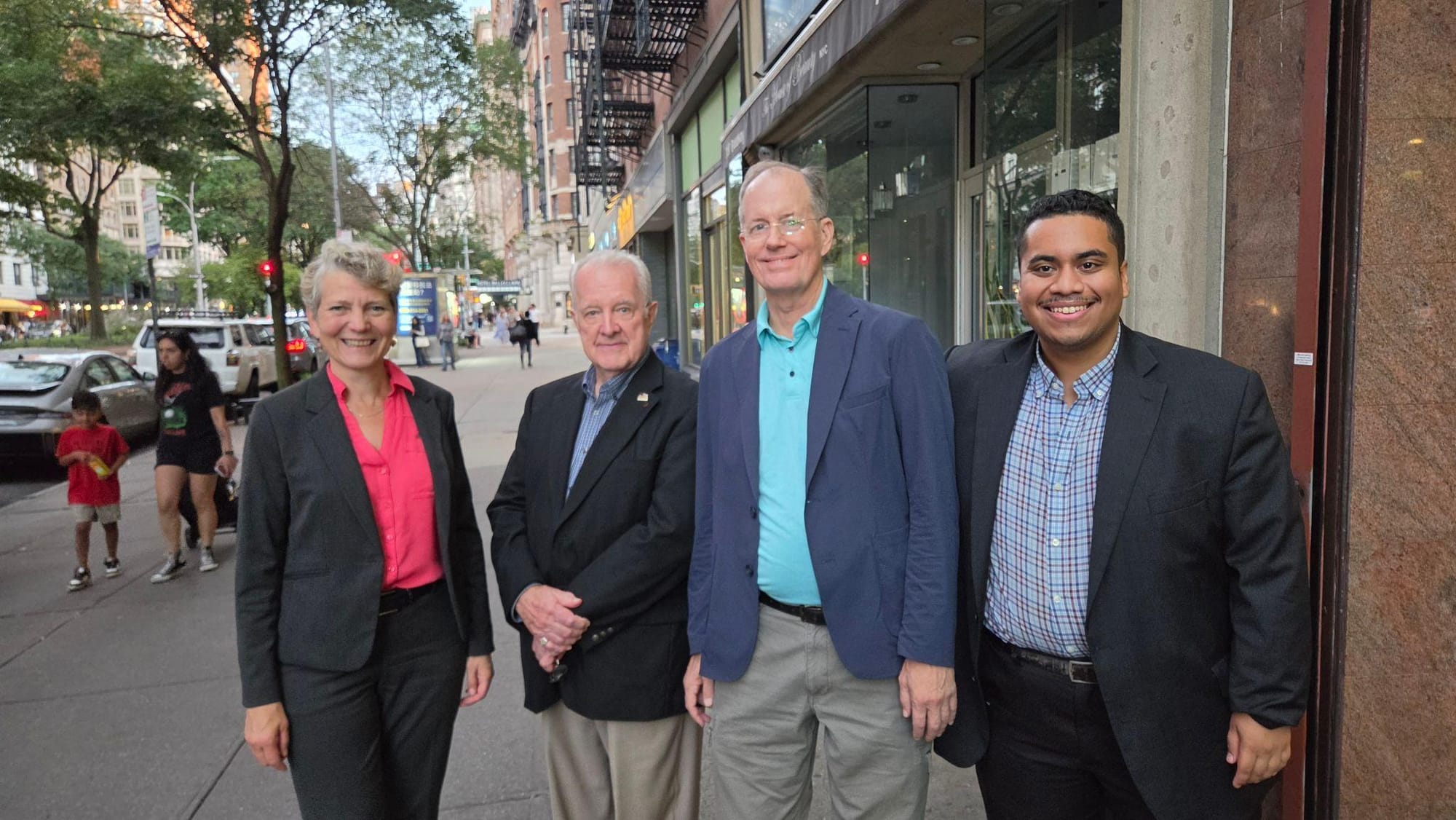
Vega then spoke about his experience with Thomas Drake, who had come to New York City to participate in the event in person. They had gone together to Ground Zero on Sept. 11, the first time Drake had ever been there. Vega recounted,
I got to go to Ground Zero for the first time with Tom Drake just a couple days ago, on September 11, and it was a very moving experience…. One of the reasons why Tom wanted to come up here and do this, agreed to do this, and Kirk and Bill and others agreed to do this, was because—and the reason I put this on—was because I was tired of these events that only have people who continue to say the same things over and over again and do no outreach to the new generation.
There’s a new generation of people right now, the Gen Z generation, that is the most active, proactive, that wants to go out and do something, that wants to go out and intervene and disrupt. So connecting the 9/11 generation—which is, I believe, anyone 30 and under—to what came before that, and to hear it directly from the people who were in some way involved in shaping this architecture of this matrix, but then say we don’t need to live in it, I thought was very powerful.
The ThinThread team revealed that they are angered and haunted by the fact that the system that they designed could have prevented 9/11, had it not been shut down. It could have saved lives without shredding the Constitution or unleashing a surveillance state worse than anything that Orwell described.
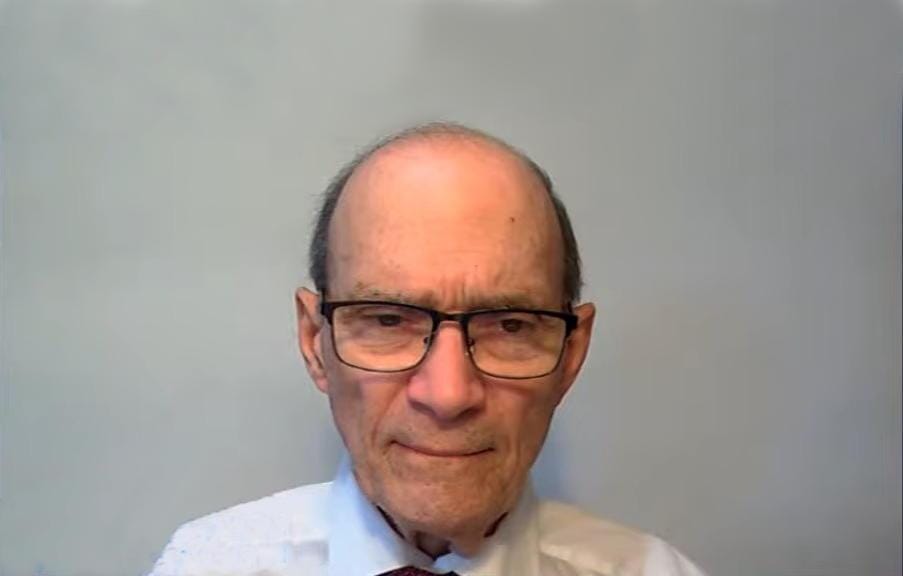
A substantial portion of the panel was dedicated to the NSA whistleblowers’ testimony as to the personal cost they experienced for courageously denouncing the NSA and other intelligence agencies that stripped away the safeguards built into what they developed. The speakers’ intention had been to protect citizens’ liberties and privacy, as protected by the U.S. Constitution, while also defending the nation from terrorist and criminal activity. Wiebe, Binney and Drake recounted FBI raids on them, lost security clearances, lost employment opportunities, and years of legal pressure after challenging NSA practices. Drake described being prosecuted under the Espionage Act and facing decades in prison after pursuing official whistleblower channels and later communicating with a journalist.
In his remarks, Drake made the point that the younger generations of citizens in the United States, and around the world, must inherit the same mission he and his colleagues undertook when they left the NSA. There are forces in the world, he said, which seek to impose a “feudal, fascist technocratic society which is anti-human and anti-life; they want to take full ownership of the human plantation.” Young people, particularly those under the age of 30, must decide now to fight for a more perfect union, and a future based upon the ideals on which the United States was founded 250 years ago.
What September 11 Is to Gen Z
by Guy Christensen
The following is excerpted from remarks given in introduction to Panel 2 of the September 13 Vega event, “9/11 25 Years Later: The Endless War Turned on You.” Christensen is a political commentator and activist.
The Patriot Act is older than I am. I was born four years after the towers fell. I have never made a phone call that wasn’t collected. I have never attended a protest that wasn’t scanned. I’ve never driven across my own city without being logged. So, when people my age are told that mass-surveillance is a warning about the future, we don’t even know what that means. For us, it isn’t a warning. This future is the only reality we have ever lived in. It is in no way an accident that we had to grow up this way. There was a decision that was made for us and sold to the world as protection.
In the late ’90s, three men in the NSA built a novel [electronic surveillance] program called ThinThread. Its importance was that it encrypted American data at the moment of collection. The Fourth Amendment was built into the machine. You needed a legal process to be able to spy on your own people. Radical, right? In January 2001, they asked to deploy it worldwide. The NSA—they shut it down. It lost to Trailblazer—280 million dollars to a private contractor, dead five years later, having burned past a billion, having never worked at all! And I need you to listen to me here. ThinThread wasn’t shut down because it failed. It was shut down because it worked, because the protection was the part that nobody wanted. Within weeks of September 11, the surveillance tech was deployed anyway, with the protections stripped out. The ethics were the disqualifying feature.
What happened next? In late 2003, Congress killed Total Information Awareness, Admiral Poindexter’s program. They killed it, because Americans were disgusted by it. And that same year, Palantir was incorporated. Palantir’s first outside investor was In-Q-Tel, the CIA’s new venture capital arm. For years, the CIA was effectively Palantir’s only customer. And shortly after it launched, the former chairman of the Defense Policy Board, Richard Perle, brought Peter Thiel and Alex Karp to meet John Poindexter at his house, so they could learn from the man whose program had just been shut down. So Congress didn’t kill the surveillance capabilities, nor the technology. They resurrected it, this time with shareholders. And the reason that this happened is structural.
When a government agency surveils you, there are hearings, there are record requests, there are oversight committees. But when a private company does it, it’s their trade secrets. The state didn’t privatize surveillance because it’s more efficient in the private sector. It outsourced the specific part they already knew was unconstitutional. Palantir holds contracts worth $10 billion with the U.S. Army alone. In 2025, the Pentagon expanded its Maven Smart System contract by $795 million. ICE [U.S. Immigration and Customs Enforcement] pays Palantir for a system that tracks every single one of you, every single person in America, in near-real time, and can predict your movement behaviors in the future. Thousands of American police departments run Palantir’s Gotham program. The current regime tapped Palantir to build a master database on all Americans, on you guys. And a few months ago, Palantir’s CTO, the chief technology officer, was sworn in as a lieutenant colonel charged with radically restructuring our military. The contractor now wears the uniform. And with JD Vance as Vice President, Peter Thiel is just one heartbeat away from the Presidency. In April last year, Alex Karp was asked directly whether Palantir’s tech had enabled the genocidal slaughter of Palestinians in Gaza. He said, “mostly terrorists, that’s true.”
I spent all of yesterday with Tom Drake, and I’m very grateful to have had that opportunity. He said something that I can’t stop thinking about. I’ll paraphrase it: What the Constitution forbids, a contract permits. They cannot search you without a warrant, technically, but they sure can make you click “Agree.” Every “terms of service” is a private constitutional amendment. It applies only to you. You did not vote on it. You cannot amend it after signing it, and you signed it to simply check your email. Once surveillance became profitable, they stopped needing terrorism as an excuse, and went scouring for everything else.
There are now more than 140,000 documented Flock cameras in over 6,000 American communities, scanning people billions of times. Forty percent of police in this country are on that network. In January, a federal judge ruled that searching a surveillance database isn’t a search under the Fourth Amendment. So, these corporations, these billionaires, and their technology are completely outside our Constitution.
Tom told me one more thing last night. He brought up Pandora’s box. Everyone knows how all the evils were unleashed, and they could never be put back inside. And this is what Tom pointed out to me: There’s a part about that story that everyone forgets about—the part that there was something still in the box. There was something deep inside, past the dark abyss. It was hope. And I’ll be honest, hope is not going to be enough for my generation. We can’t afford that as a feeling, really. But hope was in the box. It came out of the same place that the plagues did. It’s kin to them. And it’s the last thing out, because hope is what you need after the evils, not instead of them.
In 2002, it took whistleblowers from inside the NSA to tell us what our government was doing to our people and to the world. Last year, it took 13 former Palantir employees writing a letter to warn that there were no guardrails left. One former Palantir exec said that their company intended to take over the United States government and that his old colleagues are now installed literally and digitally inside of it. It’s the same act of conscience, one generation apart. And it is the only reason—the only reason—that any of us know anything at all. This is what was at the bottom of the box.
I know what surveillance is, because three men said it out loud before I was even born. And they paid for it dearly with everything they had. My consciousness is a product of their work. So is the consciousness of every person in this room who is angry about the right things. The machine they warned us about got built. It got privatized, and we are all living underneath it. They reached into the box, and it’s our turn to use what they handed us. So, I present to you Thomas Drake, Kirk Wiebe, and Bill Binney.