Oct. 9—Brazilian voters will face a stark choice when they head to the polls Oct. 25 for the final round in their presidential elections. They will, in fact, be choosing between the two paradigms being fought out internationally.
Flávio Bolsonaro, the son of the now-jailed former president Jair Bolsonaro, led the first round with 47.03% of the vote on Oct. 4. He campaigned as the “right-wing” candidate who, if elected, will pull Brazil out of the BRICS in order to align it with the United States on all policies. He promises that the country will join President Donald Trump’s Shield of the Americas operation. Domestically, he champions an austerity and privatization policy modeled on Argentine President Javier Milei’s brutal “chainsaw” economics and reaching a free trade agreement with the U.S. He has the firm support of wealthier voters and evangelical Christians.
President Luiz Inácio Lula da Silva, who came in a close second with 45.16% of the vote, is an outspoken leader of the BRICS and of the Global South’s right to peaceful sovereign development. His slogan is that “Brazil is too big to fit in anyone’s backyard,” and must fight to defend its sovereignty. He proposes that the South American nations, regardless of their government’s ideologies, join forces to build the regional infrastructure projects that can transform the region’s economic potential. He insists that the government must play a leading role in eliminating hunger and poverty from Brazil, and foster scientific and technological advances. He welcomes the cooperation of any country in that endeavor, China and the United States included—but not to loot it and only if Brazil’s sovereignty is respected.
The election will be a hard-fought battle over the next three weeks, with the outcome uncertain at this time. Brazil is the largest country in Ibero-America and the Caribbean, in territory, population, economy, and military capabilities. The Lula government’s refusal to join Trump’s so-called Shield of the Americas, and identification of it as a threat to the sovereignty of all the region’s countries, is the single biggest obstacle to the total subjugation of the nations of the hemisphere to Washington.
If Lula wins a fourth term, Brazil’s refusal to submit will embolden the opposition which is building against the Trump operation across Ibero-America, even within Shield member states. Conversely, if Bolsonaro takes Brazil into the Shield, there will be little left standing against the U.S. onslaught.
Students Take the Lead
The Bolsonaro lead after the first round of voting Oct. 4 was a shock to nationalist forces in the country, who figured that the Bolsonaro family’s corruption scandals, threats to democracy, and blatant subservience to Washington’s agenda gave the edge to Lula. These forces had been relatively complacent in the election campaign. Students took the lead in breaking the consequent demoralization, with an immediate surge onto the streets to attempt to rally the country to reverse the outcome of the first round.
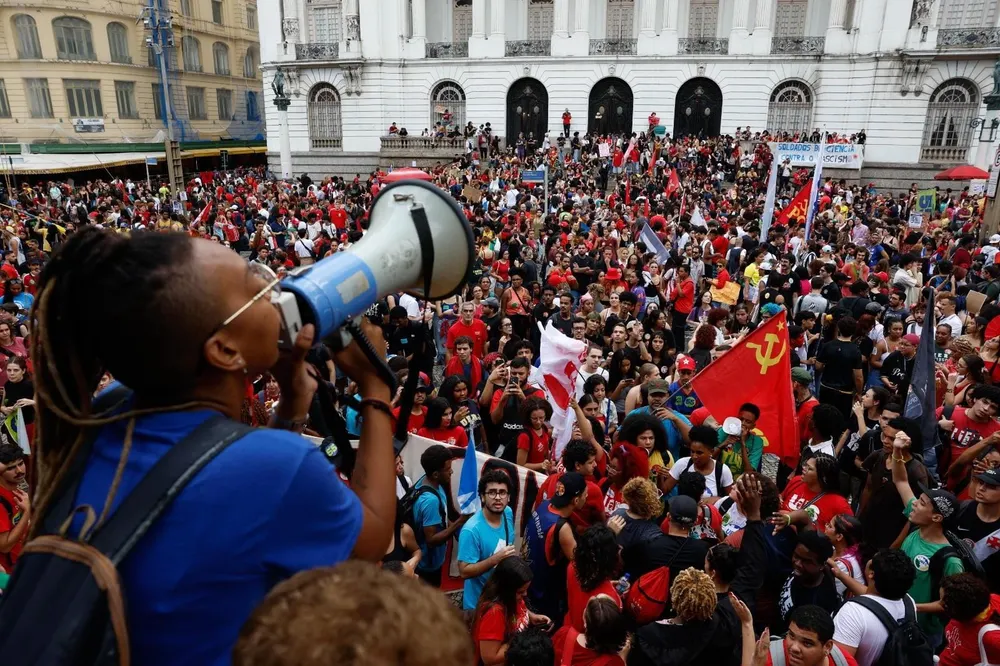
A boisterous student rally of tens of thousands took over the central avenue of Rio de Janeiro Wednesday afternoon, Oct. 7, calling itself “Youth to the Streets for Democracy.” Amid a sea of banners and placards proclaiming “Bolsonaro—Never Again!” and “If you sleep through democracy, you will wake to dictatorship,” the speakers passionately urged the re-election of President Lula da Silva, and warned that a victory for his opponent, Flávio Bolsonaro, would unleash savage cuts in education and head the country toward fascism.
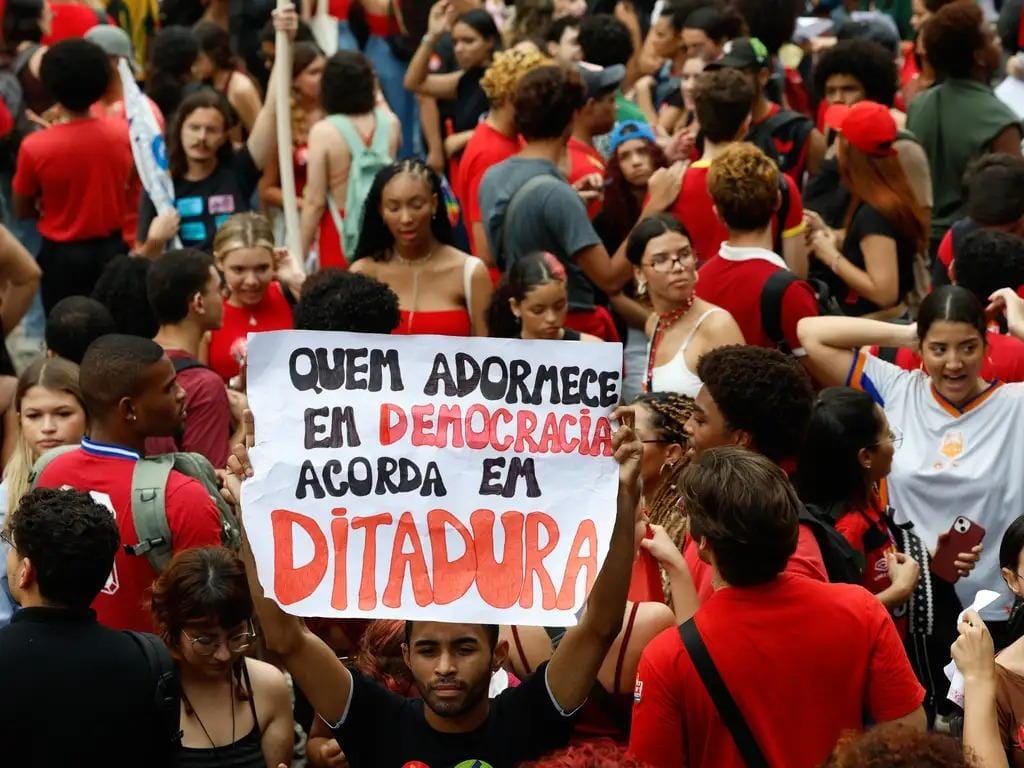
President Lula himself encouraged the emergence of this youth mobilization as a key factor to fire up larger forces in the country to break the momentum of the Wall Street-controlled neocon Bolsonaro, who since the election has been endorsed by three right-wing candidates who cumulatively could give him a further bump. In a video published Oct. 7 on his social networks, he appeared alongside young elected pro-Lula candidates. “Let’s go guys! To the streets,” he said. “Let’s talk to people! You who like Brazil, who like education, who like democracy, who want to have a quality job…. Let’s go to the street!… It’s time!”
The student rallies began across Guanabara Bay from Rio, in Niterói, Monday evening, Oct. 5, less than 24 hours after the close of polls. Several thousand students from multiple universities and high schools marched through the main avenues of Rio’s sister city in a spirited mobilization. Toda Palavra reported: “The movement, organized mainly by students of the Fluminense Federal University, injected optimism into supporters of President Lula, who are frustrated over the unexpected defeat of the PT candidate…. The joy of the students, besides infecting part of the militants who were downcast after the electoral results, sent a clear message to the other side in the second-round contests: ‘We are going to fight to the finish.’ ”
On Tuesday, substantial student marches and rallies took place in Recife, in Brazil’s Northeast, and in Belém, capital of the Amazon state of Pará. Wednesday morning, students from the State University of Paraíba (UEPB) in the Northeast occupied the university campus, in defense of “democracy, sovereignty and public education.”
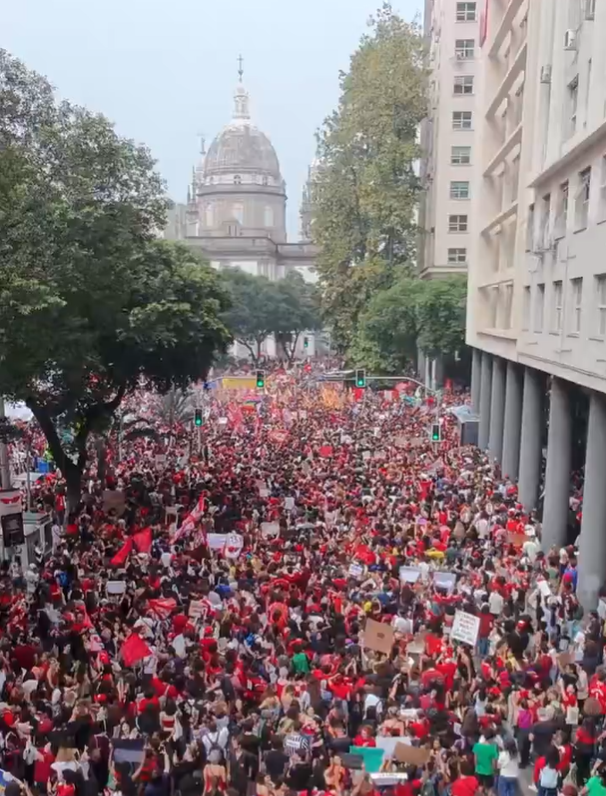
Thursday night a particularly notable student rally of over 10,000 took place in Curitiba, capital of the southeast state of Paraná. Curitiba is core Bolsonaro territory. For a demonstration of that size to materialize so quickly in a Bolsonaro stronghold caught the attention of even some hostile national press.
Rallies and protest meetings are scheduled in more than two dozen other cities and campuses over the next week. The largest is expected to be a Sunday, Oct. 11 march down a principal São Paulo avenue famous for its political rallies, Paulista. There are signs of some labor confederations in the north of the country beginning to join the demonstrations. And the head of the National Conference of Brazilian Bishops, together with other prominent Catholic clergy, have for months insisted that “Abstention is not the best choice,” and added last month a pointed defense of Brazilian sovereignty, while stressing the Church does not support any specific candidates or parties. There were over 33 million abstentions (20% of the electorate) in the first round, and a principal objective of the nationalist mobilization led by the students is to get out that vote.
A statement of support for the Brazilian youth mobilization from the International Youth Movement of the Schiller Institute is circulating among student leadership circles in Rio and Sao Paulo (see below).
Dennis Small and Gretchen Small contributed to this article.
Message to the Youth of Brazil from the Schiller Institute International Youth Movement
The Schiller Institute’s International Youth Movement for Peace Through Development on Oct. 6 sent the following message to the youth of Brazil, who are now mobilizing to ensure that President Lula da Silva is re-elected in the second round of voting in that country, which will occur on Oct. 25.
Brazil stands at the crossroads in history, as does the Global South as a whole. Five hundred years of colonial order are coming to an end, and we, members of the global Schiller Institute youth movement, stand with the youth of Brazil in demanding a new, just world paradigm.
Ordinary Brazilians need a working government that invests in its people. President Lula da Silva represents a proven commitment to economic development with social inclusion, both for Brazil and the world. Lula’s firm support for the BRICS+ countries has given Brazil strategic autonomy, opened new markets, and secured vital investments for development without submitting to the outdated colonial dictates of the IMF and the big banks. Losing this vision now would be an historic step backward. Lula has built bridges with the Global South, strengthening its voice. His strong focus on ending poverty and hunger is needed.
For Brazil, the Global South, and humanity to prosper, we need a new international security and development architecture, one that will be win-win for all participants—and a permanent end to the austerity and attacks on sovereignty that Wall Street and the City of London are imposing everywhere.
Estêvão Damacena, Brazil
Felipe Bombardelli, Brazil
Timothy Ninsiima, Uganda
Emma Munghatihe, Uganda
Winnie Doru, Uganda
Halidou Chekaraou, Niger
Clément Satger, France
Sébastien Périmony, France
Imad-Aldeen Abdulqadir, Nigeria
Carolina Dominguez, Mexico
Daniel Burke, U.S.A.
Kynan Thistlethwaite, U.S.A.
Asuka Saito, Japan