The following is Part 2 of a feature on American history first published in EIR on February 9, 1996. Part 1 is available here.

The year 2026 marks the 250th anniversary of the Declaration of Independence by what would soon become the United States of America. That instrumental document laid down the principles of an anti-oligarchic republican form of government, and would go on to be the inspiration for countless other peoples around the world, forever changing the shape of history. Today, this history is either misunderstood or intentionally misconstrued, and the U.S. has nearly abandoned the outlook of its Founding Fathers. Over the course of this year, EIR will be publishing key articles on the true anti-oligarchic history of the United States in the hopes of contributing to the widest possible discussion of these principles, the rediscovery of which has enormous implications for whether the world can get out of its current state of turmoil today.
4. International Scene Becomes Electrified
The American nationalists worked closely with their European friends to overcome the British Empire’s forceful opposition to industrialization. Britain’s very active factional allies (or paid spokesmen) within each country reiterated Adam Smith’s notion of the “division of labor between nations”—some were destined to supply raw materials, some could “naturally” manufacture.
In 1839, Czar Nicholas I sent Russian engineers to the United States, who met with engineers, inventors, and railroad officials throughout the country. The leader of this mission, Pavel Melnikov, reported back to the czar that Russia, with its great spaces to connect, must emulate America’s railroad construction.
Several years later, Melnikov and Crown Prince Alexander II headed a committee to begin this development. The Russians hired a retired U.S. Army officer, George Washington Whistler, one of the original West Point engineers who had been assigned by President John Quincy Adams to design the first American railroad, as project supervisor. Whistler directed construction of the line from Moscow to St. Petersburg, Russia’s first significant railroad. Whistler also built rail factories and fortifications, while engines were imported from the Baldwin Locomotive Company of Philadelphia. In this period, Russia implemented a protective tariff, under which it began to create an iron industry and a factory system.
But the U.S. ability to sustain such development was in serious question. The charter of the Bank of the United States had expired on March 3, 1836. For the next 25 years, there would be only brief episodes of sane presidential policy direction, until Abraham Lincoln rescued the country from impotence and bankruptcy.
Cognizant of the crisis they faced, the Philadelphia nationalists prepared a new enterprise to increase long-term national strength. A committee chaired by Nicholas Biddle came to be in charge of a substantial sum of money, the legacy of banker Stephen Girard, to found Girard College. On July 19, 1836, Biddle’s panel commissioned Alexander Dallas Bache to tour Europe and study the finest educational methods. A confidential part of the young man’s mission was to meet and coordinate efforts with the scientific elite of continental Europe.
Bache was to become one of the most important figures of civilization in the Nineteenth Century. The great-grandson of Benjamin Franklin, Alexander Dallas Bache had graduated with highest honors from the U.S. Military Academy at West Point in 1825—the year that West Pointers launched American railroads. Bache’s cheerful diligence, and the general awareness of his distinguished family tree (he was also the grandson of Treasury Secretary Alexander Dallas, who had rechartered the Bank of the United States) gave him great confidence, and inspired others to cooperative endeavors. Bache spent a year teaching at West Point and two years building fortifications in Rhode Island.
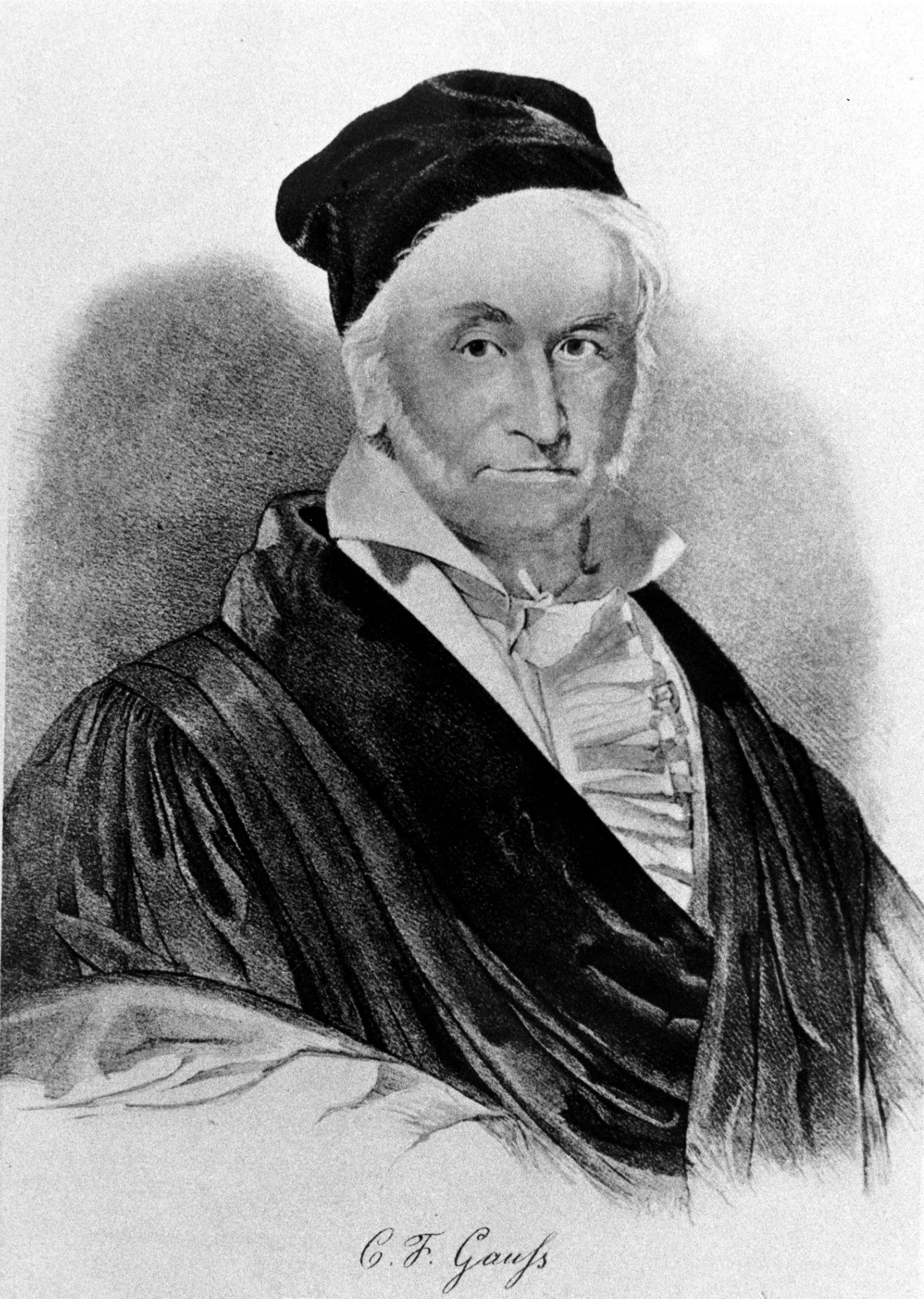
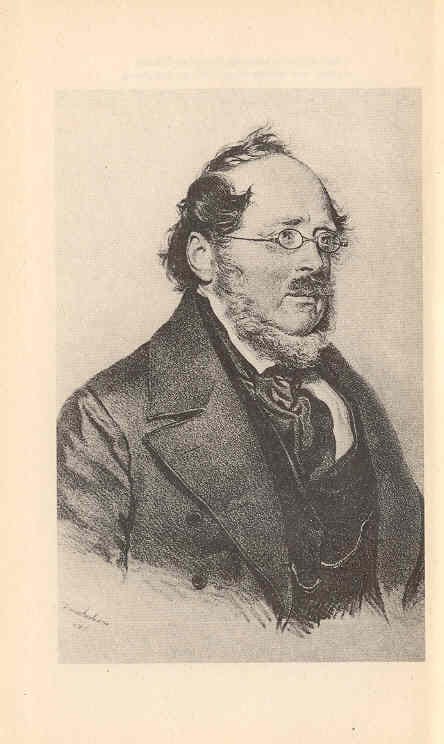
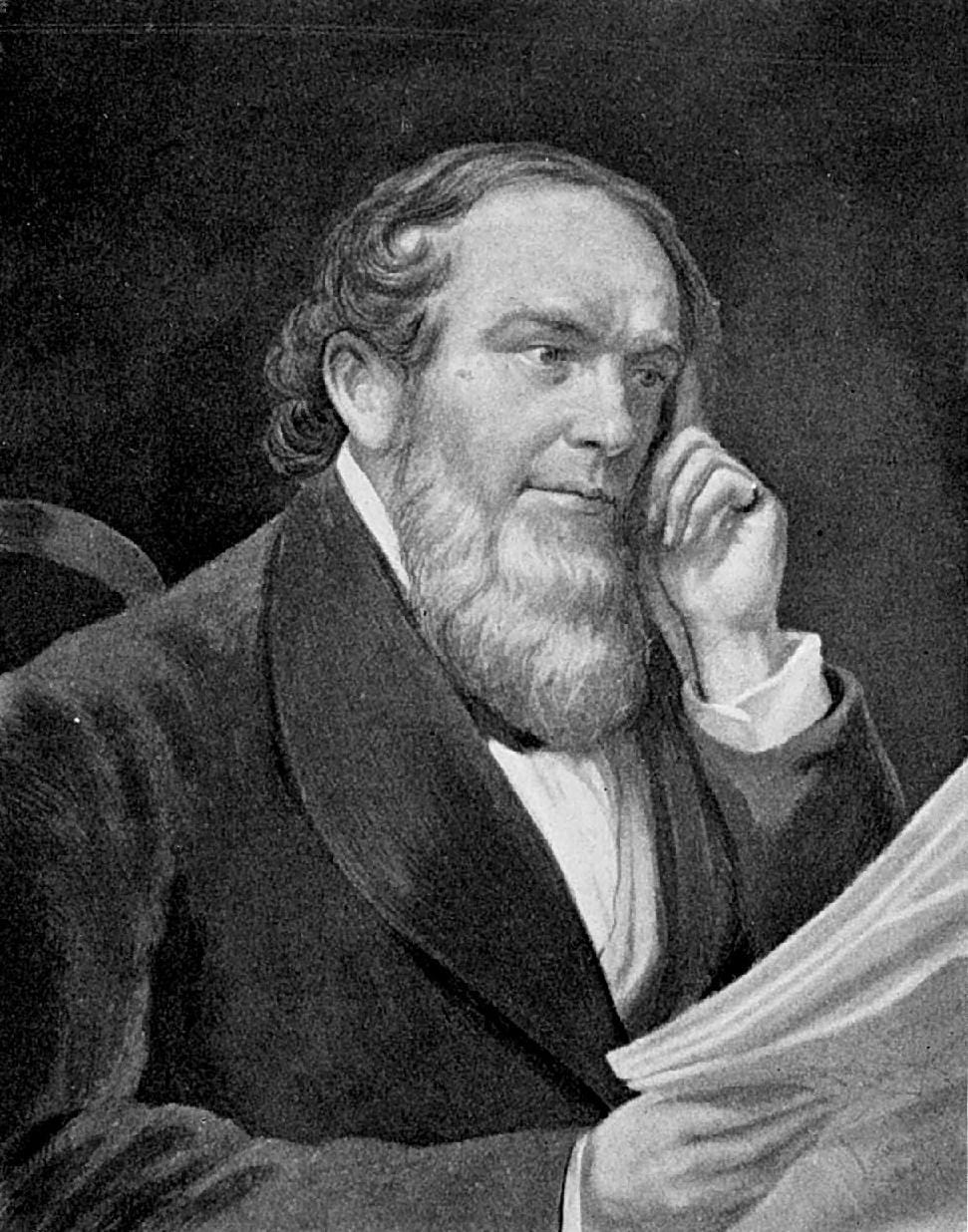
Germany’s Leibnizian mathematician Carl F. Gauss (left) shaped modern science for America and the world, despite violent British repression. Gauss coordinated with Alexander Dallas Bache (right), Benjamin Franklin’s great-grandson, who led American science and education, and created military institutions, including the Naval Academy. Friedrich List (center) sought to unify small German states into a single nation. Imprisoned and exiled, List helped lead the U.S. nationalist revival, then returned to Europe representing America. His railroad and tariff program led to the creation of modern Germany. Credits, left to right: Library of Congress, Josef Kriehuber lithograph, NOAA Central Library.
In 1828, Nicholas Biddle, then the chairman of faculty nominations at the University of Pennsylvania, invited Lieutenant Bache to return to Philadelphia to be a professor of natural philosophy and chemistry. Bache became the research leader of the new Franklin Institute, through which Bache gained close working ties with manufacturers, inventors, and skilled craftsmen. Bache headed the institute’s federally funded inquiry into the causes and remedy of steam boiler explosions, leading to the design of more powerful American engines.
Bache and a close associate, physicist Joseph Henry, embarked together for Europe on Feb. 20, 1837. The two statesmen-scientists would take different paths, on complementary assignments. Bache’s journey would encounter wild political fireworks, and would help lay the basis for an unprecedented improvement in mankind’s condition.
By the end of 1837, a strategic confrontation was to occur between the British royal family and their opponents, including Bache. The British would move violently to suppress the work of the world’s leading scientific thinkers, whose achievements would make the emerging power of America and Europe unstoppable.
List Begins the German Nation
To understand the explosive events, we must first review the work of certain scientists and political strategists, working cooperatively in the United States and Germany.
Prof. Friedrich List returned to Europe in 1830. List had sought appointment as a U.S. consul, as a promoter of U.S. exports. He proposed to get the French and German authorities to build railroads from the North Sea to southern Germany—railroads which could use and also distribute imported American anthracite coal. He was chosen as U.S. consul in Hamburg, but the British party there protested the appointment of this “dangerous political fugitive,” and the U.S. Senate rejected his nomination. He served in other appointments as an official U.S. representative, including as consul in Leipzig in 1834-37.
List’s influence in his native Germany had grown immensely during his years in America. As Europeans saw the success of America’s nationalist economic measures, Prussia had taken halting steps toward unification with some of the other German states ruled by princes.
At first he resided in Paris, the European headquarters for America’s republican intervention into Europe’s politics. List worked in Paris with Lafayette and the German poet Heinrich Heine, and through continual correspondence, with Henry Clay and the Philadelphians, and with the von Cotta family in Germany.
As his nationalist freedom movement grew, its opponents were forced to retreat. The people of the German state of Hanover demanded a constitution from their ruler, who was none other than William IV, the king of England, and son of the infamous, insane George III. (Recall that Hanoverian George I jointly ruled England and Hanover; he became England’s king when his mother—Leibniz’s ally—Electress Sophie, died before she could accede to the throne.) In 1833, King William IV granted a constitution with orderly laws and certain basic freedoms to quiet the demands from the people of Hanover.
On Jan. 1, 1834, List’s program of German unification was largely realized, when Prussia joined with other German states in the Zollverein, or Customs Union; 18 states were soon united, within an external tariff barrier protecting them from British import dumping. The Zollverein, implicitly the birth of the German nation, jolted the British into action. Foreign Minister Lord Palmerston coordinated British policy with Austria’s Prince Metternich, who had openly denounced the industrial development taking place in the uniting German states. King William countered the Zollverein with a British-Hanover-centered group of German states.
In 1834, List, now U.S. consul in Leipzig, proposed a Leipzig-Dresden railroad to begin a German national railway grid. Under the sponsorship of the king of Saxony, a railway company was formed and the line was completed by 1837. Throughout this period List’s influence grew, with backing from Alexander von Humboldt and his colleagues in the Prussian government. List’s railroad magazine (the full title was: The Railroad Journal, or National Magazine of Inventions, Discoveries & Progress in Commerce, Industry, Public Undertakings & Public Institutions, and of Statistics of National Economy and Finance) was particularly well received.
If U.S. Consul Friedrich List had kept a log book of all his undertakings, it would have provided a unique window on the Nineteenth Century. For example: musician Clara Wieck lived for a time in the List household in Leipzig; composer and cultural leader Robert Schumann fancied one of List’s daughters before deciding to marry Clara Wieck; and Schumann, a few years later, gave List a copy of his “Liederkreis” (“song cycle”) Opus 24, set to Heinrich Heine’s poems, to take to Heine in Paris.
In 1837, Metternich banned List’s journal from Austria, and got the U.S. government to revoke his appointment as consul; List moved back to France. In conjunction with the American allies there, List worked up proposals for bringing France into an industrially powerful anti-British bloc with Germany.
Electrical Science Enters World Politics
With the above backdrop, we see the stage set, politically, for the explosion which was to greet Alexander Dallas Bache, the representative of America’s political, military, industrial, and scientific leaders, when he arrived in Germany at the end of 1837.
Bache was slated to meet in a kind of “grand council” with German scientists Carl F. Gauss and Wilhelm Weber at Göttingen University. Bache had been working in Philadelphia on the measurement of the earth’s magnetism, in accord with Gauss’s scientific work. More importantly, Gauss and Weber had been experimenting, in tandem with American and French researchers, to develop the world’s first electrical machines, that could greatly strengthen the nations which were in potential conflict with Britain. These devices included the telegraph, which could shrink the great spaces of Russia and America, speed Germany’s modernization, and proffer military advantages; and the electric motor, whose use to power industry would greatly outstrip Britain’s industrial base.
Could its enemies stop this work, or would it go forward to bring vast power to mankind? We give here a chronology of the fast-breaking scientific events which were leading up to a decision:
Winter 1819-20: The Danish researcher, Hans Christian Ørsted, showed that a magnetic needle is deflected by the action of a current of electricity passing near it.
1820: Dominique François Jean Arago, a republican ally of Humboldt, discovered that an electric current passing through a wire wrapped around a piece of iron can magnetize the metal.
1820: André-Marie Ampère, the French republican and universal scientist, discovered that two wires, through which currents are passing in the same direction, attract each other, and in opposite directions, repel. Ampère concluded that naturally occurring magnetism, as in iron, is due to electrical currents in the metal’s molecules, and that the general laws of magnetism could be derived from electrical effects.
1825: Englishman William Sturgeon made an electromagnet by bending a thin iron bar into the form of a horseshoe, covering it with varnish to insulate it, and surrounding it with 18 turns of a bare copper wire. While current came from a small battery, Sturgeon’s seven-ounce electromagnet supported a nine-pound piece of iron.
1829-30: The American Joseph Henry, in accordance with the theory of Ampère, produced the intensity or spool-wound magnet, insulating the wire instead of the iron bar, and covering the whole surface of the iron with a series of coils in close contact. To greatly increase the power of the magnet, Henry wound successive strata of insulated wire over each other, producing a compound helix, formed of a long wire of many coils. He perfected the electromagnet capable of transmitting power over a long distance, and was the first to magnetize a piece of iron at a distance.
1831: Henry’s distinctive work in the discovery of induction was reported in Silliman’s Journal in July 1831. His experiment involved opening and closing a circuit on an electromagnet, making the magnet induce a current in another coil.
In an 1832 article, Henry distinguished his work from that of England’s Michael Faraday. Faraday had simply moved a magnet away from and back next to a coil, and passed a wire near a magnet.
Henry reported that his own experiment, by contrast, “illustrates most strikingly the reciprocal action of the two principles of electricity and magnetism.” And it led to his invention of the first electric motor, a simple see-saw-like device: a coil around a bar mounted on a fulcrum which rocked back and forth, alternately closing and breaking the circuit at each end of the bar.
He also applied “the results of my experiments to the invention of the first electromagnetic telegraph, in which signals were transmitted by exciting an electromagnet at a distance, by which means bells were struck in succession, capable of indicating letters of the alphabet.”
1832: Henry increased the power going through his magnet until it could lift more than 3,000 pounds. Alexander D. Bache helped publish and circulate Henry’s work in Europe as well as in America.
1833: Astronomer-mathematician Carl F. Gauss and physicist Wilhelm Weber, working at Göttingen University in Hanover, excitedly took up the leads provided by Henry’s experiments.
Gauss was, at the time, certainly the world’s leading scientist, and the ablest contemporary defender of Gottfried Leibniz. Gauss had served as an advisor to the United States Coast Survey since 1819, and was ardently pro-American; three of his sons emigrated to the United States.
Wilhelm Weber, Gauss’s working partner, discovered that the conducting wires of an electric telegraph could be left without insulation, except at the points of support. Gauss arranged the application of a “dual sign” binary code system in such manner as to produce a true alphabet for telegraphy.
Weber and Gauss built and demonstrated the world’s first long-distance telegraph. Gauss wrote to the astronomer Heinrich Olbers, on Nov. 23, 1833, that their telegraph was “conducted through wires stretched through the air over the houses up to the steeple of St. John’s Church and down again, and connecting the observatory with the physics laboratory … about eight thousand feet.” The telegraph was operated in the presence of the king’s brother, the Duke of Cambridge. The first public notice of the telegraph was given by Gauss in the Göttingische Gelehrte Anzeigen on Aug. 9, 1834.
On Aug. 6, 1835, Gauss wrote to astronomer Heinrich Christian Schumacher:
Could thousands of dollars be expended upon it, I believe electromagnetic telegraphy could be brought to a state of perfection and made to assume such proportions as almost to startle the imagination. The Emperor of Russia could transmit his orders in a minute, without intermediate stations, from Petersburg to Odessa, even peradventure to Kiachta [in Siberia, then on the Russo-China border], if a copper wire of sufficient strength were conducted safely across and attached at both ends to powerful batteries.
As a practical step toward implementation of such a Grand Design, it was proposed that the railroad initiated by Friedrich List should install the Weber-Gauss telegraph along the line. Gauss and Weber both wrote memoranda to the directors of the Leipzig-Dresden railroad, and negotiations commenced.
Some years earlier, Humboldt had introduced Gauss to Weber, and had suggested to Gauss that he interest himself in electricity—with spectacular results. What the British Empire and its allies feared the most, an uncontrollable breakout of technology and cooperative national development, was clearly in the offing.
Gauss, Weber, and Franklin’s ‘Emanation’
A.D. Bache and Joseph Henry set sail for Europe on Feb. 20, 1837; they would wend their separate ways in Britain and on the continent. Bache would arrive in Berlin in December, on his way to Hanover. But before he arrived, the British would overturn the Hanover government and provoke a deep crisis.
In June 1837, William IV, king of England and of the German state of Hanover, died and was succeeded by his niece Victoria. But the Sixth-Century Salic Law, in force in Hanover, disallowed female monarchs, and William’s brother, Ernst August, became king of Hanover.
Ernst August was a true son of mad King George III. In 1810, he was suspected of having murdered his valet Joseph Sellis, perhaps over a blackmail problem arising from Ernst August having allegedly sodomized him; but he extricated himself from that difficulty when two men were imprisoned for accusing him of the murder. He was hated by the English people. And despite his German name and ancestry, the English-born Ernst August spoke not a word of German. British Empire policy needed such a one to do a dirty job.
Over Sept. 12-20, 1837, Göttingen University celebrated its jubilee, with Carl Gauss hosting Alexander von Humboldt at Humboldt’s alma mater. Students were said to have been deeply moved by the greatness of these men and their work, and inspired to use their talents “as honestly and as restlessly” as the humanist scientists.
But King Ernst August had been to Vienna to consult with Prince Metternich. And on Nov. 1, Ernst August revoked Hanover’s 1833 constitution, which had acknowledged the representative assembly and other civil and moral norms; citizenship was replaced by subjection.
For the British, this action came none too soon. During that same month, Friedrich List submitted a proposal to the king of France for the development of a grid of railroads and a national banking system—a giant step toward an anti-British Europe. List had started work in Paris on his magnum opus, the National System of Political Economy, attacking Adam Smith, contrasting the American and Colbertiste concepts of physical production with the pure exchange of free trade, and emphasizing the needs of nations against Smith’s imaginary “cosmopolitan” world of consumers, in which no nations exist. A veritable war broke out within the French government over the List memorandum, sometimes resulting in fistfights.
In British-ruled Hanover, there was the expected popular outrage. Among the protests against the destruction of Hanover’s liberty, was a petition signed by seven prestigious Göttingen professors: physicist Wilhelm Weber, Gauss’s research partner; theologian Heinrich Ewald, Gauss’s son-in-law; the brothers Jakob and Wilhelm Grimm, philologists and famous storytellers; and three other teachers.
On Dec. 7, 1837, Bache took up temporary residence with Alexander von Humboldt in Berlin. Bache’s anticipated visit to Göttingen University, under Humboldt’s sponsorship, would retrace the steps of Bache’s great-grandfather, Benjamin Franklin, 71 years before. Franklin had come to Göttingen in triumph, just after his showdown in Parliament over the Stamp Act.
Alexander D. Bache’s own high status and heart-felt reception in Germany was reflected in an anecdote later told by Joseph Henry: “An elderly savant, on being introduced, clasped him in his arms, saluted him with a kiss on either cheek, and [said,] ‘Mein Gott, now let me die, since I have lived to see with mine own eyes an emanation of the great Franklin!’ ” Bache’s planned visit to Göttingen would occur in the same politically charged environment of scientific achievement and global political tension as had that of his ancestor.
On Dec. 12, the seven Göttingen professors who had signed the petition against revocation of the constitution were expelled from the university; three of them were ordered into exile. King Ernst August sent troops to surround the university to prevent demonstrations.
In January 1838, Bache arrived in Göttingen, now under the British terror. Bache met with Carl Gauss and the expelled Wilhelm Weber, and it is known that they discussed the progress of electrical science and the telegraph, among other topics.
But the British crackdown crushed the active experimental collaboration of Gauss and Weber. The pogrom against Gauss has been pursued by the British Empire's scientific establishment up until the present day. Indeed, the expulsion of the Göttingen professors went a long way toward neutering the academic world across the globe. In fields as seemingly diverse as mathematics, physics, philosophy, history, and economics, it became increasingly unsafe to stray from Newton, Locke, and company. As King Ernst August told Alexander von Humboldt, “For my money I can have as many ballet dancers, whores, and professors as I want.”
The Lazzaroni Create a Military-Scientific Complex
The heat of adversity and oppression had forged strong bonds of friendship between Bache and the greatest European scientists. This relationship would be the backbone of American science in its most important advances for the remainder of the century.
Bache recruited a handful of scientific associates, of undoubted loyalty, patriotism, and genius into a small junto, called among themselves the Lazzaroni (Italian for “beggars”). With strong working ties to Gauss and Humboldt, they set out to create a military-industrial complex which could guarantee the defense of the republic. America’s powerful Navy, and her steel and electrical industries, were among the direct accomplishments of the Lazzaroni and their closest allies over the next 40 years.
Participating in Gauss’s international organization to measure the earth’s magnetism, the Magnetische Verein, Bache resumed his observations at Philadelphia’s Girard College. In 1840, he hired an assistant, Philadelphian William Chauvenet, a recent Yale graduate and accomplished Classical pianist. Bache and Chauvenet would found the U.S. Naval Academy within a few years.
Bache published, in 1839, his immense Report on Education in Europe, on the elementary, secondary, technical, and military schools in Scotland, England, Prussia, Saxony, Bavaria, Austria, Switzerland, France, and Holland. Between 1839 and 1842, he reorganized the Philadelphia public schools, taking guidance particularly from the Prussian schools that he had closely studied.
Bache and his friends now saw their national mission in terms coherent with Leibniz’s “Academy” proposal. Addressing an 1842 Exhibition of American Manufactures at the Franklin Institute, Bache spoke of industrial America, a new civilization, bypassing the mere trading centers, such as the formerly powerful Venice, whose wealth had been “lavished to decorate the homes of the merchant nobles.” Bache proposed to consider, beyond any subject of partisan debate, “the means employed in different countries for the promotion of manufacturing and the mechanic arts, and of the intellectual improvement of their cultivators.”
He lauded the “great scheme” of the Zollverein, within which the Prussian state encouraged silk culture, porcelain manufacturing, metal foundries, and sugar beet production; licensed and examined the skills in trades and occupations; promoted inventions; published technical journals; and trained the young without cost as machinists, metal founders, architects, builders, and engineers. He contrasted Britain’s closed, “competitive” society, which fearfully barred all significant public interchange of technology.
Bache spoke bluntly of America’s most powerful advantage over the Old World:
The low wages of operatives generally in Europe, low relatively to the prices of conveniences, tends to keep the mass of them from intellectual improvement. Their youth is passed before they can judge of the necessity for culture, and [later adult responsibilities] … press on them so heavily, that they have time to think of little else. Until the means of life are more uniformly distributed, the mass of the mechanical population of Europe cannot become intellectual. The advantages of a different system of things, which exists with us, we should never lose sight of—never let go.
Nicholas Biddle appointed Bache to be the principal of Central High School in Philadelphia, and Bache built it into the first great public secondary school in America, the model for all others. Bache established at Central High the nation’s best-equipped astronomical observatory; Central High’s astronomer, Sears Walker, quickly taught Bache’s magnetic-observatory assistant Chauvenet the most advanced methods of the German astronomers.
Gaussian Mechanics and U.S. Naval Warfighting
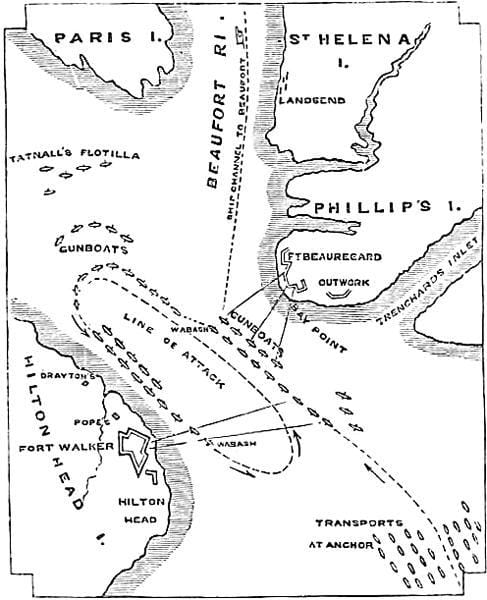 Captain Charles Henry Davis, Bache’s chief assistant at the U.S. Coast and Geodetic Survey, was a leading collaborator of Carl F. Gauss; Davis translated Gauss’s seminal work on the calculation of celestial orbits into English. Davis introduced a new principle into warfare which led to a vital Union success early in the Civil War: the capture of Port Royal, South Carolina, in November 1861. Davis, fleet chief of staff under Adm. Samuel F. du Pont, developed an “expanding ellipse formation,” which permitted what was then the largest U.S. fleet ever assembled to capture the two forts protecting Port Royal. This reversed the standard theories which held “that one gun on land was equal to four on water.” As detailed by David D. Porter in his Naval History of the Civil War, this action opened the gateway to the capture of other Rebel cities such as New Orleans.
Admiral du Pont divided his fleet into a main squadron of nine heavy ships and a flanking squadron of gunboats. The two columns passed midway between the forts. The main force turned about in the sound and plied a narrow ellipse between the two forts until their fire was reduced by the naval bombardment. The ellipse was then expanded so as to bring the naval guns closer to the forts, increasing the effect of the artillery.
This was not the only application of Gaussian elliptic functions and celestial mechanics to naval warfighting. Admiral Porter utilized the mathematical hydrodynamics which had been taught to him by Davis's Coast and Geodetic Survey, in his successful navigation and conquest of the Mississippi with General Grant.
—Charles B. Stevens
In 1842, Commodore James Biddle, brother of Nicholas Biddle, made William Chauvenet head of a school that had been informally established within the Philadelphia Naval Asylum, the elderly seamen’s home under Commodore Biddle’s command. With Bache’s help, the 22-year-old Chauvenet put old and young sailors through sophisticated courses in geometry, astronomy, and other navigational sciences.
In 1843, Bache was appointed head of the United States Coast Survey. He made the survey into a school for geodesy and hydrography for the entire military establishment, and the powerful base through which the federal government recruited and trained scientists. The work on oceanography under Bache (continuing the field developed by Alexander von Humboldt and by Benjamin Franklin), and mapping of the entire coastline, would allow the Union to impose a powerful blockade on the South during the Civil War.
Also in 1843, the U.S. Congress, under Henry Clay’s close control, financed the implementation of Samuel F.B. Morse’s telegraph. (Morse had invented a good code, but only reluctantly conceded that he had not “invented the telegraph.”) A.D. Bache and Sears Walker then developed the method of longitude computation by telegraph.
In 1845, Bache and his allies prevailed on the government to move William Chauvenet’s naval school from the Philadelphia Asylum to the Army’s Fort Severn in Annapolis, Maryland. Navy Secretary George Bancroft appointed Anglophile Cmdr. Franklin Buchanan to be superintendent; Buchanan later joined the Confederacy in the Civil War. But William Chauvenet continued in charge of the school’s instruction and overall organization. He taught astronomy, navigation, geometry, and mathematics; he and the nationalist Commodore Matthew Perry were the school’s principal overseers. Before long, the name was changed to the United States Naval Academy.
Anti-nationalists had blocked the Academy’s birth since it was proposed by Alexander Hamilton in 1799. But Bache’s patriotic Lazzaroni scientists were too powerful, even taking over Harvard and Yale. It was also helpful that Bache’s uncle, George M. Dallas, was U.S. Vice President, and that Treasury Secretary Robert Walker was Bache’s brother-in-law.
The Smithsonian Institution was founded in 1846, due principally to John Quincy Adams’s fight for it. On Bache’s recommendation, physicist Joseph Henry was appointed Smithsonian chief. Henry created the modern weather service, based on reception of reports by telegraph.
Meanwhile, Lazzaronian Benjamin Peirce founded the Harvard Observatory, and Harvard’s Lawrence Scientific School; Yale’s Sheffield Scientific School was created by Bache-ites Oliver Wolcott Gibbs and Benjamin Silliman, Jr.
During the Civil War of 1861-65, Bache was the recognized chief of America’s scientists, with his Lazzaroni at the center of military strategy and intelligence. President Lincoln often consulted with Joseph Henry, and enjoyed rolling up his sleeves to help Henry at his experiments.
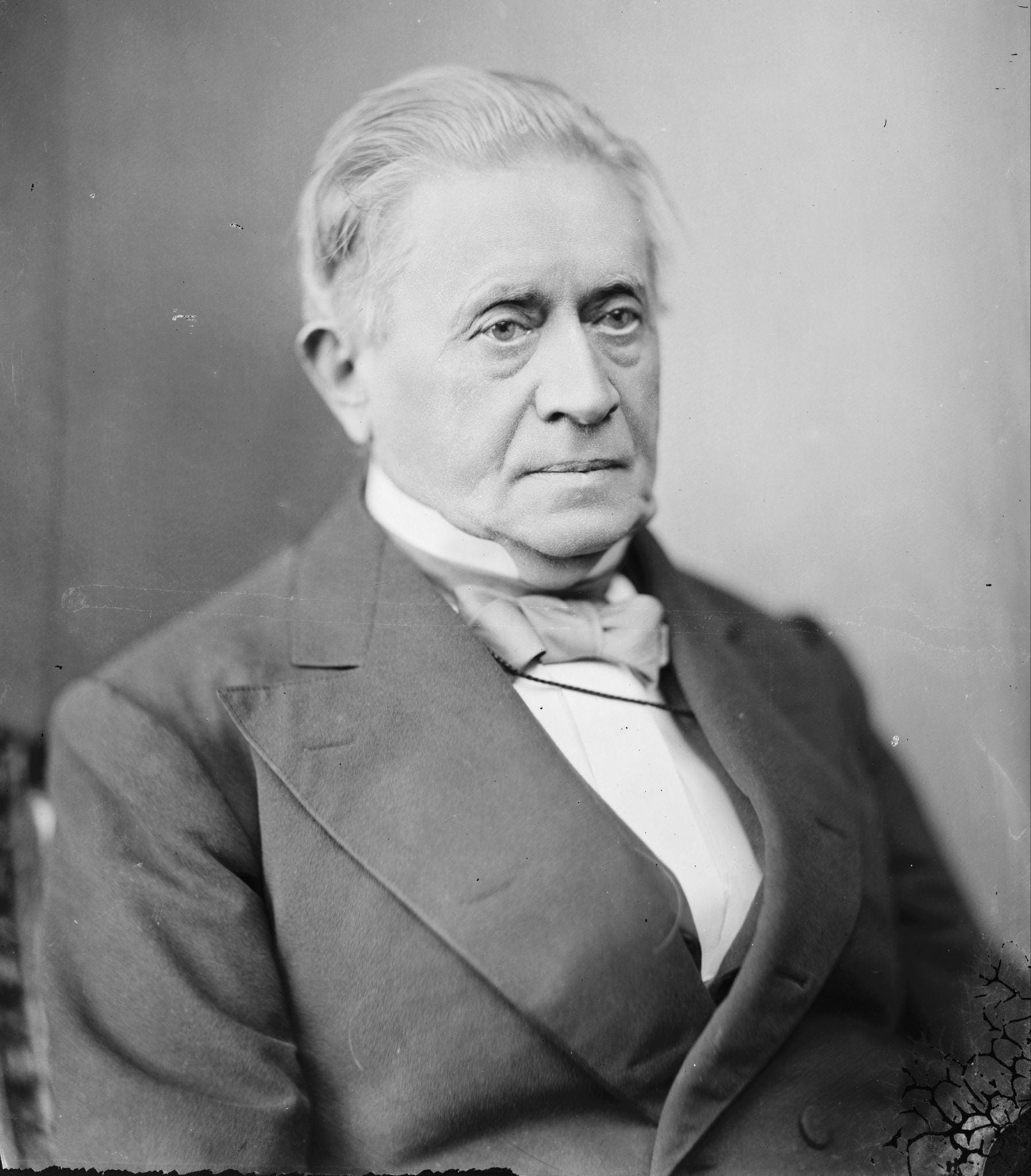
At the outbreak of the war, the President asked four men to sort out the loyalties of the naval officer corps: Alexander D. Bache; Lazzaronian Adm. Charles H. Davis, chief translator of Carl Gauss into English; Adm. Samuel F. du Pont, close collaborator of Bache and Davis; and Commodore Hiram Paulding. These men later swung the decision to produce the new Monitor ironclad warship.
National institutions had thus been formed, beginning in the 1830s, that could sharply upgrade U.S. technical competence and power. But radical free-trade dogma had dominated Congress and the Presidency; manufacturing was suppressed, and by the late 1850s, slave-grown cotton had become the leading product and export of the United States. By the time the slave owners’ rebellion started the Civil War, the country was utterly bankrupt. New national life would come from Abraham Lincoln’s revolution in economic strategy, as well as his war leadership.
5. Why Lincoln Built the Nation’s Railroads
During the Civil War, American armed forces reunited the country. At the same time, President Abraham Lincoln ended and reversed the rule of “free trade” or “laissez-faire,” by which the London-allied opponents of the American Revolution had expanded plantation slavery to the detriment of American industrial power.
Lincoln’s breathtaking economic development program, begun when the country was bankrupt, continued in effect at least long enough after his assassination, for the United States to make itself the world’s greatest industrial power. Lincoln’s measures remained in force for several decades, controlling inflation through industrial innovation, and raising U.S. living standards to unprecedented heights.
Abraham Lincoln’s economic program as President cohered with his long political career as a partisan of nationalist leader Henry Clay (1777-1852), and a follower of Philadelphia economist Henry C. Carey (1793-1879).
From the late 1840s until several decades after his death, Henry Carey shaped the thinking of nation-builders throughout the world. In his widely translated books, Carey demonstrated that the free trade proposed by the “classical” school of economics was cheap British imperial propaganda. Henry Carey assumed personal leadership of the nationalist political-industrial-scientific complex in Philadelphia, which was the backbone of support to Lincoln as President. After the Civil War, this “private” apparatus, overlapping with the government and the military, would create huge, new American industries under government protection and subsidy.
Carey and his allies formed the Republican Party in the mid-1850s. As the party’s 1860 Presidential candidate, Abraham Lincoln asked Carey to write his campaign’s economic platform; it was a “statist” proposal, for protectionist tariffs to revive American industry. As President, Lincoln asked Carey to pick some significant Treasury Department appointees, so that the free trade policy of the slave owners could be erased completely from national government practice.
While President Lincoln built the world’s most powerful armed forces, he put through an extraordinary program of economic measures, including:
- Ultra-protectionist tariffs which virtually forced into existence a new American steel industry;
- Government organization of railroad systems reaching across the wilderness to the Pacific Ocean;
- The sharp upgrading of U.S. agriculture, by such methods as government-directed agricultural science, free land for farmers, creation of the Agriculture Department, and promotion of new farm machinery and cheap tools;
- Recruitment of immigrants, to rapidly increase population;
- Free higher education throughout the United States through the Land Grant College system;
- Reestablishing national control over banking, with cheap credit for productive purposes.
In this report we will focus on the railroad project and the creation of modern agriculture, which we chose in order to correct popular prejudice: that railroads were built by “robber barons” (in truth, they only stole them after they were built), and that government support for farmers is a “giveaway” (the government actually created the private family farm in America).
When Lincoln’s first transcontinental railroad was completed in 1869, the 1,776 miles of new track took passengers and freight across mountains and desert from Iowa to California. Historians usually ascribe the building of this railroad, which immensely strengthened the United States, to such historical facts as the withdrawal from Congress of its Southern opponents. Abraham Lincoln’s unique, lifelong, personal identification with the fight for Western development, is covered over with contemptuous, patronizing remarks, from Lincoln’s ostensible supporters, and charges of corruption from his obvious detractors.
When President Andrew Jackson (1829-37) broke the Bank of the United States, and halted national support to road, canal, and railway construction, he put the brakes on pioneer settlement of the West. But American nationalists, mostly members of Henry Clay’s Whig Party, fought to continue the “internal improvements” construction policy, with the action of state governments to replace the missing federal support.
State legislator Abraham Lincoln, then 27, led this fight in Illinois. He sought to turn the mud- and ice-bound Midwest into the new industrial center of the continent, beginning with the construction of 2,000 miles of railways and canals to crisscross Illinois. Here is what his first important biographers, John G. Nicolay and John M. Hay, report:
If Mr. Lincoln had no other claims to be remembered than his services in the Legislature of 1836-7, there would be little to say in his favor. Its history is one of disaster to the State. Its legislation was almost wholly unwise and hurtful…. In the account of errors and follies committed by the Legislature … he is entitled to no praise or blame beyond the rest. He shared in that sanguine epidemic of financial and industrial quackery which devastated the entire community, and voted with the best men of the country in favor of schemes which appeared then like a promise of an immediate millennium, and now seem like midsummer madness.
He entered political life in one of those eras of delusive prosperity which so often precede great financial convulsions…. It was too much to expect of the Illinois Legislature that it should understand that the best thing it could do to forward this prosperous tendency of things was to do nothing.
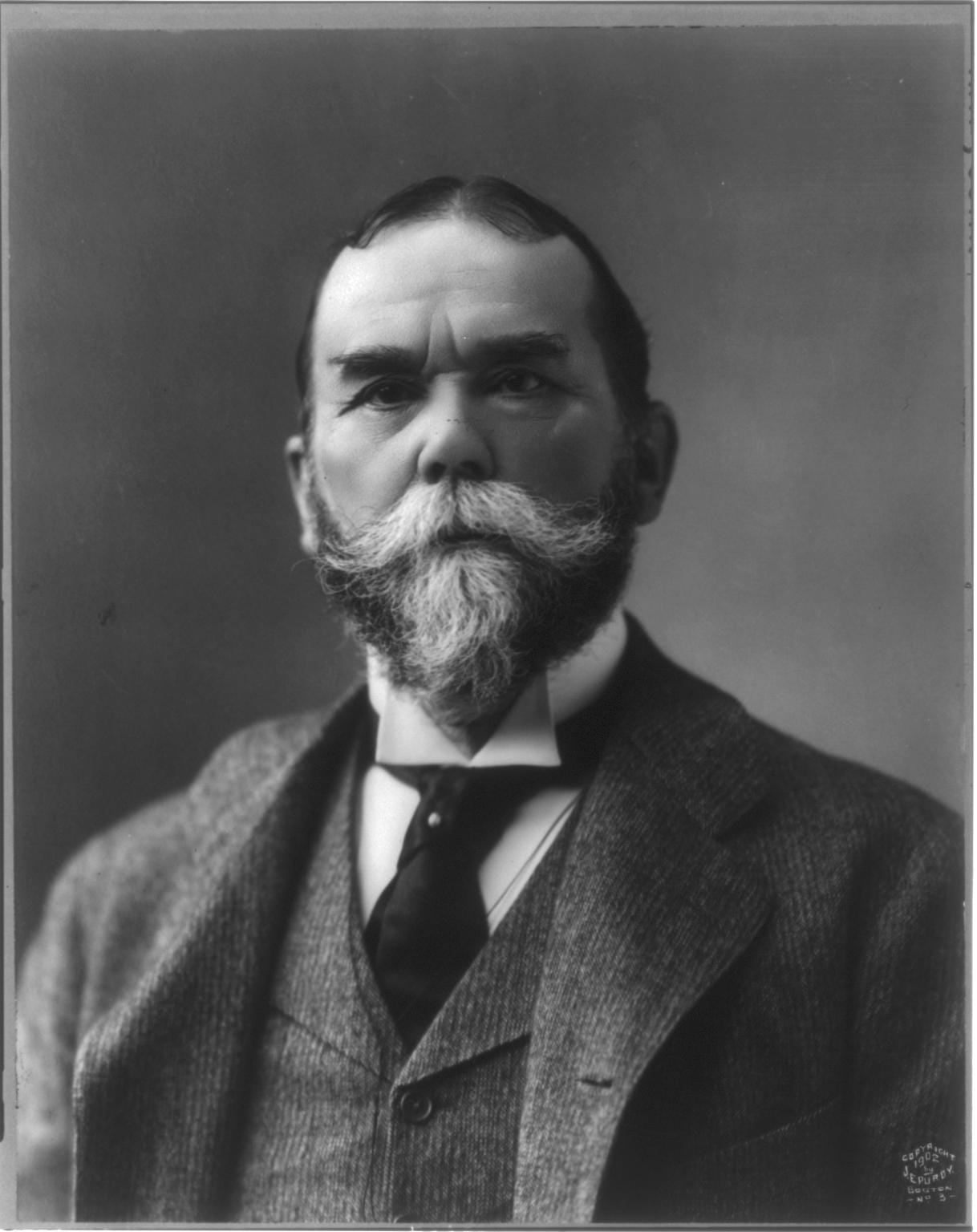
“Madness”? “Delusive prosperity”? In fact, as the Encyclopedia Britannica puts it, “The growth of manufacturing in Illinois, largely because of the development of the state’s exceptional transportation facilities, was the most rapid and remarkable in the industrial history of the United States. In 1850 the state ranked 15th; in 1870, 6th.”
Yet virtually all historians, and Lincoln biographers, reiterate the Nicolay and Hay vituperation of Illinois’ “internal improvement follies” of 1836-37. Since Nicolay and Hay were secretary and assistant secretary to Lincoln during his Presidency, their 10-volume biography was given almost unlimited credence.
Abraham Lincoln was the spirited young leader of the “Long Nine” (all over six feet tall), Sangamon County’s representatives who went to the Illinois Legislature in December 1836. Lincoln’s forces pushed through plans for the state to build a series of rail lines and canals, taking a leadership role that marked his first important political role. Twelve million dollars was appropriated, $3.5 million for the state-chartered Illinois Central line to be built from Galena in the north, to Cairo in the south. The state would borrow money on U.S. and European capital markets, taking advantage of the great excitement internationally over America’s development prospects, the success of the Erie Canal and the giant Pennsylvania program.
Lincoln also took the lead in defending and trying to expand the capital of the state bank of Illinois, hoping that, for Illinois’ purposes, it could stand in for the moribund Bank of the United States.
Construction began with the Northern Cross Railroad, projected to be built from Quincy on the Mississippi River eastward across Illinois to the Indiana line. The first locomotive to be put in operation in the Mississippi Valley was delivered from Paterson, New Jersey by riverboat in November 1838. The line was in operation from the Illinois River to the new state capital of Springfield by May 1842.
British Tighten the Credit Screws
But British-centered opposition to this American development proved too strong. The Bank of England withdrawal of credit from all American enterprises, following President Jackson’s closing of the U.S. Bank, resulted in a terrifying credit squeeze.
In the spring of 1837, the British concentrated their attack on New Orleans. Agents in New Orleans were ordered to stop all purchases for British merchants and manufacturers. With American credit now draining away to England, there were no U.S. buyers to replace the British. New Orleans banks were forced to deny credit to merchants, factories, and banks serving the entire Mississippi Valley.
The Illinois railroad building project failed for want of credit, though the Illinois-Michigan Canal, connecting Lake Michigan with the Mississippi River system, was completed by the state government in 1848.
In 1850, the U.S. government, temporarily in the hands of the Whigs, authorized the granting of federal land to the state of Illinois for the construction of a north-south railroad with a Chicago spur: Three square miles of land were to be granted for each mile of railway constructed. In February 1851, the state legislature, frightened by the earlier collapse of its plans for state-owned enterprise, chartered the Illinois Central Railroad Company. The state gave the federal land grant as an inducement to Eastern private investors to buy into the construction. Lincoln reluctantly supported this scheme as unavoidable, given the lack of national sovereignty over credit issuance. But private capital was never expected to be able to initiate significant railroad construction in America without the sponsorship and subsidy of the government.
The rail network which Lincoln had planned and championed was now quickly built, and eventually made Chicago the rail center of the continent.
John Hay: ‘A Thousand Ties to Britain’
Turning back again to the attack on Lincoln’s legislative “follies” by his supposedly friendly biographers: John Hay wrote the first volume of the Nicolay-Hay biography, on Lincoln’s first 50 years, and he steered and edited the other nine volumes, covering Lincoln’s remaining six years. But his motives may come out more clearly in his 1883 novel, The Bread-Winners, where Hay attacked the working people of America, and “the restless haste and hunger to rise which is the source of much that is good and most that is evil in American life.”
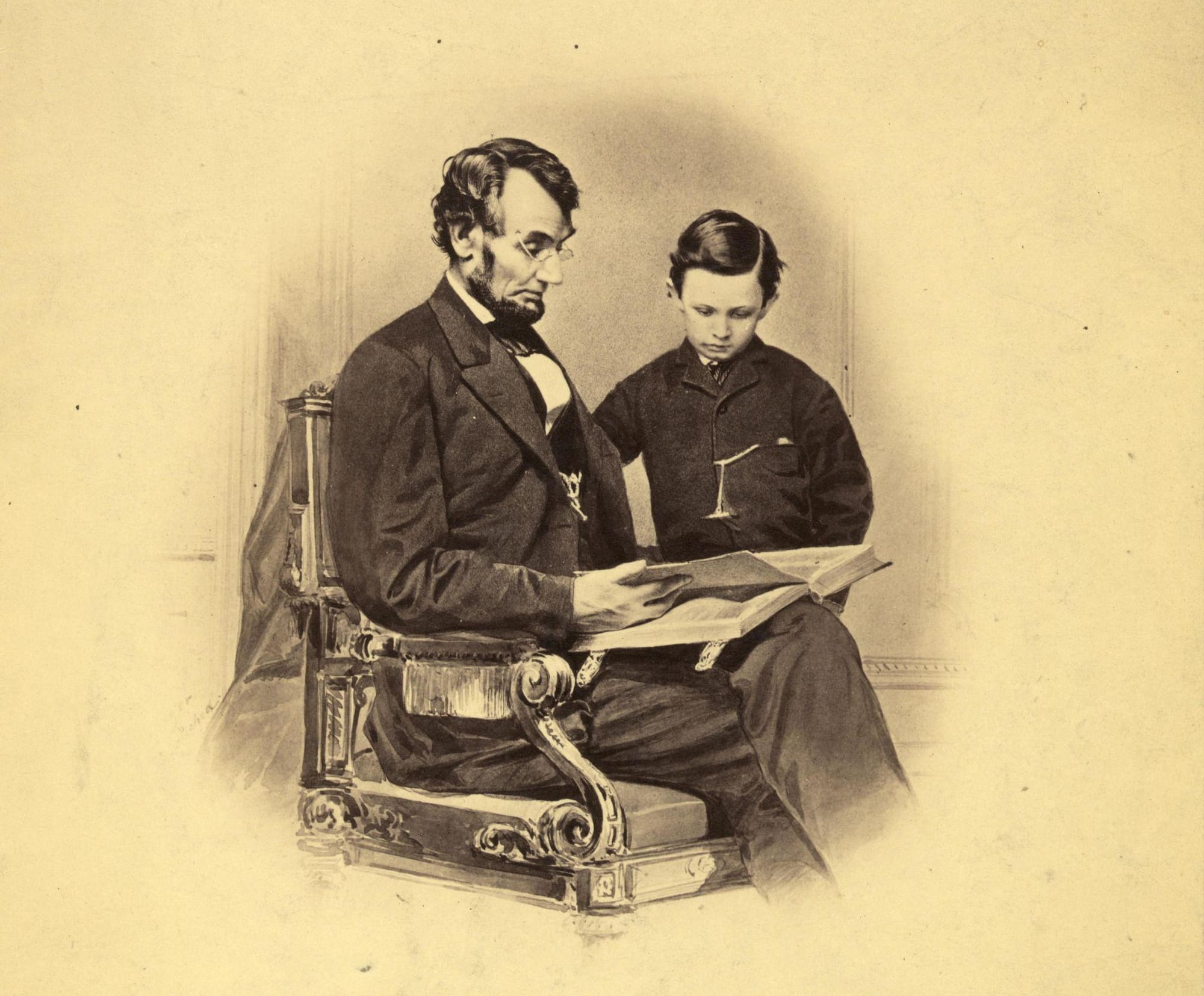
Lincoln’s opposite worldview was expressed to a German group in Cincinnati in 1861:
I hold the value of life is to improve one’s condition. Whatever is calculated to advance the condition of the honest, struggling laboring man … I am for that thing.
Hay later became famous as an atrociously Anglophile diplomat and Secretary of State. Hay expressed his own sense of identity in 1898, as U.S. ambassador to Great Britain:
Knitted as we are to the people of Great Britain by a thousand ties … there is a sanction like that of religion which binds us to a sort of partnership in the beneficent work of the world…. No man and no group of men can prevent it…. We are bound by a tie which we did not forge and which we cannot break.
His “definitive” biography of Lincoln, published in 1886, does not even mention Lincoln’s role in building the Pacific railway, next to nothing on his economic measures, and not a hint of the lifetime of dirigist philosophy behind them.
Moving Mountains
In August 1859, a year before Lincoln was elected to the Presidency, he visited Council Bluffs, Iowa, meeting privately there with a young railroad engineer/surveyor named Grenville Dodge. After serving as a prominent Union Army officer under Lincoln, Dodge went on to become the chief engineer of the Pacific Railroad. In his 1914 book, Personal Recollections, Dodge recounts his 1859 encounter with Lincoln:
He sat down on a bench with me and proceeded to pump me as to what I knew of the country west of the Missouri River. He greatly impressed me by the marked interest he displayed in the work in which I was engaged, and he expressed himself as believing that there was nothing more important before the nation at that time than the building of a railroad to the Pacific Coast. He ingeniously extracted a great deal of information from me about the country beyond the river, the climate, the character of the soil, the resources, the rivers and the route. When the long conversation was ended, I realized that most of the things that I had been holding as secrets for my employers in the East, had been given to him without reserve.
Dodge continues:
During Lincoln’s visit, some of the citizens of Council Bluffs took him to a high bluff known as Cemetery Hill, just north of town…. He was greatly impressed with the outlook; and the bluff from that time has been known as Lincoln’s Hill…. From here he looked down upon the place, where by his order, four years later, the terminus of the first trans-continental railway was established.
Lincoln signed the Pacific Railway Act July 1, 1862, authorizing huge government land grants to finance the construction. Two years later a second bill doubled the land grants and sweetened the other terms. Altogether 45 million acres of land were given away, and the government laid out some $60 million in cash, compared to only $4 million invested from private capital.
Lincoln was determined to “conquer space” to the west. At one point, when the project seemed dead for lack of funds, he arbitrarily redefined the Rocky Mountains as starting in their foothills, so that more money could be paid to the builders under the legislated formula—$32,000 in the mountains, as against only $16,000 per mile in the flatter land. It was said at the time, “Abraham’s faith moves mountains.”
6. How Lincoln Made Farmers Scientific
The power of the Union’s arms abolished black chattel slavery, the legal remnant of the British imperial past. But America still had to construct a positive alternative to the colonial plantation system. Abraham Lincoln’s abiding passion for the protection and productivity of labor shows up boldly in his presidential action to bring scientific thinking into agriculture. To modernize America’s farms, Lincoln’s administration organized a national teaching apparatus run largely by students of the pioneering German chemist Justus von Liebig. We will consider, below, Liebig’s resolute Christian humanism and his contribution to America.
British imperial apologists Thomas Malthus and David Ricardo posited fictitious “natural resources,” whose depletion by agriculture must deprive land of its natural, original value, making poverty and hunger inevitable. Colonial or other production-depressing regimes are beneficial, by this doctrine, since they delay the depletion of nature. Environmentalism is just a Twentieth-Century variant on this old theme.
But a nation mobilized in a war for freedom could not tolerate the blasphemous notion that God’s laws consign man to perpetual scarcity and backwardness. Under Lincoln’s leadership, Americans created a system to render farming so successful, so powerful and productive, that the lie of inevitable poverty was forever dispelled.
Millions of new private farms were created, by government land grants to households, and to railroads, which obtained credit by selling their grant-lands to new farmers. Farm families were educated at government expense. Government scientists supplied them with the latest intelligence on fertilizers, soil chemistry, and crop management. New farmlands opened up by government-organized railroads allowed for production economies of scale. Farmers with cheap, government-supplied credit, bought machinery, produced by patent-protected inventors using tariff-protected American steel. Diseases of livestock were conquered and eliminated by the vigorous prosecution of government science and federal law.
Lincoln’s advocacy of human advancement would put him beyond the pale in today’s politics. A visit to Niagara Falls set off reflections which led to his patenting an “improved method of lifting vessel[s] over Shoals,” while a fellow visitor to the falls complained of Lincoln’s alleged lack of a sense of wonder.
Neither did he romanticize or otherwise propitiate farmers; no farmer asked him beforehand to create the Agriculture Department or America’s farm-centered state college systems.
Addressing the Wisconsin State Agricultural Society at its annual fair in Milwaukee on Sept. 30, 1859, Lincoln reprised the argument laid down by Gottfried Leibniz in his “Academy Proposal,” on the motivation for work, and the increase of productivity by the elevation of the worker’s mind. He began:
I presume I am not expected to [engage] … in the mere flattery of the farmers, as a class. My opinion of them is that, in proportion to numbers, they are neither better nor worse than any other people.
Lincoln continued by praising the fair, rather than the farmers:
But the chief use of agricultural fairs is to aid in improving the great calling of agriculture, in all its departments, and minute divisions—to make mutual exchange of agricultural discovery, information, and knowledge; so that, at the end, all may know everything, which may have been known to but one, or to but a few, at the beginning—to bring together especially all which is supposed to not be generally known, because of recent discovery or invention.
And not only to bring together and to impart all which has been accidentally discovered or invented upon ordinary motive, but, by exciting emulation, for premiums, and for the pride and honor of success—of triumph in some sort—to stimulate that discovery and invention into extraordinary activity. In this, these fairs are kindred to the patent clause in the Constitution of the United States; and to the department, and practical system, based upon that clause.
He warned that current agricultural practices were producing very low grain yields, 8-18 bushels per acre, compared to the possibility for 50 to 100 bushels, from merely applying available methods:
What would be the effect upon the farming interest, to push the soil up to something near its full capacity?… Unquestionably, thorough cultivation will require more labor to the acre; but will it require more to the bushel?… It would [uncover] those unknown causes, which of late years have cut down our crops below their former average … in the deeper plowing, analysis of the soils, experiments with manures, and varieties of seeds…. [T]horough cultivation would spare [at least] half the cost of land, simply because the same product would be got from half, or from less than half the quantity of land….
Again, a great amount of “locomotion” is spared by thorough cultivation. Take fifty bushels of wheat … [on] a single acre, and it can be harvested … with less than half the labor which would be required if it were spread over five acres. This would be true, if cut by the old hand sickle; true, to a greater extent, if by the scythe and cradle; and to a still greater, if by the machines now in use … [which] substitut[e] animal power for the power of men….
The effect of thorough cultivation upon the farmer’s own mind, and, in reaction through his mind, back upon his business, is perhaps quite equal to any other of its effects. Every man is proud of what he does well … his heart is in his work; and he will do twice as much of it with less fatigue…. The man who produces a good full crop will scarcely ever let any part of it go to waste. He will keep up the enclosure about it, and allow neither man nor beast to trespass upon it. He will gather it in due season and store it in perfect security….
The successful application of steam power to farm work, is a desideratum—especially a steam plow…. To be successful, it must … plow better than can be done with animal power … and cheaper; or more rapidly.
Lincoln proposed the necessity of self-propelled farm machinery, before any such had been invented. But, he then pointed out, accurately, that steam power was impracticable for this purpose, despite the success of the railroad and steamship, because of the weight of fuel and water a steam vehicle must carry over farmland. This problem was solved a generation later by the use of gasoline engines.
Lincoln then proposed the family farm as one of the means for upholding the freedom and dignity of labor; he went on to describe the problem-solving mentality of the scientific farmer, so different from the ignorant peasant:
[F]ree labor insists on universal education…. I know nothing so pleasant to the mind, as the discovery of anything that is at once new and valuable—nothing that so lightens and sweetens toil, as the hopeful pursuit of such discovery. [For the] mind, already trained to thought in the country school, or higher school … [every] blade of grass is a study; and to produce two, where there was but one, is both a profit and a pleasure. And not grass alone: but soils, seed. and seasons—hedges, ditches, and fences, draining, droughts, and irrigation … saving crops, pests of crops, diseases of crops, and what will prevent or cure them … the thousand things of which these are specimens—each a world of study within itself….
Population must increase rapidly—more rapidly than in former times—and ere long the most valuable of all arts, will be the art of deriving a comfortable subsistence from the smallest area of soil. No community whose every member possesses this art, can ever be the victim of oppression in any of its forms. Such community will be alike independent of crowned-kings, money-kings, and land-kings….
It is said an Eastern monarch once charged his wise men to invent him a sentence … which should be true and appropriate in all times and situations. They presented him the words, “And this, too, shall pass away.”… And yet, let us hope it is not quite true. Let us hope, rather, that by the best cultivation of the physical world, beneath and around us, and the intellectual and moral world within us, we shall secure an individual, social and political prosperity and happiness, whose course shall be onward and upward, and which, while the earth endures, shall not pass away.
Lincoln and Continental European Science
The natural science, which was to revolutionize agriculture, was itself the work of opponents of colonial Malthusian doctrines. This is perhaps best exemplified by the successes of Justus von Liebig (1803-73), a chemist who grew up in Beethoven’s Germany. Liebig’s work would be brilliantly realized in Lincoln’s agricultural program.
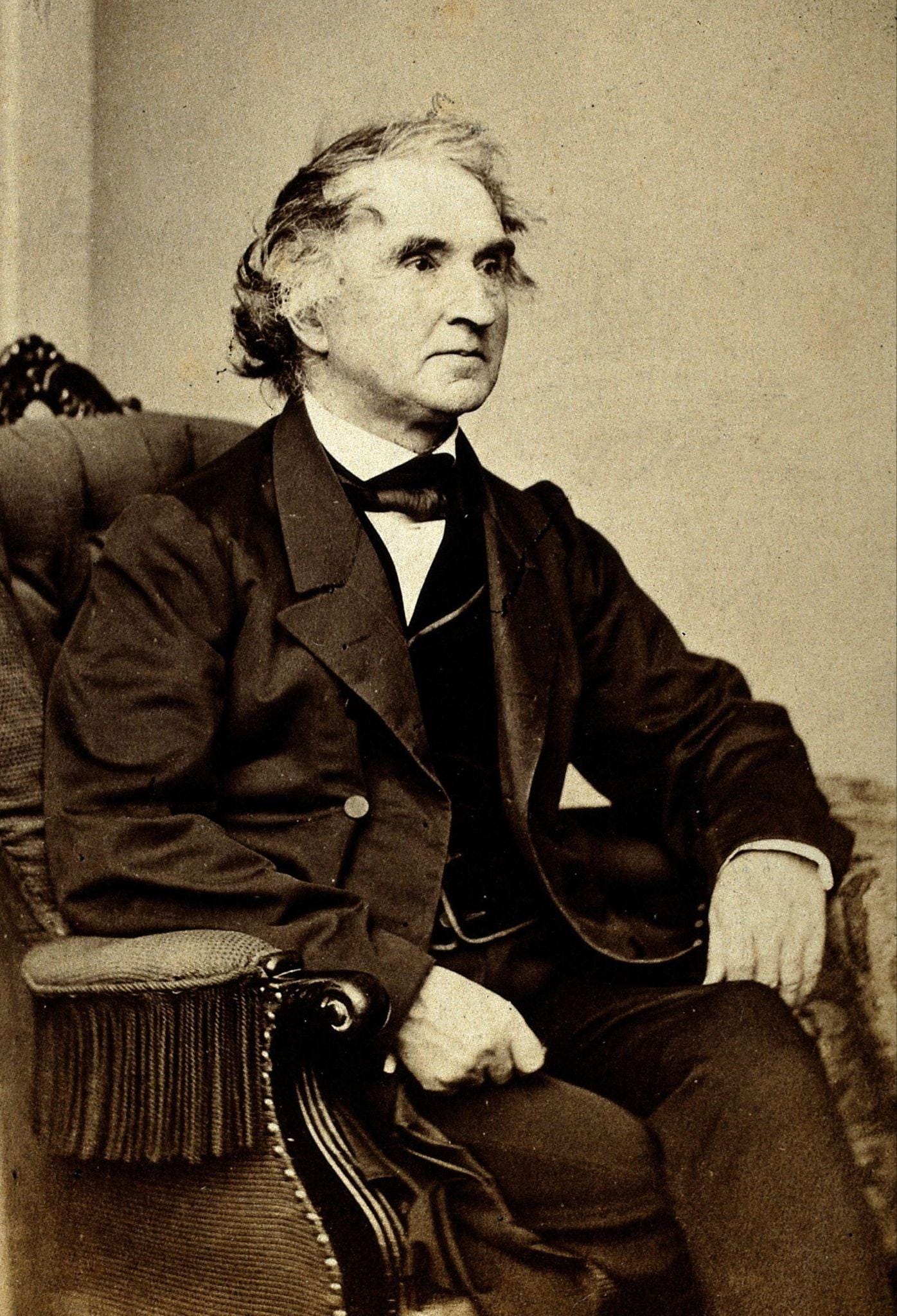
Liebig identified the mineral nutrients required for the growth of plants; he created the analytical and educational methods that made modern biochemistry and such things as artificial fertilizer possible. Liebig described his own early development as “the reading of books without any system … just as they stood on the shelves” of the library, and “thousands of essays and treatises.” According to Liebig:
[This] developed in me the faculty … of thinking in terms of phenomena…. Most closely akin is the peculiar power of the musician, who while composing thinks in tones which are as much connected by laws as the logically arranged conceptions in a conclusion or series of conclusions. There is in the chemist a form of thought by which all ideas become visible to the mind as the strains of an imagined piece of music.
At age 17, he went to Paris, and exhibited his talents under the tutelage of Joseph Louis Gay-Lussac and Alexander von Humboldt. By 1820, the French École Polytechnique, whose educators had virtually founded America’s early engineering and military science, was already more or less destroyed. So Humboldt used his influence to set up Liebig in his own chair of chemistry at a small German college, at Giessen, in May 1824.
Here organic chemistry was born; and for the first time, teaching took place in a chemical laboratory.
As Liebig described it:
[A] kindly fate brought together the most talented young men from all the countries of Europe [and America!]…. Actual teaching in the laboratory … was only for the beginners; the progress of my special students depended on themselves. I gave the task and supervised the carrying out of it…. I received from each individual [a daily report about what] he was engaged upon. I approved or made many criticisms … by each participating in the work of all, every one learned from the others…. We worked from break of day till nightfall…. The only complaint … was that of the attendant … who could not get the workers out of the laboratory in the evening, when he wanted to clean it.
Liebig’s fame grew as his published works brought before the world the new agricultural and pharmaceutical sciences he and his colleagues were inventing.
Liebig wrote of “the present conflict between practical agriculture and scientific Chemistry.” It “concerns the weightiest material interests and the fundamental prosperity of the state. The most urgent problem which the present day has to solve, is the discovery of the means of producing more bread and meat on a given surface, to supply the wants of a continually increasing population,” a problem “which science is expected to solve.”
Liebig attacks the empiricist, who, with only practical experience and no understanding of the underlying laws of nature, must fail. At the heart of Liebig’s worldview is the unique dignity of man, whose creativity is potentially limitless:
Man at first sees everything around him bound in the chains of invariable, immutable, fixed laws. Within himself alone he recognizes a something which may govern these effects, a will which has the power to rule over all natural laws, a spirit which, in its manifestations, is independent of these natural powers, and which, when it is in its conceivable perfection, is subject only to its own laws.
The … knowledge of nature forces upon us … the conviction that [beyond] this something within us … there exists [something] similar or more perfect [which] affirms the existence of a higher, indeed of an infinitely exalted Being, to contemplate and to comprehend whom our senses are too feeble, and of whom, in his greatness and sublimity, we can only form some conception by the highest cultivation of every faculty of our minds.
The Agriculture Department Is Born
On May 15, 1862, President Lincoln signed into law a bill creating the Department of Agriculture, which states:
There shall be at the seat of government a Department of Agriculture, the general design and duties of which shall be to acquire and to diffuse among the people of the United States useful information on subjects connected with agriculture … to procure, propagate and distribute … new and valuable seeds and plants … to acquire … all information … by means of books and correspondence and by practical and scientific experiments … employees [to include] chemists, botanists, entomologists, and other persons skilled in the natural sciences pertaining to Agriculture.
The first scientist appointed by the department was Justus von Liebig’s student, Charles M. Wetherill.
On May 20, Lincoln signed into law the Homestead Act, giving to any head of a family or to anyone 21 years of age, one-quarter square mile of free land for farming. For the remainder of the century, the act transferred millions of acres of the public domain to private ownership. With the first Lincoln-organized Pacific Railroad completed in 1869, settlers poured into newly opened western lands. Between 1870 and 1880, some 128 million acres were added to U.S. farmland, 49 million acres between the Mississippi River and the Rocky Mountains. The total amount of improved farmland increased 50%, from 189 million to 285 million acres.
On July 2, 1862, Lincoln signed the Land Grant College Act. The same legislation had been vetoed by “free enterprise” radical President James Buchanan, Lincoln’s immediate predecessor. The act donated federal land which the states would sell, establishing a perpetual endowment for public colleges in each state. The curriculum, besides military tactics, and “other scientific and classical studies,” was to “promote the liberal and practical education of the industrial classes,” in areas relating to agriculture and the mechanical arts.
The Land Grant schools, such as Iowa State, Ohio State, and Pennsylvania State colleges, and the older universities which shared in the federal largesse, such as Yale and Harvard, became in the late Nineteenth Century the potent center of agriculture-related research.
Evan Pugh, the founder of Pennsylvania State College, was a student of Liebig. Another Liebig student, Eben Horsford, returned to America to open a pioneering laboratory at Harvard for teaching analytical chemistry. Horsford’s innovations spanned the field from condensed milk to fermentation of bread and alcohol. Horsford’s successor at Harvard’s Lawrence Scientific School was Prof. Oliver Wolcott Gibbs, another Liebig pupil, and a member of Alexander Dallas Bache’s Lazzaroni inner circle.
Liebig student John A. Porter, the first dean of the Sheffield Scientific School of Yale, helped develop its courses in agriculture and nutrition. Another pupil of Liebig, William H. Brewer, was professor of agriculture in the Sheffield Scientific School from 1864 to 1903.
Brewer’s colleague, S.W. Johnson, returned from Europe and his studies with Liebig in 1856. He then began teaching at Sheffield and translating the latest European works on chemical analysis for American chemists. In 1869, with Johnson’s urging, Connecticut passed its Fertilizer Law requiring accurate labeling of contents, to be determined by state chemists. This was soon copied by the other states, realizing in America Liebig’s proposal for such government regulation of a field that had been entirely unknown to the previous generation. In 1877, Johnson became director of the new Connecticut Experimental Station, emulating the 100 such stations which Liebig’s influence had already established in Germany, Italy, and Austria. With Johnson’s lobbying, the U.S. Congress passed the Hatch Act in 1887, creating a national network of experimental stations.
A Rich Harvest
For about 35 years after the end of the Civil War in 1865, government-sponsored science and government-protected industry guided an immense increase in American agricultural productivity.
After World War II’s immense economic mobilization, America used the agricultural institutions founded by Lincoln to take another leap ahead in farm productivity. Science in fertilization, breeding, soil analysis, and heavy mechanization caused record crops, and gave promise for the end of world hunger.
We must still consider that one last burst of technological progress, in the two decades 1866-86, which was necessary to create the “modern times” witnessed in the Twentieth Century. America’s amazing post–Civil War development was instigated and guided by the Philadelphia-based nationalists who had tutored and sponsored Abraham Lincoln. As we shall see, the spread of modern conditions to Japan and some other nations, and the electrification of the planet associated with the name of Thomas A. Edison, were both part of this last nationalist enterprise.
End of Part 2.
Bibliography and Acknowledgments
The author gratefully acknowledges the research and counsel of the following persons in preparation of this article: Richard Black, Elliott Greenspan, Laurence Hecht, Denise M. Henderson, Carol Hugunin, Robert Hux, Michael Leppig, Alan Levinson, H. Graham Lowry, Arthur Murphy, Richard Sanders, the late Richard Sober, Charles B. Stevens, and Philip Valenti.
Many of the facts presented in this study are quite widely known, but they are not thought to be especially significant. Perhaps this may be attributed to the brain-death typical of academia, as much as to historians’ Anglophilia or other prejudice.
Thomas Edison is a good case in point. Virtually every standard Edison biography mentions that a certain Prof. George F. Barker was Edison’s science advisor and that he asked Edison to invent the electric light. And most biographies note that a certain Edward H. Johnson was Edison’s best friend and business manager. But no biography really inquires into who these people were, where they came from, or what was on their minds.
A large volume of correspondence involving Edison and these two men, a vast array of Edison’s notebooks and other treasures, are in the Thomas A. Edison papers, which are now available on microfilm at major libraries.
Some of the research for this article was done using papers from the Duke of Bridgewater Archive at Salford University, Salford, England; Matthew Boulton papers, Birmingham City Archives, Birmingham, England; Henry C. Carey papers, Pennsylvania Historical Society, Philadelphia; William J. Palmer papers, Pennsylvania State Library, Harrisburg; Wharton Barker papers, Library of Congress, Washington; records of the 1837 rebellion (for Edison’s father), National Library, Ottawa, Canada; and the George F. Barker papers, University of Pennsylvania Archives, Philadelphia.
Some sources readers may find particularly useful:
Ellis L. Armstrong, ed., History of Public Works in the United States, 1776-1976 (Chicago: American Public Works Association, 1976). Many interesting facts are presented, but it is lacking the necessary history of public policy.
Robert V. Bruce, The Launching of Modern American Science, 1846-1876 (New York: Alfred A. Knopf, 1987). This contains useful facts about Alexander D. Bache’s “Lazzaroni” grouping, but Bruce doesn’t have a clue about the philosophy, politics, or scientific method of his characters.
Henry C. Carey, Principles of Social Science, 1858, reprint (New York: Augustus M. Kelley, 1963). Lincoln would certainly have read this three-volume work, widely circulated just prior to the Civil War.
Anton Chaitkin, Treason in America, from Aaron Burr to Averell Harriman (New York: Campaigner Publications, Inc., 1985).
G. Waldo Dunnington, Carl Friedrich Gauss: Titan of Science (New York: Exposition Press, 1955).
Joseph Henry, “Eulogy on Prof. Alexander Dallas Bache,” in Annual Report of the Smithsonian Institution (Washington D.C.: Government Printing Office, 1870).
H. Graham Lowry, How the Nation Was Won: America’s Untold Story 1630-1754 (Washington, D.C.: Executive Intelligence Review, 1988).
Merle M. Odgers, Alexander Dallas Bache (Philadelphia: University of Pennsylvania Press, 1947).
Allen Salisbury, The Civil War and the American System: America’s Battle with Britain, 1860-1876, 1978, reprint (Washington, D.C.: Executive Intelligence Review, 1995). Henry Carey’s work is excerpted and placed excellently in context.
Nancy Spannaus and Christopher White, The Political Economy of the American Revolution (New York: Campaigner Publications, Inc., 1977); to be reprinted in 1996 by Executive Intelligence Review. Many extracts from America’s founding nationalists.
Since such historical figures as Franklin, Hamilton, and Lincoln acted on philosophical grounds which are today considered incorrect or dangerous, their own writings should be read in preference to most secondary works about them, which often range from pointless to deceitful.