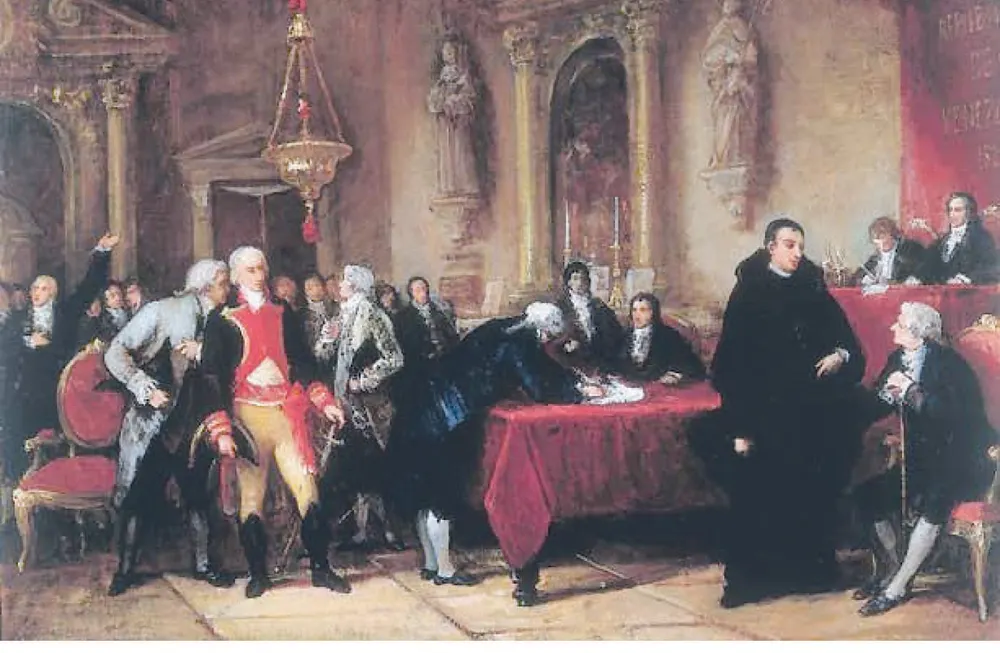
July 4—“Even that we found ourselves together here at this moment…. The entirety of world history, at the very least, were necessary to explain this single moment.”
—Friedrich Schiller, Poet of Freedom, “What Is, and to What End Do We Study, Universal History?” (1789)
There was, indeed, a time when collaboration between the patriots of the Americas was based on universal principles of justice and sovereignty.
The birth of the first republic in modern history, the United States of America, had a tremendous impact on a large number of patriots in the Spanish colonies of Ibero-America, who viewed it truly as a “beacon of hope” and a “temple of liberty.” Despite the extensive historical documentation that exists, British historiography has obscured this fact and claims that the main influence came from the “French Revolution” and the Jacobin “Enlightenment.”
In the case of the Republic of Venezuela, we have a very tangible example in the collaboration between the true patriots of both countries during the first decades of the 19th Century—a collaboration that extended to the Mexico of Benito Juárez, the “Benemérito de las Américas” (“Distinguished Hero of the Americas”), and beyond.
The year 2026 marks the 250th anniversary of the Declaration of Independence by what would soon become the United States of America. That instrumental document laid down the principles of an anti-oligarchic republican form of government, and would go on to be the inspiration for countless other peoples around the world, forever changing the shape of history. Today, this history is either misunderstood or intentionally misconstrued, and the U.S. has nearly abandoned the outlook of its Founding Fathers. Over the course of this year, EIR will be publishing key articles on the true anti-oligarchic history of the United States in the hopes of contributing to the widest possible discussion of these principles, the rediscovery of which has enormous implications for whether the world can get out of its current state of turmoil today.
Venezuela’s Declaration of Independence, which was presented for signing on July 5, 1811, is a prime example. The Declaration refers to the fact that Spain lacked a legitimate government in the wake of the Napoleonic invasion of the Iberian Peninsula and the imposition of Napoleon’s brother, Joseph Bonaparte, as king of Spain. In fact, it was this event—between 1808 and 1810—that sparked all the wars of independence on the continent, which raged for more than a decade, until around 1820-1821.
One of the most obvious examples of the similarity between Venezuela’s and the United States’ declarations of independence is found in the preamble to the latter, which states: “When in the Course of human events, it becomes necessary for one people … to assume among the powers of the earth, the separate and equal station to which the Laws of Nature and of Nature’s God entitle them, a decent respect to the opinions of mankind requires that they should declare the causes which impel them to the separation,” a concept adapted to the Venezuelan context.
The Venezuelan Declaration, states from the outset that the patriots “wish to make known to the world the reasons that have arisen from these very events that justify the free exercise of our sovereignty.” And after setting forth these reasons, they state that this is done to “fulfill the respect we owe to the opinions of humanity and to the dignity of other nations, among which we are about to take our place.”
We know that those who drafted the Venezuelan Declaration of Independence were familiar with the United States Declaration of Independence, which was translated into Spanish by the Venezuelan Manuel García de Sena, and printed in Mathew Carey’s publishing house in Philadelphia. Likewise, they conclude their decision to be free with an oath very similar to that at the end of the U.S. Declaration of Independence: “And to make this solemn declaration of ours valid, firm, and enduring, we mutually pledge to one another our lives, our fortunes, and the sanctity of our national honor.”
Juan Germán Roscio, Mathew Carey, and Benito Juárez
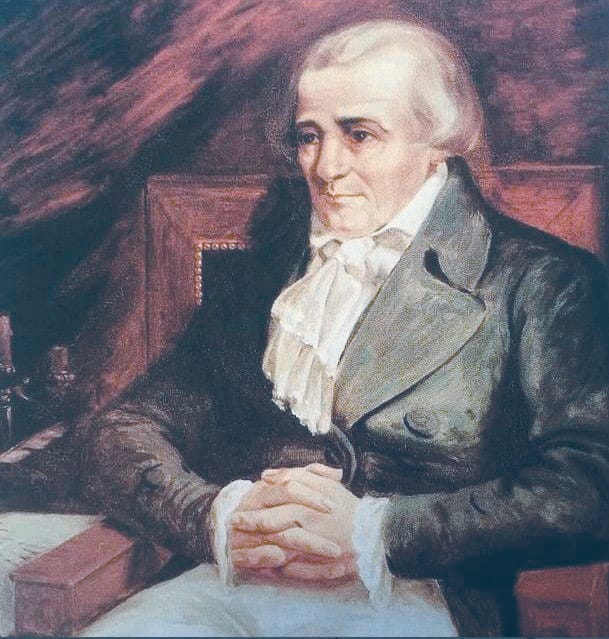
The principal drafter of Venezuela’s Declaration of Independence was Juan Germán Roscio, one of the most influential intellectuals on the continent who helped shape the first Venezuelan republic. In 1817, Roscio wrote a work that would make its way across the entire continent, from Philadelphia to Oaxaca, Mexico, and all the way to Argentina: The Triumph of Liberty Over Despotism: The Confession of a Sinner Repentant of His Political Errors, and Dedicated To Making Amends in This Regard to Religion, Which Has Been Offended by the System of Tyranny.
The first edition of the book was published by Thomas H. Palmer’s printing house in Philadelphia in 1817; a second edition was published by Mathew Carey & Sons in 1821. This edition by Carey reached Mexico the following year and became a best seller among republicans, so much so that in 1824 Martín Rivera’s print shop in Mexico produced an abridged edition of the work, and in 1828 the complete work was printed at Juan Olmedo’s Imprenta de York. This book was one of Benito Juárez’s favorites, both during his years as a lawyer and activist in the State of Oaxaca, and during his first term as President of Mexico. Indeed, Juárez drew from Roscio’s book the methodology of using legitimate theological arguments to defend freedom against the despotism of monarchies, in order to defend the Reform Laws that institutionalized the separation of church and state in Mexico.
Philadelphia was the center where many Ibero-American republican patriots arrived as exiles, and Mathew Carey’s publishing house was a gathering place for patriots from across the continent. Another Venezuelan patriot, Manuel García de Sena, translated the United States Declaration of Independence, the United States Constitution, and the works of Thomas Paine into Spanish, and all of these works were published by Carey’s print house. From there, they circulated not only in Venezuela, but throughout the South American continent.
The Argentine Colonel Manuel Dorrego was another republican patriot who was inspired by Roscio’s book. Dorrego was exiled in Philadelphia from 1817 to 1820, during which time he studied the American institutions, but Roscio’s work offered him an ideal vision appropriate to Spanish-American reality, which he brought to Buenos Aires.
Venezuela’s Declaration of Independence and the U.S. Declaration of Independence: The Pursuit of the General Welfare
In the Solemn Declaration of Independence, drafted primarily by Juan Germán Roscio and Francisco Iznardi, presented on July 5, 1811, and signed and approved by the Executive Branch on July 7 of the same year, we read:
We, the representatives of the United Provinces of Venezuela, calling upon the Supreme Being as witness to the justice of our actions and the righteousness of our intentions, imploring His divine and heavenly aid, and reaffirming to Him at this moment of our birth into dignity that His Providence restores to us the desire to live and die free, believing in and defending the holy, Catholic, and Apostolic religion of Jesus Christ as our foremost duty.
We, therefore, in the name of and by the will and authority we hold from the virtuous People of Venezuela, solemnly declare to the world that its United Provinces are, and shall henceforth be, in fact and in law, free, sovereign, and independent States, and that they are absolved from all submission and dependence on the Crown of Spain, or on those who call themselves or may call themselves its agents or representatives; and that, as such a free and independent State, it has full power to adopt the form of government that conforms to the general will of its peoples, to declare war, make peace, form alliances, conclude treaties of commerce, boundaries, and navigation, and to perform and execute all other acts that free and independent nations perform and execute….
We can surmise that, in the minds of those who led this historic process—one that extended beyond the borders of any single country—at this moment in history, “perhaps as a result of all previous world events,” the universal ideas that drove the American Revolution were present. These ideas, which gave rise in North America to the first republic to come into existence, similarly spread to all the Spanish colonies in South America, and found a foothold and fertile ground in Venezuela, among other countries. This was a highly dynamic exchange of ideas, a small part of which we present here.
The preamble to Venezuela’s first Federal Constitution, ratified in 1811, echoes the spirit and the process grounded in the fundamental principles expressed in the preamble to the United States Constitution.
Preamble to Venezuela’s First Constitution
FEDERAL CONSTITUTION
FOR THE STATES OF VENEZUELA
Drafted by the Representatives of Margarita, Mérida, Cumaná, Barinas, Barcelona, Truxillo, and Caracas, assembled in GENERAL CONGRESS
IN THE NAME OF ALMIGHTY GOD
We, the People of the STATES OF VENEZUELA, exercising our sovereignty, and desiring to establish among ourselves the best administration of justice, to promote the general welfare, to ensure internal tranquility, to provide jointly for external defense, to uphold our political freedom and independence, to preserve the sacred religion of our forefathers pure and unharmed, to perpetually ensure for our posterity the enjoyment of these blessings, and to bind ourselves together in the most unbreakable union and sincere friendship, have resolved to solemnly enter into a confederation to form and establish the following Constitution, by which these States shall be governed and administered.”

