This is an edited transcript of the presentation that Mr. Freeman gave to a July 5, 2026, Sare for President event in the Philadelphia area.
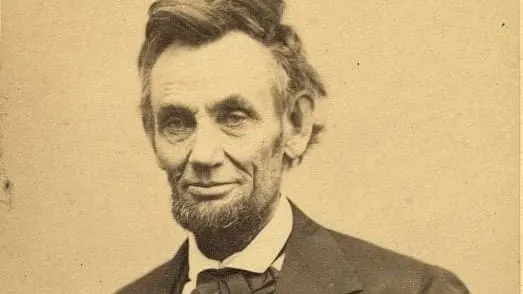
Abraham Lincoln, a student of Henry Carey and supporter of Henry Clay, both advocates of the American System, took over the American Presidency in March of 1861 in perhaps the harshest conditions any person before or since ever has.
Yet, he accomplished not only the defeat of the British-centered, -financed, and ‑directed Confederate slaveholders’ insurrection; preserved and expanded the Union; and began the decisive eradication of the barbaric Nazi-like institution of Black chattel slavery with his January 1, 1863, Emancipation Proclamation and the 13th Amendment to the Constitution, but he also led an economic miracle. In a January 12, 2002, article, Lyndon LaRouche, the greatest physical economist to ever live, wrote, “With the guidance and backing of the world’s leading economist of that time, Henry C. Carey, President Abraham Lincoln made possible the U.S. economic miracle of 1861-1876.”
Most Americans do not know that miracle exists or what it was. I hope you will get an idea of it by my selection of a few critical features to illustrate it. This presentation will emphasize that this miracle occurred, as all growth has occurred throughout history, as an economic shock wave, as described by Lyndon LaRouche.
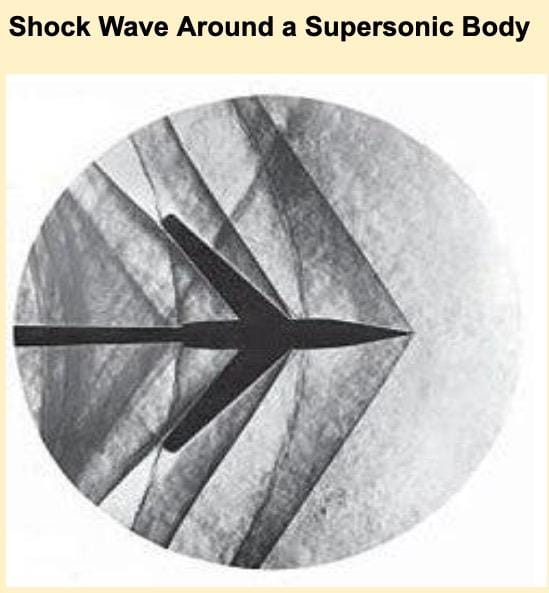
This is a schlieren photograph of an airplane model with swept wings, at Mach 1.2 [Figure 1]. When an object, such as a jet plane, travels at a speed below the speed of sound, which is 760 miles per hour, there are certain physical laws that govern its behavior. When an object travels through the air faster than the speed of sound, the object outruns its own sound, and the pressure waves pile up into one massive, powerful, abrupt shock. From the ground, we hear this as a sonic boom. LaRouche says that the old laws no longer apply, that we enter a new domain. Think of this like a linked series of generated conical waves that pass over the back of the plane, with each conical wave representing an economic platform, having a higher set of scientific principles and power, and a higher power of reason, superseded by a new wave governed by even higher principles and power. This is what Lincoln’s economic miracle accomplished. I would add in support of Mr. LaRouche, that this series of successive breakthroughs was sustained, with interruptions, until the year 1900.
The American System
There are two features that accomplished this. One, the American System of Economics, which you have heard about this afternoon. In 1832, running as a candidate from Sangamon County for the Illinois House of Representatives, Lincoln stated:
My politics are short and sweet, like the old woman’s dance. I am in favor of a national bank. I am in favor of the internal improvement system, and a high protective tariff. These are my sentiments and political principles.
But as important as those principles are, this would not have worked without another quality of Lincoln: his poetical soul. Lincoln taught the writings and insights of William Shakespeare, Bobby Burns, and Edgar Poe to his Cabinet, to his generals, to the U.S. Congress, and to America.
Lincoln read, and could recite largely from memory, in particular, Shakespeare’s Macbeth, Hamlet, Richard III, King Lear, Henry VI, Henry VIII, Julius Caesar, and The Merchant of Venice. In the Spring of 1862, Lincoln visited the Union Army along the Potomac River. U.S. Secretary of War Edwin Stanton and Secretary of the Treasury Salmon Chase were present. Union General Egbert Viele, who was part of the party, reported about Lincoln, “With a mind well stored with the grandest and most beautiful in English literature, and a memory so wonderful that he could repeat, almost word for word, whatever he read, he would sit for hours during the trip repeating the finest passages of Shakespeare’s best plays.” Lincoln loved and recited Bobby Burns’s republican poem, “A Man’s a Man for A’ That,” in a Gaelic accent. On long rides, he recited by heart to his company Edgar Poe’s “The Raven.”
Why is this important? The plays allowed him to think deeply about leadership, what is tyranny, and, with Lady Macbeth, what is blind, unreasoning ambition and evil. As the poet Percy Shelley said, “Poets are the unacknowledged legislators of the world.” Lincoln had only twelve months of formal education; poetry was the only English language he knew. Lincoln lived in the realm of metaphor, the creative mind. He wrote poetically. He could perceive problems that his generals, like George McClellan, “Fighting Joe” Hooker, George Meade, and others couldn’t even see, and Lincoln solved them, directing the war.
Lincoln had a vision beyond that of his Cabinet and the Congress, and he led them to that vision. Poetry infused his soul and gave him his character. Frederick Douglass, the escaped slave and great American, who locked horns with Lincoln many times, including in his 1876 oration on Lincoln, said in an 1880 tribute to Lincoln, “A great man: Tender of heart, strong of nerve, of boundless patience and broadest sympathies, with no motive apart from his country. He could receive counsel from a child and give counsel to a sage. The simple approached him with ease…. Take him for all in all, Abraham Lincoln was one of the noblest, wisest, and best men I ever knew.”
The Greenback: A National Currency
With respect to the ordered shock waves, the U.S. Congress in 1862 passed a series of pieces of intermeshed legislation that, taken together as a unit, are among the most powerful ever passed. I call the 1862 Congress the Alexander Hamilton Congress.
First, look at Hamiltonian credit. In 1832, President Andrew Jackson treasonously dismantled the American System that had been erected by the previous President, John Quincy Adams. Four years before the Hamiltonian Second Bank of the United States was scheduled to be rechartered in 1836, Jackson destroyed the Bank by announcing he would refuse to recharter it and ordering the withdrawal of federal deposits from the Bank to leave it without any money to function. Jackson launched the era of wildcat banking: A person with almost no credit could set up a bank, provided he bought some state bonds and could convince a state banking representative to allow him to operate. The banks were state-chartered. By 1861, when Lincoln took office, there were 1,400 state-chartered wildcat banks; there were about 7,500 different currencies, each issued by a state bank. Many currencies were counterfeit or worthless.
Lincoln and the Republican Party, which controlled the Congress once the seceding Confederate states had walked out, proposed two large bond issues to fund the costly war. The first was called the 5-20 bond, a 20-year bond paying 6% interest, first issued in February 1862 but continued throughout the war, raising between 500 and 600 million dollars. Pro-American Philadelphia-based investment banker Jay Cooke had 2,500 sub-agents to sell the bonds directly to the American citizenry. This produced an amazing response by the American people. The government also issued three-year U.S. government bonds paying 7.3%, issued in the amount of $830 million. These, too, were sold by the Cooke system.
The U.S. government also used a progressive income tax, an excise tax, and tariffs to raise money.
As a result of the continued wildcat banking, the U.S. still did not have a sovereign currency. In February 1862, explicitly pro-Alexander Hamilton banker Elbridge Gerry Spaulding, a congressman from Buffalo, New York, introduced what became the Legal Tender Act. This introduced a U.S. currency that paid no interest and thus was a non-interest-bearing loan to the United States government. It was not convertible into gold. The first Act issued $150 million, and two subsequent legislative acts issued another $300 million for a total of $450 million in only 14 months. This currency was issued to soldiers and war materiel providers as pay, but then could circulate among merchants, businessmen and farmers. The $450 million in legal tender notes, called greenbacks because the backside of the note was green, tripled the U.S. currency supply in only 14 months, expanding productive economic activity greatly. Lyndon LaRouche strongly favored this, because the currency was issued and controlled by the United States government [as stipulated in the Constitution—ed.], not a private bank. It restored sovereignty to the U.S. dollar.
There were other measures to force the closure of wildcat banks, in the 1864 and 1865 banking acts, which will be covered elsewhere.
The Transcontinental Railway
The second superlative measure from the 1862 Hamiltonian Congress was the Pacific Railway—to build the first transcontinental railway, which would connect the nation and set in motion several self-organized shock waves.
Lincoln was personally involved in the process. On August 13, 1859, he met the exceptional railroad engineer Grenville Dodge for two hours in Council Bluffs, Iowa, where, as Dodge said in his Recollections, Lincoln got all the best information from Dodge on the best route for a transcontinental railroad, which Dodge had already surveyed. Three years later, on July 1, 1862, Lincoln, as President, signed the Pacific Railway Act into law.
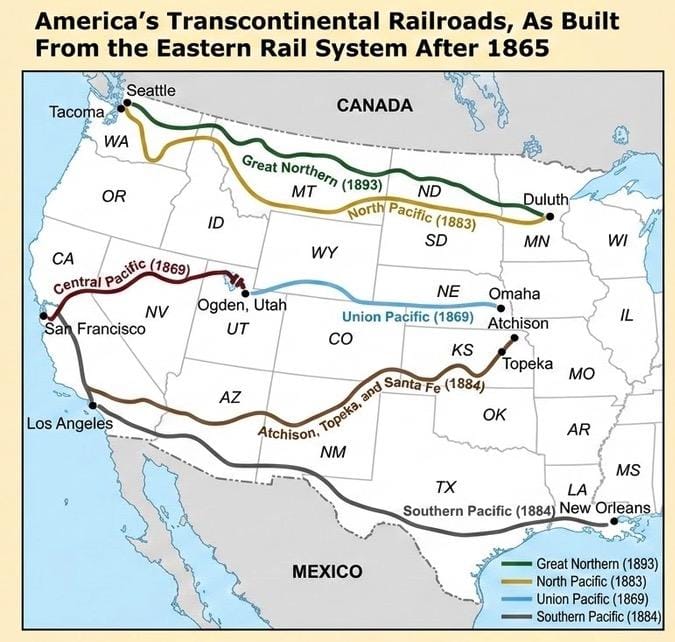
As the middle part of the map shows [Figure 2], there would be two railway companies: The first company, the Central Pacific, started in San Francisco–Sacramento, California, laying track and heading eastward; the second company, the Union Pacific, started in Council Bluffs, Iowa (near Omaha, Nebraska)—where Lincoln had met Dodge—laying track heading westward. The project started in 1863, and between 20,000 and 25,000 men worked on the arduous, and often engineering-challenging project. The track of the two railway companies met six years later at Promontory Point, Utah, on May 10, 1869, and the rail lines were joined, forming a 1,912-mile (3,077 km) rail line that was a marvel.
Consider a few of the explosive effects.
First, before the Pacific Railroad construction, a trip from Council Bluffs, Iowa, to Sacramento or San Francisco of a young man in good condition, with horses and supplies, took approximately 90 to 150 days, depending on the variables. The very first passenger train on the new transcontinental Pacific line took 4.25 days, a savings of time of 95 to 97%. Put another way, in terms of saving time, the railroad represented a growth in physical productivity of man’s transportation, of 3,500% at its uppermost level, which changes the space-time relationship between man and nature.
Second, counting the existing connecting railways from the East Coast to Council Bluffs, Iowa, the United States was now connected from coast to coast, realizing John Quincy Adams’s positive conception of continental expansion.
Third, now manufacturing and agricultural goods, including coal, metals, wheat, and corn, could cross the nation. In 1878, engineer Gustavus Swift and inventor Andrew Chase developed the first truly practical and widely used ice-cooled railcar. By the 1880s, the nation could transport fruits, vegetables, and cut-up meats in ice-cooled, insulated cars from California to Florida to Maine.
Fourth, as the map shows [Figure 2], there were five transcontinental railways, not one, covering the different latitudes of the United States, and there grew up connecting routes going north and south. The Northern Pacific, which is the northernmost one, and the Southern Pacific, which is the southernmost one, were both initiated by Lincoln. In total, he signed three of these [routes] into law.
Fifth, railroads are more than train routes; they form development corridors. Under railroad land grant acts, the U.S. government gave to the railroads strips of federal land extending outward 10 to 40 miles from both sides of the track, creating corridors up to 80 miles wide. The railroads, to gain operating capital and pay off their loans, sold this land to citizens, who bought it so that they could be near the railroad. The citizens built farms, communities, cities, schools, and new production facilities. The cities of Omaha, Nebraska; Minneapolis, Minnesota; Denver, Colorado; and Chicago, Illinois, all blossomed as a result of being in a railroad development corridor. This is city building, civilization building.
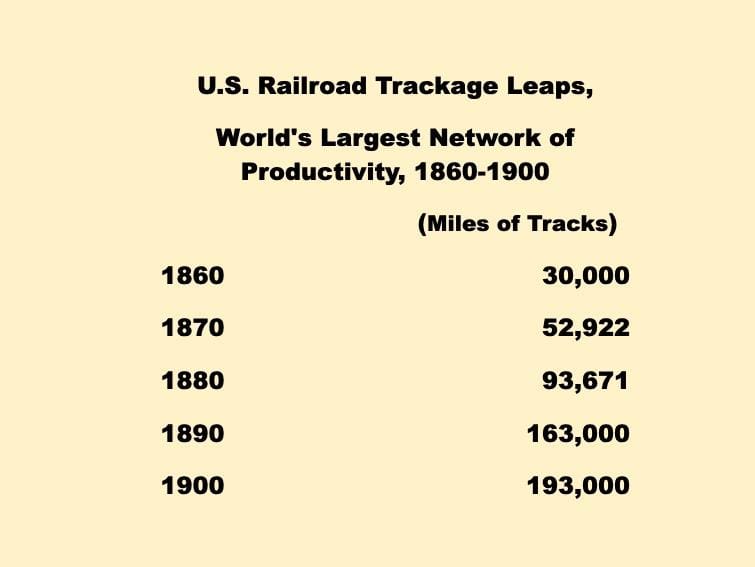
Sixth, look at [Figure 3]. The level of Class I railroad mileage in the United States rose from 30,000 miles in 1860 to 193,000 miles in 1900. That is a compounded annual growth rate of 13.4% for 40 years. If an economy grows by, say, 5 percent, for 7 or 8 years, that’s pretty good. Railroad track miles grew by a compounded 13.4% year after year for 40 straight years.
The U.S. government played the absolutely decisive dirigistic role in providing state-directed credit for the railroad building. While the private railroad companies raised funds, the U.S. government floated $64 million in bonds, a huge sum in those days, and then lent the bond money to the railroad companies to build the railways. They were thirty-year loans. The government also gave the railroads 130 million acres of U.S. land—that’s about 20,000 square miles—as a right of way for the railroad, and for the railroads to sell so that they could also have cash to pay their bills.
The railroads are the backbone of a shock-wave explosion, improving the productivity of every square mile of the United States, and of every citizen.
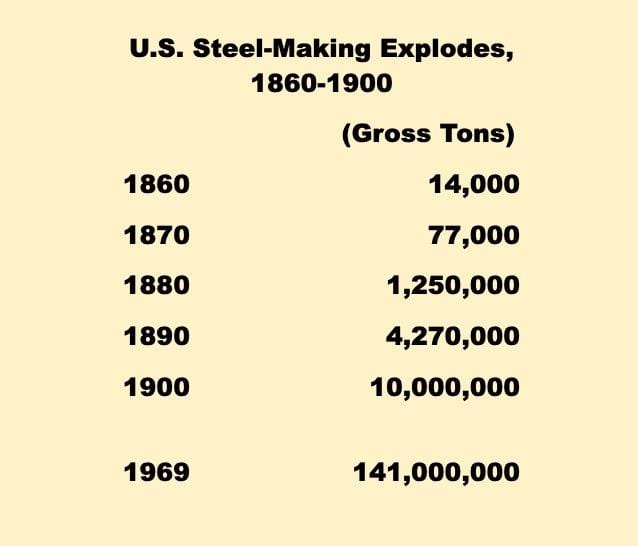
The railroads, as a science-driver, gave the impetus for the development of steel, and it was critical for building steel railroad tracks, steel bridges, and, by the 1890s, steel locomotives to handle far heavier loads and travel at higher speeds. Other elements of the U.S. economy also required greater volumes of steel. After U.S. engineer Alexander Lyman-Holley made critical technological improvements in the Bessemer steel process for the United States, steel production [Figure 4] grew by leaps and bounds, from 17 thousand tons produced in 1860, to 10 million tons in 1900 (and eventually to 141 million tons by 1969). In the last 40 years of the 19th Century, under the Lincoln economic miracle, the growth in steel-making capacity was 17.8% per year.
The steel spinoff helped produce another spinoff. Steel dramatically helped with the reaper and the harvester, which worked much better with steel than with using the more brittle iron. Comparing 1890, with the use of a steel reaper, to 1830, before there was a reaper, a single farmer could harvest seven times more bushels of wheat. Steel made farm implements more productive, farm implements made the economy more productive—an advance in one field led to an advance in another field. In 1860, the U.S. had 140,000 manufacturing factories, which tripled to 513,000 in 1900—which, by the way, is 100,000 more than we have today.
When the original work of André-Marie Ampère and Wilhelm Weber on the development of the science of electricity and electromagnetism resulted in the development of commercially deliverable electricity in the 1880s by Thomas Edison and George Westinghouse, another wave of the shock front took over. Lincoln did not invent electricity, but he did have a lot to do with the building of the railroads, as a foundation, and creating the directed environment of one invention leading to the creation of another.
LaRouche noted that the Lincoln economic miracle was exported as a model to the Meiji Restoration in Japan, to Otto von Bismarck in Germany, and to Dmitri Mendeleyev in Russia.
One cannot complete discussion of Lincoln without noting that the Emancipation Proclamation he issued on January 1, 1863, was deliberately understated but had a shocking effect. It stated:
Therefore I, Abraham Lincoln, President of the United States … by virtue of the power, and for the purpose aforesaid … do order and declare that all persons held as slaves within said designated States, and parts of States, are, and henceforward shall be free; and that the Executive government of the United States, including the military and naval authorities thereof, will recognize and maintain the freedom of said persons.
This ending of slavery and the economic miracle–shock wave, LaRouche stated, made the United States the most powerful industrial economy on Earth, and restored its moral power in fulfilling the principles of the Declaration of Independence. Today, we need to deliberately create a self-developing economic shock wave, and to elicit the poetical soul of Abraham Lincoln.