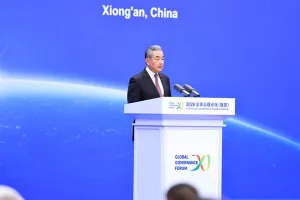
The first Global Governance Forum, entitled “Rebuilding Confidence and Cooperation: A Century of Change and Reforming and Improving Global Governance,” opened today in Xiong’an, China. Close to 400 representatives of political, strategic, academic, business, media, and youth circles, half from China, half from more than 90 other countries (the Global South, Europe, and the U.S included) are there to deliberate for three days on how to put together an international order based on mutual cooperation and development out of today’s chaos. The title of Chinese Foreign Minister Wang Yi’s keynote speech encapsulates its aim: “Pooling Wisdom and Efforts for Global Governance to Build Stability and Capacity in a Volatile and Changing World.”
A year ago, President Xi Jinping announced his Global Governance Initiative at the September 2025 “Shanghai Cooperation Organization Plus” meeting. The GGI offered principles upon which global governance—of international relations in all fields, economic, military, cultural, etc.—would have to be based for peace to be secured. The idea caught on, and over the course of the year, a Group of Friends of the Global Governance Initiative was founded at the United Nations, which over 60 nations have joined.
Now, the Xiong’an meeting has been organized “to build confidence in global governance cooperation,” forum organizers announced on Oct. 16. In addition to the opening ceremony, there will be a plenary session, 22 panel discussions/roundtables under five parallel sessions, and multiple side events, they reported.
Wang was blunt in his opening remarks: “Regarding the future of the global governance system, the world faces two stark choices: the one exalts strength, favors self-interest, monopolizes power, and practices double standards, while the other champions multilateralism, and upholds sovereign equality, mutual respect and international law.”
President Xi’s GGI offers “a crystallization of Chinese wisdom” for how to improve the current international system. “Humanity is woven together by intertwined interests and a shared future. We should unite as one, rise to the challenges, and take proactive, strong and persistent steps to make the GGI a full reality,” he urged. The goal is “to bring about a world where all countries coexist in harmony and all nations thrive in mutual appreciation.”
He specified that this requires fairness, justice, and mutual respect, with every nation having an equal right to participate in shaping these changes. “Every country, regardless of its size or strength, has the right to independently choose a social system and development path that suits its national conditions and meets the needs of its people,” he said—a principle that is asserted in the United States’ own Declaration of Independence, EIR reminds.
This also requires that the world “put development firmly at the center of the international agenda,” Wang insisted, announcing that China will campaign for “the right to development” to be recognized as a basic human right.
Can all this be done? “The rise of the Global South is the most momentous shift the world has seen since WWII,” he declared. Why? Because “it reinforces and expands the force for good on the international stage.” Ensuring the Global South has a greater say in international affairs will not only correct a historical injustice, he argued, “but provide a wealth of ideas for improving global governance.”