Xinhua News Agency on October 23 issued a paper outlining China’s position on strengthening outer space governance. The publication of this statement, which reiterates and strengthens China’s traditional position on the matter, could not have come at a more crucial time. The United States, which has traditionally maintained a policy that space exploration is one of the common aims of mankind, and had, in 1967, signed the Outer Space Treaty assuring that space would remain an area of cooperation rather than conflict, recently said that it had placed a weapon in space, a measure that was justified as necessary to protect the American continent. This was announced by US Air Force Secretary Troy Meink on September 14. While it was unclear what this weapon (or weapons) might consist of, the measure itself goes against the grain of the 1967 treaty.
The Chinese statement points to the danger of any change of policy in this respect. “The diversity of outer space actors and the prominent issues in daily supervision have led to a continuous rise in security risks,” the statement reads. “The risks of an arms race and the trend towards battlefieldization in outer space have become the greatest threats and challenges to outer space security. Strengthening global governance of outer space is an urgent issue facing humanity and a shared responsibility of all countries.”
While the number of “space-faring nations” is still limited, there is also a great interest among countries of the Global South, many of whom have no space launch capabilities, in utilizing space for their economic development. Any attempt by a single power to seek “hegemony” in space capabilities or to “weaponize” space would prevent any of these countries from developing their own space capabilities and put a damper on space exploration generally. The statement calls for a return to cooperation rather than cut-throat competition in the space arena. “Adhere to an action-oriented approach, translating the consensus on international space cooperation into practical actions by all countries to jointly promote space development.”
While space exploration began as a “space race” between the U.S. and the Soviet Union, it developed into the more fruitful cooperation in the joint US-Soviet Apollo-Soyuz project between these two “rivals.” This paradigm should also be brought to the fore in the present circumstances. While the US and Russia continue to work together in space in spite of continued political differences, cooperation with the Chinese space program ended with the foolish amendment by Representative Frank Wolf in 2011, which put a blanket restriction on any cooperation between NASA and China’s National Space Administration. While China remains open to cooperation in space with all countries, the United States does not, and the recent issuance of the restrictive Artemis Accords, preventing signer countries cooperating with the U.S. from cooperating with China has become more of a space “alliance” aimed against China.
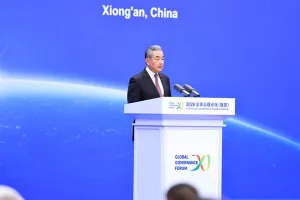
The statement notes that President Xi’s proposal for a Global Governance Initiative must also be focused on the “global governance” of space.