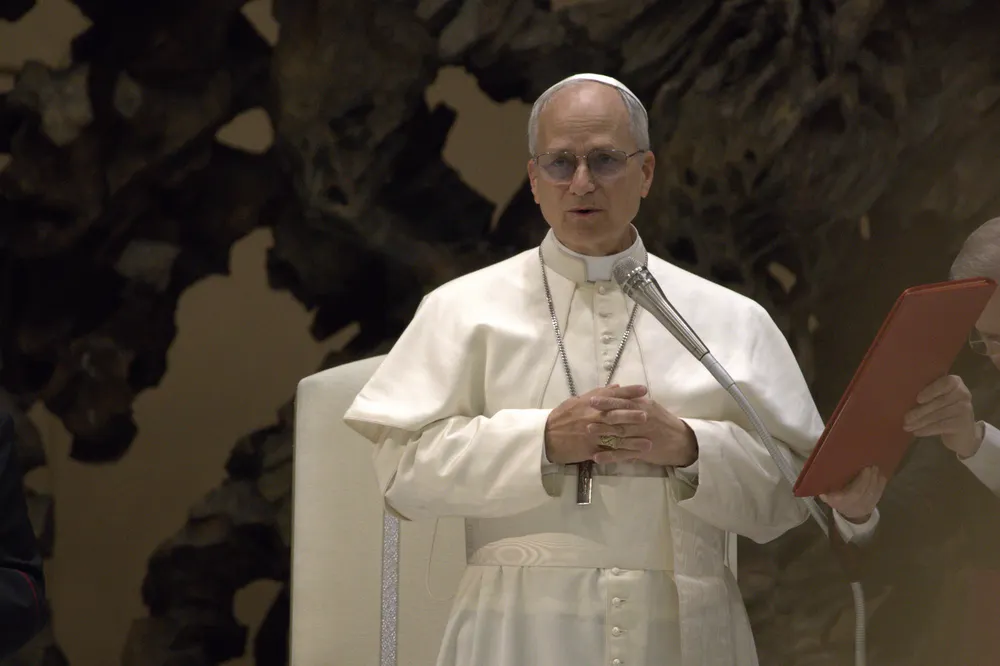
Lula da Silva was re-elected President of Brazil tonight, in the first of the three elections that will shape the strategic geometry of the APEC summit in Shenzhen, at which a trilateral meeting between Presidents Trump, Putin, and Xi is possible. In Xiong’an on Oct. 23, Wang Yi announced that China will campaign for the right to development to be recognized as a basic human right. In Harare the day before, President of Kenya William Ruto pointed to an example of that right in action, when he pointed out that the $16 billion refinery to be built at Lamu “will be almost wholly funded by African financial institutions.” In Assisi on Oct. 25, 80 religious leaders opened three days on “disarmed and disarming peace,” which Pope Leo will close Tuesday. And from Trump came the opposite outlook: “the Hormuz Strait is ours, and that’s the way we’ll keep it,” and “we could take the whole country.”
Is development a right of all people, or a permission granted by the strong? The answer depends on what a human being is.
Vladimir Vernadsky showed in 1935 that life is not found in the equations of physics. It is known by the sharp, impassable boundary it draws against inert matter, and by the fossils it leaves; over a hundred thousand years, nothing on Earth is more geologically powerful. Lyndon LaRouche, in his 2005 Vernadsky and Dirichlet’s Principle, took the method one step up, substituting “cognition” for “life” and “the cognitive migration of materials” for “the biogenic migration of atoms,” and found the same kind of thing:
“The difficulty we face in treating the subject of human creativity, as Vernadsky faced a similar problem of method in his defining the Biosphere, is that, just as the principle of life which is expressed by living processes, is not found within the province of biochemistry, the power which orders the creative powers of the individual human mind are not biological processes as such. In both instances, we are confronted by something which is universal, and physically efficient, but intangible to the senses.”
Universal, and physically efficient. An inventory of the Earth’s energy resources made in 1800 would have omitted uranium, not because it was hidden but because we had no understanding of the nuclear processes that are the source of its power. Petroleum was a nuisance before it was a fuel. Human beings create resources by discovering principles, and the fossils of that activity—the refinery, the reactor, the city—are how we know the power is there. That power is inherent in every people. That is what makes development a right rather than a favor: not that every nation should look alike, but that the same power is at work in all of them, and is everywhere the source of what is new. A refinery financed by Africans, a uranium mine in Tanzania moving to production, a “city of the future” in Hebei hosting 97 countries to talk about governance—these are examples of our species being human. “The Hormuz Strait is ours” is the opposite proposition: that the power belongs to whoever holds the chokepoint.
What is needed is the security and development architecture Helga Zepp-LaRouche has put before the International Peace Coalition every week for three years, which China now carries in its Global Governance Initiative, and which Assisi this week and the Russia-Africa summit opening Wednesday approach from their own directions.
By that standard, he wrote, the doctrines of “the cheapest price and highest rate of financial profit” that have governed the United States and Europe since Nixon “have not only failed, but have shown themselves the worst imaginable sort of threat to the future of the human species.”
What this means in practice is that development is not just one policy among others. It is the characteristic action of the human species, the fossil record we leave: an 1800s inventory of the Earth’s energy resources would have omitted uranium, not because it was hidden but because the category did not exist. Petroleum was a nuisance before it was a fuel. Just as the biosphere, through photosynthesis, created a new resource in the form of sunlight, human beings create resources by discovering principles, and a nation not acting that way is held below the human level. That is why the right is universal. It is not that every nation should look alike; it is that the same power is present in all of them, “universal, and physically efficient, but intangible to the senses,” and everywhere the source of what is new. A Bangladeshi who pays smugglers $10,000 to reach Italy, leaving a country whose life expectancy has risen 13 years since 2000, is not fleeing death. He is moving toward a place where that power has been at work to a greater extent. The remedy, to those who see such migration as a problem, is to achieve the same in Bangladesh.
The political form of this is the new security and development architecture that Helga Zepp-LaRouche has put before the IPC every week for three years, that China is now carrying into its Global Governance Initiative, and that the Pope’s Assisi gathering and the Russia-Africa summit opening Wednesday will each approach from their own side.
Humanity can choose to be human.