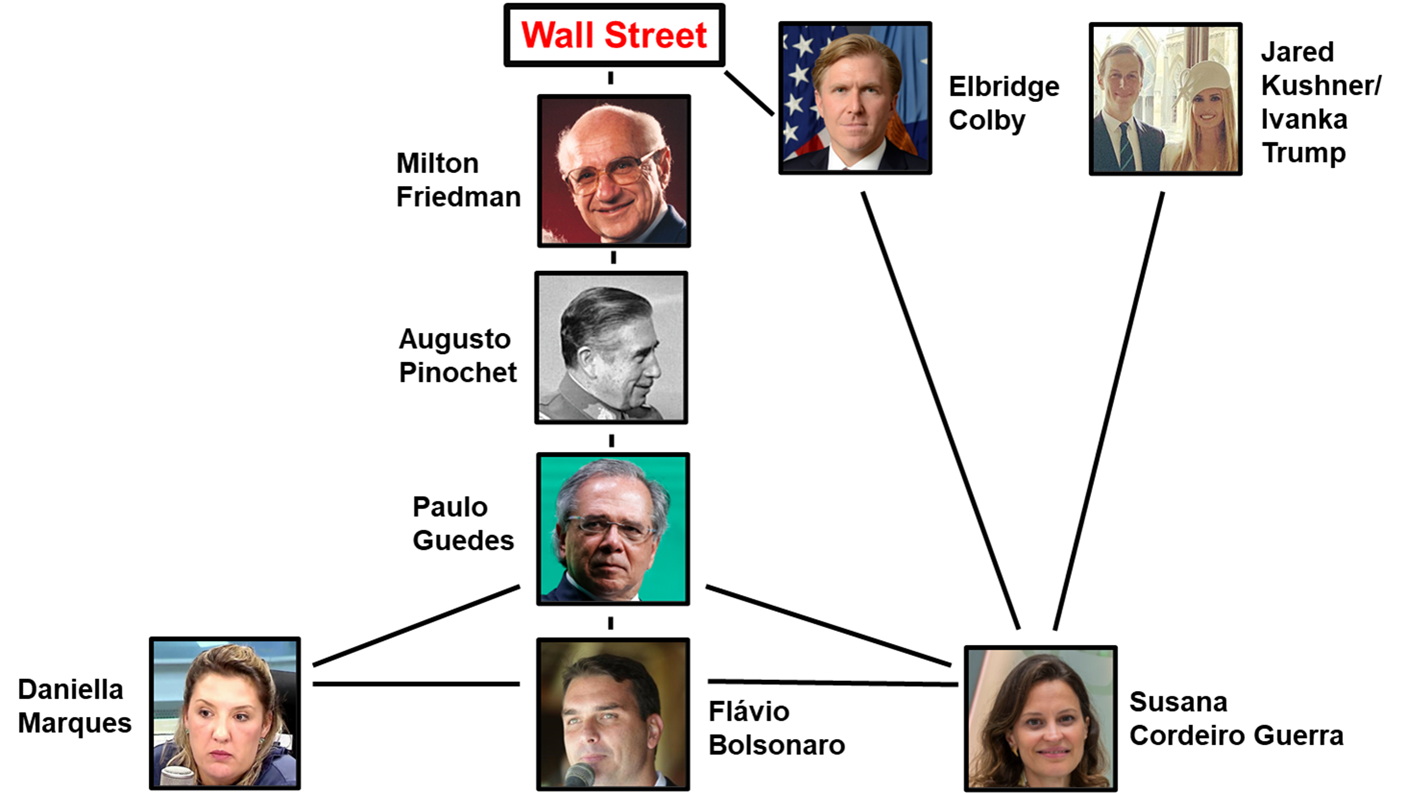
The following EIR editorial statement circulated widely in Brazil in the final 10 days before the Oct. 27 presidential elections. It was issued Oct. 21 on the occasion of the uproar caused by the economics representative of candidate Flávio Bolsonaro declaring the intention to end the Bolsa Família anti-poverty program, started in 2003, which provides baseline food and provisions for those in need. The EIR statement throws the spotlight internationally on the interconnections of the Bolsonaro campaign with the infamous Chicago School of austerity economics, and moreover, with the U.S. warfare utopians, in particular Under Secretary of Defense for Policy Elbridge Colby, promoter of U.S. strategic dominance and readiness to use nuclear weapons. Author Tim Rush last visited Brazil in August, with EIR Ibero-American Intelligence Director Dennis Small, who briefed the Oct. 23 International Peace Coalition on Brazil, using the chart reproduced below.
The positive, productive basis for Brazilian-U.S. relations was spelled out by U.S. independent candidate for President Diane Sare in a pre-election statement. Her statement is now circulating widely in Portuguese, especially among networks of Brazilian students who have been demonstrating for a better future. Excerpts are below.
Daniella Marques, Brazilian presidential candidate Flávio Bolsonaro’s economic policy coordinator, made waves in a radio interview Monday, Oct. 19, suggesting that a Flávio government would consider measures to curtail the functioning of Bolsa Família, a signature policy of incumbent President Luiz Inácio Lula da Silva, which has considerably cut poverty levels in Brazil since it was introduced in 2003.
Marques is a protégé of “Chicago Boy” Paulo Guedes, the Economics Minister throughout the term of Flávio’s father, Jair Bolsonaro, as President (2019-2023). Guedes appointed Marques to top posts coordinating major policy areas of the Ministry, culminating in naming her president of the Caixa Econômica Federal bank, one of the three largest Brazilian public banks, for eight months at the end of Bolsonaro’s term. “Chicago Boys” originated as a term for economists trained at the University of Chicago who designed and implemented Pinochet’s savage economic bloodletting in Chile after Pinochet’s military dictatorship took power in 1973. Guedes not only graduated with a PhD from the University of Chicago in 1979, studying directly under Chicago Boys guru Milton Friedman, but went to Chile to teach during the Pinochet dictatorship.
Susana Cordeiro Guerra—Mrs. Elbridge Colby
However, another of Guedes’s economic policy protégés has so far eluded scrutiny—and perhaps the incendiary float in the shape of a nuclear missile at the Flávio Bolsonaro rally on Avenida Paulista in São Paulo Sunday Oct. 18, with “Trump: Nuke Brazil” written on its side, should raise some troubling questions. She is Susana Cordeiro Guerra, currently World Bank vice president for Latin America and the Caribbean.
Born and raised in Brazil, trained in economics and social policy at elite U.S. universities, she rose to prominence as a leading member of Guedes’s team as the youngest-ever president of the Brazilian Institute of Geography and Statistics, Instituto Brasileiro de Geografia e Estatística (IBGE), serving from 2019 to 2021. She was close to Bolsonaro as well as Guedes.
Her parallel U.S. career has brought her simultaneously into the inner circle of the Trump family. She is particularly close to U.S. President Donald Trump’s daughter Ivanka, and Ivanka’s husband, Jared Kushner, becoming godmother to their daughter (as reported by Folha de São Paulo, July 17, 2025).
But her most important connection—and one that should particularly raise questions in the minds of patriotic Brazilians—is her marriage to Elbridge Colby, grandson of former CIA chief William Colby and currently the powerful U.S. Under Secretary of War for Policy. He is the Trump Administration’s most senior official publicly calling for integrating the use of “tactical” nuclear weapons into official U.S. strategic warfighting doctrine. And, he is widely reported to be the lead author of the Trump Administration’s notorious December 2025 National Security Strategy document, which revives Teddy Roosevelt’s imperial “Big Stick” doctrine of forcibly seizing Ibero-America’s assets for the benefit of Wall Street and the City of London, and expelling Chinese and Russian interests from the Western Hemisphere. For full details, see EIR’s Aug. 22, 2026, exclusive story, “U.S. Under Secretary of War Elbridge Colby’s Brazil Connection,” also posted on the EIR em Português website, “A Conexão do Subsecretário de Guerra dos EUA Elbridge Colby com o Brasil.”
Is the Trump Administration Crazy Enough To Drop a Nuclear Bomb?
Just this week, a chilling warning of how close Trump may be to adopting Colby’s prescription for nuclear war came from U.S. Army Col. (ret.) Douglas Macgregor, an informed, longtime strategic analyst who served in a top advisory capacity in the Pentagon at the end of 2020. His Oct. 18 post is titled “Is President Trump Considering the Nuclear Option? Why the Trump Administration Might Be Crazy Enough To Drop a Nuke on Iran.” The graphic just under the headline shows Trump and Colby with a nuclear mushroom cloud rising between them, and this quote from Colby: “[We should] be open to limited nuclear options proportionate to the limited U.S. stakes in regional crises.”
This escalating danger comes just as a real possibility of a tripartite meeting is emerging between President Trump, President Putin of Russia, and President Xi Jinping of China, at the Asia-Pacific Economic Cooperation (APEC) forum Nov. 18-19 in Shenzhen, China, to discuss strategic cooperation, including nuclear matters. Such a tripartite summit has been championed since August of 2025 by Helga-Zepp LaRouche, founder of the Schiller Institute, as a vital step away from nuclear war.
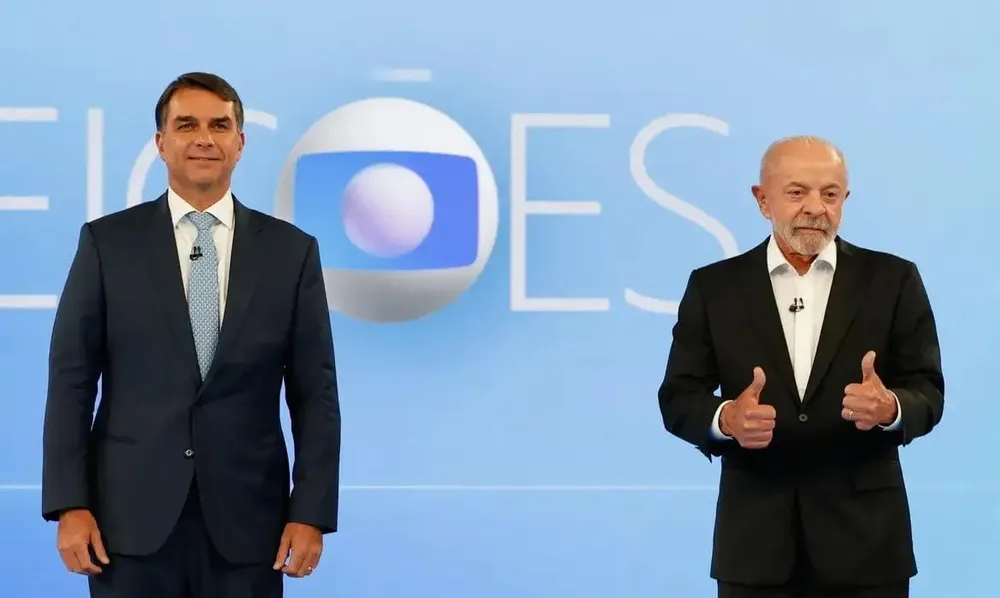
Brazil has an important role to play in this emerging new security and development architecture, and needs to be led by a statesman like Lula, rather than hit-man in the service of Pinochetista policies at home, and war policies abroad, Flávio Bolsonaro.
U.S. Presidential Candidate Diane Sare: Why Brazil’s Election Matters to Americans
by EIR Staff
Oct. 22—U.S. presidential candidate Diane Sare, in a statement released Oct. 22, writes: “Brazil holds its runoff election to determine its next President this Sunday, October 25. This election could determine the direction of humanity for decades or generations to come,” adding, “and most of your neighbors are not even aware of what is happening.” The statement is titled “Bibi Loves Bolsonaro—Why the Brazil Election Matters to Americans.”
Sare, a historian in her own right, identifies the intention of the Founding Fathers of the United States to end colonialism, especially that imposed on its southern neighbors, as an international mission. “Two American presidents, Garfield and McKinley, were assassinated in part because of their commitment to liberate all of the Americas from colonialism, and our southern neighbor Brazil is an important partner in that mission,” Sare asserts.
The two candidates in the runoff election are current President Luiz Inácio Lula da Silva and “Epstein Class–backed Flávio Bolsonaro,” Bolsonaro being the son of previous President Jair Bolsonaro, who is currently under house arrest for attempting a military coup to overturn the 2022 election. Sare points out that the first phone call Flávio Bolsonaro received after the initial results on Oct. 4 was from Israeli Prime Minister Benjamin Netanyahu.
“Speaking as an American presidential candidate,” Sare says, “the re-election of President Lula da Silva is the necessary outcome for the future peaceful development of the United States and the Americas. President Lula da Silva was one of the founding members of the Brazil, Russia, India, China partnership (later BRICS) during his earlier Presidency in 2006 and 2009, so it is clear that he is dedicated to the principle that nations with very different histories can collaborate for the mutual benefit of mankind, without sacrificing their sovereignty. Brazil, under the leadership of Lula da Silva, would be a natural partner of a United States in seeking to resolve conflicts and working together toward projects of mutual benefit for the human race.”
If Brazil were to elect Flávio Bolsonaro, this potential for economic collaboration with the U.S. would be destroyed, Sare elaborates, along with the potential to develop Ibero-America. “I stand with the young people of Brazil,” Sare says, looking to the millions of youth who have poured into the streets to support President Lula and awaken the people of Brazil.
Sare concludes by referencing her long-time mentor, Lyndon LaRouche, who was made an honorary citizen of São Paulo, Brazil, in 2002. “I am certain that he would agree with my position on this important matter.”
“It was never the intention of George Washington, Benjamin Franklin, Alexander Hamilton, or John Quincy Adams that the United States would become a global hegemon. Our mission as a republic is to demonstrate through the goodness of our deeds, and the happiness and prosperity of our people, the wisdom of a government founded on the principle of ‘the consent of the governed.’ How are we doing in that regard?”