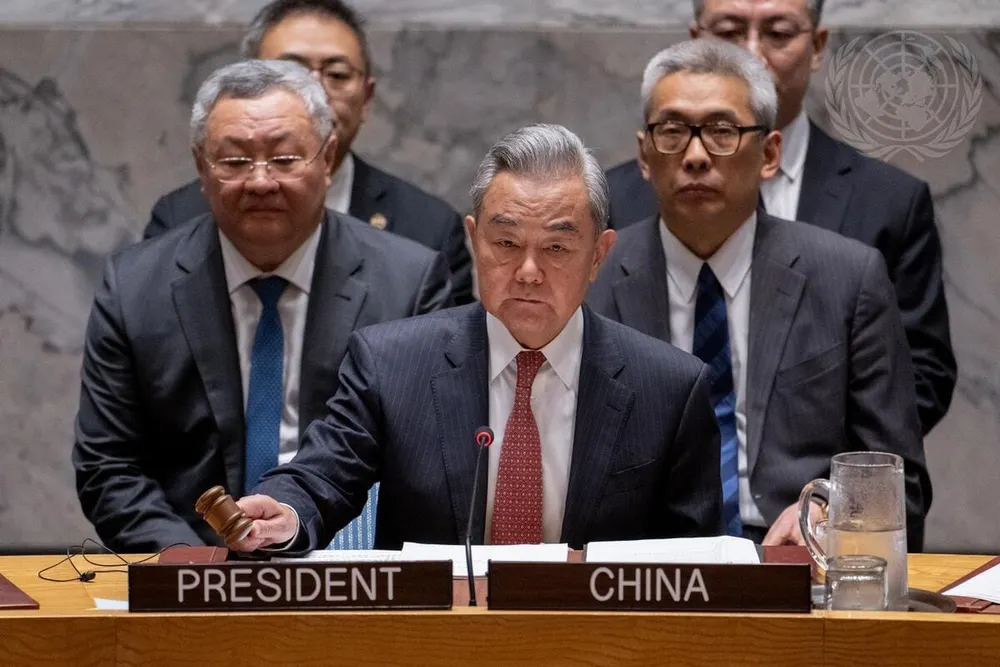
Chinese Foreign Minister Wang Yi met on Oct. 23 with UN High Commissioner for Refugees (UNHCR) Barham Salih, who is in China for the 2026 Global Governance Forum (Xiongan). Xinhua reported that Wang stated that President Xi Jinping’s Global Governance Initiative (GGI) is a useful guide for how to approach the growing global problem of refugees, specifically that “China believes that peace is of primary importance for ending the refugee crisis,” and that “development is the foundation for improving the conditions of refugees.” Only such an approach can create “conditions for addressing the refugee issue at its root.”
Wang’s emphasis on economic development as the key to keeping refugees at home is very similar to Pope Leo XIV’s insistence that the solution to the migrant problem is not only to treat all individuals with human dignity, but to provide economic development at home so that they are not driven to migrate to foreign countries.
Refugees, according to the UNHCR definition, “are persons fleeing armed conflict or persecution…. They are so recognized precisely because it is too dangerous for them to return home, and they need sanctuary elsewhere.” In that sense, their decision to leave is not voluntary.
Migrants, on the other hand, have historically been defined as individuals who choose to move to another country for economic reasons, but who can safely return home if they so decide. But it is increasingly recognized that this is a distinction without a difference. Economic migrants are in fact fleeing for their lives, because the IMF and the international banks have imposed genocidal levels of looting and austerity on their countries, making their survival and that of their families impossible.
So Wang Yi and Pope Leo are in fact addressing closely related problems with the same approach: Development is the new name for peace.


