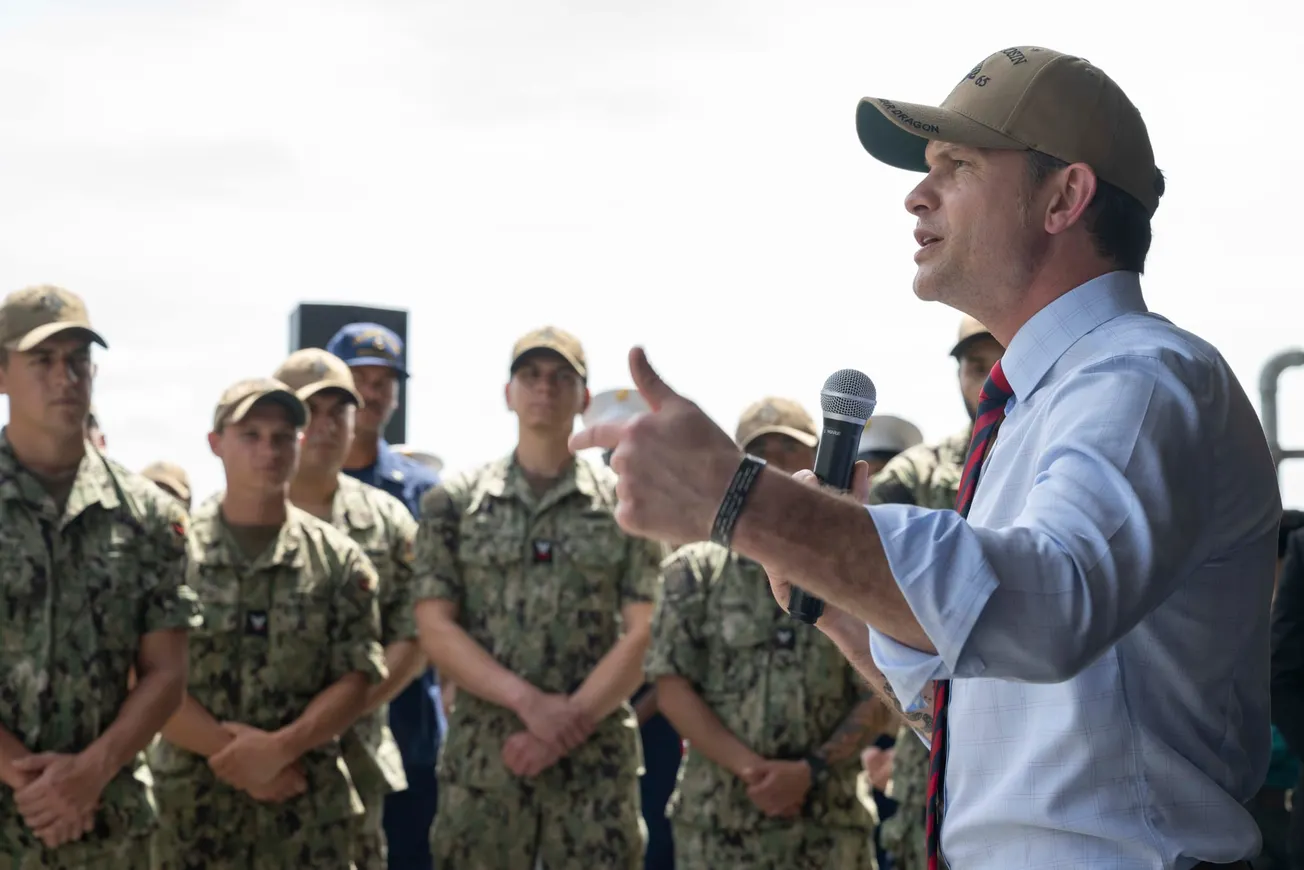

Elbridge Colby, Undersecretary of War for Policy and a rabid China-Hawk, is touring Southeast Asia, after a raving, triumphalist kick-off speech in Manila Aug. 10. Leaving the Philippines, he is off to Thailand, Indonesia, Singapore and Cambodia. Politico last week reported that Colby was “obsessed” with trying to get an invitation to China, but China has refused.
Speaking at the Stratbase Institute in Manila, Colby gave a long, detailed speech on what he referred to as the new “denial defense” of the United States in Asia, clearly describing a new alliance of nations under U.S. direction for the stated purpose of preventing a “hegemon” in Asia, without naming China, nor Russia. He stressed that the red line for defense is the “First Island Chain,” meaning Taiwan. Colby’s Manila remarks essentially confirm how the United States is moving to install NATO in the Pacific, under various guises, which is what Russian President Vladimir Putin warned of in his speech on a missile cruiser of the Russian Pacific Fleet, on the same day as Colby was in Manila.
Colby’s speech draws on the National Security Strategy (NSS), though without reference to his own role in drafting it. He makes reference repeatedly to America’s former “Big Stick” policy, and proudly declares that it now is back: “Our legacy foreign policy of the post-Cold War period was fundamentally out of date and ill-advised. President Trump has reversed that failed course. Under Secretary Hegseth’s leadership at the Pentagon, we are carrying out the President’s agenda to restore American strength, put Americans’ concrete interests first, and do so in a way that updates our relationships around the world and puts them on a much sounder footing.”
A few selections from his presentation illustrate his triumphalist stance:
• America’s interests are more engaged than ever in the Indo-Pacific, and that we at the Department of War are concentrated on ensuring those interests are stoutly defended. This means a strong and growing U.S. investment in the region. But it is also coupled with a newfound but common sense expectation of much greater effort and contribution by our allies and partners.
• In Europe, we talk about this as NATO 3.0—a rejection of the fanciful era of post-Cold War talking shop NATO and a return to the tradition of the hard-nosed Atlantic Alliance of the Cold War period, focused on the core business of military strength and readiness. In the Western Hemisphere, meanwhile, we see the Trump Corollary as a return to the best tradition of the Monroe Doctrine—of a policy designed to empower and enable the countries of Latin America to deal with the serious challenges we together face in the Western Hemisphere.
• Countries in the region know that we are not embarking on some novel approach of retrenchment. That is the cheap talk of the cognoscenti. Instead, countries here in Asia understand that America is returning to a traditional, time-tested strategy of flexible realism: clarity about our priorities, seriousness about deterrence, and an understanding of the value of both forcefulness and diplomacy.