From Forest to Steppe – The Russian Art of Building in Wood
by William Craft Brumfield
Duke University Press, Durham and London, 2025
Hardcover, 440 pages
$50.00
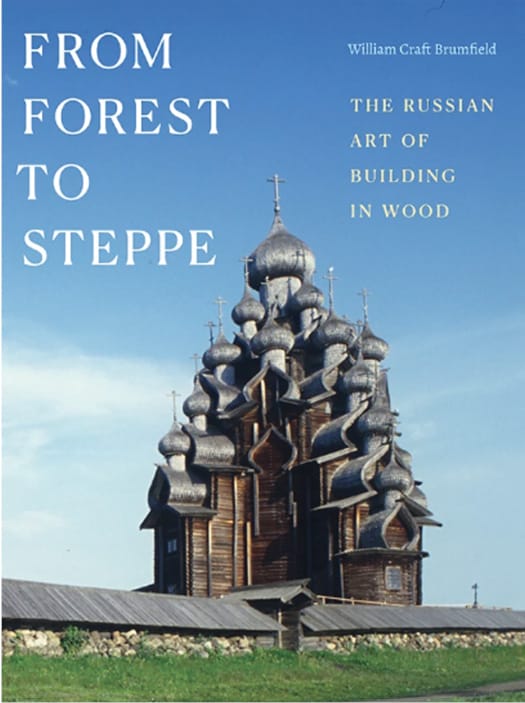
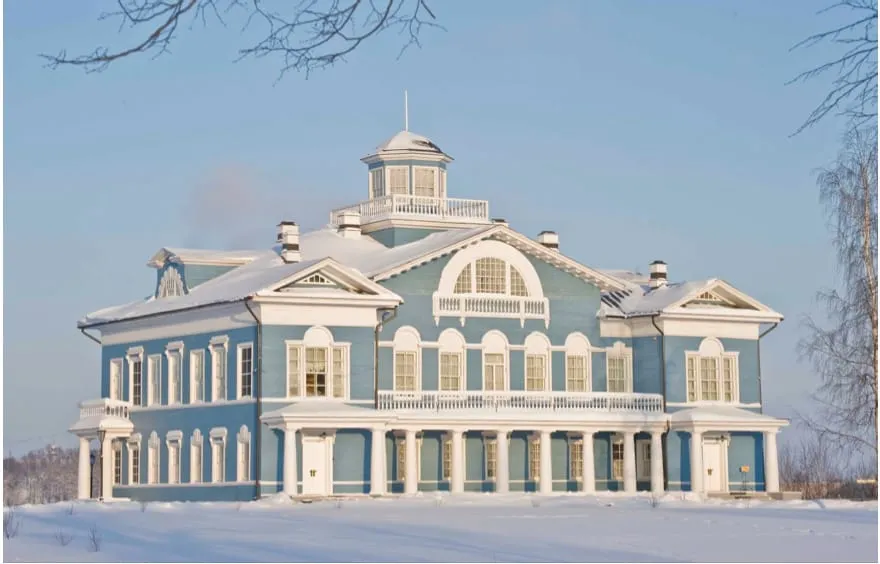
Jan. 23—In America, mention of the archetypical log structure, the log cabin, carries with it a host of associations from our history, from Native American structures to early colonial and pioneer days, Abraham Lincoln, and so on. For us, and for many, William Brumfield’s latest volume holds astonishing surprises. Comprising both engaging narrative and a rich, handsomely produced trove of his photographs made over the course of five decades, From Forest to Steppe takes us from one end of Russia to the other, from south to north, not only showing us structures ranging from simple country huts to palaces (yes, palaces!), but provides an unusual view into the cultural, economic, and historical environment in which they were created. Prof. Brumfield’s meticulous documentation provides a wealth of information about places few will ever visit, down to the date of each photograph. Superfluous? Not when you discover how many no longer exist to be seen. More than a few remarkable buildings were subsequently lost to a lightning strike or other fire, collapse, or destruction, sometimes just weeks after the shutter was clicked.
How Could Palaces Be Built of Logs?
In the 1700s, wealthy, cosmopolitan Russians had kingly estates built in the styles they had witnessed in European capitals. Building in brick came late to Russia, from European master craftsmen, but even so was an expensive proposition for the country’s poor economy. St Petersburg’s urban development being exceptional. Wood, however, was plentiful and available, and a long tradition of building in wood—which, in Russia, Brumfield underlines, means logs—had developed. As the photographs show, the peasantry harbored no dearth of highly skilled and imaginative craftsmen.
“If the house wasn’t built of brick, it could resemble one,” he writes in the introduction. Devices including simply covering the logs with planking, or using lathing to hold stucco, transform the appearance of the structure. As for interiors, all means of techniques might be used, at least by the wealthy who could hire master craftsmen, to mimic the appearance of rich marble and other materials. Rooms with towering classical columns and ornate mantles hide extensive use of papier mâché and plaster.
In more traditional structures, including churches, public buildings, and fine rural houses and barns, the beauty created by the artful shaping and carving of wood, from shingles to ornate window casings and other ornamental detailing, shows endless ingenuity and playfulness, combined with a remarkable comprehension of the structural requirements of longevity. Many of the buildings shown, albeit maintained and restored, were built well over two centuries ago.
Photography Worth Studying
This is not a coffee table book; the seriousness of its scholarship surpasses any such label. Nonetheless, the photography (and most pages have at least one photograph) stands out. While not every photograph shows a handsome structure or could be taken under ideal circumstances, each is professionally considered, often poetically timed and composed with respect to timing of the lighting, atmospheric conditions, and other elements. Some images are stunning. This is especially notable, due to the irony that Prof. Brumfield never intended to be a photographer at all; it just fell into place early on in his career. This particular set of photographs (this is just one of the author’s forty books on Russia) dates back as early as 1970; a digital camera did not take the place of film for him until 2006.
Many of the author’s excursions to remote locations and harsh environments in his tireless pursuit of buildings undiscovered and learned of only by happenstance, required no little endurance and patience. Not only getting there at all, but conditions for his own well being on the way and for his camera and film (and later digital capture) were necessarily taxing. Although he doesn’t mention this, cold, dry weather can quickly cause battery failure (for a light meter), a frozen shutter, sparks of static electricity on the image from winding the film just a bit too fast, or even film snapping mid-roll. Siberia’s permafrost is famous for a reason.
Dedication To ‘Document Creativity’
What inspired this American to get going, and keep going in his remarkable mission of documenting history in Russia, especially building in wood in Eurasia? Dr. Brumfield touched on aspects of this question in an amiable book presentation he made in December 2025 in Washington D.C., hosted by the Embassy of the Russian Federation. He described points in his life that drew him in that direction, even when he had no predilection, nor even Russian ancestors. But as a youth, born in 1948 in North Carolina, he had read Tolstoy, he had read Dostoevsky, finding them engaging.
His first trip to Leningrad came in 1970, followed by a trip to Uzbekistan. He was “prepared” for great interest in these places, he related, because by then he was at Tulane University in New Orleans, Louisiana, whose ornate architecture was an environment providing “a creative experience” for him. As he came to be a professor of Slavic literature, history, and culture, and fluent in Russian, he found that the “camera was the unexpected instrument” of his work. He likened this to how art historians approach works of art: “You have to see it … you have to show it.”
In short, Dr. Brumfield said that photography allowed him to document “generations of creativity” in Russian history. While for him personally, “Russia and Russian culture helped me understand who I am. Russian culture gave me this gift, and I am returning it to the world.”
Russian Ambassador to the United States Alexander Darchiev welcomed Prof. Brumfield at the embassy event, pointing out that he had been awarded the Dmitry Likhachev Prize in 2014 for his scholarly contributions, and awarded the Russian state Order of Friendship medal in 2019, the highest decoration given by Russia to foreign nationals. Darchiev praised the dedication shown by Prof. Brumfield as a contribution to restoring productive relations between Russia and the United States.
As this is written, Prof. Brumfield is engaged with his Tulane University students in cataloguing in full detail his unique archive of 100,000 photographs. His dedication to his life’s mission, as finely represented in this book, is a gift to historians and researchers the world over.