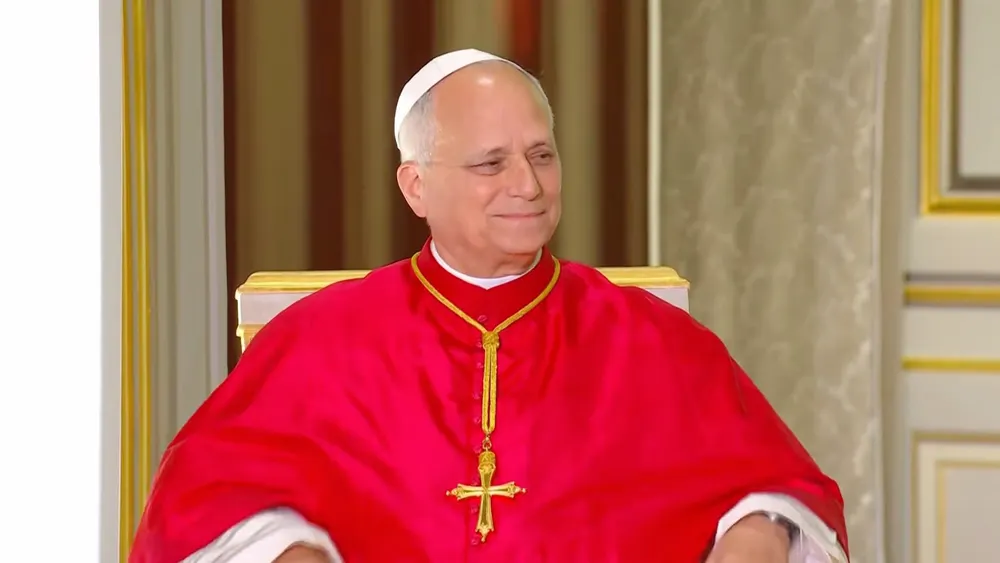
In a continuation of the ideas expressed within his encyclical, Magnifica Humanitas, Pope Leo XIV addressed participants in a meeting on “The Art of Possibility: Weaving Together,” promoted by the Dicastery for Culture and Education in Vatican City, on Friday, Oct. 2, reported Vatican News.
He said that art can become “a form of cultural and spiritual regeneration” when it “resists homogenization, slows the gaze, and compels us to pause before that which refuses to be consumed.”
He invoked the famous quote of St. Augustine from his Confessions, “You have made us for yourself, O Lord, and our hearts are restless until they rest in You;” “restlessness” in this context refers to the universal human desire to be filled and fulfilled in its search for Truth. He said that “art, when authentic, is animated by this restlessness…for the Church, art is never ‘a mere accessory,’ but instead ‘a fundamental place of listening—a space where one allows oneself to be instructed about humanity’s aspirations and wounds, its thirst for beauty, justice, and peace, and its search for meaning.”
In this era of search engines and the capacity for AI to generate nearly perfect images, His Holiness noted that “it has become urgent to distinguish human art from what is produced by machines” and pointed out that there is an ontological difference between human art, and images recreated by AI.
Pope Leo concluded his address by assuring artists and curators “that the Church regards you with esteem, gratitude, and hope; that it needs you and wishes to walk alongside you, so that together we may safeguard the ‘magnificent humanity’ entrusted to us.”
Subjectively, one can see for oneself how well AI stands up to recreating famous paintings in this video. At 1:42, the comparison of the two renditions of the Mona Lisa is striking; even a non-expert can see that in the AI-generated image (on the right), the eyes are ‘dead’ and expressionless.

