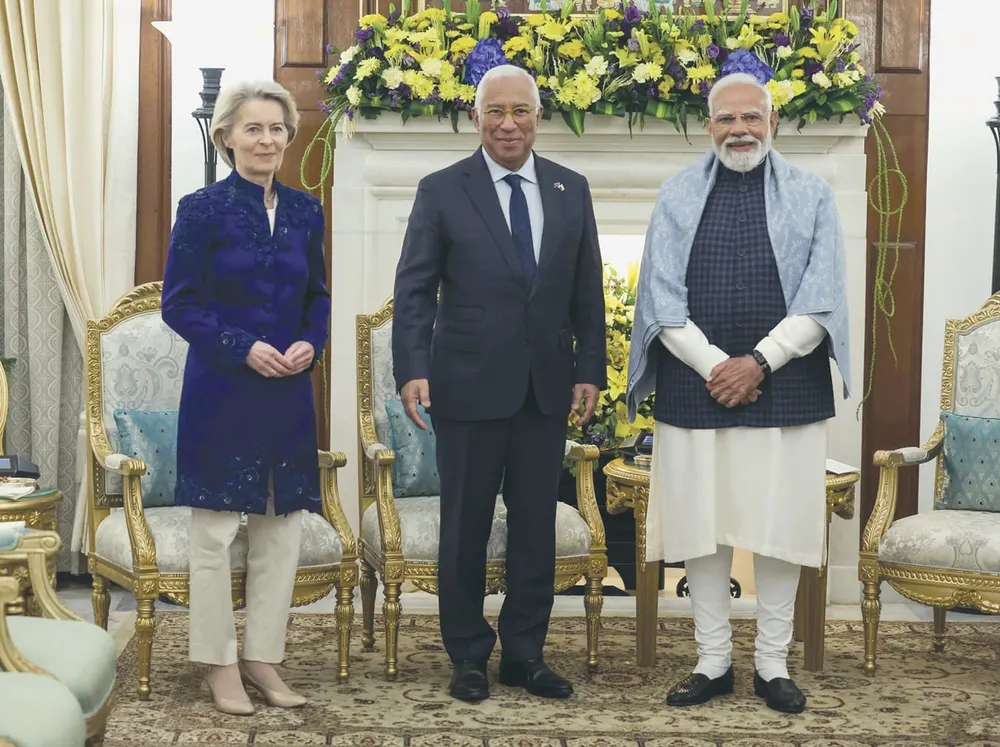
Feb. 5—On Jan. 27, EU Commission President Ursula von der Leyen and Indian Prime Minister Narendra Modi signed a free trade agreement in New Delhi. On the European side, the motive, after 20 years of negotiations, is to provide the ailing EU car producers with options for doubling their exports by 2032 and to increase the sales of weapons systems. While India has shown an interest in diversifying weapons imports beyond the traditional agreements with Russia, the EU’s intent to drive a geopolitical wedge between Moscow and Delhi will not fly, all the more so as the economic cooperation between India and Russia has increased in the framework of the BRICS.
The benefits forecast for EU automakers will be limited, as even the planned doubling of exports, from 4% to 8%, is far from sufficient to revive the sector. Nevertheless, India will reduce its tariffs to 10% on vehicles priced above €17,739, and set an annual import limit of 200,000 on combustion-engine automobiles.
In addition to military deals, new opportunities in the civilian economic sector will also be opened as India reduces tariffs on imports of machinery and chemicals. However, the EU input into India’s industrial sector over two years would only be in the range of some €500 million, and the measures imposing a reduction of greenhouse gas emissions are likely to burden any industrial modernization initiative.
What is required is very different, namely, large-scale infrastructure cooperation such as the joint venture between Germany’s Siemens corporation and Indian producers to build 1,200 locomotives, amounting to an investment volume of several billion dollars. This also shows the advantage of direct bilateral cooperation over the bloc-based orientation of the EU.
The agreement still has to be approved by each member nation of the EU, as well as by the European Parliament, which could take many months. All in all, trade relations will remain within the old paradigm of the European free market orientation. Although some aspects may turn out to be useful, the EU-India agreement does not signify a shift to promoting mutually beneficial cooperation between the West and the developing Global South. While European leaders, abandoned by the United States, are undoubtedly looking for new partnerships, they have not given up on their visceral hostility toward Russia and their opposition to China, both of which are major actors in the Global South.