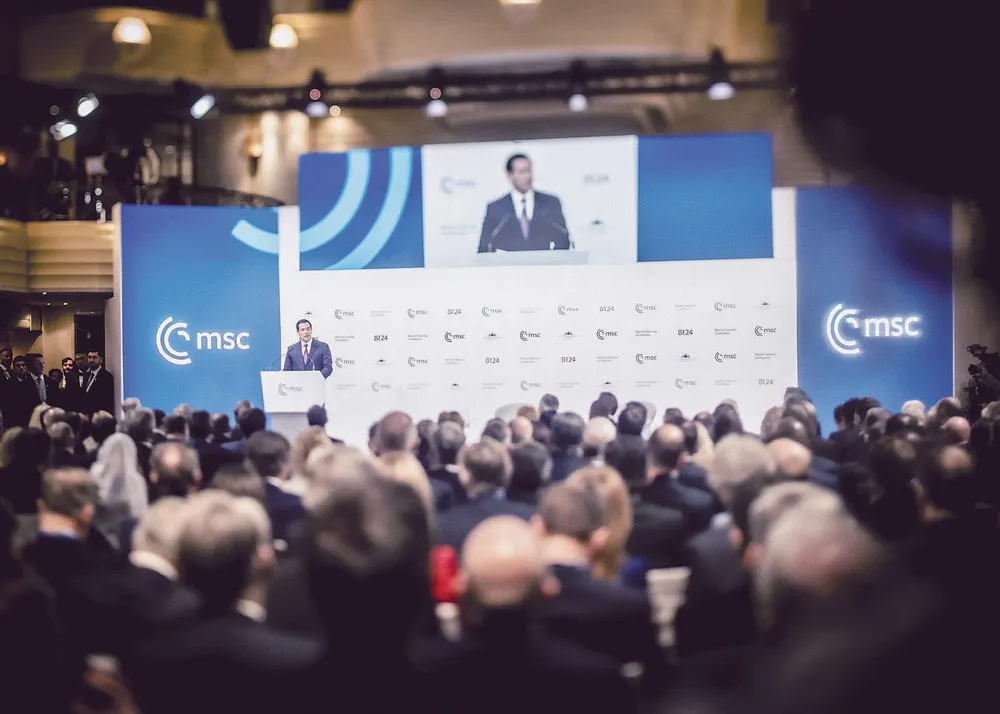
Feb. 19—The Munich Security Conference of February 13-15 did not provoke the same éclat as last year’s uproar over the sharp criticism of Europe delivered by U.S. Vice President JD Vance, but it did confirm that neither European leaders nor U.S. President Donald Trump’s administration are ready to accept the profound shift away from the West by the majority of the planet, in favor of a more just world order. Instead, there is a push to reassert “power politics” and an unabashed policy of “might makes right.” For the Trump administration, that means first and foremost asserting a quasi-total control over the “Western Hemisphere,” while European leaders rush into rearmament and a war economy.
Perhaps most telling of the problem is that, while the various leaders were praising their own “values” and “superior system,” not a word was said of the Jeffrey Epstein affair and of the moral depravity and financial greed which permeate the rotten system and its so-called elites.
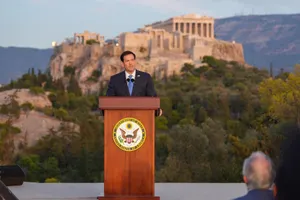
U.S. Secretary of State Marco Rubio delivered a culturally confused landmark address that, while posing as a defense of Western civilization, including references to the greatest Western minds such as Beethoven, Shakespeare, and da Vinci, was really a call for the continued domination of the dying, decaying system of European colonialism:
For five centuries, before the end of the Second World War, the West had been expanding—its missionaries, its pilgrims, its soldiers, its explorers pouring out from its shores to cross oceans, settle new continents, build vast empires extending out across the globe. But in 1945, for the first time since the age of Columbus, it was contracting. Europe was in ruins. Half of it lived behind an Iron Curtain and the rest looked like it would soon follow. The great Western empires had entered into terminal decline, accelerated by godless communist revolutions and by anti-colonial uprisings that would transform the world and drape the red hammer and sickle across vast swaths of the map in the years to come.
Reversing this trend is what President Trump intends to do today, Rubio proclaimed, and “we want to do it together with you [Europe].” He further admitted that brute force will be the method of choice for re-establishing such a “Western empire,” noting that “in a perfect world,” we would use diplomacy and international law. “But we do not live in a perfect world, and we cannot continue to allow those who blatantly and openly threaten our citizens and endanger our global stability to shield themselves behind abstractions of international law which they themselves routinely violate.”
While Rubio held out the promise that the United States and Europe could once again rule the world together, that could happen only under certain conditions. He implicitly called on European countries to adopt their own version of the MAGA policy for Europe. Thus, he rightfully criticized the Europeans for their policies of deindustrialization, of a climate-change agenda that has led to exorbitant energy prices, and of the loss of sovereignty. However, at the same time, he suggested that they should give up the “welfare state,” stop “mass migration,” and impose tariffs on the rest of the world. Although he did not say so explicitly, Rubio’s speech suggested that those European governments that don’t go along could be subjected to “regime change” operations run by Washington.
European Leaders on Auto-Pilot for War
Between the dramatic assaults against sovereignty and the international order by the Trump administration on the one hand, and the mindless drive toward war with Russia on the other, European leaders were left in a conundrum of their own making. They each conveyed that European countries must keep pushing their vast and costly rearmament program, under the pretext of becoming able one day to wage war against Russia, while at the same time becoming more independent from the United States.
British Prime Minister Keir Starmer gave a wildly militaristic speech against Russia, raving that we must be able to deter aggression and, if necessary, to wage war. We must “do whatever it takes to protect our people, our values, and our way of life,” Starmer said, ironically daring to mention “our way of life” just as the scandal around the Epstein files erupts. “The road ahead is straight and it is clear,” Starmer proclaimed. “We must build our hard power, because that is the currency of the age…. We must be able to deter aggression, and, yes, if necessary, we must be ready to fight.”
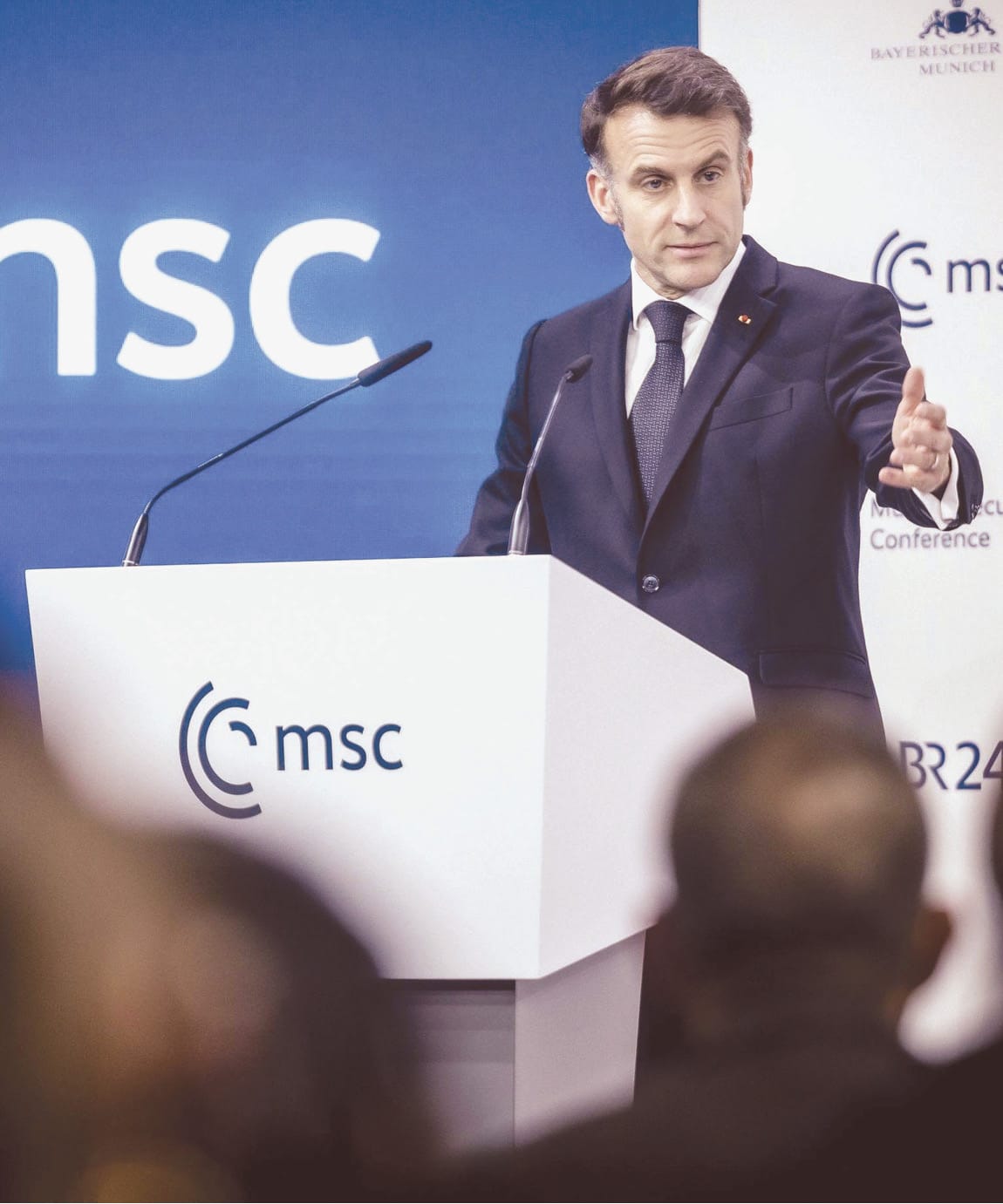
French President Emmanuel Macron criticized what he characterized as defeatist speeches about Ukraine, arguing that Russia is actually weakened by the war. He claimed that Russia is now in a recession, it is “completely dependent on China,” and is facing “military failure.” Therefore, Europe must show “audacity,” and must be “clear” on its support of Ukraine. Macron also called for “de-risking” from the United States, and for Europe to take more actions that will cause it to be “respected.”
As for German Chancellor Friedrich Merz, he also pounded the war drums against Russia, saying that defending Europe’s freedom will require everyone to “make sacrifices.” Merz claimed that the war could only come to an end when Russia is “economically and militarily exhausted,” and that in order to make that happen, Europe will invest hundreds of billions of euros in rearmament. The Chancellor also said there is a rift between Europe and the United States, and that the rules-based order “no longer exists.”
Talk of Nuclear Arms Spreading in Europe
One other notable subject that reared its head in Munich was that of expanding Europe’s nuclear weapons capabilities in light of the United States’s stepping back from the region. A major facet of this discussion is the potential agreement to extend the UK’s and France’s existing capabilities to other countries, in a similar way as the U.S. nuclear umbrella has been extended over NATO members for decades. Both Macron and Merz acknowledged that such a discussion is now underway, though no official results have been released publicly. During his speech in Munich, Macron said that France and Germany are discussing “how we can articulate our national doctrine with special cooperation, common exercises, and common security interest, this is what we’re doing for the first time in history.” Merz has similarly confirmed that such discussions are ongoing, telling an interviewer from Machtwechsel on Feb. 18, “Times have changed now, and I would like us to at least discuss the offer from the French.”
Several other European countries are reportedly part of this discussion as well, including Estonia, Latvia, Sweden, Finland, Norway, and the Netherlands. “Nuclear deterrence is a prominent subject” at this year’s conference, Latvia’s Foreign Minister Baiba Braže said in a post on X. She highlighted the occurrence of a closed-door meeting on the subject on the sidelines in Munich that included many European governments and NATO’s Assistant Secretary General for Political Affairs and Security Policy, Boris Ruge.
In Poland, however, President Karol Nawrocki thinks his country should start developing nuclear weapons of its own. “I’m a great supporter of Poland joining the nuclear project,” he said in a Feb. 15 interview. Nawrocki was asked by the interviewer whether he was referring to a nuclear sharing program as is being discussed between Germany and France, and he insisted that he was talking about a “Polish project … a Polish nuclear potential.”