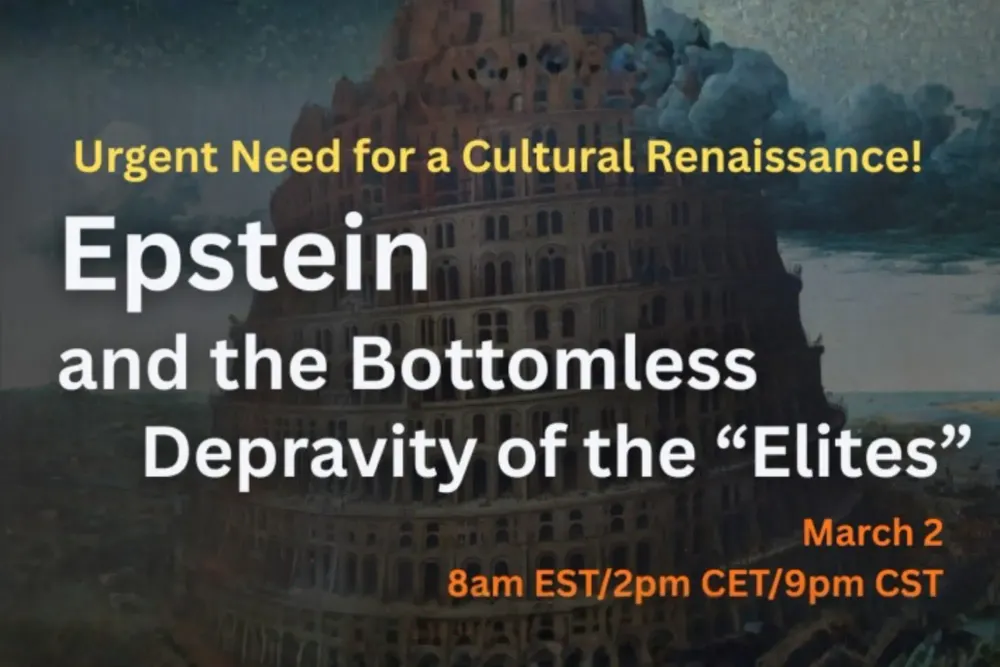
March 6—On March 2, EIR held an emergency roundtable seminar on the urgent need for an entirely new system for the world, titled, “Epstein and the Bottomless Depravity of the ‘Elites’—Urgent Need for a Cultural Renaissance!” The recent launching of a full-scale war by the United States and Israel against Iran served as the immediate subject of discussion for the event, underscoring the title of the first panel: “On the Road to Armageddon?” However, the release of millions of documents related to Jeffrey Epstein over the recent weeks and months provided the backdrop for discussion on the even darker and more deranged situation which currently grips the planet.
“We are meeting here at what very likely is the gravest moment in world history so far. It is more likely than not that World War III has already begun.” With that solemn warning, Schiller Institute founder Helga Zepp-LaRouche opened the event. The unprovoked attack on the Islamic Republic of Iran, she explained, has taken the world into a spiral of escalation which could lead within a short period of time to a global nuclear war. “It is therefore most urgent that all citizens of goodwill mobilize to call on their governments and parliaments in every country on the planet to immediately cease all military actions and return to diplomacy.”
However, the participants also addressed the cultural depravity represented by the newly uncovered “Epstein class,” whose members invariably are also tied to many of the ugliest policy decisions of the recent decades. As Dr. Kwame Amuah said at the event, “the descent of true leadership, the descent of spirituality, the descent of decency, the descent of diplomacy, and the descent of brotherhood is what is putting the world on edge now.”
The seminar included the participation of leading individuals from around the world, truly representing a “movement of world citizens,” as this event’s precursor, EIR, had called for.
Below you will find all the speeches from the participants of Panel One, as delivered. Next week, EIR will publish the remarks from Panel Two, titled, “Mankind ”
We Have To Reverse Course and Return to Diplomacy
by Helga Zepp-LaRouche

The following is an edited transcript of remarks by Helga Zepp-LaRouche to the March 2, 2026 EIR Emergency Online Forum, “Epstein and the Bottomless Depravity of the ‘Elites’—Urgent Need for a Cultural Renaissance!” Mrs. Zepp-LaRouche is the founder of the Schiller Institute and Editor-in-Chief of Executive Intelligence Review. She was introduced by the Schiller Institute’s Dennis Speed, moderator of the event. The video is available here.
Dennis Speed: Executive Intelligence Review would like to welcome you to our EIR Emergency International Online Forum, “Epstein and the Bottomless Depravity of the Elites; an Urgent Need for a Cultural Renaissance.” Now, the hour-by-hour changes in the present world crisis can only be accurately comprehended from the standpoint of current history, not so-called current events. With the initiation by the United States and Israel of war on Iran this past weekend, many have recalled the disclosure, by the American general Wesley Clark [U.S. Army] back in 2007, of the Anglo-American military objective adopted no later than the days immediately after the September 11, 2001 attacks on the World Trade Center and the Pentagon, of “taking out seven countries in five years.” General Clark at that time in 2007 named Iraq, Lebanon, Somalia, Sudan, Libya, Syria, and finally Iran as those targets. But there was another speech, given also in 2007, in July, by the founder of Executive Intelligence Review, the late economist and statesman Lyndon LaRouche. We want to play an excerpt from that speech from 18 years ago now.
The time has come to make some history, to make a turning point in history because there is no alternative. We have a military force, naval and others, stationed off the Indian Ocean region, which contrary to all nonsense from some idiots in the U.S. community, is a preparation for [Vice President Dick] Cheney to unleash war against Iran in terms of a massive air attack. You don’t move B-52s into that area. You don’t move four task forces into that area. You don’t do the other things that are being done unless you’re prepared while Congress is away to launch war. The consequences of launching a war are unbelievable. This would be a different form of World War III. You could not put this back in the bottle. Too many things are unstable.
First of all, this occurs at a time where the world monetary financial system is actually now currently in the process of disintegrating. Nothing mysterious about this; I’ve talked about it for some time. It’s been in progress; it’s not abating. What’s listed as stock values and market values in the financial markets internationally is bunk. These are purely fictitious beliefs. There’s no truth to it; the fakery is enormous. There is no possibility of a non-collapse of the present financial system; none. It’s finished now. The present financial system cannot continue to exist under any circumstances, under any Presidency, under any leadership or any leadership of nations. Only a fundamental and sudden change in the world monetary financial system will prevent a general immediate chain- reaction type of collapse. At what speed, we don’t know, but it will go on and it will be unstoppable. And the longer it goes on before coming to an end, the worse things will get. And there is no one in the present institutions of government who is competent to deal with this. The Congress, the Senate, the House of Representatives are not currently competent to deal with this.
Our present situation, therefore, emanates from that past intention. And our present circumstance, both in terms of the Congress of the United States and the financial circumstance as well, is exactly as was stated 18 years ago. Will war with Iran bring about the fall of the Epstein class and its war party? The title of Panel One of today’s conference asks the question, “Are we on the road to Armageddon?” And our first speaker is the founder and leader of the International Schiller Institute and Editor-in-Chief of Executive Intelligence Review, Helga Zepp-LaRouche.
Helga Zepp-LaRouche: Dear ladies and gentlemen, world citizens from many countries, I welcome you. We are meeting here at what very likely is the gravest moment in world history so far. It is more likely than not that World War III has already begun. With the unprovoked attack by the United States on the Republic of Iran, we have now entered a spiral of escalation which could escalate within a short period of time to a global nuclear war. It is therefore most urgent that all citizens of goodwill are mobilizing to call on their governments and parliaments in every country on the planet to immediately cease all military actions and return to diplomacy.
According to a report by Reuters, the Pentagon told the U.S. Congress shortly before the attack that there was no sign that Iran was going to attack the United States first. So, it was unprovoked. With the attack on Iran and the assassination of Supreme Leader Ayatollah Khamenei—who has now been declared a martyr—the killing was the equivalent of killing the highest leader of Christianity, the Pope. We have now entered a dynamic which could lead to an escalation which, if not stopped, will mean the end of civilization in a global nuclear war followed by a nuclear winter in which all life on Earth will be eliminated. We therefore join the appeal by Pope Leo XIV, his call to the world, to all nations to recall their moral responsibility to seek peace. The Pope said in his recent Sunday Angelus, “Stability and peace are not achieved through mutual threats, nor through the use of weapons, which sow destruction, suffering, and death, but only through reasonable, sincere, and responsible dialogue. Faced with the possibility of a tragedy of immense proportions, I make a heartfelt appeal to all the parties involved to assume the moral responsibility of halting the spiral of violence before it becomes an unbridgeable chasm,” said the Pope.
The U.S. attack on Iran is a repetition of the U.S. attack on Iraq in 2003, where it is now 100% documented by the testimony of active participants in the process, that all responsible relevant U.S. officials knew ahead of time that neither did Saddam Hussein possess weapons of mass destruction, nor was there any threat from Iraq to other countries. It was a premeditated, willful act of mass murder. Likewise, the attack by Israel and the United States on Iran in June 2025 was based on lies that Iran supposedly would possess nuclear weapons within a few days; ignoring the fatwa by supreme religious leader Khamenei that the aim to possess nuclear weapons was in contradiction to Islamic law, and therefore would not be pursued.
In its newest attack, the United States pretended again to be in negotiations with Iran in Geneva while preparing an attack which—according to sources—[U.S. President Donald] Trump had already decided on many days ahead. According to various reports, including one from analyst John Helmer, Iran had agreed in negotiations to the nuclear enrichment conditions, and probably also agreed to stop backing Hezbollah, the Iraqis, and the Houthis. Apparently, it was unacceptable to Iran to give up its missile program, which it obviously regarded as crucial for its self-defense. According to these sources, General Daniel Caine, Chairman of the Joint Chiefs of Staff, warned President Trump that a conventional attack on Iran and the nuclear facilities and missile stocks would not be successful and therefore he advised a “balancing act.”
Now, in the meantime, news has arrived that according to sources [cited in] the “Overmatch Brief,” a situation assessment from the Pentagon recently [leaked], has shown that Chinese hypersonic missiles could have sunk the U.S. aircraft carrier Gerald R. Ford. And according to other contacts, Journal du Dimanche, the French magazine, said that the Chinese have sent the same CM-302 [hypersonic] missiles to Iran. The question being, do the Chinese have the key to deploy them? Also, other sources say that the Iranians have been given electronic jamming devices to prevent the take-off of U.S. F-35s from the aircraft carrier.
Now, it is also reported by many analysts who are extremely familiar with the military side of events, that the [current inventory of] U.S. interceptor missiles can only last for about one to two weeks, while President Trump has announced this war will now take approximately four weeks; and that, due to the massive delivery of weapons to Israel to flatten Gaza, and to Ukraine, American ammunition reserves have been reduced to maybe a very short period of time, one to two weeks, whatever. It is also reported that, apparently in the recent meetings of [Israeli] Prime Minister [Benjamin] Netanyahu with Trump in Miami, it was communicated that Israel regards the Iranian missiles as an existential threat to Israel; and that they have no choice but to attack and use nuclear weapons—with American agreement or not.
Naturally, Russia and China are acutely aware of this. If Israel uses nuclear weapons against Iran, will Russia and China be able to sit back and see the destruction of one of their BRICS nations?
Let’s take a step back and review how we got to this point.
I think we have to go back to 1991. After the end of the Cold War, the United States—and that was only 35 years ago—and everybody else, recognized that there was a realistic possibility for a peace order for the 21st Century. And many people—Hans-Friedrich Genscher [Foreign Minister of the Federal Republic of Germany, in 1989 when the Berlin Wall fell], [the then-President of the Soviet Union Mikhail] Gorbachev, Jack Matlock [U.S. Ambassador to the Soviet Union, 1987-1991], and many others have spoken about this. They recognized that there was the chance for a new peace order. People talked about a common European house, a security order from Vladivostok to Lisbon. There was even talk about Russia joining NATO, because there was suddenly no more enemy. But that historic chance to build a lasting peace order for the 21st Century was missed, because the neocons in the United States and Great Britain decided to attempt to create a unipolar world based on the Anglo-American special relationship, using the British Empire as their model. With it came “color revolutions,” the extension of NATO six times to the east—contrary to the promise not to move one inch to the east—regime change in many countries, and the infamous interventionist wars in Afghanistan, Iraq, Libya, Syria, etc. All of these attempts led to a dramatic blowback, whereby the countries of the Global South, who now represent a global majority of 85% of the human species, decided that they would attempt to create and establish their right for economic development. This was essentially enabled through the rise of China and through efforts like the Belt and Road Initiative and the Shanghai Cooperation Organization trying to establish a new economic system.
The recent security doctrines of the United States, such as the [2025] U.S. National Security Strategy and other U.S. doctrines, leave no doubt that the United States, even in the second term of the Trump administration, intends to be the dominant force in the world and is obviously determined to dismantle these efforts to create a system of equal partnership for all.
The amazing thing is that the European “Coalition of the Willing” (Great Britain, France, and Germany) are now not attacking the U.S. attack on Iran—an unprovoked act of aggression in total violation of international law—but saying that the Iran retaliation against U.S. bases in different countries in the Middle East is what needs to be attacked. And they even say you cannot always apply international law when you are dealing with such situations. And in this way, they even put themselves in contradiction to the U.S. Democrats who are sharply condemning Trump’s attack. Have these three European governments lost any moral compass by arguing that in this case international law can be neglected?
Let us be absolutely clear: We may already be in the middle of World War III, and therefore we urgently have to reverse course and return to diplomacy. This is what we must do! I am therefore asking the participants of this conference—that is you all—to launch an urgent appeal to all world governments, parliaments, the UN Security Council, and the UN General Assembly to return to international law and diplomacy. This return to diplomacy must be done in the spirit of the Peace of Westphalia, which came together because the war parties realized that if they would continue the war, there would be nobody alive to enjoy the victory, because they would all be dead.
And is this not more true today in the age of thermonuclear weapons, when nobody would be alive if this present situation plays out? We are therefore confronted with a test of mankind. Do we have the moral fitness to survive? We must put on the table the urgent need for a new security and development architecture, which must take into account the interest of every single country on the planet.
I have written Ten Principles outlining what the substance of such a negotiation must be. It must urgently include an orderly reorganization of the totally bankrupt world financial system, as my late husband, Lyndon LaRouche, warned about in the video clip you saw in the beginning.
Let us, therefore, call forth the most beautiful image of man each of us has within us and we ever have been thinking about, to act with courage and with love for mankind. Let us fully appeal for the United States and all other countries to return to the table of diplomacy and act in a responsible way, because our very existence as a human species is at stake.
Thank you.
The West Is in a Structural Crisis
by Prof. Zhang Weiwei

The following is an edited transcript of remarks by Prof. Zhang Weiwei to the March 2, 2026 EIR Emergency Online Forum, “Epstein and the Bottomless Depravity of the ‘Elites’—Urgent Need for a Cultural Renaissance!” Mr. Zhang is a professor of international relations, and director of the China In stitute, Fudan University, Shanghai. The video is available here.
Hello, Madame Helga LaRouche; hello, everyone. Today, really, the world is in crisis, in chaos. There is a lot of deeply intertwined turmoil and many crises: the war against Iran, launched by the United States and Israel; the Gaza conflict; the Greenland crisis; the [Jeffrey] Epstein files; extensive social divisions across many societies, and more. And though these events may seem unrelated, to my mind they are, in fact, deeply interconnected. They have challenged the bottom line of human conscience, the foundations of peace and justice, international law, basic human rights and our shared humanity. In my view, these crises are the inevitable outcome of several interrelated causes, such as the alienation of power from the people, both domestically and internationally; the practice of the law of the jungle and logic of might makes right; and widespread moral depravity among many Western elites. I think they also expose some profound structural contradictions within the Western political system. To overcome this predicament if possible, and indeed, we have to urgently call for a cultural renaissance, one that Madame Helga LaRouche has advocated for many years.
Consider the Greenland crisis. It’s driven by hegemonic logic and narrow geopolitical self-interest. Consider the tragedy in Gaza. It lays bare blatant double standards with regard to human rights, etc., and it proves that the so-called rules-based international order is merely a tool for the powerful and that the credibility of this order has collapsed. As for the Epstein files, they reveal the moral bankruptcy of many contemporary Western elites, where the law has become a protective shield for the privileged. The illegal war on Iran and the assassination of its Supreme Leader [Ayatollah Ali Khamenei], represent a blatant disregard for international law and the basic principle of national sovereignty. Many social divisions plaguing the United States and other countries also reflect systemic failure. Partisan confrontation has evolved into widespread identity conflicts, unprecedented inequality, and racial division and other social crises, or they have fueled growing internal violence.
In part, the political elites deliberately divert public attention from domestic turmoil and tensions by stirring up external conflicts and even wars. All these events lead to one conclusion: The Western democratic model as practiced in the United States, and in many other countries, is trapped in a deep structural crisis, a crisis of institutional degeneration and governance failure, marked by poor leadership, governance incompetence, and moral corruption…. It’s high time we draw upon and share the wisdom from our diverse civilizations to reshape the foundational values of our society. More than 2,500 years ago, the Chinese philosopher Confucius compared the rulers and the elites to a boat, and the people, to water. He observed that water can carry the boat and can also overturn the boat. In other words, when rulers and the elites become seriously divorced from the people, they will eventually be abandoned by the people or even overthrown by the people.
The Chinese culture has long emphasized moral character and personal integrity of political leaders as the most essential criteria for such leaders. The Confucian teaching is: cultivate yourself, regulate your family, govern the state and bring peace to the world. So, self-cultivation and a harmonious family have long been regarded as fundamental requirements for legitimate leadership in China’s long history and for legitimate leaders in China’s long history. Broadly speaking, moral cultivation together with the ability to uphold justice and distinguish right from wrong, is a precondition for a good leader and good leadership. I believe other civilizations hold similar values of morality and integrity for their leaders. So, I think we must pull the finest of wisdom from all the different civilizations to lay the foundation for a global cultural renaissance for the advancement of our shared humanity.
We draw upon the strength of different civilizations, promote cultural exchanges and mutual learning, and use the power of culture to end the prolonged alienation of power by its people, to end the supremacy or the power of capital, to eradicate moral depravity and cultural decline, and to reject the law of the jungle and the belief that might is right. We must firmly uphold the international legal system centered on the UN Charter. So, let a global cultural renaissance light the way forward for the One Humanity, for our humanity. Thank you all.
Make the Survival of Humanity a Priority
by Prof. Beatriz Bissio

The following is an edited transcript of remarks by Prof. Beatriz Bissio, as translated from the Spanish, to the March 2, 2026 EIR Emergency Online Forum, “Epstein and the Bottomless Depravity of the ‘Elites’—Urgent Need for a Cultural Renaissance!” Ms. Bissio is an associate professor in the Postgraduate Program of Comparative History, Federal University of Rio de Janeiro, Brazil. The video is available here.
Thank you very much. I am very honored with the invitation to participate in this important meeting. I will speak in my mother language, Spanish, and I hope you all will understand through the translators.
Well, after those important speeches, what I prepared is something I feel very deeply, and I hope you will share my ideas.
We lack the words and metaphors to describe the times we are living in. At a time in history when humanity has developed technologies and knowledge that could solve many of the challenges we face—whether in the areas of climate change, health, overcoming hunger, or closing the social and economic gap that divides the world—a tiny fraction of human beings, less than 1%, are pushing the rest, 99%, to the brink of collapse. Why? Because they know that the system that sustains them, capitalism in its cruelest form, cannot survive without the destructive power of weapons.
The aggression of the United States and Israel against Iran has already turned into a regional conflict. All the justifications used by President [Donald] Trump, who is becoming increasingly erratic, are lies. Iran does not pose a threat to the United States; in fact, Iran has insisted (as was stated clearly by our dear Helga LaRouche) on its refusal to develop a nuclear bomb for religious reasons, and was negotiating as much as possible while maintaining its sovereignty—as should be the case when there are differences—until two days before the aggression, with a view to continuing this diplomatic dialogue in good faith with the United States and with the mediation of Oman. But the United States and Israel, once again—they have done this before—used diplomatic dialogue as a smokescreen to hide their true objectives: military attack on Iran with the aim of achieving “regime change.” They encouraged the false hope that, by decapitating the Supreme Leader, by turning [Ayatollah] Ali Khamenei into a martyr, the Iranian people would seize the opportunity to take to the streets and overthrow the regime.
What a misunderstanding of reality! What poor analysis and what bad faith, clearly. Only a profound ignorance of what the Islamic faith means, of what is implied by this faith, and believing the lies which they themselves spread and which the Western press spread, which they end up believing; only such a deep ignorance could lead to the idea that decapitation and the killing of Ali Khamenei would open the doors to the clamor of the population for regime change.
So, what is going on? Let’s say that this so-called “mistake” is leading into a regional war. The martyrdom, the death of their Supreme Leader, his family, and other leaders of the Iranian government, their assassination—what this is leading to, besides the thousands of deaths, including the deaths of American soldiers on military bases across the region which the United States has, and which have been attacked in response by Iran–besides all of those victims, we are, in fact, already facing the dramatic internationalization of the conflict and a military escalation of unforeseeable results, as has been stated very clearly by our hostess, Helga Zepp-LaRouche.
But, in addition to serving Israel’s ambition to destroy its strongest adversary in the region, the truth of the matter is that the aggression against Iran—and we have to understand this—has been an aggression against the BRICS nations. We know the importance of Iran in the BRICS; and in particular, without doubt, the importance of Iran for China and for Russia. I won’t go into the details of this, of the different justifications or reasons for making such a statement, but to just mention one aspect of this. It is estimated that between 20-25% of the oil consumed daily by China comes from Iran. Regardless of the sanctions, they have found a way for that oil to reach China, and other countries as well, other consumer nations.
Therefore, here from Brazil, Brazil is also a member of the BRICS. Brazil, which is the most important country of Latin America, if you view it from the standpoint of demographics, its territorial expanse, its wealth, its position within the BRICS. Observing this situation from Brazil, we clearly have to view this as a problem which is not far away; it is here as well. The consequences of this aggression against Iran are also here in Latin America directly. They involve us directly. We already had in the first days of the year, we witnessed the aggression against Venezuela, the kidnapping of President [Nicolás] Maduro and his wife, the bombing of Venezuela. This was the first warning of what could be coming, and now, in fact, Brazil observes this aggression against Iran with extreme concern. That’s what has been stated most clearly by the Brazilian government, by President [Luiz Inácio] Lula [da Silva], through the Foreign Ministry, and other members of the government.
In other words, the current version of the Monroe Doctrine, or the “Donroe Doctrine” as Trump aspires to call it, and which, of course, finds echoes here within our area. A lot of the press in Brazil has aligned itself with the doctrine coming from the United States, unfortunately. They do so, unfortunately, very uncritically. There is an alignment of most of the press, and also of the extreme right, with these positions. And we here in Brazil in 2026 are in an electoral year. This will be a decisive election, a general election which covers the Presidency, all of the governors, the state legislative assemblies, the parliament. In fact, this is going to be a very decisive moment not only for Brazil, but for the entire region, given the weight that Brazil has in the whole region, especially in Latin America.
Therefore, as we look at this situation, personally, I believe that what is called for is to convene a call for all of the peoples. They are the ones who suffer these aggressions; they are the ones facing aggression. To call for unity, as has been well analyzed previously in these platforms which the Schiller Institute and EIR have provided us. We need unity of the people to demand a return to diplomacy, that diplomacy prevails over conflict, that the survival of humanity again be made a priority, and that we join and align in defense of the most important values of humanity which have been created in human civilization, to create a future. A future which is not being permitted by those who are promoting and pushing the world towards a nuclear world war.
Therefore, to avoid this possible destruction which is so close and so dangerous, the people of the world must unite. We must make our voices heard, we must go out into the streets, we have to go to workplaces, we must organize. We have to be at the universities discussing these matters with the youth, with new generations, discussing the challenges we face.
Thank you very much.
Samuel Huntington Is Wrong
by Prof. B.R. Deepak

The following is an edited transcript of remarks by Prof. B.R. Deepak to the March 2, 2026 EIR Emergency Online Forum, “Epstein and the Bottomless Depravity of the ‘Elites’—Urgent Need for a Cultural Renaissance!” Mr. Deepak is a professor and former director of the Center of Chinese and Southeast Asian Studies, Jawaharlal Nehru University, New Delhi, India. The video is available here.
Thank you. It is my privilege to be one of the participants in this august gathering of distinguished guests, colleagues, and friends. We meet today at a moment of deep uncertainty in world affairs. The international environment is marked by rising tensions, geopolitical rivalries, and the erosion of trust between nations. From the Russia-Ukraine war to crises in regions such as Latin America, even in the Indo-Pacific, and now the U.S.-Israeli war, the global order appears increasingly fragile. The expiration of major arms-control arrangements like the New START Treaty raises concern about strategic stability. At the same time, political scandals, economic protectionism, and ideological polarization have contributed to a broader sense of moral and institutional decline in global governance.
In such a turbulent international context, I believe the joint declaration issued by Schiller Institute on January 12, calling for the re-establishment of international law and the creation of a new global security and development architecture, becomes particularly significant. Since many of the panelists have been talking about cultural dialogue, cultural renaissance, I think I wish to focus on one particularly meaningful example of such a dialogue: the dialogue of civilizations between India and China in the last two millennia.
Unlike the pessimistic vision proposed by Samuel P. Huntington in his well-known thesis of the Clash of the Civilizations, history shows that civilizations do not inevitably collide; instead, they often interact through dialogue, exchange, and mutual learning. One of the most remarkable features of this interconnectedness between India and China, was what scholars in China and India describe as a circulatory movement of ideas, people, technologies and commodities across regions. The most profound example of this exchange was the transmission of Buddhism from India to China beginning around the First Century, as Buddhist ideas moved across cultures, they absorbed and interacted with local philosophical traditions, particularly Confucianism and Taoism.
The result was the emergence of a uniquely Chinese form of Buddhism, characterized by new interpretations, artistic expressions and even newly compiled sutras. In this way, Buddhist philosophy became both a bridge and a catalyst for intellectual synthesis between two civilizations. Alongside religion, many other elements of knowledge also travel through these networks.
Ancient Indian and Central Asian contributions in astronomy, literature, music and linguistic fields entered China and enriched regional knowledge systems. These intellectual exchanges expanded the horizon of both civilizations, and helped shape the development of Asian scholarship for centuries. Equally important were the people who facilitated this dialogue. It was primarily people-centric dialogue; thousands of scholars, monks, translators and travelers journeyed between India, Central Asia and China. Their dedication created one of the most remarkable translation enterprises in human history.
In fact, if we say that the entire repository of Buddhist literature in East Asia was created by these people, it won’t be wrong. In fact, many ancient Indian Buddhist texts that were lost in India, or the land of origin, survive today only in Chinese and Tibetan translations, and various scholars and monks were instrumental in this interconnectedness or bridge-building, for example, Faxian, Paramarth, Kumarajin, Xuanzang and I Ching. These individuals traveled across deserts, mountains and dangerous routes in search of knowledge. Their journeys were not merely religious pilgrimages; they were acts of cultural diplomacy. They collected manuscripts, studied languages, documented societies and translated texts that would shape intellectual life across Asia. In fact, Xuanzang’s celebrated work, Great Tang Records of the Western Region, provides invaluable information about geography, society and religious institutions of ancient India. Some of the archaeological discoveries in India have been based on what Xuanzang wrote during the 7th Century AD.
There were civilizational exchanges between India and China. They are the manifestation of this interconnectedness. It was not limited only to ideas and religion; it also involved technologies and economic interaction. Trade routes carried commodities and practical knowledge between the two regions. A fascinating example of this development is the sugar-making technology traveling first from India to China, and then of course coming back in a circulatory movement to India in the form of granulated white sugar.
Other technologies and commodities followed similar paths. China introduced innovations such as paper, silk, porcelain, and tea to broader Asian markets and then the world at large. The openness that characterized these exchanges was also evident during the height of Tang Dynasty in China. The Tang period was remarkably cosmopolitan in character. Archaeological discoveries in places such as Quanzhou, Tali, Lop Nur, further testify to the multicultural networks that flourished across the region. Perhaps one of the most vivid artistic reflections of these exchanges can be seen at the Mogao Caves in Dunhuang. These cave temples located along the Silk Road networks contain murals and sculptures depicting diverse people, religion, and artistic styles. They stand as enduring monuments to centuries of cultural interaction and diplomacy. It is important to recognize that cultural exchange has never been limited to Asia alone.
Western civilizations have also made profound contributions to global development through advances in science, philosophy, technology, and the arts. As one of the most celebrated Indologists in China, Professor Qi Xiaolin has emphasized that interaction between cultures is always complex. Exchange can produce confluence, assimilation, resistance, and transformation. Yet, it is precisely through this dynamic process that civilizations evolve and flourish. Professor Qi Xiaolin has also talked about the benefits or the advantages of this cultural diplomacy. In fact, he flags out three.
First, for more than 2,000 years, India and China have learned from each other and enriched each other’s cultures. Second, the cultural heritage of humanity is not the product of any single nation. It is the collective creation of all people. Recognizing this fact can strengthen mutual understanding and friendship. Third, the civilizations of China and India belong to the broader Oriental cultural sphere, whose influence may play an increasingly significant role in the future of global civilization.
In conclusion, the history of interaction between India and China offers an important lesson for our own time. Civilizations do not prosper through isolation, exclusivism, or protectionism. They grow through dialogue, exchange, and mutual learning. At a time when geopolitical tensions threaten international stability, the example of past civilizational dialogue reminds us that cooperation across cultures is not only possible, it is essential.
If we draw inspiration from these historical experiences, we may yet build a global order based on respect, inclusiveness, and shared human values. Such a vision is not merely an ideal of the past; it is a practical guide for the future of humanity.
Thank you very much.
The United States Was Not Threatened by Iran
by Dennis Kucinich

The following is an edited transcript of remarks by Dennis Kucinich to the March 2, 2026 EIR Emergency Online Forum, “Epstein and the Bottomless Depravity of the ‘Elites’—Urgent Need for a Cultural Renaissance!” Mr. Kucinich is the former mayor of Cleveland (1977-1979) and served in the U.S. House of Representatives (D-OH) from 1997 to 2013. He is also a two-time Democratic presidential candidate. The video is available here.
Thank you very much. I just want to say, having listened to Professor Deepak’s presentation, how measured and erudite it was, and what a pleasure it was to have the opportunity to listen to him and also to participate, unfortunately only briefly, in this important meeting.
As some of you know, I posted on Substack a column that I regularly write, concerning the United States’ and Israel’s attack on Iran. And in particular, there are two things: One is the murder of the Ayatollah [Supreme Leader Ali Khamenei], and the second is the attack on the [Shajareh Tayyebeh] little girls’ elementary school [in Minab, southern Iran]. The death toll there now exceeds 150, mostly children.
This is a war of choice, and it’s a war of choice that the United States and Israel unfortunately have conspired to execute upon the people of Iran. There are many reasons that are now being given, all of them false. The underlying concern that I have is that this is a further expression of a longstanding colonial mindset and one that is now tethered to a type of megalomania that’s obsessing some of our leaders in the United States.
The United States Congress must go forward, not just with the War Powers Resolution, but this is certainly a cause for impeachment. In some ways it would be symbolic, because, while the votes may narrowly be there in the House, the Senate does not possess the votes to remove the President [Donald Trump]. There are only two measures that Congress has to take any action. One is impeachment, and the other one is to cut off funds for this enterprise in Iran.
Unfortunately, the commitment that President Trump made to [Israeli] Prime Minister [Benjamin] Netanyahu seems to be very deeply entrenched in longstanding relationships the President has with supporters of Israel, as well as the fact, unfortunately, that groups that support Israel have a very strong hand in the United States Congress. However, one thing they cannot control is the American people being willing to go to the streets to protest this carnage that has put not only the lives of innocent Iranians at risk, but has put the lives of people throughout the region at risk, as well as the men and women who serve in the armed forces of the United States who are in the region and who also might be called upon in some way to participate in this act of aggression.
So, the debate has to go back to Congress, and while I’m not particularly optimistic about what this particular Congress can do, it is urgent that Congress take up this matter, because it’s a constitutional issue. It is a clear abuse of Article I, Section 8 of the U.S. Constitution, which requires that Congress approve all such military actions, in particular declarations of war or practices of war. The President has repeatedly violated that, but now we’re at a crisis point where he’s precipitating what could be World War III. We must not gild this issue. When war begins, the fact is, there is no control. War is generally the lack of control. Things spin out of control, and that’s already happening. And so we in the United States here, need to insist that Congress take action. But the American people, who have already seen the abuse of power by this administration, who have seen it in the streets of our city through the Immigration and Customs Enforcement operation (ICE), which functions as a private army, the people of the United States will have to move forward and demand that they take back their government. This will have an impact on the midterm [elections], but in some ways that’s a small matter right now, because we’re talking about something that’s months away; and actually, before the new Congress takes place, it’s many months away. So, Congress still has to speak; the American people have to act.
And finally, to our friends across the world: It’s important to know that not everybody in the United States supports this wanton and reckless warring upon another nation. It’s important to remember that there are those of us in the United States who understand the implications of international laws that are being broken now, and broken repeatedly. And it’s important to understand that we do not indulge in this ceremony, the destruction of innocents, all over the world. We have an obligation as Americans to stand up for our people for sure, but also to stand up for people around the world who are interested in peace. The United States was not threatened here, and President Trump was not threatened. This is a clear violation of international law, and as someone who has led the effort against many of the wars in the last 30 years, I can tell you that this is a time for straight talk, for careful analysis, and for us to link arms around the country and around the world in the cause of peace and social and economic justice.
So, thank you very much for giving me this opportunity to participate. I’m sorry that I’m not going to be able to stay on this call, but I felt an obligation to share with you some thoughts from the standpoint of a former member of the United States Congress for 16 years, a two-time Democratic presidential candidate, and somebody who sees himself not just as a citizen of America, but as a citizen of the world. Thank you very much.
President Trump Has Made Big Strategic Mistakes
by Prof. Ding Yifan

The following is an edited transcript of remarks by Prof. Ding Yifan to the March 2, 2026 EIR Emergency Online Forum, “Epstein and the Bottomless Depravity of the ‘Elites’—Urgent Need for a Cultural Renaissance!” Mr. Ding is a professor from the Institute of Global Governance and Development, Renmin University, Beijing, China. The video is available here.
It’s really a pleasure to take part in these very important conferences at the moment when the world has been on the verge of a collapse. In the Middle East, this time we see the world is escalating because of this assault by Israel and the United States. And [U.S. President Donald] Trump actually thinks that it is very smart to launch this assault to kill all these Iranian leaders. But it [an assault on Iran] triggered a desperate war on Iraq on the part of Iranian people because most of the people think that it’s a time of Armageddon, so they will fight back in the last hours. The Iranian armies have launched so many missiles, ballistic missiles to destroy American military bases in the Middle East, in other Gulf countries. Also, some aircraft on those bases have been destroyed, have been brought down, shot down by Iranian missiles. So, the whole thing signals that the Trump administration may easily launch a war, but he will have a lot of difficulty to end this war. Because the war will prolong to some extent, and visibly the United States or Israel are not prepared to maintain a long-term war in the Middle East even with the Iranian people. So that’s something very critical.
They think that they were very smart as well in the case of Venezuela. They can take over the leader of another country [Venezuelan President Nicolás Maduro] by kidnapping him, while this time, in the case of Iran, they think that they were very smart by killing all these leaders at once. But they will trigger a tremendous war in the Middle East, and this war will drag in all these neighboring countries, all these American troops [stationed abroad—ed.]. And I think that Donald Trump understands this since the last Iraq war [2013-2017, followed by Islamic State insurgency] and Afghanistan war [Oct. 2001-Aug. 2021]. He doesn’t want to involve all American troops on the ground, so he thinks that he can smartly destroy his enemy’s leaders by launching this kind of assault.
But strategically it’s a big mistake, because it cannot allow Americans to gain advantage in the strategic spheres. And it will prolong America’s economy into a long-term crisis, because the U.S. economy is on the verge of a crisis because of this so-called AI [artificial intelligence] bubble. The New York stock market was relying heavily on these AI companies while there was a big risk. As the U.S. government is forced to spend money on military actions, money will shift from the stock market into the military sectors. So the lack of liquidity in the stock market will, to some extent, poke the bubble. And once the bubble has burst, it will involve the U.S. economy in a deep crisis, something like 2008 or even worse. So that’s a serious situation.
Well, we have to recognize that for several months the Trump administration has been committing a big mistake, first threatening to take over Greenland, to take over even Canada, and then to trigger the anger everywhere among these Western allies. Now in the Middle East, he has committed another fundamental, strategic mistake; and this strategic mistake will lead the United States to a very dangerous path. If he continues, he will eventually lose the end of this war, and so lose face. And then, if he continues, he will lose the midterm elections in November this year, because America will run out of energy for economic development. So, the American electorate will be very angry about his decisions, especially those states who supported the Trump administration, who supported Donald Trump as a candidate will be very disappointed by his public policies. Additionally, the [U.S.] tariffs have seriously affected a lot of states where all the electorate have voted for him, and then they were very disappointed, because the tariffs have hurt small- and medium-sized business people.
The global economy was so seriously impacted that the tariffs didn’t only hurt American consumers, but also American producers. A lot of American manufacturing producers rely on the global supply chain to maintain their products, to maintain their cost-competitiveness. The tariffs have raised the cost for everything, so small- and medium-sized business people cannot support, cannot bear the cost of these tariffs. Many of them went bankrupt because of the tariffs. So a political decision made by Donald Trump which might seem to protect the American people, ended up ruining many of the American people, and also a lot of American manufacturing businesses.
That’s how this year, the consequences of these political decisions and economic decisions will be revealed more and more seriously, and people will understand that all this rhetoric has no fundamental basis to be implemented or to carry out all these positive results. So, I have just said a few words about this.
Thank you for listening.
The Nature of Depravity in the West Has Created World Fault Lines
by Namit Verma
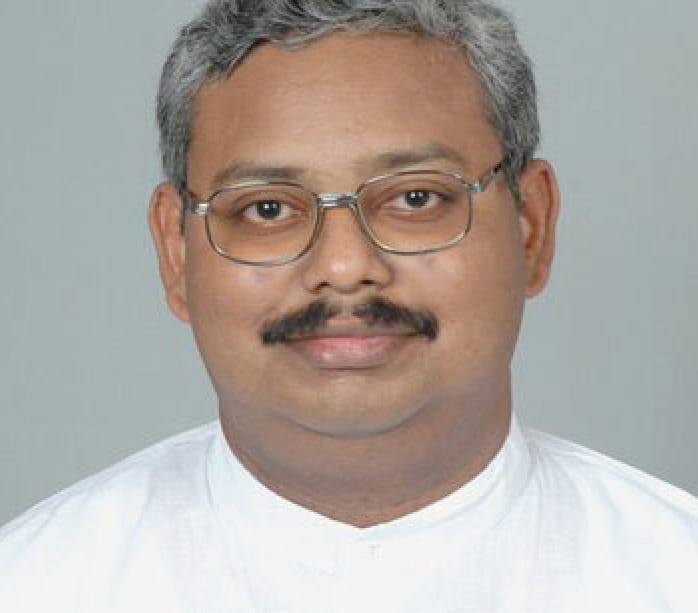
The following is an edited transcript of remarks by Namit Verma to the March 2, 2026 EIR Emergency Online Forum, “Epstein and the Bottomless Depravity of the ‘Elites’—Urgent Need for a Cultural Renaissance!” Mr. Verma is an author and security analyst in India. The video is available here.
It was very educational listening to this diverse panel, and also as you have positioned the subject today, “[Jeffrey] Epstein and the Bottomless Depravity of the Elites.” It certainly has something to do with the state of affairs of the world today, but I will address this initial subject briefly and then go on more towards the state of the world today.
The initial subject is important because it is representative of the decline of American governance. It is also connected with the withdrawal of the American government from the ambit of many UN organizations. It is very strange that the United States, which has a legal obligation to provide, let us say, some kind of protection against criminal interference to the United Nations, that is the basis of their hosting the UN at New York. And so, when the charges against Mr. Epstein were primarily that he was interfering with diplomats visiting the [UN] General Assembly, this aspect of the subject was initially ignored, and only the pedophilia issue came up. And that was dealt with at the level of a Florida court, wherein deal-making took place; and the interference with the United Nations votes—something which [Russian Foreign Minister] Sergey Lavrov has recently exposed at great length of how non-American visitors are targeted and blackmailed through these operations—now that aspect was ignored in the initial arraignment and his [Epstein’s] 18-month judicial sentence was also effectively reduced to 13 [months], and he got out. Then, after that, a very interesting thing happened in the United Nations.
The UN had three platforms to deal with gender issues. All three, all of a sudden, were merged following Mr. Epstein’s release in 2009. And at that point of time, if you recall, the Epstein scandal was primarily—or, not primarily, but the big names involved at that point of time in 2009 were Prince Andrew [Mountbatten-Windsor] and some others. And these nations, the nations that they represented from the old order, came together to reinvent the UN’s gender participation. And they merged all the three earlier platforms and created something called UN Women. The role of Mr. Epstein in creating this organization has been glossed over, and subsequently [glossed over] for a period of eight years. UN Women was founded, and the decision to found it happened immediately after Mr. Epstein was released, with the slightly curtailed imprisonment. And then, eventually, a new leadership for gender justice was put in place. That leadership remained for eight years and did not forward any further complaints from the United Nations to the U.S. government. So, Epstein remained at large, renewing his activities for eight years. It was only when that protective umbrella of the leadership within [the UN-ed.], its tenure was over, that in 2019, that he got arrested once again and this time on federal charges, as should have been done on the first occasion.
And once that happened, there was no way he could get out, and things started coming out in much greater detail. Eventually he was terminated by a suicide; but still, as we have seen, there’s still much more to come out. Even now, the documents we are seeing are largely redacted, and they have implications on the global order. We must contend with how many UN General Assembly votes have been impacted by these details. This issue has just not been addressed.
As an Indian I’m a little embarrassed, because there could be some ramifications for Indian participation in this cover-up. But this is, as the subject suggests, the exposure of the depravity of the elite. That moral bankruptcy, as Professor Zhang Weiwei of China had initially mentioned, that moral bankruptcy of the entire global leadership has been brought into focus by the Epstein drama, and the global implications are not being mentioned. The whispered charges, or now more openly speculated charges, of his role as an intelligence asset of Israel, and the recent situation where Israel’s ability to manipulate Washington is being seen by the entire world. I am not making a comment on whether this influence is good or bad for the world.
The fact is that our world is fractured, and even our system is fractured. The problems are because of the West and the UN, which is dominated largely by the West. Of course, now China’s role in the Security Council has helped bring in an oriental representation, and perhaps an oriental point of view, which Professor Deepak was talking about. But the dominant conversation is still rooted in the West’s understanding, possibly limited, of the dichotomies and the contradictions in the global partnership, which have not been addressed.
Helga talked of the Westphalian order of nation-states. But the nation-state, wherein the supremacy of the nation-state is taken as a given, is seriously challenged by new theological orders which have a span far beyond individual nation-states. And that is what Pan-Islamism is all about, various versions of it. Whether the situation in the world which Professor Deepak mentioned, is the opposing world views of the orient, which belief is centered in positivism, and the clash of civilizations suggested by [Samuel P.] Huntington, there has been a perception that at a strategic level, the Christian West, which again is something beyond the Westphalian concept, felt it was not prepared to take on Pan-Islamism and wanted to weaken the Pan-Islamic movement by initially bringing it to a containment or a conflict which would weaken its power. By sponsoring such a conflict in South Asia, we in India have been paying for this interference of the West for the last hundred years. Fortunately, Indian leaderships have skirted it, and in the old days we would skirt it by endorsing a secular plank.
In the recent days, something which has been a subject of great comment in the last week, is that the Israeli attack [on Iran] began immediately after the Indian Prime Minister’s visit to that country. It is reasonable to infer that the Indian Prime Minister might have been taken into confidence about the events that were going to follow. And while that has led to some criticism at home as well, it is very interesting to observe how such an engagement with Israel may have been necessary for India at this point of time, to once again postpone that entrapment of a conflict between two civilizations in this region. What has happened, the way the West has finally played out, there has been a change on the board on which America has played these issues.
The Iran conflagration vis-à-vis Israel has led Iran to attack seven other Islamic nations. So we [India] at least have evaded becoming the fall guy or the victims of sapping the rising Islamic trend. It’s almost like in the old days, history tells us of how Vlad [III, Prince of Wallachia—ed.] was thrown in the way of a sweeping Ottoman movement into Europe. India, and the more ancient Sanatani and Buddhists, and other peacenik civilizations, would not want to become fodder merely to sap the strength of one so that it can be weakened and then fought in Europe. These are realities which are often not stated but need to be understood. All this has happened.
Today what America is playing, it is using Islam against Islam in the two theaters which it has sparked off in the last one month, in the Middle East and also in the Pakistan-Afghanistan theater. All these fires it is lighting. That then brings us to the issue of why all these fires are being lit. These fires are being lit because the American nation stands over-extended financially, and the nature of the depravity of the elite is primarily about a self-claimed right to consume beyond their means and beyond moral fault lines. The morality of it is what the Epstein thing brings out into the open.
But there is also the fact that the American consumption rate is much higher than the value produced in America. This difference of value is the reason why in economics today we have terms like purchasing power parity. This is an admission of the fact that the value system is spiked. Now, coming back to how the value system is spiked, we know that the petrodollar is, of course, the key. These wars are as much about controlling the pricing of the petrodollar. These sparks which are being lit, which we find very worrying, across the border between Pakistan and Afghanistan, everybody is tremendously watchful and must be. India, China, and Russia, all three which surround this theater, are impacted, and must be watchful not to allow this to spread. This is essentially about threatening us and our economies. The biggest challenge for us, is that we have been cornered into a situation where we are not producing our own energy requirement, we are importing it. Thereby our value is being blamed. We have the energy resources, the hydrocarbon resources, but through manipulation—and corruption is the biggest manipulation that the United States has used as a weapon. The CIA has weaponized it worldwide.
There is another fact which came up, which I would like to address, about how this is actually a war. It is a war, but President Trump chooses to call it a combat. But therein lies another contradiction. If it is not a war, then he is not authorized by American law to authorize a political assassination, something which was underlined by the Frank Church Committee [in 1975]. That is again grounds the President has violated. Perhaps he is hiding behind the fact that the Israelis did the assassination and not him. That is another part of the new American playbook—get somebody else to do individual acts while you achieve your own agendas.
Thank you, and hopefully we can evaluate some of these issues in greater detail.
As People from Africa, We Call for Diplomacy So the World May Be at Peace
by Timothy Ninsiima

The following is an edited transcript of remarks by Timothy Ninsiima to the March 2, 2026 EIR Emergency Online Forum, “Epstein and the Bottomless Depravity of the ‘Elites’—Urgent Need for a Cultural Renaissance!” Mr. Ninsiima is affiliated with the Petroleum and Geology Society of Makerere University, Kampala, Uganda. The video is available here.
Hello everyone, I’m very happy to address the people on this emergency roundtable on this great motion which has been portrayed by the Schiller Institute. I’ll briefly talk about the subject and also talk about what’s happening around the world. When we go to [Jeffrey] Epstein—the lessons we learn from Epstein—because Epstein was not an African, and someone would wonder why people in Africa are a little bit concerned about him. But the lessons we learn from him give us a clear hint about the power dynamics and power imbalances which are happening around the world.
As our societies grow, we find that sometimes we favor oligarchs to run our systems. If power is over-concentrated in the hands of the few and the system ends up decaying, you will see what’s happening—like Epstein and also the culture today and the pedophile thing. So as Africans, we also learn from Epstein, and we should tame our communities and we shouldn’t favor the growth of these oligarchs which end up destroying our world and our societies. We should also strengthen our institutions to make sure that our culture is respected.
But if I’m to speak about some of the few developments which are happening in the world, for instance the issue with Iran, for sure people in Africa and people in the Global South, and also the youth from Africa, we should unite about this subject. Because today it’s the Iranians, the other time it was the Venezuelans, also the Greenlanders. And if we keep quiet they may also come back for us; so that’s where we draw the inspiration to comment about such subjects. The war in Iran, which has been started by the United States and Israel, may not really concern much about what we’ve been told, about posing a potential threat of nuclear war, but we see it as a war. In my mind, I see it as a war of fighting for influence of global resources. It’s all about oil, it’s about gas, it’s about the influence in the Middle East where Israel will take over the Middle East and America also asserts its hegemonic powers over the world.
But we should come together and fight this and say that it should be diplomacy. That’s why I come to Helga’s words, we’ve said that we should return to urgent diplomacy because when you look at fighting, fighting has never brought any good results. I come from a region in Uganda close to [the Democratic Republic of] the Congo, and fighting has been in the Congo for over 30 years. Thanks to some of the global powers and their interest in mineral resources, they’ve created a cocktail of problems supporting factions, and they end up fighting for over 30 years. But if you look at the diplomatic space vis-à-vis the fighting space, you find that diplomacy has been given very little space and fighting has closed that. It has not worked, and the situation—which is very complicated like the one in Congo—is so nuanced. It is manifest that if you want to approach it in a way of war it will not work, and it has not worked. But the only goal is to bring all the parties together and call for diplomacy.
And in that same spirit, we also urge the powers, the people in the Middle East and the Gulf countries and people from the world, to call for peace in Iran so that we could also prevent things like a nuclear Armageddon. The war has just started but if it’s not well controlled, we might create a bubble which will induce a chain reaction of events which could end up in a nuclear Armageddon. So, we call for peace and diplomacy as people from Africa and also people from Uganda so that our countries may be at peace and the world may be at peace. Thank you.
Epstein and the Crisis in Leadership
by Dr. Kwame Amuah
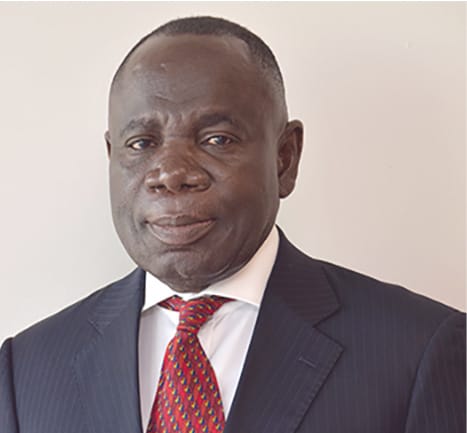
The following is an edited transcript of remarks by Kwame Amuah to the March 2, 2026 EIR Emergency Online Forum, “Epstein and the Bottomless Depravity of the ‘Elites’—Urgent Need for a Cultural Renaissance!” Dr. Amuah is an academic and writer on security matters. He was formerly a Senior Advisor on Nuclear Affairs for the South African government and is a former regional chair of the Nuclear Disarmament Forum. The video is available here.
Thank you very much for the invite, and I just want to very briefly discuss some things from a book which I recently got published titled The Descent of Man. Some of the chapters I hammered on are the descent of true leadership, the descent of dialogue, the descent of diplomacy, the descent of spirituality, the descent of decency, and another twenty aspects of the descent I also touch on.
But I want to talk a bit about the descent of true leadership. I think one of the major challenges we are facing now is man’s inability to develop the type of leadership which understands the essence of humanity; that we are all in this universe to help in doing God’s work on Earth. God’s work on earth manifests itself in different areas. One is peace on Earth, brotherhood, and sisterhood. And I believe that once we appreciate [this], man begins to appreciate through our leadership; issues of war, issues of violence, and issues of indecency will all begin to go down. And I know we are talking about diplomacy. Instead of solving problems through dialogue, we are now solving problems through brute force, and the reason people are resorting to that gets back to the descent of true leadership. If you look in Africa, in the Americas, and then in Europe, look at the type of leadership we have. And there are many who will say that, in fact, the only good man in the room when it comes to global leadership—people probably refer to the Chinese President [Xi Jinping] and [the Russian President Vladimir] Putin, and a few others. But let’s go to Europe. In Europe we have leaders who are more looking at war, who are more encouraging [Acting Ukrainian President Volodymyr] Zelensky to fight more and not to sit at the table.
So briefly on the issue of Epstein, it’s also around the issue of leadership; and I talk about the issue of the descent of decency. Our body politic lacks decency, lacks dialogue. And also, what pains me most is [the fact] that God has placed us on this Earth as an instrument of his will; and as an instrument of his will, we become the messengers of peace. And when we recognize that and our leadership recognizes that, I don’t think we will have leaders who will move to the island of Jeffrey Epstein; because they know why God has placed them here. I know there are many people who have different reasons why, probably through Israel, but I don’t believe that.
If the moral compass is there, which underpins all leadership, I don’t think our world will get to the stage where we are on the verge of another war—another world war if it gets out of hand. So, I will come back to the fact that the descent of true leadership, the descent of spirituality, the descent of decency, the descent of diplomacy, and the descent of brotherhood is what is putting the world on edge now. So, I agree that diplomacy is key. But let’s get back to the true cause of it, and that is our ability to develop, and appoint and elect leaders who understand why we are on this Earth. And I believe this is the only Earth I know, and I hope many will recognize that. Thank you very much.
Take Positive Action for Peace: The Oasis Plan
by Father Harry Bury

The following is an edited transcript of remarks, as delivered, by Father Harry Bury to the March 2, 2026 EIR Emergency Online Forum, “Epstein and the Bottomless Depravity of the ‘Elites’—Urgent Need for a Cultural Renaissance!” Father Bury has been a Catholic priest for some 70 years, is a lifelong peace activist, a leader of Pax Christi, and founder of the Minneapolis-based organization Twin Cities Nonviolent. The video is available here.
Most, or at least certainly many people on this planet, are fearful right now, because we’re on the road to Armageddon. The situation is so serious that we need to do everything we can to stop the terrible things that are happening in our world. The depravity that we experience with the behavior of the [Jeffrey] Epstein crowd, that depravity is beyond description. Iran also, which really doesn’t have the ability to defend itself against bullies, the United States and Israel, it, too, makes a huge mistake by trying to fight back, thinking that using violence is the way to get what it wants.
Self-defense through violence doesn’t work, as history has shown us. When we examine what Lyndon LaRouche, a genius, and a person who preceded him in the 15th Century, Nicholas of Cusa, both of them are geniuses, and both of them said that if we want to have peace in the world, we need to change the way we are thinking. We need to change the way we’re thinking. We need both to believe that God has given us the intelligence and the creativity, intelligence-wise and emotion-wise, to create an environment in which violence no longer exists. Yes, we have that ability as humans. What we need to do is change the way we think. One of the ways is to stop believing that the way to end wrongdoing is by punishment which is violence. Punishment does not work! The evidence we have throughout the world is that the rate of people going back to prison after they’ve been released from prison is 80-85%. Thus, punishment, which is violent, doesn’t work. Rather, we need to think differently. The way to think differently is to believe that it is acts of non-violence that are the answer. Nonviolent action.
Spiritual gurus in our dear world since the early Greeks, largely taught that violence doesn’t work. We see that now historically. What works is nonviolent action. The Schiller Institute and Twin Cities Nonviolent, its partner, have advocated a way of achieving peace through nonviolence. It is the Oasis Plan. The Oasis Peace Plan advocates that we will have peace through development through the development of every nation. The way to have peace is for all nations to be able to equally obtain what they need, and that’s what the Oasis Plan teaches, that if we help every nation be equal to every other nation, all developed, then we will have peace. So, that’s what the Schiller Institute and other groups, like BRICS, are seeking to do in our world. We need individuals and nations to join and begin to think differently. Namely, the way to stop evil-doing is not by violence, vengeance, getting even, but by active nonviolence.
The Oasis Peace Plan is one of the ways to do that, and we need to put it in operation right away. It’s about thinking differently; differently, meaning that we don’t punish people who have done wrong. Punishment doesn’t work; it just causes most individuals to figure out a different way of doing evil without negative consequences.
What we need to do is act positively. Seek to rehabilitate people who have done wrong. We do that by positive actions like giving them respect. Our research has indicated that there are a few institutions that treat incarcerated people with respect. When they treat people with respect the recidivism rate goes from 80% to 13.7%. So, we’re learning that when we treat individuals in a way that is aimed at rehabilitation—not punishment, but positive actions like development—then people change their minds, and that’s what we’re working to achieve, as Lyn LaRouche and Nicholas of Cusa pointed out. In addition, the Holy Father, Pope Leo [XIV], recently said, and I quote, “Stability and peace are not achieved through mutual threats, nor through the use of weapons, which sow destruction, suffering, and death, but only through reasonable, sincere, and responsible dialogue. Faced with the possibility of a tragedy of immense proportions, I make a heartfelt appeal to all the parties involved to assume the moral responsibility of halting the spiral of violence before it becomes an unbridgeable chasm. May diplomacy regain its proper role and may the well-being of people who yearn for peaceful existence, based on justice, be upheld, and let us continue to pray for peace.”
This is what Lyndon LaRouche expressed and what Nicholas of Cusa introduced to us: a way of thinking differently so we no longer believe, if we listen to them, that punishment/violence is the way to end wrongdoing. The way to end violence is through positive action. The beginning of that is to show respect to those who have done evil, not to punish; to really seek to change our thinking. So, we urge all of you to join with us in this effort of implementing the Oasis Plan of peace through development, as we are doing in North Minneapolis. We’re working with ex-gang members, helping them to see that it is through positive action, nonviolent actions, that they find happiness and meaningful fulfillment in their lives. Hence, at the local level and at the international level, we use the same process of peace through development. We teach people how to read and write. That’s development on the micro level, and on the macro level it is helping every nation be equal to every other nation, and that happens through cooperation, not by competition. Competition doesn’t work. It makes us enemies of each other. What we need is to help each other get all our needs met, and that’s what the Oasis Plan is about—helping all nations get what they need to have fulfilling lives.
I urge you all to consider changing your mind and begin to see that the real answer to peace is through positive action, as the Oasis Plan indicates.
Thank you very much.