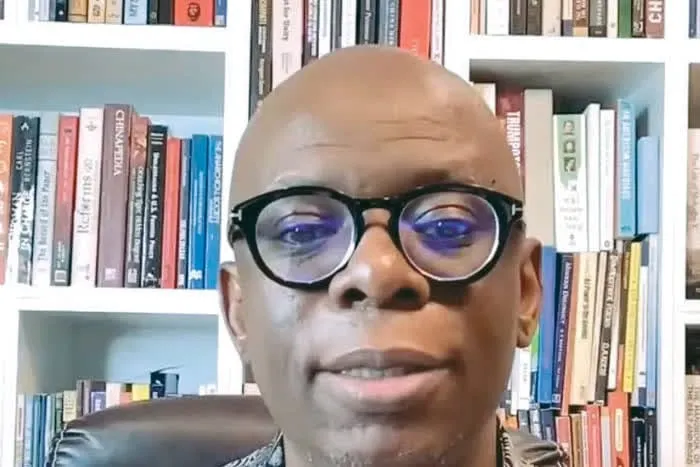
The following is an edited transcript of remarks by David Monyae to the March 2, 2026 EIR Emergency Online Forum, “Epstein and the Bottomless Depravity of the ‘Elites’—Urgent Need for a Cultural Renaissance!” Mr. Monyae is the director of the Center for China-Africa Studies at the University of Johannesburg. The video is available here.
Firstly, I’d like to say, it’s a great honor to speak before you. I’d like to specifically thank Helga and all organizers of this important seminar. Africa, like all other continents, is deeply affected by events taking place in the United States and currently in the Middle East. I’ve been asked to speak on Africa-China relations. However, in the context of the current situation in the Middle East, I would like to add that at the end of my notes. I’ve divided the talk into three phases of the relationship between Africa and China.
The very first phase is the historical period, which is with the coming of the People’s Republic of China (PRC) into the revolution of Chairman Mao from 1949 to 1978. China’s engagement with Africa during this particular era was shaped by anti-colonial solidarity, Cold War competition, and Beijing’s search for Global South alliances. Many African movements received political support from the government of the People’s Republic of China, including training, resources, and diplomatic recognition. The landmark project of this period is the Tazara Railway of 1970 to 1976, symbolizing South-South cooperation and China’s commitment, despite its own poverty. China’s African diplomacy focused on recognition in the United Nations, culminating in 1971, when African votes helped Beijing regain their seat within the United Nations. Relations were mostly political, not yet driven by trade, investment, or large infrastructure.
The second phase of the relationship between the two is post-1978, the opening-up period from 1978, to key issues under Deng Xiaoping. China reoriented its foreign policy towards modernization, markets, outward engagement, access to raw materials for China’s industrial boom, and new export markets for Chinese manufacturing. Africa was all-important for China in this regard. Diplomatic partners were supporting China’s rise, and I think you see the relationship continuing in these spheres. China’s firms began entering Africa in infrastructure, construction, textiles, and agriculture. The foundation was laid for structured cooperation, culminating in the establishment of the current Forum on China-Africa Cooperation in the year 2000.
In the third phase, which is the contemporary period, Africa-China ties became systemic, including trade, infrastructure, digital technology, security, and multilateral diplomacy. China became Africa’s largest trading partner, starting in 2009, with trade surpassing 250 billion U.S. dollars in recent years. We cooperated with massive infrastructure footprints, roads, ports, rail, energy, ICT [Information and Communications Technology], driven by the Belt and Road Initiative. Digital technology became a new frontier. Companies like Huawei and ZTE anchor Africa’s digital transformation. African countries use Chinese finance and technology to fill longstanding developmental gaps: industrial parks, special economic zones (SEZ), renewable energy, and manufacturing clusters. There has been increasing influence in multilateral spheres. We have seen the expansion of BRICS, South-South cooperation, support of the African Union—particularly Africa Agenda 2063—the addition of Africa into the G20, and a shared narrative about development independence. The relationship is no longer one-dimensional. It’s political, economic, and technological and, increasingly, security-oriented.
In conclusion, how the Middle East conflicts will affect the Africa-China relationship: There are a number of things that one could lay out that improving the African continent depends upon. Asia is important in terms of its trade and increasing bulk in terms of investments coming from that part of the world. While we’re talking about China-Africa, increasingly we’re having additional states, in particular the Gulf States, becoming deeply involved in Africa with investments and the like. Like all other conflicts, the Middle East is quite close to the continent. Our trading routes, the Belt and Road, as we have mentioned, and the tension between bigger powers that remain Africa’s traditional partners, such as the United States and the European Union, still play a critical role in the African continent.
As one of the least-developed continents in the world, Africa requires a stable global order. Under this environment, it would be really difficult for Africa to fulfill some of its core objectives of poverty alleviation, dealing with inequality, as well as unemployment, infrastructure development, dealing with the rising issue of climate change, and to catch up, not just broadly on development, but to catch up on some of the key cutting-edge technology, as we enter the fourth industrial revolution. And therefore, like all colleagues, we condemn in the strongest terms, wars of choice, abuse of human rights, and unjust wars. And we join with others for a peaceful resolution to the conflict and mobilization of the people.
We, the people, as it says in the United Nations Charter, need to be activated and ensure that we mobilize everyone in favor of peace, not wars. With those words, I thank you once again. Thank you for having me, and I wish this seminar success.