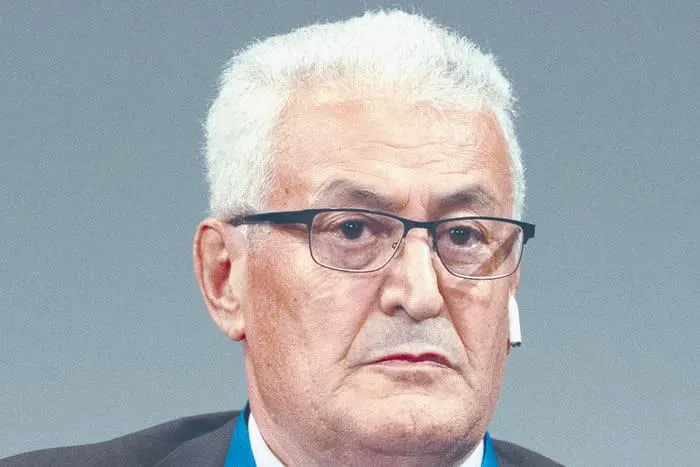
The following is an edited transcript of remarks by Ali Rastbeen, as translated from French, to the March 2, 2026 EIR Emergency Online Forum, “Epstein and the Bottomless Depravity of the ‘Elites’—Urgent Need for a Cultural Renaissance!” Mr. Rastbeen is the president of the Académie Géopolitique de Paris. The video is available here.
We are currently at a structural turning point in the international system. The world order that has been consolidated since 1945, and then reinforced after 1991 around Western preeminence, is not disappearing; it is undergoing a profound transformation. This transformation is manifested in readjustments of economic, military, and technological power, the emergence of multipolar configurations, and increased strategic competition, now structured by irreversible interdependencies. This dynamic corresponds to what contemporary strategic literature refers to as “hegemonic transition.” When the power gap between a dominant actor and its challengers narrows, the structure of the system becomes more fluid, but also potentially more conflictual. China, Russia, and several regional powers are redefining the global balance of power, while the United States remains a central military and financial power but is seeing its ability to impose universal norms on its own gradually limited.
The reconfiguration of power-centers is the first dimension of this transformation. Multipolarity is expressed through the emergence of coalitions and groupings that redistribute global power. The expansion of the BRICS, now under India’s rotating presidency in 2026, illustrates the desire to broaden the representation of emerging economies in global governance and to rebalance institutional power relations. In this model, Russia consolidates its influence over Eurasian security, China weighs heavily on the strategic balance in East Asia, India asserts itself in the Indian Ocean and with the Global South, while Brazil and South Africa play a stabilizing and structuring role in their respective regional spaces. The BRICS countries are not simply an institutional alternative; they represent a coordinated response to existing power structures, aiming to promote more representative and less concentrated governance.
The second dimension concerns the crisis of traditional multilateralism. The post-war multilateral system is showing signs of congestion and inefficiency. The United Nations Security Council remains paralyzed on several major crises, due to the recurrent use of the veto and a perceived lack of representativeness, which is fueling an erosion of institutional legitimacy. Calls for reform are growing, particularly to increase the role of developing countries and adapt decision-making mechanisms to contemporary realities. In this context, the so-called middle powers are seeking to play a more active role in revitalizing international cooperation in order to preserve a functional multilateralism in the face of rising blocs and systemic rivalries.
The third dimension lies in the militarization of interdependencies. Economic and technological ties are becoming direct instruments of strategic power. Semiconductors, artificial intelligence, digital infrastructure, and energy networks are no longer just drivers of growth; they are levers of domination and instruments of pressure. Supply chains are turning into arenas of geo-economic confrontation. At the same time, financial fragmentation is accelerating. The establishment of alternative mechanisms to dollar-dominated systems, including the increased use of local currencies in certain exchanges within the BRICS countries, reflects a desire to reduce vulnerability to extraterritorial sanctions and increase strategic resilience.
The fourth dimension can be seen in regional realignments, particularly in the Middle East, which has become a veritable laboratory of multipolarity. Iran is developing a strategy of indirect influence and strategic depth; Saudi Arabia is adopting a diplomacy of balancing between Washington, Beijing, and Moscow; while Israel is adjusting its posture in the face of persistent hybrid threats and a more complex strategic environment. International mediation, particularly that facilitated by China between Riyadh and Tehran, illustrates the diversification of crisis management mechanisms and the end of the exclusive domination of a single external actor in the region.
The fifth dimension concerns the normative question. Multipolarity is not limited to a redistribution of material power; it also engages the normative legitimacy of the international system. The principles of sovereignty, human rights, and collective security remain central to international discourse, but their selective application undermines their perceived universality. The future of a stable architecture will depend on normative coherence, the predictability of state behavior, and mutual recognition of vital interests among the major powers.
In the face of these transformations, several strategic directions are necessary for international decision-makers. First, multipolarity must be institutionalized rather than endured, by integrating emerging powers into reformed decision-making mechanisms in order to strengthen collective governance. Second, arms-control regimes and regional de-escalation mechanisms must be strengthened to avoid an uncontrolled security spiral. Finally, it is essential to preserve areas of functional cooperation on global public goods, whether in the areas of climate, food security, financial stability, or cybersecurity. This approach must be both preventive, in order to limit the risks of confrontation, and proactive, in order to define standards for cooperation in an environment that is less structured by the hegemony of a single actor.
In conclusion, the emerging global architecture will be neither a return to the past nor a complete break with the existing order. It will be hybrid, polycentric, and evolving. Its stability will depend less on the exclusive domination of a single power than on the ability of the various poles to recognize their strategic interdependencies, accept regulated competition, and cooperate in an institutionalized manner to manage global challenges. Multipolarity, if organized and regulated, can become a factor of balance; if it remains uninstitutionalized, it risks generating lasting conflictual fragmentation.