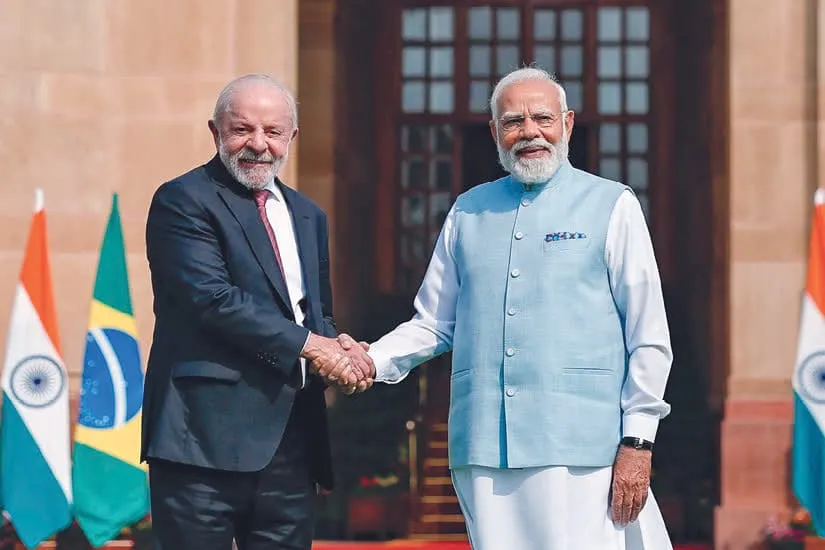
Feb. 24—“Brazil and India are not just two major democracies of the Global South. We are the meeting point of the pharmacy of the world with the breadbasket of the world…. Two megadiverse countries, with cultural strength and commitment to multilateralism and peace,” wrote Brazilian President Luiz Inácio Lula da Silva, following his Feb. 21 state visit to India at the invitation of Prime Minister Narendra Modi.
President Lula called his meetings in India “superlative” when the two addressed the press. Prime Minister Modi, for his part, underlined that the collaboration of their two countries “in the fields of technology and innovation holds significance not only for our two countries, but also for the entire Global South.” “When India and Brazil work together,” he said, “the voice of the Global South becomes stronger and more confident.”
Both Brazil and India are founding members of the BRICS, the one-year rotating chairmanship of which passed from Brazil to India on Jan. 1, 2026. Lula described the two countries as “partners” in building a more just and peaceful multilateral system “ruled by international law,” and reported that the two national leaders had spoken “at length about perseverance on the path to peace. There can be no sustainable and equitable development in a world torn by conflict.”
As the breakdown of the Western-dominated world system has escalated, the two leaders have developed a mutually “trusting” relationship, as Modi put it. Lula had invited the Indian President for a state visit after Brazil hosted the BRICS Summit in 2025, where the two agreed on a 10-year plan to develop bilateral relations in five strategic areas: defense and security; food and nutritional security; energy transition and climate change; digital transformation and emerging technologies; and industrial partnerships in strategic areas. Over the course of 2025, Indian-Brazilian trade grew by over 25%, reaching $15.2 billion. They agreed in this summit to keep the momentum going, while coordinating on anti-dumping measures to protect national industries.
Prime Minister Modi has been very active diplomatically in the past few months. After a fruitful visit to Delhi by Russian President Vladimir Putin in December, the EU-India Free Trade Agreement was negotiated in January, and on Jan. 31, the India-Arab Foreign Ministers’ Meeting (IAFMM) was held in Delhi, after a gap of ten years. They discussed a wide range of regional and global issues of mutual concern, including the question of Palestine, support for multilateralism and respect for the sovereignty of states, counterterrorism efforts, and reforms of the United Nations Security Council in full respect of the UN Charter.
At the same time, India has come under very strong pressure from the U.S. President Donald Trump administration to reduce its cooperation with Russia, China, and the BRICS, but Delhi has not given in, despite the threats of ridiculously high tariffs from Washington.
Nonetheless, following Modi’s productive meeting with Lula, he proceeded to visit Israel, where he shamelessly said in a speech before the Knesset that “India stands with Israel, firmly, with full conviction, in this moment, and beyond.” Modi also did not mention Palestine or the genocide in Gaza, nor denounce the pending U.S.-Israeli attack on Iran, which would take place mere hours later. Centuries-long British geopolitical manipulation is behind India’s susceptibility to anti-Islam sentiments, which is clearly being utilized in an attempt to pull India away from the aforementioned dynamic.