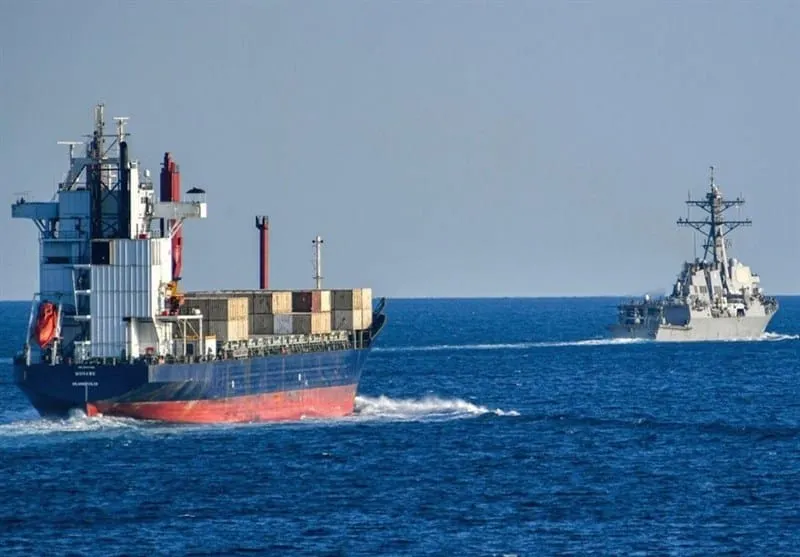
President Trump escalated the confrontation over the Strait of Hormuz on Thursday morning, ordering the U.S. Navy to “shoot and kill any boat... that is putting mines in the waters of the Strait of Hormuz. There is to be no hesitation,” he posted on Truth Social. He ordered minesweeping operations to continue “at a tripled up level.”
In a second post minutes later, Trump claimed “total control over the Strait of Hormuz,” declaring that no ship can enter or leave “without the approval of the United States Navy.” On negotiations, he claimed that “Iran is having a very hard time figuring out who their leader is"—a remark that functions as a rolling excuse to keep extending a ceasefire in the war with no achievable military objective.
The posts came a day after Iran’s Revolutionary Guard seized two commercial vessels in the Strait—the Liberian-flagged Epaminondas and the Panama-flagged MSC Francesca—and fired on a third. Bloomberg reported that marine traffic through the Strait has ground to a halt. On the same day, Iran’s parliament deputy speaker announced that Iran had received its first revenue from tolls on ships transiting the Strait—a direct assertion of sovereign control over the waterway Trump claims to dominate.
The pattern of retreat dressed as strength is manifest in other ways. On Wednesday, April 22, Trump announced that he had personally saved eight Iranian women from execution. Iran’s judiciary denied that the women were ever facing execution, calling the claim “fake news.” (Official Iranian social media accounts have variously claimed both that the eight women are AI fabrications, or that they are either released or are facing charges that could not carry a death sentence.) Trump’s source was an unverified social media post by a pro-Israel activist. This fabricated victory, like the indefinite ceasefire extension, provides domestic cover while the strategic reality hardens against Washington.
Iran’s top negotiator, Parliament Speaker Mohammad Bagher Ghalibaf, was blunt: “They did not achieve their goals through military aggression, nor will they through bullying.” Meanwhile, in London, military planners from over 30 nations convened for a two-day conference on a British- and French-led mission to reopen the Strait—a parallel military track in which the United States appears to be conspicuously absent.