The following is an edited transcript of the speech by Professor Theodore Postol to Panel Two of the April 6, 2026 EIR Emergency Roundtable event, “A Dialogue of Civilizations: Is There Still Time To Prevent the War Against Iran from Escalating into a Global Nuclear Conflict?” Dr. Postol is professor emeritus of Science, Technology, and International Security at MIT. Some of the images from Dr. Postol’s presentation have been adapted by EIR with permission. Subheads have been added. The video is available here.
Well, thank you very much. I thought that it would be important to help people understand the immediate reality or danger that we’re currently facing. And my purpose is really to—to be absolutely blunt—is to shock people with certain detailed facts of the situation.
And the reason I feel this is important, is because the consequences of a nuclear escalation are increasingly dangerous as time goes on. And there are many people who don’t seem to understand how dangerous this is and how devastating the consequences would be if nuclear weapons were used. Now, we’ve come to a point in the war between Iran, the United States, and Israel, where the weight of initiative has gone to Iran. The Americans, of course, are deceptively talking about how defeated Iran is. Of course, Iran has been taking, and will continue to take, tremendous amounts of damage from the onslaught of American and Israeli attacks. But the fact of the matter is, from a point of view of Iran’s capability to inflict unacceptable damage to both the American and Israeli forces, it has created a situation where basically, I would say (to put it in rather crude terms), Israel and the United States are, in effect, losing the war. And the effectiveness of Iran’s ballistic missiles and drone attacks has really been quite spectacular.
I have to say, I took Iran’s capabilities in both these areas quite seriously, but I was not prepared for how effective the Iranians have been. And it’s also quite clear, they will continue to be very effective. Now, the consequence of this is that, as the war continues—and it will, because the Iranians are not going to give up, in spite of false claims by President Donald Trump that they’re negotiating with the Americans. The fact of the matter is that the Israelis are going to become more and more desperate as this war continues. The problem with this is, the Israeli government is controlled by a group of messianic extremists, people who seem to, quite bluntly, belong in the 8th or 9th Century BC with their mindset about the world. And I am extremely concerned, and I think others would agree with me on this, that as things continue to deteriorate for Israel, these very extreme political leaders in Israel could actually use nuclear weapons at some point against Iran.
Iran’s Nuclear Capability
Now, a very important point, the real main point I want to make in this discussion, is that Iran does have the ability—even though Iran has not yet built nuclear weapons—Iran does have the capability to put together a nuclear strike-force in a relatively short period of time, even if Iran has been attacked with multiple nuclear weapons from Israel. So, it’s extremely important that anybody who is in a position to argue against this understands that—particularly, I’m thinking, in the Israeli government—understands that such an attack will also result in the end of Israel being a state. Because the Iranians can strike back with enough power to be able to basically destroy Israel in retaliation. The retaliation may come a day later, if plans have already been made, or it may come a week later, or even a month or two later, because it depends on how quickly Iran can put together its nuclear weapons from the materials it has in hand.
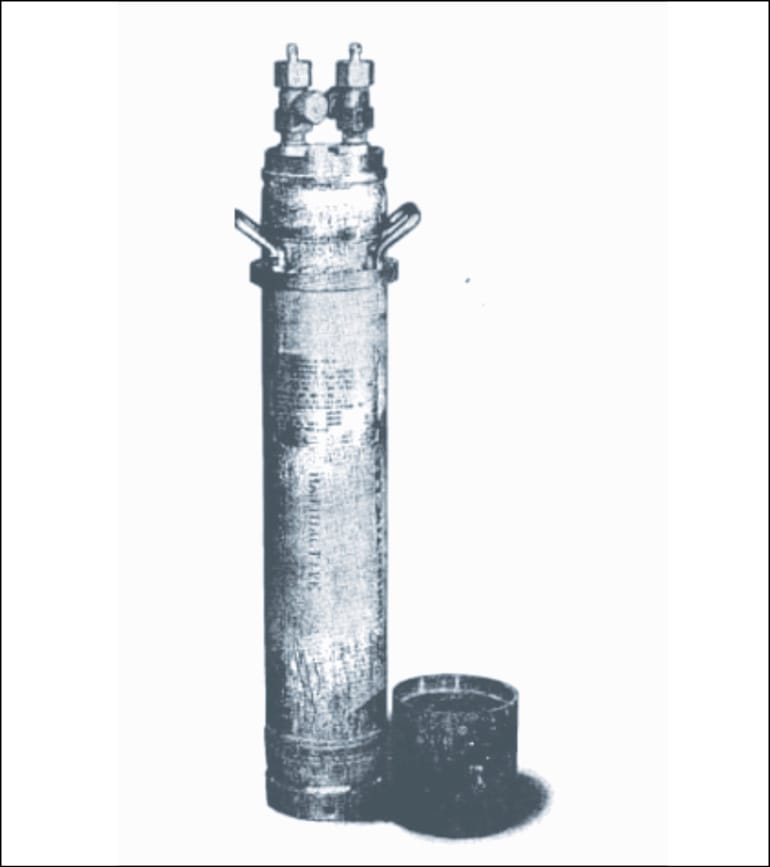
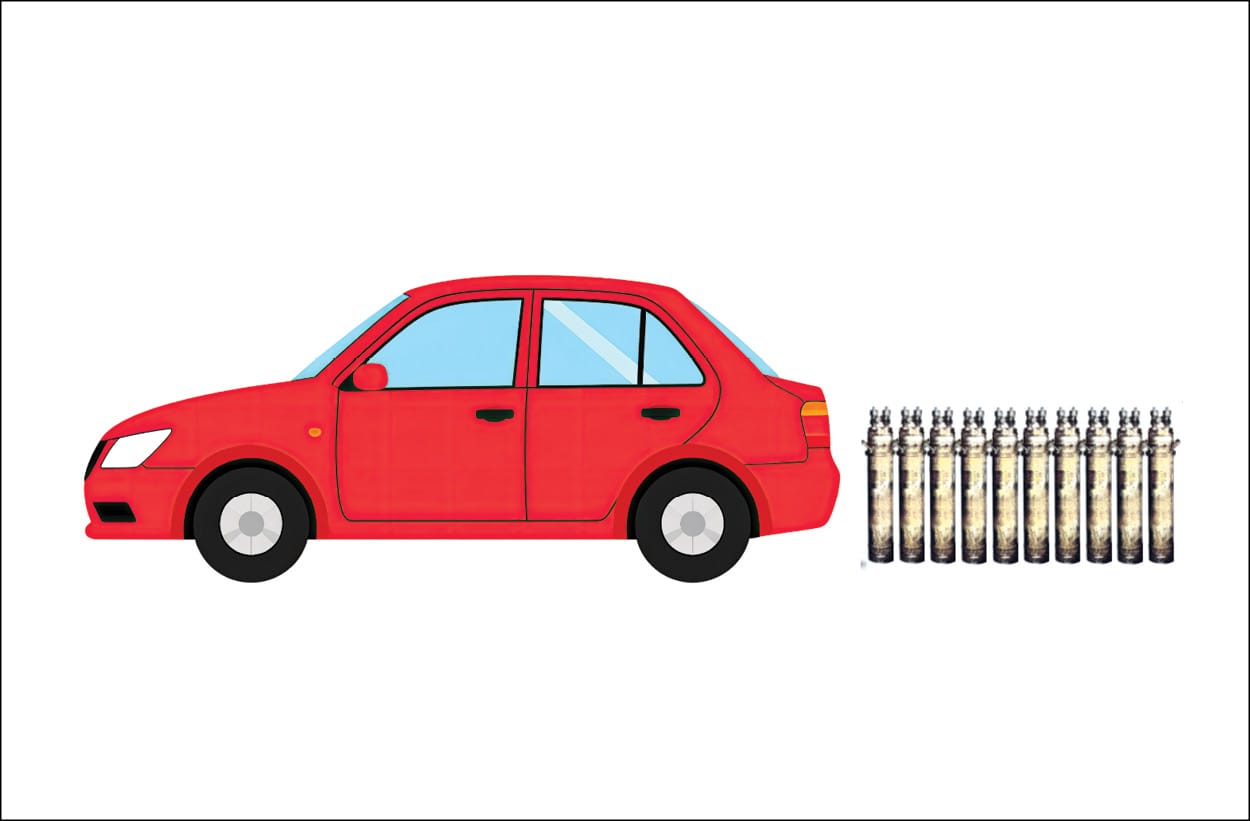
I won’t spend much time on this, because I think at the moment it’s more important to focus on the consequences of this attack. But just to give people a sense of Iran’s stockpile: Iran has about 10 or 11 atomic bombs[-worth of material]. These are atomic bombs of the power that destroyed Hiroshima, and it’s in the form of uranium hexafluoride, and it’s 60% enriched [in the fissile isotope uranium-235, U-235]. And the additional enrichment that Iran is capable of doing, I want to underscore, Iran has the equipment to enrich this material adequately for atomic bombs within weeks or months, or possibly even a shorter time. So, the fact that Iran has chosen not to weaponize this material yet, does not mean it won’t be able to respond. Iran also has tremendous manufacturing capability, all of which is underground, and it will be possible for Iran to respond. This [Figure 1] is a typical container that can carry roughly one atomic bomb worth of enriched uranium in the form of uranium hexafluoride, and just to give you a sense of the size of these containers [Figure 2], here are the 10 or 11 containers you would need to carry the 10 or 11 atomic bombs worth of enriched uranium hexafluoride. So, it’s easily moved around.
And it was predictable—I want to underscore—it was predictable that the United States could not destroy this in the early attack that it executed against Iran; supposedly this Operation Midnight Hammer. These containers are extraordinarily rugged. If, by accident, and I want to underscore “by accident,” you knew where these containers were stored—incidentally, all the containers don’t have to be stored together, of course. If you hit the cave, you know, the underground installation, and you managed to cave in the cave; if it [the strike—ed.] was not deep enough, so, you couldn’t get to it [the nuclear material—ed.]—which, incidentally, is likely you wouldn’t—the worst that could happen is, the cave would collapse, and then the Iranians would come in later and just dig out these containers undamaged. So, the chances that the Iranians don’t have this material are effectively near zero.
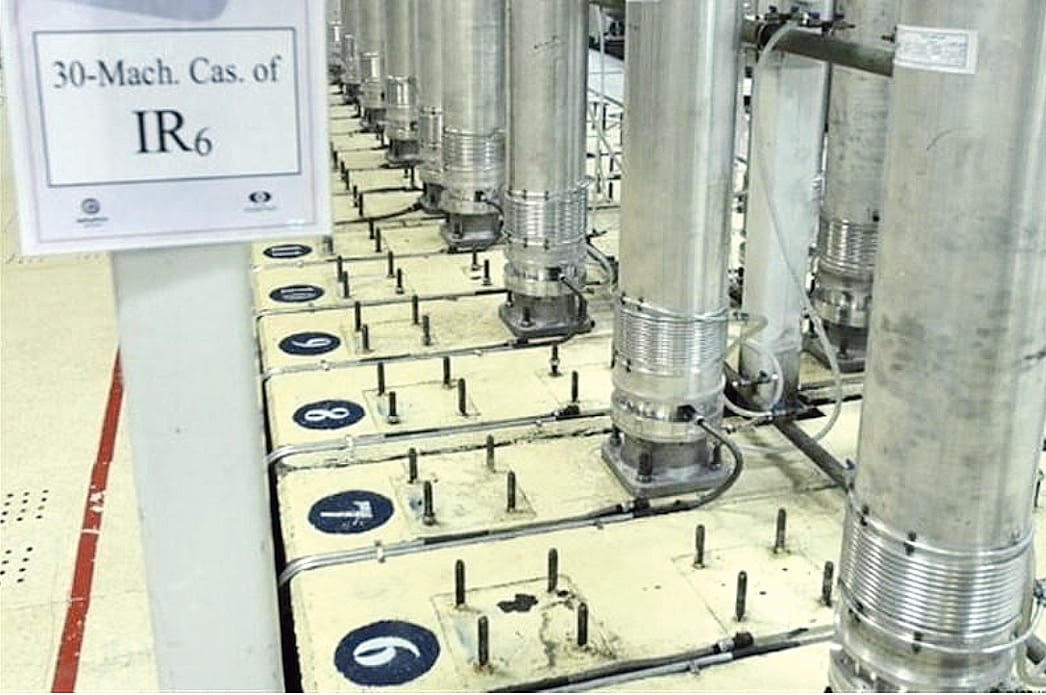
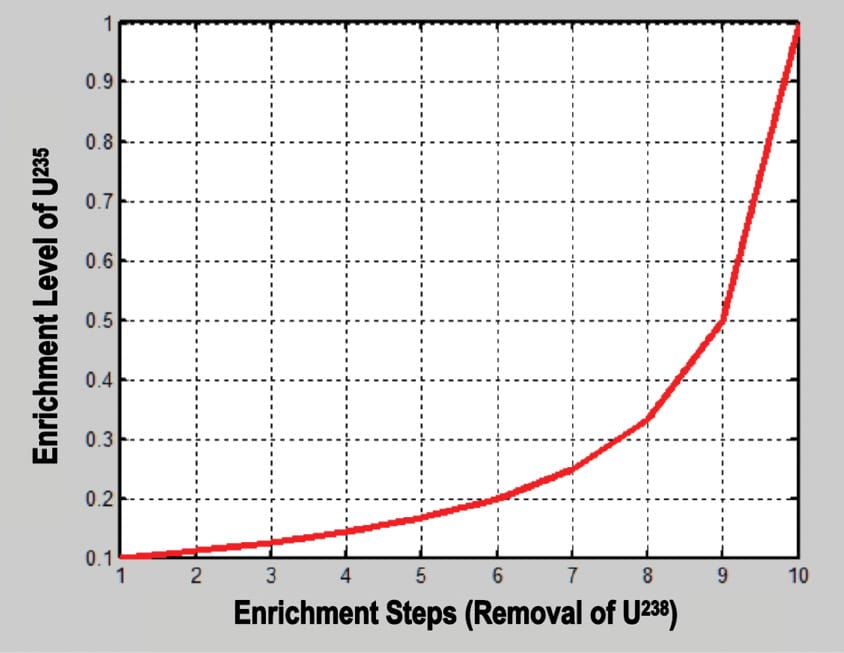
I’m not going to spend any time explaining to you what these materials look like. Let me just quickly show you; these [Figure 3] are centrifuges. I won’t spend any time talking about them. These are the devices which Iran would use to concentrate the 60% enriched uranium to maybe 87%, 88% or 90% [U-235] weapons-grade material. And just to give you a sense of how quickly this could be done [Figure 4], if you imagine you had 10% enriched uranium, uranium hexafluoride, and you had cycles of enrichment using these centrifuges, each cycle would take— Think of it as like having water and sugar mixed together, and you want to take the sugar and boil off the water. So, each unit of time, you boil off roughly the same amount of water. So, when you’re at 50% enrichment—they’re now at 60%—boiling off this last fraction of water takes almost no effort. So, that’s where Iran is at this time.
No Test Needed
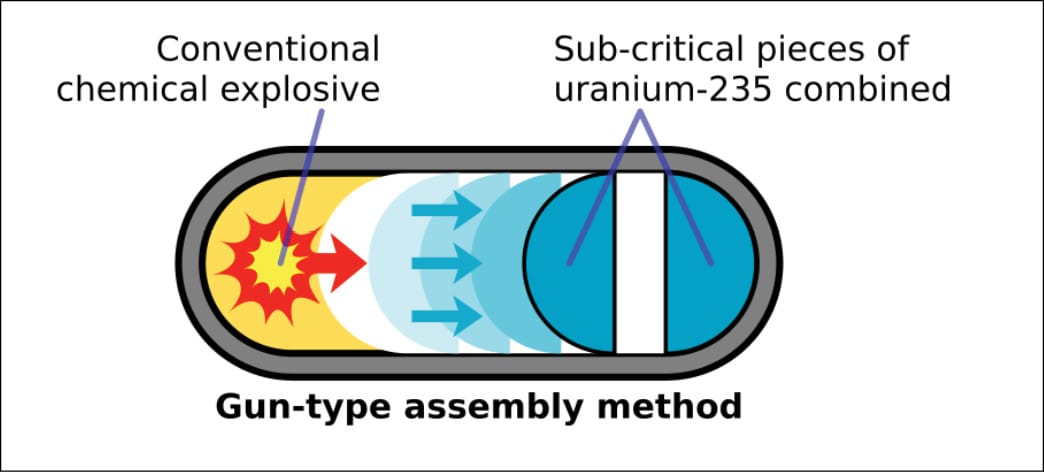
The net result is that they can easily convert this material to uranium metal, and then build an atomic bomb of a very simple design [Figure 5]. This is just a notional design. But the bomb that the United States dropped on Hiroshima was never tested. Plutonium bombs require testing because plutonium is difficult to assemble; you need a complicated assembly mechanism, which I won’t go into here. But uranium is just—you push the stuff together. And all you need to do is take your weapon design, you fabricate it out of depleted uranium, you test the implosion; if it works, you just substitute the enriched uranium for the depleted uranium, and you go and use your bomb, just like the United States did in Hiroshima. No test needed. So, they are poised to be able to use such a bomb.
Now, let’s imagine that the Israelis very unwisely attacked Iran with nuclear weapons. Let me also point out that it is very unlikely, based on what we know, that Iran would preemptively attack Israel with nuclear weapons. The Iranians are not suicidal. They have shown very great restraint with their program. And they understand that it would be suicidal to attack Israel with nuclear weapons, since Israel has nuclear weapons, and could and would respond. But it’s not so clear that the Israelis wouldn’t strike at them because of the extremist character of the Israeli political elite.
So, my point here is to explain to everyone, but in particular to Israelis who do not want to see their country destroyed, that an attack on Iran with nuclear weapons will result in the destruction of Israel. And that’s important to understand, because there are certainly very rational Israelis who might— First of all, political leadership might sober up, and secondly, there are very rational people working in the Israeli government who might just say, “Sorry, Mr. Prime Minister Netanyahu, we’re not following that order.” So, I’m really hoping to sober up people with these facts. I’m trying to be candid here.
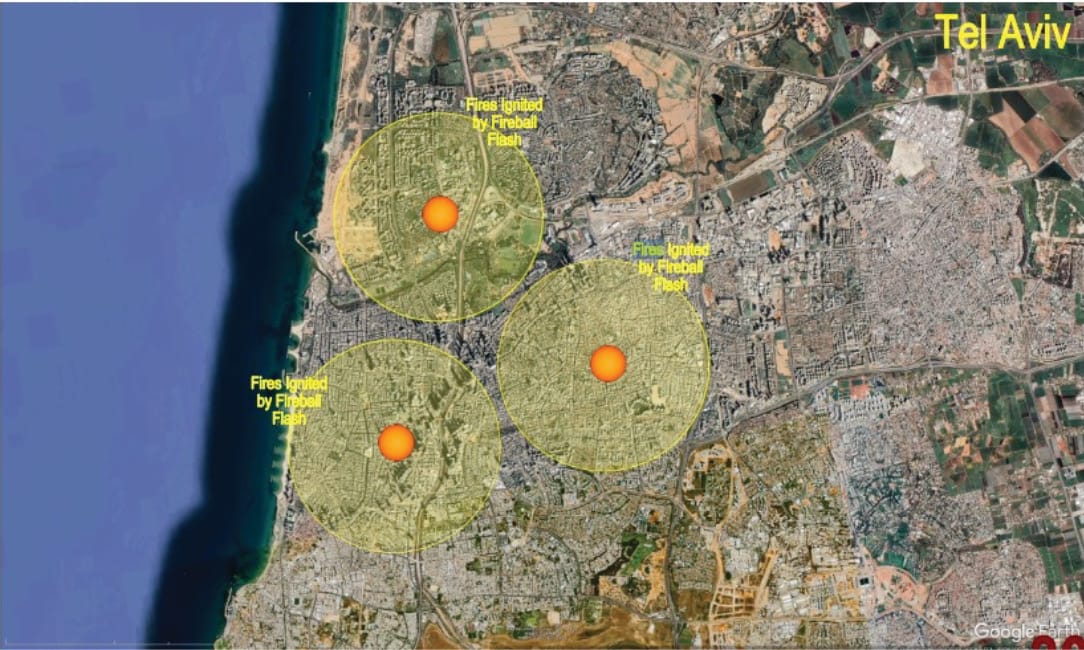
Here [Figure 6] is an example of an attack that I might plan. I’m saying me, because I know a lot about the weapons’ effects, and so would the Iranian political military targeter. Now, the military targeter has just seen their country attacked with nuclear weapons. We have to put ourselves in the mindset of the targeter. That targeter wants to do the maximum damage to Israel in response. We have 11 nuclear weapons. The targeter might take three. Tel Aviv is the most populated city in Israel. There’s more of Tel Aviv than is shown here. And you just place three bombs down. These are nuclear weapons that are 15 kilotons in yield, Hiroshima size; they’re low-yield nuclear weapons by modern standards. Now, the yellow regions, which are shown here with a sharp yellow line, these are the regions where fires would be initiated from the fireball. It’s a mistake to think of a blast as what does damage and kills people. These weapons ignite fires at much greater range than the blast, and that is important.
What I’ve shown here is an icon of a fireball. What is a fireball? This nuclear weapon detonates. A very large amount of energy is released in a very short interval of time. The temperature at the center of the weapon, this is an atomic weapon now, rises to maybe 10 million degrees Kelvin. The surface of the Sun is about 6,000 degrees Kelvin, and so 10 million degrees is an enormous temperature. It heats the air immediately around it to maybe a million degrees as it’s cooling. That million degree small volume of air violently expands outward and creates a fireball hundreds of meters in diameter. Now, this hundreds of meters of diameter fireball is rapidly cooling as it expands out violently. When it expands out violently, it acts like a fast-moving piston on the surrounding air. The density of the air inside the fireball is maybe 1% that of sea level. The expanding fireball acts like a fast-moving piston on the surrounding air, so it creates a shell of dense air that creates a shockwave.
Hotter than the Surface of the Sun
But the most damaging part of that fireball is the 8,000 degrees Kelvin temperature the fireball has when it reaches its maximum size. Eight thousand degrees Kelvin is about a couple of thousand degrees Kelvin hotter than the surface of the Sun, and each unit area of that fireball is radiating three or four times as much light and heat as its equivalent area at the surface of the Sun. And this is only kilometers away from the ground, whereas the Sun is 150 million kilometers from the Earth. So, this sets fires everywhere.
Notice that there’s, in this particular attack—which is diabolically constructed to cause as much damage and kill as many people as possible—I have intentionally left regions which would not be immediately set on fire. And the reason for this, is I’m going to depend on a firestorm that develops to cause extreme damage to an even bigger area than the individual bombs cause damage in.
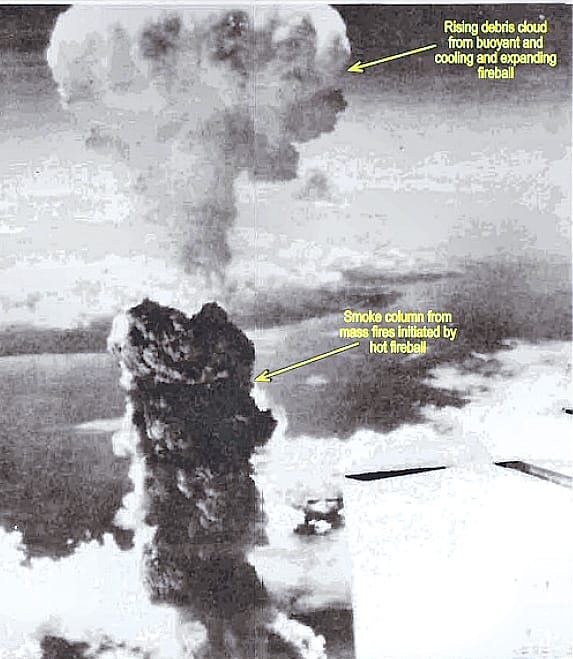
So, initially you get fires started everywhere. And to give you a sense of how intense that can be, this is the atomic mushroom cloud from Nagasaki [Figure 7]. Here you see the cloud which is mostly condensed water vapor filled of course with very radioactive material. The radioactive material inside this cloud cover here is maybe 10 or 50 times more intense than the radioactivity released at Chernobyl when the reactor just exploded. The radioactivity is going to drop at a very fast rate, but it’s going to be tremendously high for a long time. Here below you see a smoke cloud, black smoke cloud. That is the cloud of combusting smoke generated from the fire below, which has been instantaneously generated by the explosion. And it’s rising up following the motion set up by the buoyantly rising initial fireball. We see the same thing at Hiroshima. So, the firestorm created at Hiroshima was also created in Nagasaki. Sometimes people say it wasn’t. There was a firestorm created, no question about it.
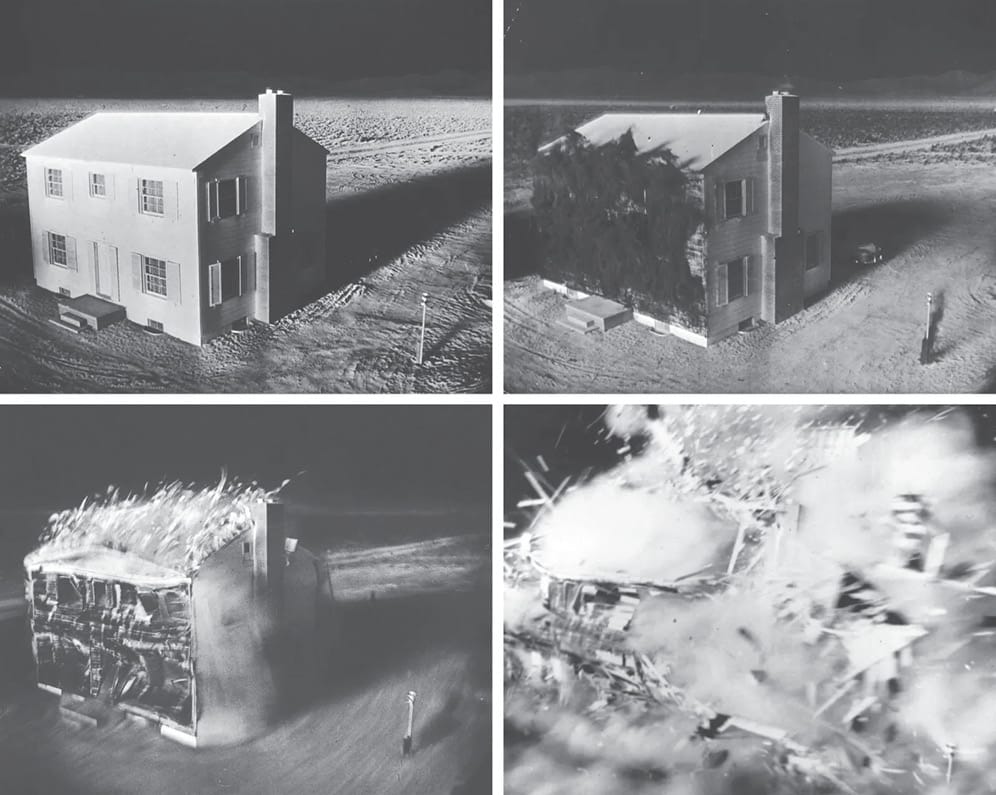
And so, if you want to get a sense of what this looks like, this is a mislabeled chart [Figure 8], so I’m going to give you the information. At about one-hundredth of a second after the detonation, after the maximum release of energy, if you were maybe at a one-and-a-quarter-kilometer range—this is a small nuclear weapon—you would begin to see the light from the fireball. By one tenth of a second, because this is the yield of the weapon, you see the front of everything combustible burning off buildings. The interior of this building, of course, would be set on fire. At about four seconds after the fires have been initiated, the shockwave would be arriving. You can see the edge of the shockwave ripping off the tiles in the roof and also caving in the front of this building. And then the building gets enveloped by the entire shockwave and gets crushed.
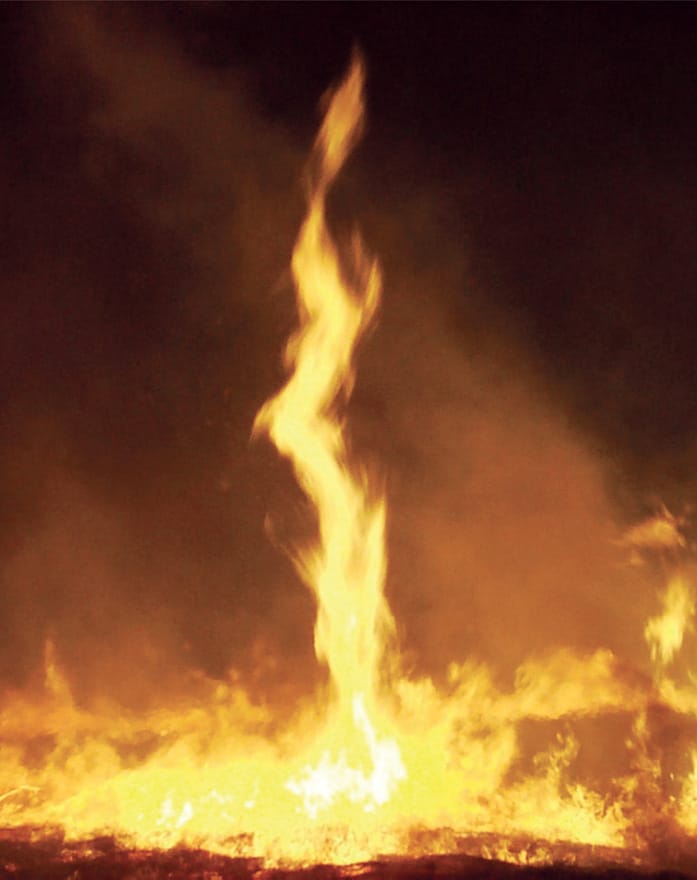
So, basically what happens is you set a fire that’s over a vast area. This is set up by updraft of winds, and you get a rainstorm—this is actually [what occurred in] Hiroshima. And basically, you would get a rainstorm of radioactive black rain that would fall around, downwind of the fire zone. And if people were caught in the streets, the intensity of the fire [Figure 9] would be large enough that there would be tornadoes in the streets. The air temperature would be above the boiling point of water. The air speeds would be a hurricane force. And if you were in the street trying to escape, you would be basically incinerated in the open street. And if you were in a shelter, you would basically be roasted. And I’ll stop there.
I think it’s important that people understand what we are dealing with here. We don’t want this to occur; that’s the point I’m making. And we need to understand the reality in order to generate a sensible amount of concern about what would happen if we let this thing get out of control.