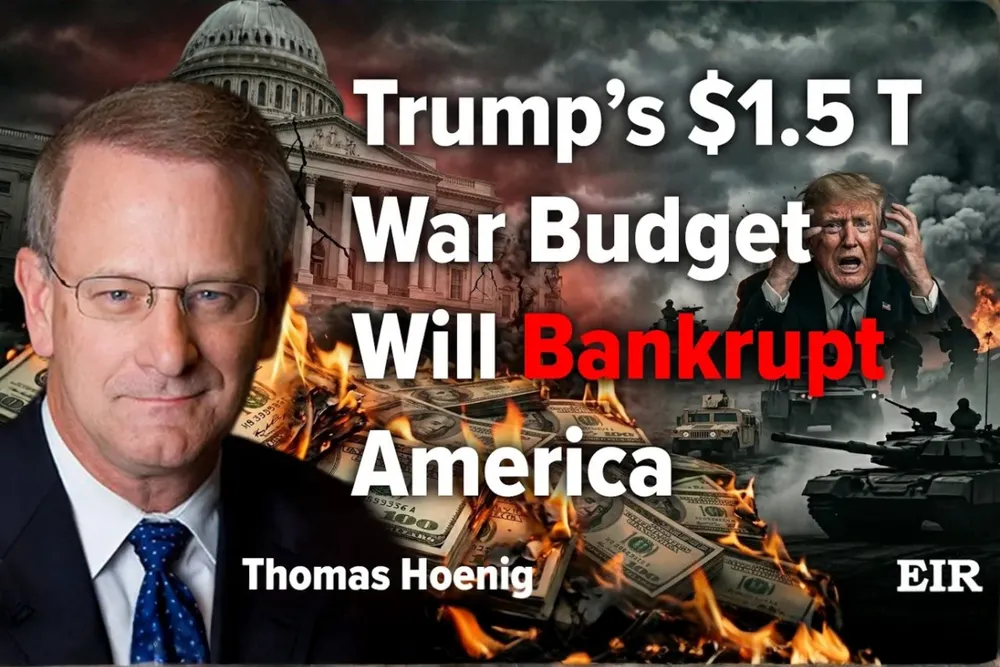
Are We Nearing a Break in the $31 Trillion U.S. Treasury Market? As the U.S. national debt barrels toward $40 trillion, the stability of the global financial system is being called into question.
In this exclusive interview, Paul Gallagher of EIR sits down with Thomas Hoenig, former President of the Kansas City Federal Reserve Bank (1991–2011) and former Vice-Chair of the FDIC, to discuss the "monetization" of debt and the looming threat of a Treasury market crash.
Hoenig, a long-time critic of quantitative easing, warns that the Federal Reserve is once again purchasing massive amounts of new debt issuance—nearly 25% since late 2025—under the guise of "technical adjustments." With foreign buyers like China and Japan pulling back, and the U.S. Treasury shifting heavily toward short-term bills, are we on the verge of a "buyer’s strike" that could spike interest rates and collapse the market?

EIR: I’m speaking this morning with Thomas Hoenig. He was president of the Federal Reserve Bank of Kansas City for some two decades, in the nineties and the first decade of this century, and then after the global financial crash in 2007-08, and the flood of quantitative easing, in 2009 he became vice chair of the Federal Deposit Insurance Corporation for another six years. While at the Fed, he was a governor who consistently voted against quantitative easing—money printing—by the Federal Reserve, sometimes being the only dissenting vote in that regard. Now he is at the Mercatus Center at George Mason University in Virginia.
So, Tom, since you obviously have a great deal of expertise and experience with the Federal Reserve and the U.S. Department of the Treasury and the banking system: Right now, the Federal debt of the United States has crossed or is immediately now crossing 100% of gross domestic product (GDP). And that is debt that does not include the trust funds for Social Security, Medicare, Medicaid, etc. This debt is held by the public. And it has grown, I think in the past five months by another trillion dollars. The debt is growing by more than 4%, nearly four-and-a-half percent, a year, and GDP is growing by less than 2% a year. So, it’s easy to figure out where that is headed, since there’s nothing acting to turn it around.
The Federal Reserve has its own policy, and I wish you would begin by explaining what that policy is at the current time, what the Federal Reserve is actually doing to deal with, or not to deal with, this debt situation.
Thomas Hoenig: Well, the Fed is, deliberately, or by their own volition, monetizing that debt, and helping to further monetize that debt. It has, at its meeting of Dec. 10 [2025], told the world that it was doing a “technical adjustment” to “end quantitative tightening”; that is to stop letting debt run off and begin to purchase debt again—for “liquidity purposes”; when, in fact, what they’ve done is to buy substantial amounts of new issuance of debt—by now, almost 25% of that [since the Dec. 10 meeting—ed.]—and then by buying that, they provide reserves into the banking system, which they can further lever up to help finance the national debt.
So, the Fed is once again in a position of monetizing the debt, helping to further monetize the debt in the private sector. And that, in and of itself, is inflationary as the government spends that money. It goes into deposits, it’s recycled. And there’s a multiplier effect from that, that does add to demand [for Federal debt—ed.]. And I think that’s unfortunate, because by the end of this year, if you look at gross debt—and that includes all these trust funds; they have to claim that, to pay the Social Security recipients at some point. So, if you add that, the debt at the end of this year will be $40 trillion, and the Fed will hold anywhere from 12 to 15% of that debt. That’s as much as foreign countries in aggregate. It’s as much as money markets.
And so, we’re in a really growing debt cycle that can be, will be quite damaging to the economy over time.
EIR: Did you notice that the President, Donald Trump, recently reported, himself, that he had told his Office of Management and Budget Director Russell Vought that the United States Federal government “could not pay Medicare, Medicaid, daycare,” as he put it? And that that would have to be paid by the states? So, clearly there’s a threat there.
Hoenig: Yeah. Well, that’s probably a true statement, in the sense that we cannot continue to borrow to pay all this indexed and automatic growth in our entitlements programs; something has to give. Shifting it to the states won’t solve the problem. Maybe it is another form of finding a way to pay for it, but the states would have to raise taxes, because the states can’t borrow to fund entitlements. So, you could see that there’ll be some kind of a cost-push to the citizens to help pay for it, one way or the other.
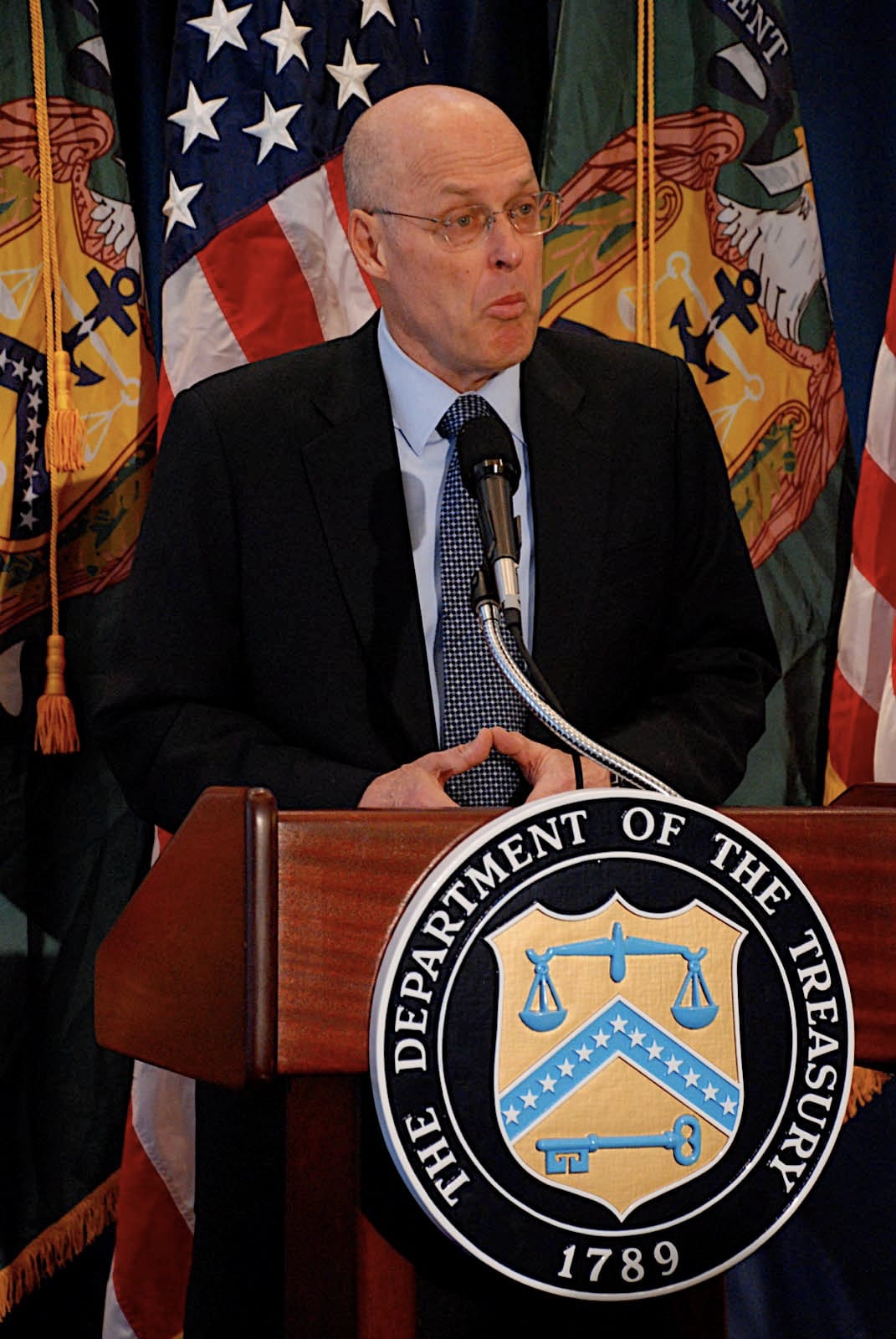
EIR: Now there have recently been—and very recently, in the last few days—a number of warnings about the U.S. Treasury market. One of them, which I think got the most publicity, was from the former Treasury Secretary Henry Paulson, who warned about a sort of a “buyer’s strike” that would gradually develop with both foreign and domestic purchasers of Treasuries, being willing to buy less and less as interest rates keep going up, until that increases the debt. And at a certain point, he foresaw the Federal Reserve having to buy, not 25% of the issuance of debt from the Treasury, but having to buy much higher percentages than that.
There was another warning, I think it came from Bloomberg, that hedge funds have now gotten to a position of 8% of the Treasury market.
And there was a note from the Treasury itself, which suggested that perhaps they [hedge funds] had gotten much further than that, to much more than 8%; the note said that they were significantly undercounting—I think the word was “dramatically undercounting”—the holdings of Federal debt by hedge funds, which, of course, are in that market to speculate with derivatives.
Hoenig: Yep.
EIR: So now, there are at least those warnings. I think they were not the only two. Are we facing a crash in the Treasury market itself?
‘We Are in Danger of Seeing Interest Rates Spike’
Hoenig: I think that we are in danger of seeing interest rates spike. As the Treasury market is oversupplied with debt, number one, we’re seeing some of our allies— One of the advantages for the United States has been a reserve currency status, which has meant foreign countries have wanted to have dollars, and they’re willing to also hold Treasuries as a source of those dollars.
But that is beginning to wane. We’ve seen Japan slow its purchases to some extent. Certainly, Europe is also less inclined. They’re not dumping Treasuries, by any means, but … as a percent of what they held, they’re holding less. China certainly has dropped its holdings of Treasuries and is working very hard to decouple from the dollar. So, there’s a lot of reasons why foreign countries are not as interested in holding more Treasuries. I think Hank Paulson’s right about that.
I also think that the [U.S.-based] banks are full of U.S. Treasuries, and they’re going to keep them very short-term. And that’s one of the reasons the Treasury is issuing very short-term Treasury securities: because they [the banks] have more Treasuries than they really need. If you talk to them, I know that the Fed is, and the Treasury is, indirectly or directly easing the capital standards for banks so that they can hold more Treasuries. So, there’s all kinds of things being done to create a source of demand. That’s what stablecoins is really about, and why the Treasury is supporting that. You have another source there; you think you’re going to get these so-called stablecoin issuers to hold Treasuries. All, all designed to create demand for Treasuries.
And that’s a sign that you’re issuing too many in the first place. I think anyone who holds a long-term Treasury is probably worried—and should be worried—and that’s why you don’t see the demand for it.
So, I think there’s a lot of truth to what Hank Paulson’s saying. I’ve been saying it for some time: … We’re paying a trillion dollars a year now. If interest rates rise—and I think they may if this continues—that means we have a kind of a snowball effect, of the interest becoming a larger portion, growing the debt itself each year…. At a very fast pace. And that’s unfortunate, and I think it will cause us to have a debt crisis somewhere in the future. No one knows exactly when, but we probably are creeping towards it more quickly than some people thought.
EIR: Well, there was another warning of a slightly different kind, reported also, I think by Bloomberg news, that there’s also been ongoing a big shift, on the part of the Treasury, to issuing more and more short-term Bills—that is, one year duration or less. And, a lot of it is less than one year. They cited a figure of $1 trillion [of these] to be issued in 2026, and another $1 trillion in 2027, as being the very-short-term debt that the Treasury would issue. That’s a departure, is it not?
‘It Won’t Get Better with $2 Trillion New Debt a Year’
Hoenig: Well, yes it is. Usually the Treasury tries to spread the maturity structure out on that. And in fact, the Fed holds a great deal of the longer-term Treasuries, and has not been allowing those to roll off as quickly, but the Treasury has been issuing short-term, and I will say this. The Fed has been buying mostly very short-term Treasuries over the last four months when they re-engaged in quantitative easing.
And so, yes—and that’s because as a treasury, you do not want to have the impression of having a difficult time selling your debt.
And if you try to offer 30-year Treasuries, you’re going to have a very poor auction. And I think even one of the 10-year auctions here, recently, was a poor auction. That is, the so-called bid-to-cover ratio [the total value of offers to buy, divided by the total value of Treasuries to be sold—ed.] was lower than they had had in past experiences. So, they’ve shortened and shortened, and I think that’s part of the story of why the Treasury market is not as robust as it once was, and I don’t think it’s going to get better with time as we issue $2 trillion of new debt each year.
And remember, now, there’s two factors here. One, is you have to roll over that maturing debt, and then you have to issue to fund the new debt. So, you have about, what, $9-11 trillion rolling over each year. And then if you have $2 trillion additional, that puts a heavy burden on the markets.
Damaging to the Markets, Damaging to the Citizens
EIR: Well, then in this situation, President Trump is engaging in several wars, which he had said he was not going to do, but that was a promise broken pretty thoroughly a while ago. And in doing so, he has proposed that the United States needs, or that the administration wants, a $1.5 trillion defense budget next fiscal year, starting end of October.
That is in comparison to a defense budget which, so far in U.S. history, has not gone above $1 trillion. So, you’re talking about a 50% increase in a single year. I don’t know if that’s possible. I’d ask you if you think it is possible, but how could that possibly be compensated?
You Can’t Spend a $1.5 Trillion Annual War Budget
Hoenig: I don’t know how it could be compensated, to be honest with you. The only way you could do it is a massive increase in debt. Again, there’s no interest that I can see in paying for it with taxes, in Congress; I don’t think Congress has any interest in increasing taxes at this time. And actually, I don’t think Trump does, either. I think he would prefer to borrow the money to do so. And I think that means incredibly more pressure on interest rates to go up.
When you supply that amount of debt in that short of a period, I can’t see how interest rates can avoid going up under those conditions. Number two, that would also raise the volume of debt. We’d have more than $40 trillion very quickly, of new debt. We’d have maybe $45 trillion before two, or three, years pass, because once you get to $1.5 trillion, you’re not going to come down very easily under the current administration.
So, I think that would be very damaging to the markets, very damaging to the citizens—because with those kinds of interest rates, good luck getting a home to be able to borrow on it.
So, there’s lots of negatives about doing that. And the other factor is increasing your budget by 50%. In that period of time, you can’t spend that. Do you want to expand the war that we have going on? Is that part of what you want to do? Do you want to buy new technology, or new equipment? Who’s going to manufacture it? How do you deploy the contracts in that period of time?
It’s a war budget, and that I think is very hard to avoid corruption that comes with that kind of spending.
EIR: Well, what you just raised is, implicitly, that underneath this vast amount of debt, there should be a rapidly increasing physical-economic production, that is increasing in both production and productivity. Even that, as you say, probably would not support a one-and-a-half-trillion-dollar defense budget.
But there has to be investment in real productivity in the economy, to handle any debt like this. And recently, most capital investment has been in these data centers, and there’s now been some doubt expressed about whether they’re actually going to get built. So, what will we do if that investment push breaks down?
War and Debt vs. Productivity
Hoenig: Well, that means that the debt will be much harder to service, obviously. One of the things that economists have found—and the Congressional Budget Office is also to document it in its own estimates—is that when you load up a nation with debt like this, and you create this amount of interest liability, over time your productivity actually suffers. You know, our economy had a 3% real growth rate, average, for years. It got as high as 4%. We’re now talking 1.8%.

They think that AI, this new artificial intelligence, will somehow raise that, but it’s not going to do so anytime soon. And these data centers, even if they are built and the building of them increases GDP, the building of them, by themselves, doesn’t necessarily increase productivity.
And you’re gambling on whether you will have sufficient productivity at the end of this process, to warrant taking on this kind of debt nationally, and among these companies that are taking on the debt. Debt can be a very useful tool for growth, but excessive debt, like so many things, is anti-growth, in time.
And that’s what I fear may happen: As we increase debt for military reasons, we increase debt for artificial intelligence reasons, we’re not increasing productivity in other industries, which is also necessary. So, we’re making some pretty bold moves here, and I’m not sure they’ve all been thought through.
EIR: Well, there is an idea which has taken hold in both Europe and the United States, as these defense allocations have grown. It’s not only in the United States, but Europe also is acting as if it were preparing to go to war with Russia, and spending special funds of various kinds in order to re-arm.
Along with that has gone the idea, in both continents, that if you want to reverse a decline in productivity in the real economy—clearly there has been, for most of this century, a decline in growth of productivity—that if you want to reverse that, you have to go to defense spending; you have to leverage war contracts to get new productivity. What do you think of that?
Hoenig: I don’t think much of it. I think you can increase GDP by going to that kind of an economy, but that’s not necessarily, in any sense, improved productivity. I’ll give you a better example, and that is, between 1995 and 2000, when we addressed our national debt problem, and we reduced the deficit from whatever the number was, down to zero, and ran a small surplus, the productivity of the U.S. economy increased and averaged about 4%—one of our best growth spurts in decades.
The other time we did it, was in the Fifties, when we were actually downsizing from a major war. We were beginning to focus on domestic product production and so forth. And in the 1950s, when the deficit was brought down to closer to 3% from its very large level, productivity—excuse me, real GDP growth—was again around 4%. So, if you really want to improve productivity, I think what you have to do is manage your debt, get it under control so that then, if you’re an investor, you have more confidence that interest rates will stay stable, that you don’t have to print money and create inflation for growth.
You can, in fact, do it through systematic investment and improvement in productivity across the economy, not just in one industry like defense…. So, I think there’s a much better way. And that is to address a major problem that this nation has, and that is the growing debt, having too much debt, and the need to address that, so that then investment can be directed towards more productive endeavors than paying interest on the debt.
Inflation: ‘Elevated and Rising’
EIR: You’ve been an advocate in the past, of restoring the separation between investment and commercial banks—the Glass-Steagall Act—as it existed from the Thirties to the Nineties—at the same time that I, and the LaRouche movement, were agitating for that change. What role are the banks, especially the bigger banks, playing in this situation you’re describing now, which is obviously a very bad one?
Hoening: Well, the major banks are, you know, they’re really bank holding companies, and they have both their bank and their investment banks—their broker-dealers—under the same corporate umbrella. And right now, the Fed, the [Office of the Comptroller of the Currency] OCC, the [Federal Deposit Insurance Corporation] FDIC are easing the capital standards and the liquidity standards. That allows them to pay out money from the banks who are insured, and are clearly designated as too big to fail. They’re moving that capital over to the broker-dealers. The broker-dealer then is in a better position to fund debt….
EIR: Last question. What do you think is coming out of this current war drive, in terms of inflation?
Hoenig: Well, I think we’re seeing a supply shock. We’ve already had the tariff shock. Now we have this, a war shock, the supply shock of energy prices. That’s the first level, but that works through the rest of the economy.
So, I really do anticipate inflation remaining elevated and rising, as we go through the rest of this year, and even after that. Because you have to restore the productivity of the energy sources, and the infrastructure around that, the movement of materials around that. So, I think we have an inflationary outlook ahead.
The Organization for Economic Cooperation and Development out of Paris, the OECD, their estimates are 4.2% inflation, sometime this year. And I think that’s probably a fairly conservative bet, depending on how long the war goes on, and how long it takes to rebuild from that; and how much money-printing goes on between now and then.
If we have a lot more money-printing, which is happening right now, I think we could see inflation extend well into ’27, ’28. And then the correction will be rather painful.