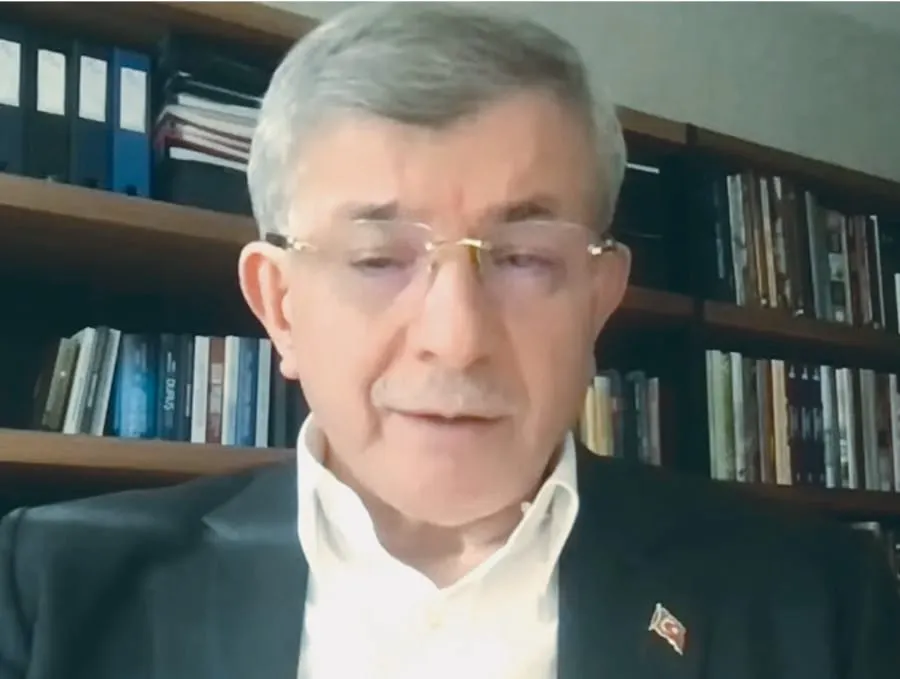
The following remarks were delivered during the May 15 EIR Emergency Roundtable, “The Iran War and the ‘Controlled Disintegration’ of the World Economy.” A detailed overview of the event, which included high-level speakers from around the world, is available here. Ahmet Davutoğlu is the former Minister of Foreign Affairs (2009-2014), and former Prime Minister (2014-2016) of Türkiye. Subheads have been added. The video is available here.
Thank you very much for this excellent organization, roundtable discussion, and inviting me and giving me an opportunity to meet some of my very respected colleagues like Richard Falk. The topic is very important, very strategic, and very timely.
In 2017, I wrote an article, “Systemic Earthquake,” in an e-journal edited by my dear friend Richard Falk. That was the first year of the first President Trump era, and I predicted that the world was going through a systemic crisis, a very comprehensive systemic earthquake, which would shake all of the international structures. Unfortunately, today we are in the midst of this systemic earthquake.
Why do we need an order, especially in economic relations? The economy needs order. Economic relations and progress need order, as Helga has emphasized. The basic term of order is predictability. Without having predictability, you cannot make a plan; you cannot establish a rule of order. So today, President Trump, and Trumpian diplomacy, destroyed predictability. No company, no individual, no state today can predict, not next year, even next month, next week.
I followed President Trump’s and Chinese President Xi’s meetings very closely. There were very good, very pleasant wordings, but I don’t think that the Chinese side was convinced of the real intention of President Trump. Because last year, he declared a trade war against China, and he has been using his terminology, his rhetoric every day. So today, the international order and regional structures are all being shaken. The values—how can we see international order? First, the values, the common values, regardless of continents, economic development, etc. The basic values, as my dear friend Richard mentioned, all the basic values of humanity have been violated in the Gaza genocide. And there was no real response from the leading powers. The global masses, peoples all around the world reacted to this genocide in Gaza. And we also have written a book with Richard on this. So, when these values have been violated, there has been a widespread understanding that you can do anything you want if you have the power. There is no rule. There is not any criterion one has to respect. And these values have been shaken. The international system has been shaken: The Westphalian system [has been shaken].
What Are We Facing Today?
So now, what are we facing today? I want to give you three examples in the last almost six, seven years. The first one was pandemics. Pandemics, in fact, showed us the significance of traditional geopolitics; because the main problem of pandemics, global pandemics and their impact on the global economy, was the issue of logistics and the supply chain. And that has been a big threat to the world population in the transfer of the basic needs of peoples around the world.
The second was the Russia-Ukraine war. And I think it is a great success of Türkiye, that Türkiye established a grain corridor during the war of Russia-Ukraine. And even the African people, African nations, needed grain from Russia and Ukraine. But because of the war, it had been affected. Now, the Istanbul Strait, Dardanelles Strait became the basic life-stream for this grain corridor. Now I want to say, I have seen Helga’s maps. Please imagine certain trade routes, sea routes, and the straits from the north to the south: Istanbul, Dardanelles, Suez Canal, Bab-el-Mandeb, Hormuz Strait, Malacca Strait, and several straits in the Indonesian archipelago. So, if you close these straits, international trade will collapse. Today, the Istanbul Strait, the Bosporus, was critical for the grain corridor. The Hormuz Strait is critical for the energy corridor, but not only as an energy corridor. Some people think about natural gas and LNG, but I think Helga was very right when she referred to fertilizers. Today, in many countries, there is not enough fertilizer to be put on the soil, and that will create a food shortage. So, it is a big crisis.
How can we overcome this crisis? Let me summarize my proposal as a solution to this, which was published in [international non-profit media organization] Project Syndicate two, three weeks back. I am following this very closely as a former Prime Minister, former Minister of Foreign Affairs, and I have close contacts with almost all of the players in the region. Today, we have four basic questions regarding the war. I don’t want to say the war. It is an Israeli-American aggression against the Iranian people, not the Iranian state only, but Iranian cities, Iranian people, Iranian civilization. It was a shame for President Trump to declare that he will destroy a whole civilization. This is inhuman. This is barbarism.
So, what are these four? The first and urgent issue is opening the Hormuz Strait. The second is the nuclear program of Iran and how we can solve it. The third one is the proxy wars, what they’re being called, but basically the absence of a regional security architecture. The fourth, the mother of all problems in the Middle East, is Palestine.
Now, step by step, my proposal is this: First, the Hormuz Strait. Iran has control over the Hormuz Strait and Oman is different from the other [Persian] Gulf countries and is in some sort of dialogue with Iran. Iran has certain rights. Because of this war, it has been attacked without any UN Security Council resolution, without any verified reason for this. Yes, but Iran now is under pressure from many countries that they should open the Hormuz Strait, because it is not only affecting Americans or Israelis, but it affects all the world’s affairs. Many developing countries are suffering as well. And I again agree with Helga: the cost of this war is trillions, not billions.
So, on the other side, the Americans want to control this strait, basically, because of the strategic interest of Israel. Today, there is a clear contradiction between Israeli interests and American interests, and therefore, American public opinion is getting more and more suspicious about Israeli Prime Minister Netanyahu’s war plan. Before Netanyahu, many Israeli Prime Ministers tried to convince American Presidents to attack Iran, but they were wise not to follow these adventurist calls. But unfortunately, Trump, because of his unpredictability, because of his egoistic approach, some sort of psychological problem, he followed Israeli Prime Minister Netanyahu’s advice and suggestions. Now, he is cornered.
In China—can you imagine, the basic global rival power—he begged from Chinese leaders to help him to open the Hormuz Strait? And if it is closed, he even offered LNG to China. So, he needs a solution as well.
And most importantly, of course, are the Gulf countries. This is not a war between Iran and the U.S. only. Other parties which are victims of this are the Gulf countries. And of course, the absent factor is Israel.
Cutting the Gordian Knot
Now, my proposal to open the Hormuz Strait is like a Gordian knot of the Hormuz Strait. If it continues under Iranian full control, that will be an excuse for the Americans to attack Iran. If it is controlled by military force—which is unimaginable, and I don’t think it will happen—but if it is controlled by the Americans, that will be a threat to Iran and to the region as a whole, because unfortunately “America” means Israel. So, there should be a third party for a transitional, temporary control of the Hormuz Strait to open the Strait in order to ease the pressures on the developing countries and other countries, especially regarding the supply chain of energy supply.
Who could these states be? I think it should be such a group of states, not one state. Pakistan? I admire Pakistan’s efforts to find a solution. I wrote letters to several leaders, including Prime Minister Shehbaz Sharif, about this solution. They are doing very well. But one country cannot take this responsibility. My suggestion is four countries who have good relations with Iran, confident relations with Iran, and who have good relations with the Gulf countries, especially with Saudi Arabia, and have some relations, dialogue, and some sort of convincing power over President Trump. These countries might be Pakistan, Indonesia, Malaysia, and Türkiye. Pakistan, Indonesia, and Malaysia are Indian Ocean states. And Türkiye, because of being a neighbor to Iran, could play a role there. If these four countries could guarantee Iran certain measures, I mean, about the absence of attack against Iran—I think these four countries are all members of OIC [Organization of Islamic Cooperation]. They all have good relations with Iran. They all have very good relations with Saudi Arabia and the Gulf countries.
And three of them are members of the Peace Board of Trump, which I am against. This is not a Peace Board; this is a Board of Neocolonialism. But still, first, maybe we can see some benefit out of this. Three countries, Türkiye, Pakistan, and Indonesia are members of the Peace Board. They should say to President Trump that it is time now for peace. We cannot afford war in our region, and we cannot afford another genocide in Palestine and Lebanon. So, I think there is a chance. They can take over this control to guarantee without any military, but a naval mission mandated by a UN Security Council resolution until the other solutions have been resolved. They can function in some sort of facilitating role over the Hormuz Strait.
The second issue is the nuclear program. I fully agree with Richard [Falk]. Throughout my academic and intellectual career, I have always promoted a nuclear-free region. If Israel has nuclear power, nuclear weapons—not only power, but weapons—nobody can say to other countries not to have it. The best option is a nuclear-free Middle East, if it is not possible.
I was the mediator between the IAEA and Iran, and between P5+1 and Iran, and between the United States and Iran, Barack Obama and Ahmadinejad, between the two Presidents, supported by Turkish Prime Minister Recep Tayyip Erdoğan, and Brazilian President Lula da Silva. In 2010, we signed an agreement, the Tehran Agreement. According to this agreement, enriched uranium would have been deposited in Türkiye in exchange for fuel for a peaceful nuclear program in Iran. This was the most viable solution for the crisis. And this was guaranteed by President Barack Obama through a letter to the leaders of Türkiye and Brazil. Unfortunately, the United States didn’t accept this; but that model is still there. Iran, several times from the time of Ayatollah Khomeini until now, repeated that they don’t want to have a nuclear weapon. This is an option.
The third level is a regional security architecture. There should be a new security mechanism between Iran and the Gulf countries as the first layer. The second layer should be a new regional security architecture from Pakistan to Egypt, from Türkiye to Iran and all the Middle East. The fourth is the solution of the Palestinian question. There should be international pressure on Israel to respect UN Security Council and UN General Assembly resolutions. And without solving the Palestinian question, without establishing a viable state of Palestine, there cannot be peace in the Middle East. That is basically the security architecture which I have proposed.
Thank you very much for your patience.