The Lead
Cooperation or (Un)-Controlled Disintegration: The Choice After Beijing
by Jason Ross (EIRNS) — May. 14, 2026
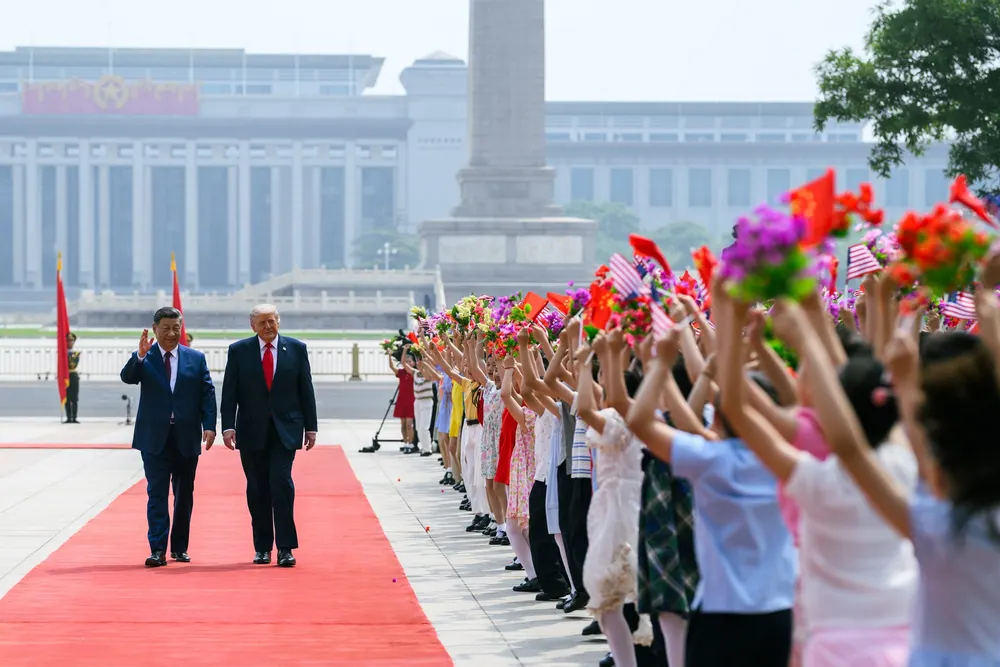
On May 14, Presidents Xi Jinping and Donald Trump met in Beijing and pledged “a constructive China-U.S. relationship of strategic stability”—a three-year framework, an institutionalized economic channel, and a high-level calendar through year’s end. The handshake at the Great Hall of the People was the opening of a possible road back from the brink. On the same day, however, the road in the opposite direction was being constructed in London and Washington. The May 15 EIR Emergency Roundtable will examine the choice between these two roads, and the program required to take the right one.
The Beijing opening was itself made possible by the strategic failure of the U.S.-Israeli war on Iran, which has not delivered the results its planners so confidently projected. Helga Zepp-LaRouche, on her weekly webcast on May 13, named the shift: “The fact that a middle-sized country could withstand the United States, the strongest military machine on the planet, for more than two months—that changes the chessboard strategically completely.” The American doctrine of recent decades—to prevent any country from “bypassing it economically, politically or militarily in terms of strength”—has been falsified in the real world. China watched. So did the Gulf states, which are now, in Zepp-LaRouche’s phrase, “scrambling,” because “the United States bases are not a protection, but a liability.”
The cost of the war that produced this shift, however, is staggering, and most of it is yet to be felt. The damage is the leading exhibit of where the wrong road leads. The World Food Program projects 45 million additional people pushed into acute hunger, taking the global total past 319 million—an all-time record. The total monetary cost of the war, counting destroyed productive capital and foregone output, is on the order of $4 trillion. The Pentagon’s April 29 figure of $25 billion is less than 1% of the true bill. Put another way, military spending can exact costs 100 times greater. Iran’s actions in the Strait of Hormuz, an entirely predictable response, are reverberating through the global economy.
In the mid-1970s, the New York Council on Foreign Relations published 1980s Project which explicitly called for the “controlled disintegration” of the world economy as a means of preserving establishment political control. In November 1978, then-Federal Reserve Chairman Paul Volcker declared in England that “a controlled disintegration in the world economy is a legitimate object for the 1980s” and worked to bring it about. The model exists.
And the same road continues to be built. In Britain, the London-based Council on Geostrategy this month published a report pitching a “sub-strategic” nuclear capability the U.K. has not had since the 1990s, including the tripling of purchases of the U.S.’s nuclear-capable F-35A, in order to add a new “rung” to the escalatory ladder against Russia. In Washington, Energy Secretary Chris Wright has testified that the United States has no technical need to resume explosive nuclear testing—but might do so “for other reasons” of a political nature. The Congressional Budget Office estimates this week that President Trump’s Golden Dome missile-defense program will cost $1.2 trillion over 20 years, and would be incapable of stopping a peer-adversary attack. Each is a deliberate investment, intellectual or financial, in continued strategic escalation, incompatible with a serious reading of the Trump-Xi framework.
Beijing offers a different premise: Real cooperation between the world’s two largest economies is incompatible with controlled disintegration. The Bessent-He Lifeng economic channel, the prospect of a Trade Commission, and the parallel multilateral track at the BRICS Foreign Ministers’ Meeting in New Delhi, and the New Development Bank’s Annual Meeting in Moscow are the architecture of a different road. They are the moves of states acknowledging, as Zepp-LaRouche has put it for four years, that “the present order is clearly disintegrating. So this is now the time for this conception”—a new security and development architecture that, in her words, “must take into account the interest of every single country, or it will not work.”
That conception is the central topic of the May 15 EIR Emergency Roundtable Dialogue, “The Iran War and the ‘Controlled Disintegration’ of the World Economy.” Speakers include Helga Zepp-LaRouche, an Iranian Ambassador, Princeton Professor Richard Falk, former President of Guyana Donald Ramotar, a Brazilian BRICS scholar, Nigerian investigative journalist David Hundeyin, a former Indian government official, and EIR Ibero-American Editor Dennis Small. The Roundtable will be held Friday, May 15 at 11:00 a.m. Eastern Time, online via Zoom and live-streamed on YouTube, with simultaneous interpretation in Spanish, French, and German.
To put the event in perspective, Zepp-LaRouche told her webcast audience: “As long as you participate, you can bring in your ideas and not be somebody sitting on the sidelines, which is a bad idea in times like this.”
The Beijing summit has created an opportunity. EIR’s roundtable provides what is needed next. Tune in; bring others. The hour is late.
Contents
New World Paradigm
- In Beijing, Xi and Trump Pledge a Constructive U.S.-China Relationship (↓)
- International Reactions to the Beijing Summit: Moscow Welcomes, Western Press Searches for Conflict (↓)
- Trump on Historic U.S.-China Relations (↓)
Strategic War Danger
- Chinese Vessels Pass Freely Through Hormuz; White House Frames Xi as Opposing Tolls (↓)
- Another Intelligence Leak Showing Iran Retains Substantial Missile Capabilities (↓)
- The U.K.’s Missing ‘Rung’ on the Nuclear Escalatory Ladder (↓)
- U.S. Official Says No Technical Need for Nuclear Explosive Testing (↓)
Collapsing Imperial System
Harley Schlanger Update
Watch The Daily Update with Harley Schlanger, a short video update available every weekday morning from The LaRouche Organization.