The Lead
EIR May 15 Roundtable: The Iran War and the 'Controlled Disintegration' of the World Economy
by Dennis Small (EIRNS) — May. 10, 2026
EIR will hold an Emergency Roundtable Dialogue on May 15, 2026 at 11:00 a.m. ET.
“The Iran War and the ‘Controlled Disintegration’ of the World Economy”
It is now two and a half months since the Feb. 28 closure of the Strait of Hormuz, a predictable—some would argue intended—result of the unprovoked U.S.-Israeli war of aggression against Iran. If this war continues for another few months, it is likely that the world economy will enter into a spiral of collapse leading into a full-scale global depression, including skyrocketing poverty, hunger, industrial collapse, and population dislocation and forced migration—as well as a guaranteed hyperinflationary blowout of the entire $2.4 quadrillion global financial bubble.
It will make the Great Depression of the 1930s pale in comparison. The closest parallel will be with the New Dark Age of the 14th century, with its notorious Black Death that wiped out up to half of the population of Europe.
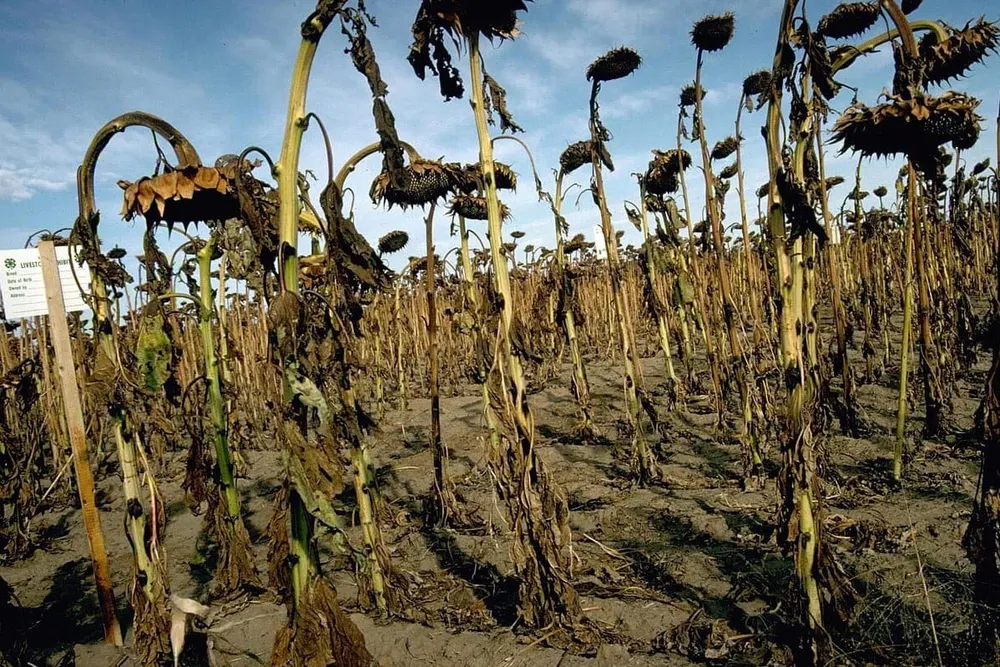
This is because of the massive dislocation of the physical means of survival of billions of people that is well underway, triggered by the closure of the Strait of Hormuz, through which 20% of world oil exports and 30% of the world supply of fertilizer formerly transited. This is already having devastating, non-linear effects:
• World Food Program Deputy Executive Director Carl Skau reported that “an extra 45 million people are projected to be pushed into acute hunger because of rises in food, oil and shipping costs, putting the global tally above its current record level of 319 million…. This would take global hunger levels to an all-time record and it’s a terrible, terrible prospect,” he said.
• Many impoverished nations in east Africa depend on imports of fertilizer for more than 85% of usage. It is estimated that a 10% reduction in fertilizer application will result in up to 25% less rice, corn and wheat there, with devastating human consequences.
• U.S. diesel prices—which is the lifeblood of American farming activity—have soared by more than 50% since the war began, with ripple effects throughout the economy.
• The German industrial economy is in free fall, as a result of the combined effect of the sabotage of the Nord Stream pipeline and now the shortages of gasoline, and especially jet fuel, as a result of the Iran war.
We emphasize physical economy because Man’s productive activity is actually a living process, as the renowned American physical economist Lyndon LaRouche proved scientifically. If one significant area of that process is destroyed, the entirety will tend to collapse in a nonlinear fashion. This is what some observers refer to, simplistically, as a “supply chain” effect.
The real financial cost of the war is also staggering—probably upwards of $4 trillion, according to EIR’s estimates. The Pentagon’s acting comptroller told Congress on April 29 that Operation Epic Fury had cost about $25 billion, but this covered only U.S. munitions and operations through Day 60, with damage to overseas bases explicitly excluded. When that is added in, along with Israeli military expenditures, the total rises to some $200 billion. There is also in the range of $1 trillion in physical damage across Iran and the Gulf states. The IMF’s April Regional Economic Outlook further estimates that as much as 2% of global GDP will also be wiped out by the war—implying $1.5-$2 trillion in lost global output for 2026 alone.
So, $4 trillion is probably on the low side of the real monetary cost of the war to date.
How many productive jobs could be provided if those funds were invested in infrastructure, agriculture and industry? How many bridges, ports and high-speed rail lines could be built? How many lives could be saved by increased investment in hospitals, schools, and essential pharmaceuticals?
Over a longer time period: The war kills hundreds of thousands directly and through cascading food and energy shocks; pushes hundreds of millions into hunger over the next two to three years; and—through the destruction of productive capital and the diversion of $4 trillion from development to destruction and the rebuilding of what once was—could reduce the planet’s mid-century potential population by something on the order of a half-billion to a billion. The war’s most consequential casualties may be people who, had it never been started, would have been born into a more productive global economy and were not.
All of this is clearly unnecessary—but is it also an intentional policy of Malthusian depopulation being implemented by the international financial establishment centered in the City of London and Wall Street? In the mid-1970s, the New York Council on Foreign Relations (CFR)—to this day the premier U.S. Establishment’s foreign policy think-tank and sister organization of Britain’s Royal Institute of International Affairs (RIIA/Chatham House)—published a voluminous study, Project 1980s, which explicitly called for the “controlled disintegration” of the world economy as a means of maintaining their slipping political control. In November 1978, then Federal Reserve Chairman Paul Volcker delivered a speech in England pronouncing that “a controlled disintegration in the world economy is a legitimate object for the 1980s”—and Volcker then proceeded to raise U.S. interest rates to the deadly level of 21.5% in December 1980.
The true economic cost of the Iran war—and the alternative policies to build a new security and development architecture for the world—will be the central topic explored by highly qualified experts at the May 15 EIR Emergency Roundtable Dialogue. Confirmed speakers include:
Helga Zepp-LaRouche (Germany): Editor-in-chief, Executive Intelligence Review; founder, Schiller Institute
H.E. Abolfazl Pasandideh (Iran): Ambassador of the Islamic Republic of Iran to Mexico
Prof. Richard Falk (U.S.): professor emeritus of International Law and Practice at Princeton University
David Hundeyin (Nigeria): investigative journalist, founder, The Spearhead
And others to be announced.
Contents
New World Paradigm
Strategic War Danger
- Iran Responds to Latest U.S. Proposal, Source Confirms (↓)
- Putin Reiterates Russia's Willingness To Take Iran's Enriched Uranium (↓)
- Will 'AUKUS' Become 'JAUKUS'?: Japan, Australia Sign New Defense Agreement (↓)
New World Paradigm
Collapsing Imperial System
- Merz's Criticism of Fico Visit to Moscow Draws Fire (↓)
- Putin Makes Note of European Scrambling To Find an Interlocutor with Russia (↓)
History and Culture
Harley Schlanger Update
Watch The Daily Update with Harley Schlanger, a short video update available every weekday morning from The LaRouche Organization.
In-Depth
New World Paradigm
Putin Underlined Trump's Role in Stopping Planned Ukrainian Provocations on Victory Day
by Bill Jones (EIRNS) — May. 10, 2026
[Speaking to the Russian press on May 9]( http://en.kremlin.ru/events/president/news/79718](http://en.kremlin.ru/events/president/news/79718) Russian President Vladimir Putin underlined the importance of his conversation with U.S. President Donald Trump in preventing the provocations threatened by Volodymyr Zelenskyy on Victory Day. “The issue of May 9 celebrations was raised during my latest telephone conversation with U.S. President Trump. Incidentally, I think he spoke very well about that. He recalled our alliance in the fight against Nazism,” Putin said.
“I told him about my plans to declare a ceasefire on May 8 and 9. Why May 8? Because victory is celebrated in Europe on May 8, and Ukraine has accepted this too, and I think that they now celebrate Victory Day on May 8.
“But this is not important. What matters is that President Trump actively supported that initiative, which we made public a day later. However, our announcement has not produced any reaction. A day or two later, when Kiev considered the matter and saw that the U.S. Administration supported our idea, they saw fit to react to it,” Putin said.
Strategic War Danger
Iran Responds to Latest U.S. Proposal, Source Confirms
by Carl Osgood, Dennis Speed (EIRNS) — May. 10, 2026
Iran has sent its response to the latest U.S. proposal regarding an end to the war to the mediating party, a source at Iran’s Foreign Ministry said. Speaking to Tasnim on Sunday, May 10, the source confirmed that Iran has submitted its reply to the most recent American proposal concerning the termination of the U.S.-Israeli war of aggression. No details about Iran’s response have been released so far.
Iran has repeatedly stressed that, at the current stage, negotiations are focused on the issue of ending the imposed war. Earlier, spokesman for the Iranian Foreign Ministry Esmaeil Baqaei said in an interview with PressTV that Iran’s current priority is clear. “For now, we have decided to focus on ending the war, because this issue is a matter of concern for the entire region, for our nation, and for the international community.”
Putin Reiterates Russia's Willingness To Take Iran's Enriched Uranium
by Dennis Speed (EIRNS) — May. 10, 2026
In reply to a question in his press conference on May 10,, Russian President Vladimir Putin again indicated that Russia would be willing to take Iran’s uranium and to reduce the enrichment. He noted that previously there had been a consensus that Russia would take the enriched uranium and dilute it. ‘Initially everyone agreed, he said “Even the U.S. representatives agreed to that, but then they toughened their position and demanded that it be transferred to the territory of the United States. After that, Iran toughened its position and said they would not transfer the uranium.” Lamenting the loss of Speaker of the Iran Parliament Ali Larijani, who was killed in the U.S.-Israeli bombing, he noted that Larijani had come to him and said “You know, we also have changed our position. Now we are not prepared to send our enriched uranium anywhere. We propose that Russia change the format of the cooperation and establish a joint venture, but on Iranian territory, and there dilute the uranium.” This, however, Putin noted, was not acceptable to either Israel or the U.S.. “That’s exactly what happened, and frankly speaking, we thus reached a dead end.”
He indicated, however, that the Russian proposal was still an option, and that it would secure the oversight of the IAEA in dealing with this issue. “First, everyone would know exactly what materials exist, in what quantity, and where they are located. Second, everything would remain under IAEA supervision. And finally, the process of diluting the uranium would also take place under IAEA oversight, in a transparent and safe manner. For our part, we do not need anything from this. At the same time, we don’t need anything merely to excuse the expression, flex political muscle and claim that nothing can be done without us. We simply want to make our fair share of contribution acceptable to all sides toward easing tensions,” Putin said. “And if this proposal does not suit everyone, then so be it. In any case, we will support any arrangement or solution that helps break the deadlock and opens the path toward a peaceful settlement.”
Will 'AUKUS' Become 'JAUKUS'?: Japan, Australia Sign New Defense Agreement
by Janet West (EIRNS) — May. 10, 2026
On May 4, Australia and Japan signed four new agreements—on defense, critical minerals cooperation (such as rare earth elements), energy, and a joint declaration on economic security cooperation, reported ABC AU news.
Prime Minister Anthony Albanese and Japanese Prime MInister Takaichi Sanae met in Canberra for the talks and signings. They also celebrated the 50th anniversary of the two countries’ signing of the Basic Treaty of Friendship and Cooperation. “Our friendship has never been closer, and in these uncertain times, friendships matter more than ever,” gushed Albanese. The joint declaration asserted that the two countries would maintain close cooperation and active communication regarding actions to be taken in response to geopolitical tensions, or major market disruptions.
The declaration made a not-so-veiled swipe at China by stating, “We express our strong concerns over all forms of economic coercion, and the use of non-market policies and practices that are leading to harmful overcapacity and market distortions, as well as export restrictions, particularly on critical minerals, that could have a significant negative impact on global supply chains.” This refers to China’s dominance in the global supply chain of rare earth elements, having the world’s majority of those resources. Takaichi also noted that the defense ministers of both countries would be exploring “tangible” ways to “further elevate and institutionalize comprehensive security cooperation.”
This is concerning in light of Japan’s military buildup in the recent few years. Al Jazeera reported that:
“In 2022, Japan’s national security strategy was expanded to include ‘counterstrike capabilities,’ which means it can hit back if attacked. As part of this strategy, Japan is due to acquire 400 U.S.-made Tomahawk missiles, which can be launched from submarines and naval vessels.” In August 2025, Australia purchased 11 upgraded Japanese Mogami-class frigates, which were armed with advanced sensors and Tomahawk missiles, according to East Asia Forum. The article suggests that Australia should collaborate with Japan to develop conventional long-range submarines, enabling Japan to complement the AUKUS agreement.
In a major shift away from Japan’s defense strategy of 1947—when it formally renounced the use of war to settle international disputes—during March 2026, Japan deployed long-range missiles to the Kumamoto Prefecture on the southwest coast of the island of Kyushu, which are capable of hitting China. Ominously, Bloody King Charles, in his address to the U.S. Congress on April 28, 2026, praised AUKUS as the “most ambitious submarine program in history” and reminded his audience that Australia is “a country of which I am also immensely proud to serve as Sovereign,” leaving no doubt as to who is really in command in Australia.
New World Paradigm
Slovakia's Fico Gives a Lesson in Statecraft
by Gretchen Small (EIRNS) — May. 10, 2026
Slovakia’s Prime Minister Robert Fico is a serious statesman, who does not give a damn about what bellicose European “repeat after me” politicians say about his visit to Moscow to mark Victory Day over the Nazis. He chuckled when Russian reporters told him, after he laid a wreath at the Tomb of the Unknown Soldiers, that no other European leader would do what he had just done. “There are always a few ‘black sheep’ in the European Union family, and I belong to that herd,” Fico replied. “I am opposed to a single mandatory viewpoint. I think this approach is very wrong, and I often express opinions that do not align with this one `correct’ political viewpoint that we are supposed to uphold….
“The main reason I am here is that it is an indisputable historical fact that it was the peoples of the former Soviet Union, and particularly those of today’s Russian Federation, who paid the highest price in the fight against fascism and in World War II,” he declared. He recalled that there were “tens of thousands of young people” who died in the battles to defeat fascism—young people who were only 18, 19, 20 years old.
To not acknowledge that is “a denial of history…. I try to show respect to everyone who contributed to the fall of fascism,” he added. Fico reported that he intends to go to Normandy for the anniversary of the opening of the Second Front, and the day before going to Moscow he had visited the Dachau concentration camp in Germany, where thousands of Red Army members had been executed, “just in that one place.”
Question: In Europe, who even says such things?
His answer: “Better one than none. I have no reason, neither at my age nor given everything I’ve been through, to change history that cannot be undone. And I am all the more convinced of my views, because two years ago they wanted to shoot me in Slovakia, and not because I stole someone’s wife, but because of my clear stances and views—my political views. That’s why. So believe me, I had absolutely no problem deciding to come here to Moscow for these celebrations….
“Despite the critical and crisis-ridden atmosphere in Europe, I am a politician who prefers dialogue over strong words; I care about normal, friendly, and standard relations between the Russian Federation and the Slovak Republic.”
That policy applies equally to relations with all of Slovakia’s neighbors. Asked about Hungary’s new Prime Minister Péter Magyar, Fico said he is looking forward to meeting and working with him just as he had with Viktor Orbán; “in Slovakia, we say that having a bad neighbor is worse than having your house burn down.”
Brussels may deny it, but Fico made clear he is not the sole “black sheep” in the EU. He reported that when he meets with Putin, he “will convey some messages, because several European politicians have taken an interest in this trip.”
China Attempts To 'Pour Oil on Troubled Waters'
by Janet West (EIRNS) — May. 10, 2026
During the first several months of 2026, China’s President Xi Jinping has encouraged major diplomatic efforts in an attempt to provide leadership to a dangerous strategic picture, noted Xinhua.
This year is significant, since it is the 30th anniversary of the China-Russia strategic partnership and the 25th anniversary of the signing of the China-Russa Treaty of Good-Neighborliness and Friendly Cooperation. Additionally, China will host the APEC Economic Leaders’ Meeting (Nov. 18-19) and the U.S. will host the G20 Summit (Dec. 14-15).
During January, China hosted the President of the Republic of Korea Lee Jae Myung, and the Taoiseach (Prime Minister) of Ireland Micheal Martin, the first such visit in 14 years by an Irish Taoiseach; Martin visited an Irish R&D company in Shanghai and encouraged Ireland-China economic cooperation.
In February, German Chancellor Friedrich Merz flew to Hangzhou, Zhejiang Province, accompanied by about 30 senior executives of German companies, reported DW media. While voicing concerns about the trade deficit between the two countries, Merz also signed several MoUs, which covered sectors like automotive, machinery, energy, logistics, finance, and agricultural exports, aimed at stabilizing economic ties.
During April, Xi met with Sheikh Khaled bin Mohamed bin Zayed Al Nahyan, Crown Prince of Abu Dhabi, the United Arab Emirates, and made several proposals to promote peaceful development in the region, and later that month met with Mozambican President Daniel Chapo, underscoring China’s willingness to work with African nations for economic development.
“We need to safeguard the UN-centered international system and the international order underpinned by international law, promote an equal and orderly multipolar world and a universally beneficial and inclusive economic globalization, and foster the building of a community with a shared future for humanity,” Xi said during his meeting with Spanish Prime Minister Pedro Sánchez on April 14, noted Xinhua.
Collapsing Imperial System
Merz's Criticism of Fico Visit to Moscow Draws Fire
by Janet West (EIRNS) — May. 10, 2026
Slovakia’s Prime Minister Robert Fico visited Moscow for the Victory Day celebrations on May 9—the only EU leader to do so—and met with Russian President Vladimir Putin at the Kremlin, but didn’t attend the Victory Day parade, reported Euractiv. He did, however, lay a wreath of flowers at the Tomb of the Unknown Soldier.
Slovakia has maintained friendly ties to Russia and is dependent upon Russian oil. Earlier this year, it reiterated its opposition to providing any military support to Ukraine, although it has supported humanitarian aid. It has faced tremendous pressure from the so-called Coalition of the Willing. Several countries—Estonia, Latvia, Lithuania, and Poland—refused permission for Fico’s plane to use their airspace while he travelled to Moscow for the Victory Day event.
German Chancellor Friedrich Merz spoke on May 9 at a press conference during a visit to Stockholm, and not only reiterated his support for NATO, but sharply criticized Fico’s visit to Moscow, reported the Brussels Times. “Robert Fico knows this is not our shared view. I deeply regret his attendance, and we will discuss his visit to Moscow with him,” said Merz.
Russian Foreign Ministry spokeswoman Maria Zakharova responded swiftly to Merz’s remarks, noting in coverage by Sputnik that “There would be no Europe Day without the victory of the Soviet people. There would be nothing but a vast concentration camp with gas chambers,” in reference to the defeat of Nazi Germany and the crucial role played by the Soviet Union in doing so.
Putin Makes Note of European Scrambling To Find an Interlocutor with Russia
by Bill Jones (EIRNS) — May. 10, 2026
In his May 9 press conference after the Victory Day celebrations, Russia President Vladimir Putin did not mince words about the dangers from Europe, or the growth of the revanchist tendencies in Germany and other European capitals. At the same time, he noted the various signals coming from Europe with regard to their growing need to establish some sort of productive contact with Russia.
Putin responded to one reporter, who asked about the increasing provocations coming through the Baltic region, indicating specific strikes having been made deep in Russia, some of which came through Baltic airspace. He asked if Russia should not expand its “buffer zones” in Ukraine. Putin replied, “You have answered your own question. Our objective is to ensure that no one can threaten Russia. That is what we will continue to pursue.
“We know that Ukraine receives technology from Europe and that some systems are assembled there. They are playing for the upper hand, but judging by what has just been said, they are already seeking contacts with us, realising that this play for the upper hand could be costly,” said Putin.
By “what has just been said,” Putin was referring to recent statements by the European Council seeking a “candidate” to be in contact with Russia. He also noted that Gerhard Schröder would be an ideal candidate for such contact, but otherwise, it would have to “be a leader that has not badmouthed Russia.”
History and Culture
May 8, Commemoration of the Victory Over the Nazis: The Parade Of Immortals
by Christine Bierre (EIRNS) — May. 10, 2026
The victory over Nazism on May 8th 1945 was celebrated in France with a traditional parade, organized by the Russian Embassy, in collaboration with various organizations, and Communists, Gaullistes, and patriots whose ancestors fought in the Resistance.
Among the participants were the descendants of those who gave their lives in this struggle, who marched in the parade carrying the portraits of their ancestors killed by the Nazis in the war. The parade started close to the Republic Plaza and walked all the way to the Cimetière du Père-Lachaise, where French, European and Soviet Resistance fighters are buried, in collective and other tombs.
A phenomenon of note is the fact that as many as 100,000 Soviets, who had been captured by the Nazis, fled the Wehrmacht and joined the Resistance in France. A tomb is dedicated to them at Père Lachaise Cemetery. It is there that Jacques Cheminade, president of French political party Solidarité et Progrès, presented the following speech. Prior to that, the parade had stopped before other tombs commemorating the victory at the cemetery: tombs of French and Western Resistance fighters where our friend Col. Alain Corvez (ret.) gave a short speech, as did the spokesman of the Party for the Renaissance of Communism (PRCF), two of whose main leaders, both resistants such as Léon Landini, passed away this year, shortly before their 100 year birthdays. Solidarité et Progrès members, which was among the parade’s organizers, were also present.
Here is the speech by Jacques Cheminade, President of Solidarity & Progress, presented at the monument commemorating some 35,000 Soviet Resistance fighters against the Nazis in France:
“All those who have dedicated their lives to a just cause carry a share of immortality. We owe them.
“First, we owe it to them to remember their struggle, in these times when their history is forgotten, and, even worse, when the enemies of humanity try to minimize or disfigure it.
“Here, these immortals are the Soviet Resistance fighters who fought in France and for France, approximately 35,000 prisoners of war who escaped and joined our Resistance. Those who participated in the liberation of Lyon, Montpellier, Toulouse, Clermont-Ferrand, Paris, and Nîmes, as well as Oléron. There is Georgy Ponomarev creating the first detachment of Soviet patriots in France, the Stalingrad detachment. There is Stephan Kotsour sacrificing his life to save his comrades and enable the liberation of Lagon. There is the Jacquou le Croquant detachment, with Victor Alexeenko and Sacha Khatogounov. There is the maquis of the Massif Central, where my family comes from, and among them, the ‘Soviet maquis.’ There is the detachment of young Russian women Resistance fighters in eastern France.
“Those intellectuals and religious figures, who died in combat: Boris Vildé, shot in 1942; Mother Marie Skobtsov, who died at Ravensbrück; and Princess Obolensky, beheaded by the Nazis. Here, too, lies the memory of [Régiment de Chasse 2/30] Normandie-Niemen, of Maurice de Seynes, who sacrificed his life trying to save his Russian mechanic.
“For them and so many others, our memory must refuse to fade. Not with vain nostalgia, but with the determination they bequeathed to us.
“Because memory alone is not enough. Today, the whole world is rearming, and from Gaza and Iran to Ukraine, where our European countries are waging a proxy war, reality challenges us. Even more so than last year, when we were here together, the time has come to commit ourselves, as our elders did, hoping for the victory of the cause of humanity.
“It is the spirit of the National Council of the Resistance that each and every one of us owes to them to revive. I think that if this soldier could see and hear us, he would tell us that there is an urgent need. An urgent need to commit ourselves to peace, development, and mutual security. Here, on the base, we read, ‘The nation remembers.’ This soldier is the image of all those who died for peace, justice, and victory. As for them in their time, the moment of common salvation has come. In our age of nuclear weapons, we should have hundreds of thousands in our streets and squares against war and to build peace. This is what remembrance should inspire. That this is not the case can only awaken our conscience and inspire our commitment.”