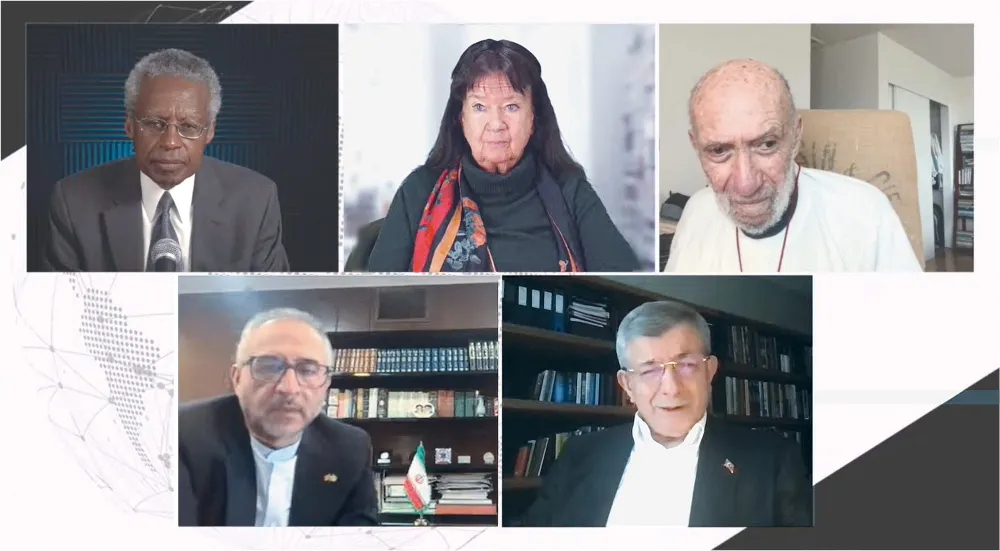
The following is the discussion that occurred during the first part of the May 15 EIR Emergency Roundtable, “The Iran War and the ‘Controlled Disintegration’ of the World Economy.” The video is available here.
Helga Zepp-LaRouche: I find the proposals by you, Mr. Davutoğlu, extremely useful. Because I think if these countries you named—Indonesia, Malaysia, Pakistan, Türkiye—cooperate, you already represent a very sizable part of the Muslim world. And I would just really suggest, you know, why not take what you propose and add to what I was proposing about the Oasis Plan? Because the business model of the [Persian] Gulf States clearly is damaged, to say the least. It was based on the idea that you had a small establishment living in great wealth. Much of the labor was done by guest workers, and the whole project was protected by U.S. [military] bases, or so they thought. Now it has turned out that these U.S. bases did not protect these countries, but became a liability.
So, these countries have to rethink what their future will be. Israel has to rethink, as I said; in the IDF [Israel Defense Forces] and the security services, there is a debate if the present policy is viable or leading to the potential destruction of Israel. Likewise, Afghanistan, Iraq, Syria, Yemen, Lebanon, all of these countries have been destroyed by previous interventionist wars. They need urgent reconstruction. Afghanistan, for example, after 20 years of NATO, was left in the worst humanitarian crisis on Earth, according to the WHO. It’s still not better. Iraq is still in shambles. Why not have the four governments you are mentioning—Türkiye, Indonesia, Malaysia, and Pakistan—suggest seriously to put a joint development perspective on the table?
The Gulf States have enormous sovereign wealth funds, which they wanted to invest in some useful projects like recreating museums and other things; but also, to have ski resorts in the desert, which I don’t think makes so much sense. You could use the same money to invest in the well-being of the people, including the guest workers, whom they probably will need for the indefinite future, and build up a real economy for the benefit of all people. That is, in my view, the only way the conflict between Israel and Palestine can ever be overcome, because you have to have a model which serves the interests of each.
And given the fact that it was mentioned by several people that we are in a systemic crisis, I think that model for the Middle East must really be applied for the whole world. I mentioned the Africa 2063 plan. Ukraine needed reconstruction before the war broke out. Ukraine could have been the bridge between Asia and Europe in the context of the Belt and Road Initiative. Now, maybe with the visit of President Trump to China, and the—at least for now—good resonance between President Xi Jinping and Trump, maybe that moment can be used to launch an initiative to really change the fate of the world. But bold action is necessary.
So, my concrete suggestion to you would be, can you not approach these four governments and suggest that your proposal and my proposal be joined?
Ahmet Davutoğlu: I think I fully agree. The best way of peace is economic interdependency. There is no other way. You can sign peace plans, you can make many declarations, but the best way of peace is economic interdependency. Whenever you have economic interdependency, nobody will be starting a war. So, economic interdependency means development. French and German armies invaded Berlin and Paris for many centuries. When they realized that there is a need for a new approach after the Second World War, they created the EU as an economic interdependency. Similarly, now we need to have regional economic development projects.
When I was [Türkiye’s] Minister of Foreign Affairs, I declared the Mesopotamian Economic Integration Process of Türkiye, Iraq, Syria, and Iran. Also, another project was the Levantine project [also known as the Levant Quartet—ed.], Türkiye, Syria, Lebanon, and Jordan. So, today one of the best models of regional economic cooperation was the GCC [Gulf Cooperation Council] and ASEAN. Unfortunately, today the GCC is dysfunctional; and the GCC as a totality had certain agreements with Iran. For example, the United Arab Emirates today attacked Iran, but they had close economic ties. Now, this system has fallen—has been destroyed by these attacks.
I fully agree with you about American bases in the Gulf. Yes, it is a liability, but I can assure you the Americans can declare that they are withdrawing their bases. What will they do? These bases will be national bases of the Gulf States, and the United States will send some advisors, and will sell trillions of dollars worth of weapons, F-35s, to these countries just to escalate. We should not forget this. They provoked Iraqi President Saddam Hussein against Iran, then they destroyed Saddam.
So, this logic of war is very dangerous. But I fully agree with you. Therefore, when I proposed this, I made this proposal— I sent letters to Iranian President Masoud Pezeshkian, in fact, three letters during this war. And even before the war, during the negotiations in Oman— I sent my suggestions to the Iranian ambassador when he invited me to the embassy, asking my opinion to be sent to President Pezeshkian. And I insisted that Iran should be around the table of negotiations, because the main reason for Trump is to win the midterm election.
I also sent letters to Pakistani Prime Minister Shehbaz Sharif, who is my close friend, to Anwar Ibrahim, Malaysian Prime Minister, he’s also my very close friend, and Indonesian President Prabowo Subianto. And of course, I sent this to the Turkish President Recep Tayyip Erdoğan as well. I don’t know how they will react, but we have to be creative. This is a deadlock. In deadlock, everybody wants to keep the status quo. But in fact, those who are breaking the status quo can bring peace.
And lastly, without taking the floor too long, I agree with you. With this, Iran has the right of compensation. When Iran says we need compensation—yes, there was no reason for this war. But the compensation should not be from the Gulf States only, because the Gulf States didn’t decide for the war. They found themselves in a war. Who started the war? Israel and the United States.
Today, what I am scared of is that— And I want to tell the Iranian ambassador from Mexico, as well. And yesterday, I sent two video messages to two international conferences in Iran, sending my messages. At any time, Israel and the United States may withdraw—or they may change the attention to another crisis point. In January, we were talking about Venezuela. There is no Venezuela today. They can make another attraction, but the crisis between the Gulf States and Iran may continue there.
Against this, there should be a new fund of cooperation, a regional economic fund, let me say, to be beneficial to this new energy flow or the new system. And my suggestion to the Iranian brothers as well is—instead of just asking for certain payments from the Strait of Hormuz, there should be a much more comprehensive economic plan to overcome this crisis. My friend, the Iranian former Minister of Foreign Affairs, Manouchehr Mottaki, came to see me in Istanbul. He came to Van, in Eastern Anatolia, by car, by bus or by car. From there, he used an airplane. They said that many bridges on the way were destroyed. So today, there has been huge destruction in Iran. There has been destruction in the Gulf States as well.
Who is responsible for this? The clear answer is Trump and Israeli Prime Minister Benjamin Netanyahu. And against these two people, there should be a regional belonging, supporting each other. And I fully share your opinion; and we can bring these proposals together, a geopolitical solution framework, as well as a developmental, visionary project together.
Amb. Abolfazl Pasandideh: [via translator] A very important point in this matter. First, before anything else, I would like to thank Foreign Minister Davutoğlu for his correct analysis. And similarly, my thanks to the panelists who are participating.
I think that the world has to reach this conclusion, because you cannot deal with a double standard facing the world. And obviously, humanity needs to see benefits for everybody so that we can bring about peace. Any kind of solution which is done under pressure is not going to be a lasting solution.
If countries are quiet before these kinds of crises and these kinds of challenges, that silence will be damaging to them as well. And obviously, if that silence is continued, we could even reach a situation of shortages of food itself. We all have to reach this kind of conclusion and to know that we are all in the same ship; we are all passengers on the same ship. If we decide to drill a hole in the boat, it’s going to be very bad for all of us. So, in this case, we do have a bad character and a good character—but there’s no such thing as a good and a bad terrorist. We know that they are the ones who are provoking this. They are the ones who are damaging all of humanity and Iran.
If we are to reach peace, we need to do this in every area and every part of the world. We see today that the Israelis are carrying out a holocaust, just like the previous holocaust was terrible.
My opinion is as follows: My suggestion is that if the entire world coordinates, through that we can achieve peace. Thank you very much for all of your considerations.
And I would especially like to thank Helga Zepp-LaRouche and also Mr. Dennis Small, who helped coordinate this roundtable that we’re participating in. If you allow us, since we also have another meeting, we are forced to say goodbye to you all today, right now, and we thank you. And truly, this was a real class for me, all of the analyses which have been presented today.
Prof. Richard Falk: I wanted to comment briefly on one aspect of my friend Ahmet Davutoğlu’s very creative and important proposal of a multi-dimensional approach to this present crisis and combined with Helga’s developmental focus on the Oasis Plan and the idea of creating a structure of mutual benefits derived from economic interdependence. My question to you, Ahmet, is, you are, in a sense, in the first part of your proposal, punishing Iran by removing its only effective measure of countermeasure, which we should remember is a non-military one; but it is one that has led to Trump, at least, seeking this off-ramp. And there is no basis for trusting the international community to come to the rescue of Iran should Israel resume in another few months a further attack and an attempt to achieve regime change.
So, is it reasonable to expect Iran to forfeit its one means of effective protection without some corresponding tangible indication of a changed view of security on the part of the U.S.?
Davutoğlu: Thank you, Richard. You are always very creative, and you are bringing new dimensions to all these issues. When I thought about this proposal, I also thought about what the Iranian response would be. In my proposal, I said these four countries will take this mission in coordination with Iran, not just in coordination with Iran and Oman, because the other side [of the Strait] is Oman. And a UN Security Council mandate should be given. In that UN Security Council resolution, there should be a clear guarantee that during this mission, there will be no attack against Iran, neither by the U.S. nor Israel. This will not be a permanent solution. This will not be a permanent regime of a formal state. This will be just a temporary solution just to allow all the sides to negotiate on the matters for a sustainable system.
Falk: Would you trust that guarantee if you were an Iranian?
Davutoğlu: If there is no guarantee, then these four countries will withdraw, and Iran will take over the Strait again. Iran will not lose anything there. If the U.S. or Israel will not fulfill their promises, these four countries will say to President Trump and the UN Security Council that if there is any single attack, if there is any single tension, they will withdraw their mission. And in Iran, the status quo of today will come back.
I remember my mediation during the Israel-Syria peace process in 2008. I put conditions to Israel and Syria—two conditions. One, to Israel, you will not do anything, any aggression in the West Bank and Gaza. And I put conditions to the Syrian side— You will not provoke anything in Lebanon. So, for almost eight months, when there were these indirect negotiations continuing, there was a calm in Lebanon and Gaza.
Similarly, now, these four countries will say, if there is any single attack, aggression against Iran, we will not do this mission. And Iran is the only country controlling there. They will take over this strait again. And this status quo will prevail.
Speed: I’m very sorry, but we have to conclude the discussion now. Helga, you wanted to say something?
Zepp-LaRouche: One minute. I would like to address all the panelists, including those who are leaving now, that I would suggest that we take this result that we have accomplished so far, which obviously is very preliminary; but nevertheless, it is a concrete proposal. Because in 11 days from now [on May 26], there will be in the UN Security Council, a special conference organized by China, who is the chair this month of the UN Security Council, to discuss the need to uphold the principles of the UN Charter.
And I think given the fact that the whole world order is in disarray, maybe if we can agree from this panel to make a motion to the UN Security Council discussion, to adopt what we are discussing here, then it may catapult the whole discussion on a better level.
Speed: Thank you. I think that probably is unanimously supported. Again gentlemen, thank you very much for what you’ve said so far. If you are able to stay, that will be very good.