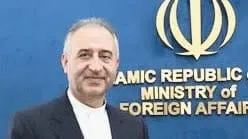
The following remarks were delivered during the May 15 EIR Emergency Roundtable, “The Iran War and the ‘Controlled Disintegration’ of the World Economy.” A detailed overview of the event, which included high-level speakers from around the world, is available here. Abolfazl Pasandideh is the ambassador of the Islamic Republic of Iran to Mexico. The video is available here.
Ladies and Gentlemen, distinguished scholars, thinkers, and honored guests. Allow me to begin with an undeniable reality: In today’s interconnected world, no major war remains limited to geographic borders. War does not only destroy cities and infrastructure; it also damages the global economy, food security, the environment, cultural heritage, and even the psychological stability of the international community.
Today, we are no longer speaking about a “possible war.” We are speaking about a war that began on February 28, 2026, and for nearly 40 days placed the region and the world under severe tension. It was a war that proved that the cost of military conflict in the 21st Century goes far beyond the battlefield.
The military attack by the United States and Israel against Iran was not only a regional crisis; it also created a major shock to the global economy. The conflict quickly affected energy markets, transportation, international trade, and financial markets. Its effects were felt everywhere—from global stock exchanges to the daily lives of ordinary people around the world. Because of its geopolitical position and the strategic importance of the Strait of Hormuz, Iran plays a key role in global energy security. A large part of the world’s oil and gas exports passes through this area. When the war began and insecurity increased in the region, the global energy market faced a serious crisis, and oil prices rose sharply in a very short time.
But the problem was not only the rise in oil and gasoline prices. Higher energy prices also increased the cost of global transportation—from shipping and trade to aviation and supply chains. As a result, the prices of food, medicine, basic goods, and services increased in many countries. Developing countries and vulnerable populations suffered the most, while the risk of food insecurity and shortages of essential goods increased in different parts of the world.
This war showed how fragile the global economy really is and how much international stability depends on peace in the Middle East. The damage to the real physical economy was also severe. Important infrastructure, industrial centers, energy facilities, transportation networks, and civilian structures were damaged. Global supply chains were disrupted, and financial markets faced uncertainty, capital flight, and declining investor confidence.
According to economic estimates, the direct and indirect costs of this war for the United States reached tens of billions of dollars. Pressure on the military budget, higher energy costs, market instability, and rising inflation created a heavy burden on the American economy. This war once again showed that even major powers are not protected from the economic consequences of large-scale conflicts. Israel also suffered serious losses. Military expenses, economic disruption, lower investment, a decline in tourism, and growing security pressures had major effects on its economy and society. Iran, too, faced serious human and economic losses. Infrastructure, economic facilities, and the daily lives of millions of people were affected.
Yet this war revealed one important truth: No complex regional crisis can truly be solved through war and destruction.
Ladies and Gentlemen, alongside the economic damage, the world also witnessed losses that may never be fully repaired. The regional environment suffered greatly. Pollution in the Persian Gulf, fires, toxic materials, and damage to ecosystems are not problems limited to today; they will also affect future generations. In addition, Iran is one of the oldest centers of human civilization. Its historical and cultural sites are part of the shared heritage of humanity. Threats against Iranian cultural heritage—from Persepolis and Pasargadae to Naqsh-e Jahan Square and other UNESCO sites—were not only threats against one nation, but against the historical and cultural memory of mankind.
Perhaps the most important lesson of this war is that continuing the path of confrontation and militarism could push the world toward a dangerous period of global recession and economic depression—a crisis that would be extremely difficult to control. If wars, sanctions, and instability become the dominant trend in international relations, the world economy will face long-term inflation, lower investment, disruption of trade, rising public debt, and growing poverty and inequality. Such a situation would threaten not only economic security, but also social and political stability around the world.
Allow me to highlight one important point. Imagine where the world could be today if, instead of war and confrontation, the path of dialogue and peace had been chosen. If President Donald Trump, instead of encouraging military escalation, had supported lasting negotiations and diplomatic solutions, billions of dollars spent on weapons and destruction could have been invested in economic development, fighting poverty, education, healthcare, scientific innovation, and climate change. In that case, global markets would have enjoyed greater stability, energy prices would have remained under control, international trade would have suffered less damage, and the world economy would not be facing this level of uncertainty and anxiety.
Peace is not only a moral value; peace is a strategic and economic necessity for the survival of humanity. Today, the international community stands before a historic choice: to continue the cycle of wars and crises, or to move toward dialogue, multilateral cooperation, mutual respect, and collective security.
We believe that the future of humanity will not be decided by missiles and wars, but by wisdom, cooperation, and dialogue among nations. Thank you very much for your attention.