The following article is republished with permission from the author, and from the NachDenkSeiten website, where it was posted May 18. Stephan Ossenkopp, Schiller Institute–Germany representative in Berlin, is editor of the blog, Die Multipolare Welt.
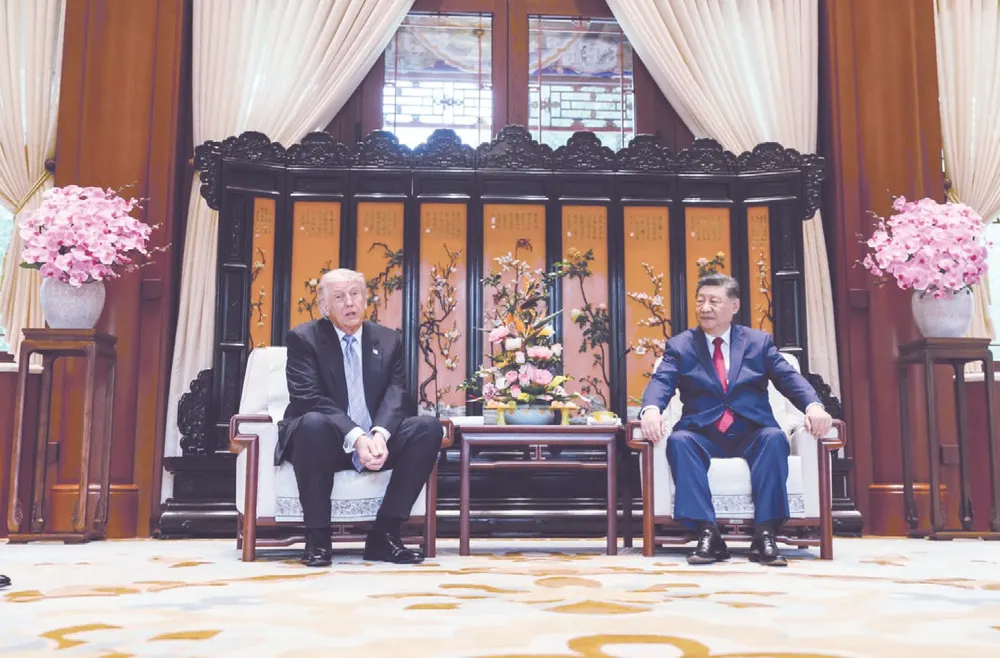
May 18—The visit of U.S. President Donald Trump, accompanied by a large part of his Cabinet and a substantial delegation of business leaders, has generated a flood of images and video clips. Major Chinese newspapers have published extensive special sections, photo spreads, and feature articles. Douyin, the Chinese equivalent of TikTok, is littered with snippets of the various encounters. These range from the visit to the Temple of Heaven to selfies taken at dinner—for example, between American entrepreneur Elon Musk and Lei Jun, the CEO of the Chinese tech giant Xiaomi, who is also a multi-billionaire. Particularly noteworthy was the scene in which the Chinese President took his American guest to the otherwise inaccessible government district. “Some of these trees are 150 to 200 years old,” Xi told the astonished Trump. “This one over there is even 400 years old.” Trump replied, “Can trees really get that old here?” Xi nodded emphatically. This is Chinese soft power: continuity and appreciation.
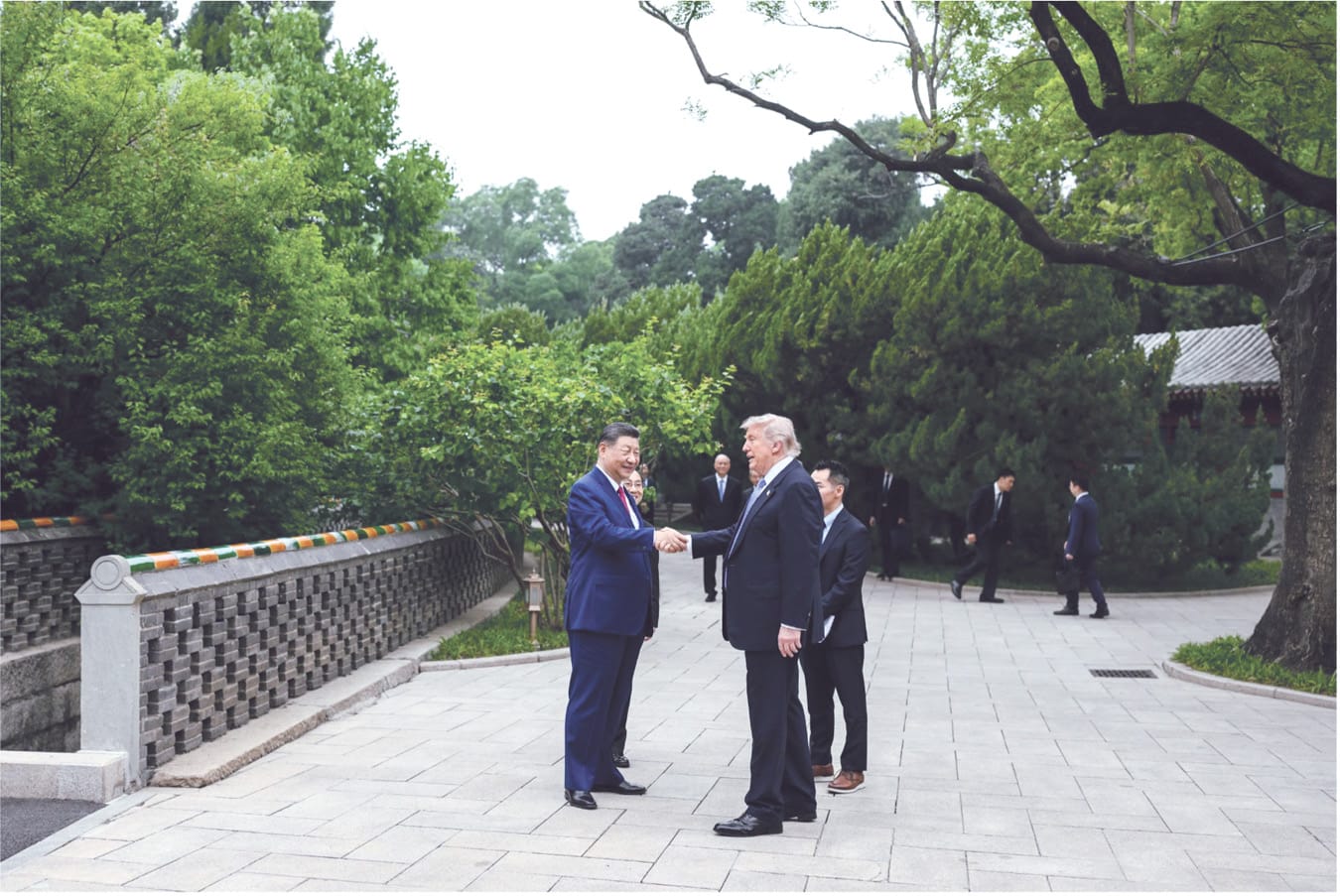
The Zhongnanhai government complex was originally an imperial recreation park 400 years ago, featuring a central (zhong) and a southern (nan) lake (hai). After the fall of the last dynasty, this district served as the seat of various governments. With the founding of the People’s Republic of China, Mao Zedong moved in, and since then, this place has been the political heart of the country. The President, the Premier, and the Central Committee of the Communist Party have their official residences here, and use the venue for crucial meetings and assemblies. Chinese media considered it significant that Donald Trump was able to engage in a quiet and informal dialogue with the Chinese President at this particular site. Xi then showed Trump the Temple of Heaven, a symbolic and ceremonial site that, in Chinese interpretation, represents the relationship between heaven, ruler, and state. Its origins date back to the early 15th Century. Trump was visibly impressed by Xi’s personal tour: “A magnificent place, incredible. China is beautiful.”
‘Did You Talk about Taiwan?’
According to Chinese newspaper reports, Xi Jinping subsequently described Donald Trump’s visit as historic and groundbreaking. The most important point, repeatedly emphasized in almost all articles, was that an agreement had been reached on a framework, a so-called constructive strategic stability. This means that in all difficult areas—from the trade dispute to technological rivalry and the question of international leadership—no further escalation or confrontation should be sought, but rather, at a minimum, stable coexistence, or better yet, a renewed rapprochement between the two superpowers. This, it was argued, was only possible through personal meetings between the heads of state and thus created the basis for renewed trust.
The American press seemed to have little understanding of this, and repeatedly brought up contentious issues. “Mr. President, did you talk about Taiwan?” one journalist repeatedly exclaimed. The U.S. media audience was to be supplied with short-lived crisis stories. They wanted to see tough negotiations, heated debates, and accusations. But that was clearly not the purpose of the U.S. President’s visit to China after nine years of absence.
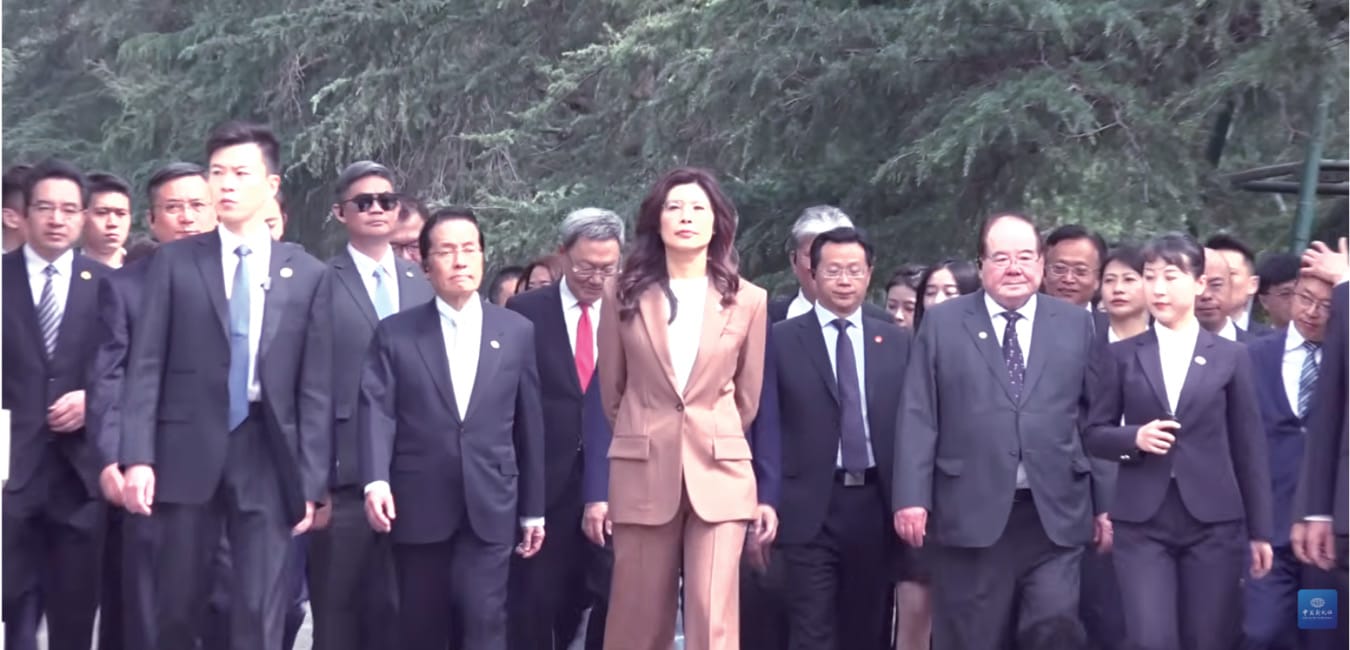
Taiwan was, of course, also discussed. However, there is nothing to negotiate or debate on this matter. For Beijing, it has always been clear that this is an internal Chinese territorial issue, while some in the West would prefer to see the declaration of an independent Taiwan. The secessionists in Taipei, however, face strong opposition, which is trying to block the arms buildup with American money and weapons for as long as possible. The leader of the resurgent opposition party, the Kuomintang, recently met with the Chinese head of state for a friendly exchange, attracting considerable public attention.
The Chinese leadership cites legally binding documents from the end of World War II stipulating that Formosa (Taiwan), colonized by Japan, must be returned to China. Even though the People’s Republic did not yet exist at that time, and the civil war was not resolved until 1949, Beijing has been recognized under international law as the sole representative of China since the Oct. 25, 1971 adoption of UN General Assembly Resolution 2758, “Restoration of the Lawful Rights of the People’s Republic of China in the United Nations.” Three formal agreements known as the Three Communiqués established diplomatic relations between China and the United States. Xi Jinping did not threaten Trump—as the West claims—when he said at the reception in the Great Hall of the People that the Taiwan issue could only be dealt with correctly in one way.
‘The Last Thing We Need Right Now Is a War’
On the return flight, Trump spoke at greater length to reporters. Xi “does not want to see a fight for independence, because that would be a very strong confrontation. And I heard him out…. I didn’t make a comment on it. I heard him out.” Trump added later, “I think the last thing we need right now is a war that’s 9,500 miles away. I think that’s the last thing we need.”
At the same time, the extremely liberal, i.e., anti-Chinese, Washington Post published statements by an American military expert. China is building “so many sophisticated types of munitions that our industrial base can’t even come close to producing them,” John Culver wrote. “The Chinese have a shipyard that builds more ships than all of our shipyards combined. They launch as many ships annually as the entire French navy.” America may have experience with inferior opponents and insurgent groups, but none with an equal adversary in war. Whoever uses up their ammunition first loses the war, Culver concluded. “I wonder when the Americans will start saying that we’d better not get involved in a Taiwan war.”
It’s Obviously About the Economy
The central question at the heart of U.S.-China relations remains an economic one. Specifically: How many more goods should China buy from the United States? The U.S. is carrying a gigantic trade deficit of almost $300 billion with China. America has a trade deficit with virtually every region of the world, including the EU, Mexico, and Canada. America’s share of global value-creation has fallen from over 20 percent to under 15 percent in the last 40 years. The United States is therefore no longer a major contributor to the production of globally traded goods.
China’s share has risen from two percent to over 20 percent in the same period. China has become the world’s industrial powerhouse, and the gap is widening. The range of products China needs to buy from the Americans is also shrinking. Until now, aircraft and agricultural products were usually the first choice. But Trump’s trade war has drastically reduced China’s purchases of American aircraft and crops, and caused Beijing to diversify its sources. That’s why Trump brought Boeing CEO Kelly Ortberg to Beijing to sell at least 200 commercial airliners to Chinese carriers. (It could even be as many as 750, Trump said.) In addition, 450 engines from General Electric, whose CEO was also part of the delegation, could be exported.
Sean Stein, president of the U.S.-China Business Council, tried to project optimism by saying that America and China are not only the two largest but also the most innovative economies. But China is the real draw. The Chinese embassy in the United States had just released figures showing that more than 80,000 American companies have invested in China, while only 7,000 Chinese companies are based in the U.S. The state agency for economic development in Beijing said there is enormous potential for practical economic cooperation between Beijing and Washington. American companies like 3M already manufacture in China more than 50 percent of the products they sell to Chinese consumers. Some U.S. companies in China are experiencing growth of up to 30 percent, a rate significantly faster than the global average. Business leaders rave about China’s vast market, complete industrial ecosystem, support for long-term growth, rapid innovation cycles, and resilient supply chains.
The Chip Ban and Other Sanctions
“Will you sell your chips to Huawei?” a reporter asked Jensen Huang, the CEO of Nvidia, during an ad-hoc interview. Completely taken aback, Huang turned to the reporter and said, “What kind of strange question is that?” The question was clearly too sensitive. Nvidia is prohibited from selling its most advanced computer chips, primarily used to train AI models, to China. The American government aims to slow China’s progress in artificial intelligence, as it currently lacks the capability to manufacture these high-end semiconductors itself. Until recently, a similar situation existed with AI software. That changed when the Chinese start-up DeepSeek emerged, competing with the American AI model ChatGPT. It was recently revealed that DeepSeek will train its models on Huawei processors in the future. Technology company Huawei was one of the early victims of Trump’s boycott and sanctions policies during his first term. Many had predicted Huawei’s demise. Now the tech giant is back on top. Sales figures for its smartphones in China have just surpassed those of Apple’s iPhone.
Huawei is now playing a key role in China becoming less dependent on Nvidia chips. While a scaled-down version of the Nvidia chip was offered for sale in China, the Chinese have not yet made any purchases and are now turning to domestically produced processors. This is precisely what Jensen Huang had warned against. According to The Economist Intelligence Unit, despite the summit between Xi and Trump, Chinese companies will refuse to buy Nvidia processors, because there is now “a golden opportunity to offer their own products as Chinese companies gradually close the gap with their overseas rivals.” On his flight home, Trump was asked about this and said, “They want to develop their own chips.” Incidentally, the Chinese are also developing their own airliner, the C919. The president of the manufacturer, Commercial Aircraft Corporation of China (COMAC), has already been seen at the same table as Boeing CEO Ortberg. China wants to be on the same level.
Two Keynote Speeches that the West Did Not Report
Then there were the two short but remarkable speeches at the evening banquet. Xi mentioned China’s 15th Five-Year Plan and its aim of “modernizing the country in all areas through high-quality development.” He also spoke about the 250th anniversary of American independence and how the ice between the United States and China was broken in the 20th Century: “Fifty-five years ago, President Richard Nixon sent Dr. Henry Kissinger to visit China, and ‘ping-pong diplomacy’ ensued between our two countries. Through the efforts of both governments and peoples, the door that had remained closed for over 20 years was opened. This marked a milestone in contemporary international relations. Since then, China and the United States have written many chapters of friendship through mutual openness and cooperation.” This is how the Chinese leadership places Trump’s visit in its historical context.
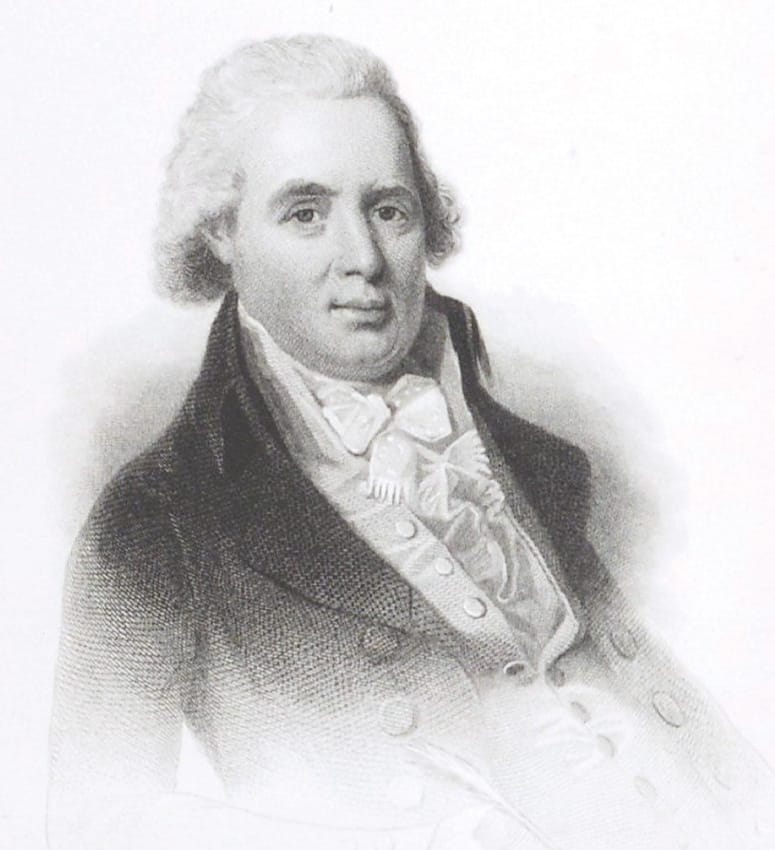
Trump responded to Xi’s speech with a reference to history: “The relationship between the American and Chinese people dates back to the founding of the United States. The first American consul in China, Samuel Shaw, arrived in 1784 on the first American merchant ship to reach these shores.” He continued: “Founding Father Benjamin Franklin published the sayings of Confucius in his colonial newspaper, and the sculpture commemorating that ancient Chinese era is proudly engraved on the facade of the United States Supreme Court.” He added that the Washington Monument also bears the words of a Chinese official who called General Washington a “hero of the people.” Shortly afterward, Trump raised his glass and proposed a toast “to the deep and lasting friendship between the American and Chinese people.” Someone had written a remarkably harmonious speech for the American President.
Will the Consensus Hold?
Consider the context. For years, President Trump has not only waged a de facto trade war and imposed a technology embargo against China. He established the “Donroe Doctrine” and, in blatant disregard of international law, intervened against a Chinese ally, Venezuela. Since the end of February, Trump has been waging an unprovoked, brutal war against Iran, a key ally of China and a BRICS partner, a war rife with barbaric rhetoric. And yet, Xi Jinping has not rebuffed him but has proposed strategic stability. Either Trump’s positive response is merely a show, or influential circles in the United States are also interested in achieving at least a temporary truce. After all, reports of devastated U.S. military bases in the Persian Gulf, depleted ammunition stockpiles, disaffected troops, and a massive global economic crisis have now even reached the U.S. mainstream media. China, for its part, is following its civilizational DNA. It wants stability—both domestically and globally—because otherwise it will hardly be able to achieve its future goals of a fully developed China by 2049. The Chinese see themselves as part of a “community of fate.”
Whether Trump’s surprisingly positive outlook on China will last, or whether he will revert to his old, frenetic ways in Washington, remains to be seen. In any case, Trump has invited his “friend” Xi to the White House for a return visit on September 24. Afterward, they will meet again in November at the Asia-Pacific Economic Cooperation (APEC) Forum in Shenzhen and at the G20 summit in Miami in December. Will this series of meetings and a possible concretization of their shared consensus on “strategically stable relations” open a higher level of dialogue, enabling at least a fundamentally peaceful coexistence between the United States and China? Or will it only take another arms deal for Taiwan, another military attack on Iran, an election defeat and the rise of hardliners in the United States, or an incident in the South China Sea, to tip the scales back toward confrontation? The Trump-Xi summit, the visit to the Temple of Heaven, and the subsequent banquet have demonstrated that, despite all differences and existing resentments, respectful interaction is possible. Everyone can only benefit from renewed and lasting cooperation between the United States and China.