
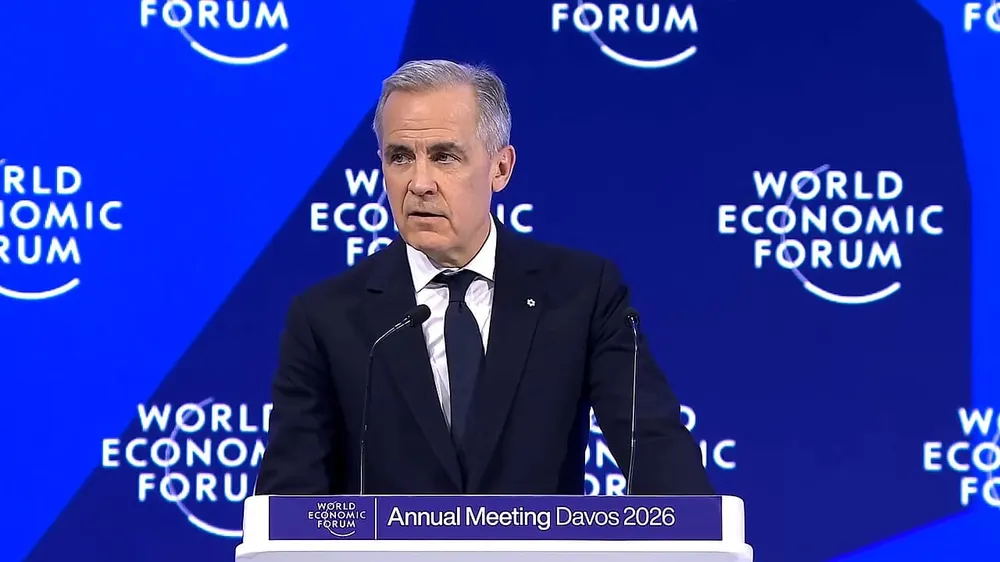
Mark Carney and Luc Frieden, the prime ministers of Canada and Luxembourg, respectively, penned a highly significant op ed in the June 25 Financial Times https://www.ft.com/content/cef7b1a9-1ccc-40bd-9e87-cca118a528a3 calling for the rapid creation of a new multilateral bank in the trans-Atlantic financial system, not for urgently needed infrastructure and development projects, but to pump unheard of amounts of European and Canadian finance capital into military production. As such, it is an effort to recreate on a grand scale the horrors of Hitler’s central bank head, Hjalmar Schacht. It goes along with the City of London’s broader plan to make a British-led Europe the new center of their empire, complete with their own nuclear capabilities, financial apparatus, and unhampered wars of aggression to destroy Russia and China.
Carney is the former Governor of the Bank of England and the Bank of Canada, and was also the head of the crucial global Financial Stability Board. His new article is headlined “Credible deterrence requires a new NATO bank,” and explains: “The essence of deterrence is credibility. Since Russia’s unlawful invasion of Ukraine, NATO allies have come a long way in strengthening their military capabilities. But it is not enough. Credible deterrence needs more: it needs to be backed by financial and economic power. Our ability to mobilize capital must be just as reliable as our armed forces. The answer is a bold multilateral solution: the creation of the Defence, Security and Resilience Bank (DSRB).”
Carney had publicly reported on the idea of a DSRB, a NATO bank, back in April 2026, when he announced that it would be hosted in Canada and that work had begun on drafting a founding charter, with the help of several banks, including JPMorgan, Deutsche Bank and Royal Bank of Canada. The idea for the DSRB actually originated with Rob Murray of the Anglophile NATO think tank, the Atlantic Council, which published an article by Murray on his proposal on December 13, 2024. Murray has quite a curriculum, including serving as “NATO’s inaugural head of innovation, where he designed and negotiated the creation of the Defence Innovation Accelerator for the North Atlantic and the NATO Innovation Fund, the Alliance’s sovereign-backed venture capital fund for dual-use technologies.” Before that, he “spent eleven years in the British Army, specializing in intelligence, surveillance, and reconnaissance. His work has been published by the Financial Times, Politico, and Chatham House,” his Atlantic Council bio reads.
NATO needs an additional 850 billion euros per year—that is just shy of one trillion dollars per year—to finance the military buildup, Carney claimed in his FT op ed. The problem is that “capital management rules prevent the defense ecosystem from receiving financing at the volume it needs from private banks.” Commercial banks can only lend “about €12 for every €1 of capital into defense, (whereas) the DSRB’s multilateral guarantee architecture will allow them to lend more than twice as much.” He proposes to do this by ensuring the DSRB obtains a AAA rating by having the full backing of the governments involved, “in case of need.”
“By issuing loan guarantees to private financial institutions, the DSRB will play a key role in reducing risk for the private sector and make it possible to crowd in sizable amounts of additional capital for defense supply chains.” In other words, huge amounts of speculative finance capital will be channeled into military production, backstopped by government guarantees, which are in turn backstopped by looting the living standard of the populations in question—exactly as happened under Schacht.
Carney proposes to kick off his new DSRB at the upcoming NATO summit in Ankara this July, and then have it up-and-running in 12-months time. “Canada and Luxembourg are proud to be leading this effort. We share a commitment to multilateralism. Both our countries host major financial centers with expertise in cross-border solutions and the backing of triple A rated sovereigns.”
Carney concludes: “We believe this can be another milestone in the NATO partnership, opening a new era in transatlantic relations. Together, we will turn financial guarantees into security guarantees, and finance into deterrence”—and, one might add, turn the planet into rubble.