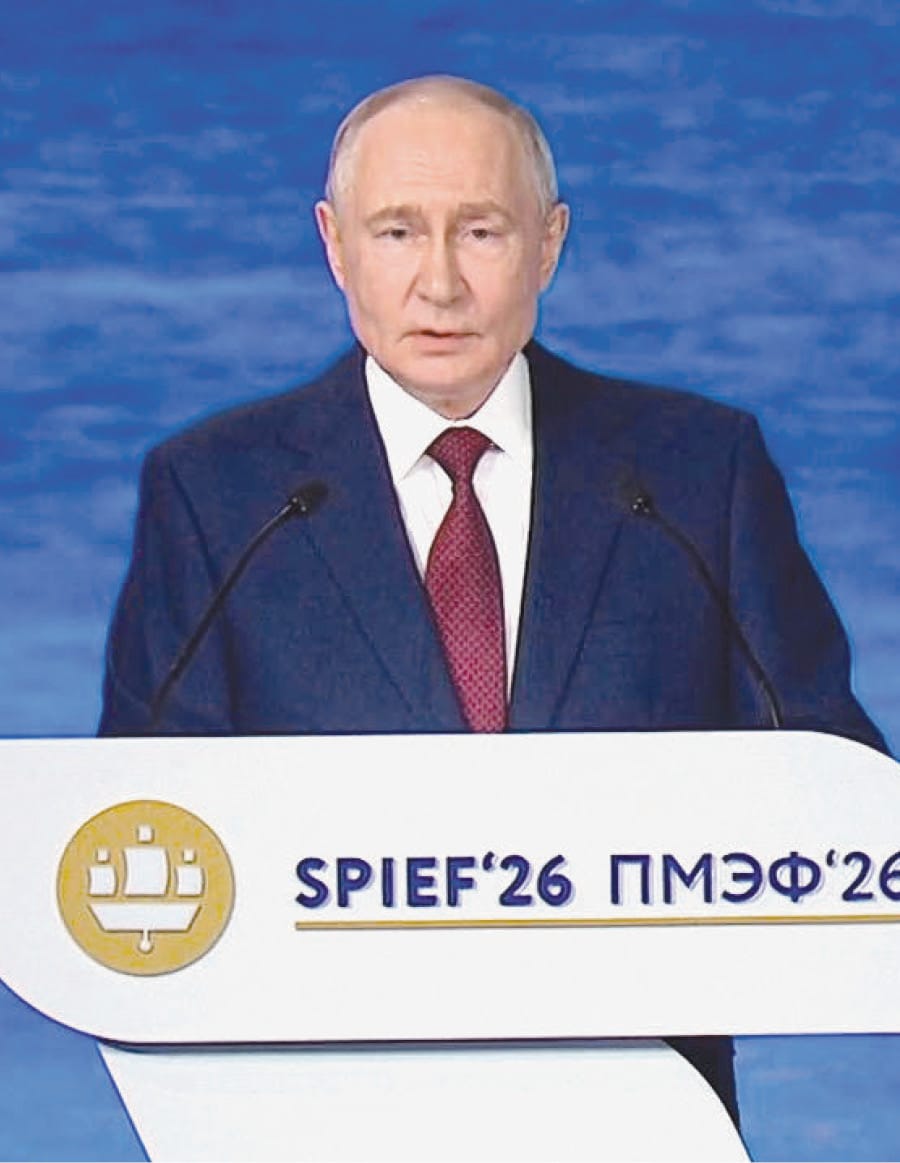
June 8—The following are excerpts from the keynote address delivered by Russian President Vladimir Putin to the June 5 plenary session of the St. Petersburg International Economic Forum (SPIEF), as transcribed on the Kremlin site, with subheadings by EIR. The Forum, June 3-6, was titled, “Pragmatic Dialogue: The Path to a Stable Future.” Putin’s speech first addressed the international strategic dimension, then focused on Russia’s domestic economic growth, and opportunities for international partnership and investment. A lengthy question and answer period followed presentations by guest leaders from Uzbekistan, Tanzania, and China.
The unrivalled and appealing nature of the St. Petersburg Forum lies precisely in the opportunity to engage in free dialogue on matters that are of interest to entrepreneurs, entire industries, and even entire countries. We remain open to everyone interested in engaging with our country and are ready to pursue equal and mutually beneficial cooperation. We are convinced that this particular approach where partners hear one another, understand their partners’ interests, and identify common solutions represents a harmonious path of development and makes it possible to respond to the serious challenges facing the modern-day world….
[We see] how the short-sighted EU bureaucracy policies are being implemented to the accompaniment of aggressive rhetoric and leading to Europe continuing to lose its standing in the global economy, while also undermining regional and global security. In fact, European elites are inciting chaos and are trying to embroil ever more countries into it.
‘Change in the Paradigm of Global Development’
These processes did not arise all by themselves; they are the result of the world undergoing the largest structural transformation in decades. This transformation is not a transition from one phase of a cycle to another. We are witnessing a change in the paradigm of global development.
I would like to bring your attention to what came before. For decades, the global development model was built around a limited number of financial centers, technological solutions, insurance and logistics hubs, credit rating agencies, and reserve currencies. This construct was presented as universal and supposedly suitable for everyone, and, above all, as supposedly neutral. In reality, however, it was increasingly used as a tool to exert political pressure and promote unfair competition, where settlements, technologies, logistics, or even access to information could be cut off at a moment’s notice in order to punish those who chose to act in their own national interests. In essence, it was a deliberately created system of dependency and resource extraction….
Let me reiterate: the roots of today’s global turbulence lie in the ongoing transition from a vertical, hierarchical model—one that primarily served the interests of a limited number of states—to a far more complex, distributed, and multipolar international order. What does this mean in practice? Above all, it means that the geography of economic growth is changing, with new centers of development emerging across the countries of the Global South…. In these countries, populations are growing, the middle class is taking shape, industrial capacity is expanding, and domestic markets are developing. As a result, new cities, roads, ports, energy infrastructure, and digital networks are being built. At the same time, these nations are establishing their own financial institutions….
New Corridors for Development
Today, international trade is becoming more efficient, direct shipments without unnecessary intermediaries are increasing, settlements in national currencies are developing, and new corridors are opening up. In Eurasia, these include the [International] North-South [Transport] Corridor, the Trans-Arctic transport route, and connections via the Caspian Sea, Central Asia, the Black Sea, and the Far East. All these projects and logistics routes are tangible features of today’s and, importantly, tomorrow’s development….
As I have already noted, the sanctions and, basically, the theft of Russia’s international reserves have had an irreversible effect on the positions of the world currencies, the U.S. dollar and the euro. This is an objective reality that cannot be ignored. Today, every country—let me stress, every country without exception—understands that, like Russia, it could at any moment lose access to assets lawfully held in dollars or euros, as well as to Western financial and payment infrastructure…. Incidentally, confidence in the West is also being undermined by the state of its public finances, reflected in rising government debt and persistent budget deficits….
Clearly, given the circumstances, countries around the world are taking their assets out of the West and shifting to payments in national currencies, increasingly using alternative payment systems, and expanding the role of digital financial assets, including central bank digital currencies.
In its trade relations with its key partners, Russia uses national currencies as the primary means of payment. Thus, the share of the ruble in our export transactions is currently standing at 65 percent, or almost two thirds.
Importantly, the world needs modern, flexible and responsible financial architecture without risks, prohibitions or barriers, but with incentives for sovereign development. Its instruments must reduce costs, speed up settlements, and expand access to financing, and, of course, ensure proper counteraction to tax evasion, fraud and money laundering. Naturally, this must always be given special attention….
It is clear that technological progress is the most important factor driving global transformation…. In essence, major states—true civilizations—face an historic choice: either they create their own platform and technological frameworks, or they become a digital periphery.
Russia—Sovereignty and Economic Momentum
In these tense and challenging conditions, Russia continues to strengthen its sovereignty not by isolating itself, but by expanding its circle of partners. Yes, economic momentum is currently subdued…. But let me remind you of the task set for the government: starting next year, we must return to sustainable growth rates in the domestic economy….
First, as I noted earlier, a sovereign economy is built on the full-cycle implementation of technologies and the use of advanced solutions that simplify business operations, automate processes, increase labor productivity, and improve the overall efficiency of the economy. This is especially important in such areas as defense and security….
The second point I wanted to highlight is that people, the knowledge they have, their skills and their ability to master advanced technology and create breakthrough goods, services and shape entire market segments—all this has an immediate and defining bearing on sovereignty, both today and tomorrow….
Thirdly, it is evident that the sovereignty of a nation as expansive as Russia is defined not solely by the strength of its capital or a few major industrial centers. It is crucial that each region attracts investment, creates high-quality jobs, and develops both its production capacity and its urban environment….
Finally, in conclusion, I would like to emphasize once again that a strong and sovereign country cannot be isolated. As I have said many times, recent experience has demonstrated that we need to produce critical goods domestically and to strengthen infrastructure that is essential for national security, business development, and improving the quality of life of our citizens. At the same time, we must continue to strengthen ties with foreign partners, expand cooperation, and promote cross-border projects.
Naturally, we will continue implementing plans to increase the capacity of our road and rail networks, including the development of a high-speed rail system based on domestic technologies. As is well known, the pilot project in this area is the Moscow–St. Petersburg high-speed railway.
I am also referring to the expansion of seaport capacity and the development of the Trans-Arctic Transport Corridor as a major global transport artery. We will continue developing our merchant and icebreaker fleets, building tankers and vessels of various classes. Our goal is to rank among the world’s top ten countries in terms of the total deadweight tonnage of the national merchant fleet.