The following is the text of the new introduction, written by Spanish members of the Schiller Institute, to the 2024 Schiller Institute pamphlet “Development Drive Means Billions of New Jobs, No Refugees, No War,” which has been reissued in Spanish by the Schiller Institute in Spain on the occasion of Pope Leo XIV’s trip to that country.
We present here a revised version for Spain of the report published in 2024 by the Schiller Institute, “Development Drive Means Billions of New Jobs, No Refugees, No War.” This edition contains an analysis of the global migration crisis in the context of a global war that could ultimately become nuclear.
But beyond the data and its interpretation, the objective of this report is to identify the root causes driving mass migration, in order to propose comprehensive solutions that require profound change: replacing the current bankrupt system with one that defends national sovereignty, the development of all nations, the common good, and the flourishing of Classical culture.
In this regard, what is novel about the content of this study—and what most concerns the Schiller Institute—is the great project of the World Land-Bridge, formulated over 30 years ago by the economist and philosopher Lyndon LaRouche, which outlines the main development corridors and infrastructure connections for global development—a proposal that essentially coincides with China’s Belt and Road Initiative, under the principle of “a shared future for humanity” within a framework of economic cooperation and dialogue among civilizations. We completely reject the opposite orientation, the idea—and the practice—of Samuel Huntington’s discredited “clash of civilizations” theory.
The radical paradigm shift that is required means moving away from the colonial relations of domination that hinder the development of the Global South, toward genuine cooperation based on concrete projects such as those outlined in this document: high-speed transportation corridors and intercontinental tunnels to connect and spread economic development to all regions of the planet; high-tech agriculture to ensure food security for all people; water management projects that support food sovereignty and human consumption; the development of energy sources with high energy flux density, such as nuclear energy (both fission and fusion); the creation of space science research centers; and much more.
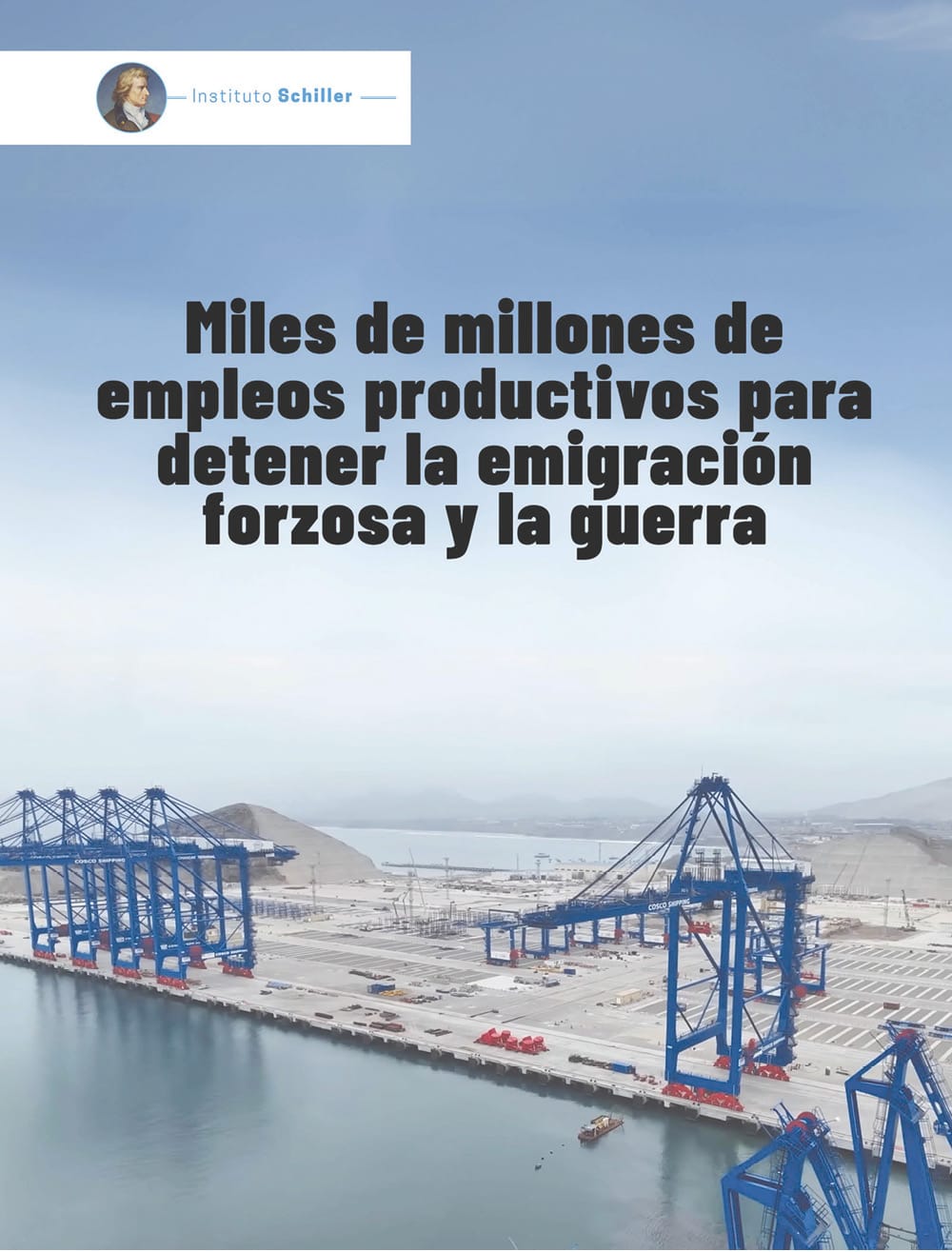
Today we find two opposing positions: that of the collapse of the Western world clinging to colonialism and its theories of the past two centuries; and that of the growth and expansion of the Global South, which demands definitive decolonization and an end, once and for all, to Western domination.
The first finds its clearest expression in the collapse of the speculative financial system of the City of London and Wall Street, along with their counterparts in the G7 and the International Monetary Fund; the second, in organizations such as the BRICS, which demand equality in international relations and are driving fundamental changes in the international economic architecture.
With that in mind, let us consider the current state of the world: with deadly wars in Iran and in Ukraine, either of which could lead to a nuclear confrontation between the United States and NATO, on the one hand, and Russia and China, on the other; with the collapse of the global speculative financial system, and its cancerous $2.4 quadrillion bubble, and the collapse of the very means of physical and economic survival for entire nations; with waves of desperate migrants, forced to emigrate due to wars and economic collapse, heading toward countries that lack the means to absorb them into a productive workforce, and with xenophobic hatred being stoked against them precisely by the global financial interests that created the problem in the first place. And with the economies of Europe and the United States dominated by a mad arms race, inspired by the policies of Hitler’s central banker, Hjalmar Schacht, with their well-known consequences.
As Pope Leo XIV said in a message addressed to the 59th World Day of Peace on January 1, 2026, this rearmament has contributed to “a global destabilization that is becoming increasingly dramatic and unpredictable…. Today it seems that the response to these new challenges is sought not only through the enormous economic effort of rearmament, but also through a realignment of educational policies.” It is time to put a stop to this madness.
In an open letter to Pope Leo XIV, dated March 9, 2026, the founder of the Schiller Institute, Helga Zepp-LaRouche, wrote: “At a time when there is the danger of a world war and when some use the cloak of religion to argue for an early Armageddon, that same voice of reason must be raised” to launch a “dialogue of civilizations” whose purpose is to bring together all nations and peoples in order to build a new international security and development architecture, as detailed in the following pages. Zepp-LaRouche urged a return to the thinking of 15th-Century Cardinal Nicholas of Cusa as a necessary approach.
We understand that Spain’s stance against the illegal, unprovoked war of aggression against Iran, Palestine, and Lebanon is a positive step and constitutes a magnificent opportunity that could place our country in a position of mediator within the framework of the dialogue of civilizations.
From prehistory to the modern age, the Iberian Peninsula has served as a bridge for the Mediterranean world between Europe, Africa, and Asia, and across the Atlantic to Ibero-America, to which we are bound by a vast cultural heritage, with contributions from both sides.
At this historic crossroads, Spain must play a role in building a future for the world, making a qualitative leap by driving a shift in Europe’s stance or initiating its own dialogue with the developing world, engage with the BRICS, join the Belt and Road Initiative, and promote infrastructure development projects such as those proposed in the World Land-Bridge, forging relationships of equality with its peers based on building a new paradigm of a shared future for humanity.
From the perspective of the ordinary citizen, who generally has no direct connection of any kind to the projects mentioned in this introduction, the following question arises: Will there be political will to allow them to be carried out someday? Because, for example, the Strait of Gibraltar Tunnel is such an important project from the standpoint of the physical economy of Spain, Portugal, Africa, and even the world that it is absurd that it is not a priority on the agendas of current politicians and that it is not constantly in the news of the major media outlets. And yet, it is not.
The truth is that ordinary citizens usually do not ask themselves enough questions about what is happening around them and, above all, why it is happening. The rise in prices for no apparent reason should already be a permanent red flag regarding the kind of difficulties that lie ahead.
Perhaps, for this reason alone, ordinary citizens should begin to take responsibility. For all these reasons, it is also time for the average citizen to accept that it is their responsibility to ensure that political decisions are made for the benefit of the majority, for the common good.
—Schiller Institute, May 2026
Spain: The World Land-Bridge’s Bridge to Africa and Ibero-America
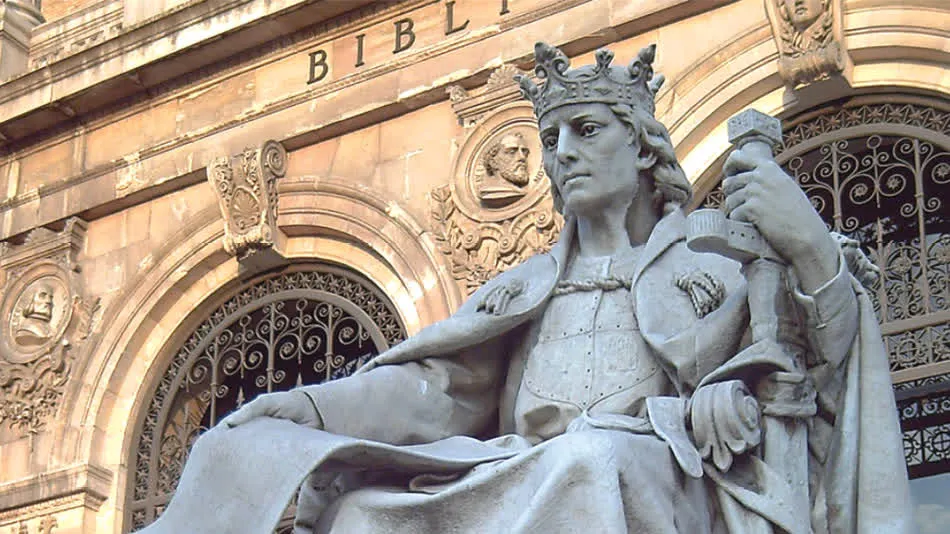
The new, Spanish-language edition of the Schiller Institute pamphlet, “Development Drive Means Billions of New Jobs, No Refugees, No War,” includes a chapter on Spain’s role in the World Land-Bridge, “Spain: The World Land-Bridge’s Bridge to Africa and Ibero-America,” which emphasizes projects such as the Strait of Gibraltar Tunnel, and the crucial importance today of the historic tradition of the 13th Century Spanish King Alfonso the Wise. (The theme of Alfonso the Wise was also developed by the Pope in his June 6 Royal Palace address in Madrid.) The following is an excerpt from that chapter.
This would not be the first time in its history that Spain has played a catalytic role at the crossroads of cooperating civilizations. Under the personal guidance of Alfonso X, “The Wise,” King of Castile and Leon from 1252-82, the Castilian capital of Toledo was built into Europe’s most important scientific center of the time, and the nexus for the transmission of the Greek Classics and the highest achievements of the Arab Renaissance into continental Europe. Alfonso was especially known for his work in astronomy, and for his Toledo School of Translators, which brought together the outstanding scholars of the world’s three major monotheistic religions—Islam, Christianity and Judaism—to render the most advanced religious and scientific texts of each culture, into the languages of the others. It is past time for a new “Alfonsi Era.”