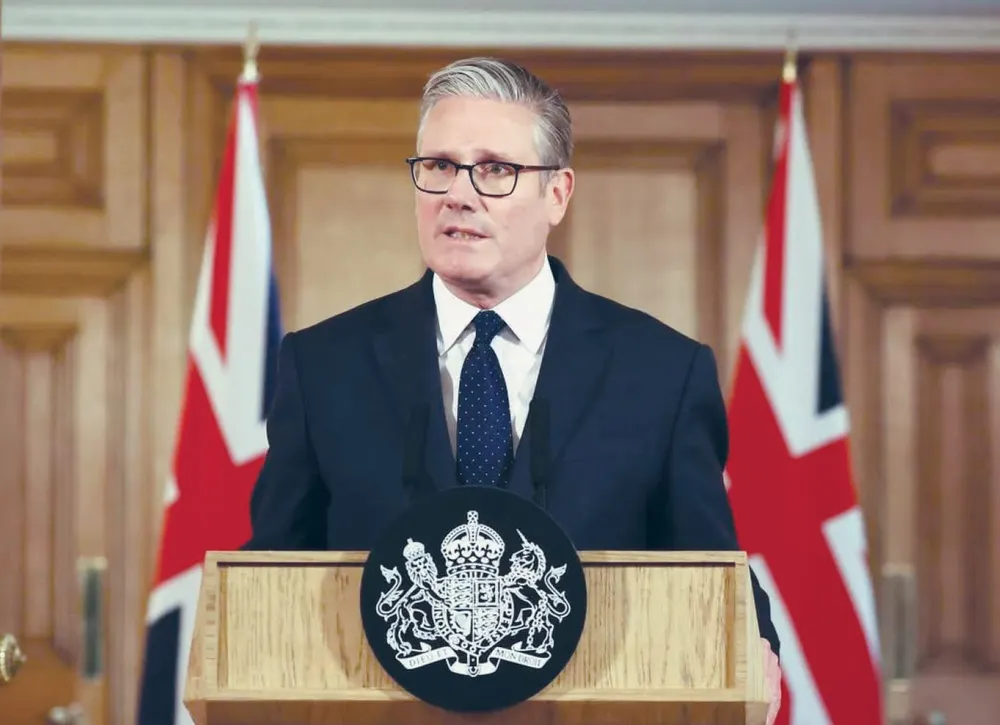
June 24—What was described as “inevitable” since the Epstein-Mandelson scandal broke in the UK on February 9, 2026, came to pass on June 22, as Sir Keir Starmer announced his resignation as Prime Minister of the United Kingdom. The Mandelson story encompasses much of what was wrong with Starmer’s tenure. The attempt to cover up the truth is part of that story: Did Starmer know about his Jeffrey Epstein connection when he appointed Lord Peter Mandelson as UK’s ambassador to the United States, as seemed likely, and if so, why appoint him?
This discredited Starmer, who is also the former head of the Crown Prosecution Services, and had tried to project the image of being squeaky clean. Lord Peter Mandelson, known as the “Prince of Darkness” due to his conniving ways, has seen his fair share of scandals, including his great friendship with the pedophile Jeffrey Epstein. Now, his backroom deal granting Peter Thiel’s Palantir complete access to the metadata files of the National Health Service (NHS) is under investigation as a major crime.
If, as Starmer initially insisted, he was unaware of the depth of Mandelson’s alliance with Epstein—or worse, knowingly appointed a corrupted figure to manage the “special relationship” with the United States when facing the challenge of dealing with U.S. President Donald Trump—what does that say about his ability to faithfully serve the interests of the British empire?
Starmer’s Hit Team
The Mandelson scandal opened the door a crack to offer a glimpse into the dirty truth behind Starmer’s rise, which was orchestrated by a team under Mandelson to oust Jeremy Corbyn as UK Labour Party leader. Mandelson had been a key figure in Tony Blair’s takeover of the Labour Party through the creation of “New Labour” in 1994, which was the vehicle that put Blair into 10 Downing Street. New Labour allegedly offered a “third way,” neither liberal nor conservative. In reality, it gave Blair the freedom to quietly continue Prime Minister Margaret Thatcher’s radical “Big Bang” neoliberal economic reforms as a “centrist” policy, to move away from Labour’s “leftist” tradition.
The result was Blair’s election as Prime Minister in 1997. While Prime Minister, Blair led the UK into a series of imperial wars and regime-change operations on behalf of the City of London, and the UK’s physical economy continued contracting in real terms, bringing the Tories back into power when Blair’s successor, Prime Minister Gordon Brown, stepped down in 2010. Brown was replaced by Prime Minister David Cameron, who formed the first of six Tory governments in the next twelve years.
As New Labour floundered, it was successfully challenged from within by Jeremy Corbyn, who was elected the leader of the Labour Party in 2015. Corbyn ran as an anti-austerity, anti-war, anti-establishment candidate. He criticized the Thatcher-Blair economic policies of deregulation and privatization, and opposed the Blair-UK war policies, including Blair’s role in bringing the UK into the Iraq war in 2003 through collaboration with MI6 in concocting a fabricated story of Iraqi President Saddam Hussein’s possession of weapons of mass destruction. He also called for the withdrawal of the UK from NATO, denounced UK support for the “dirty war” aimed at overthrowing President Bashar al-Assad in Syria, and opposed the renewal of the Trident nuclear missile program. Under Corbyn, Labour was increasing its share of votes and was perceived by ruling circles in the City of London as a real threat.
To counter Corbyn, Mandelson, who had developed a reputation as a “spin doctor” through his work with New Labour, was brought in to deal with Corbyn’s insurgency. He enlisted the support of Morgan McSweeney, who was named director of Labour Together (LT), a think tank associated with New Labour, founded in 2015. The intent behind McSweeney’s appointment to LT was the destruction of Corbyn and a reversion of Labour Party policies to the neoliberalism of Blair. To this end, McSweeney drafted an internal document for LT which defined two goals: the ouster of Corbyn, and the selection of a candidate to replace him who would represent the interests of the British establishment.
McSweeney had entered politics as a young Blair aide. Though his relationship with Mandelson was at times rocky, the two joined forces to use LT to undermine Corbyn, accusing him of anti-Semitism. Corbyn supported measures to end Zionist occupation of Palestinian territories and had campaigned for the UK to recognize Palestinian statehood. Among McSweeney’s operations against Corbyn was his creation of the Center for Countering Digital Hate, which was involved in the smear campaign of Corbyn as an “anti-Semite.”
To pay for these operations, McSweeney raised 730,000 Pounds ($930,000) from 2017 to 2020, in undeclared donations, largely from Zionist Lobby supporters such as Sir Trevor Chinn and Gary Lubner, a Zionist born in South Africa into a family which defended Apartheid. Money from Chinn, Lubner, and corporate networks flowed into both Labour Together and the Labour Friends of Israel. These funds were used not only to smear Corbyn, but to get behind a candidate to replace him.
That candidate was Keir Starmer.
Starmer’s ‘Loveless Landslide’
With Corbyn out of the way, Starmer was swept into office in elections on July 4, 2024 in what is called the “loveless landslide,” with Labour winning 411 of 650 seats in the House of Commons. His victory was not attributed to his personal competence or charisma, but to the abject failures of the succession of Tory Prime Ministers, such as Boris Johnson, Liz Truss, and Rishi Sunak, who wrecked the economy by doubling down on the Thatcher model—privatization, deregulation, free trade—a formula that benefits the corporate cartels of the City of London in the tradition of the British empire. It depends on loot stolen from former colonies, which in turn requires a bigger defense budget. It also increases domestic unrest, as the population of the UK is looted, driving real wages down and unemployment and part-time jobs up. Under Tory leadership, this model triggered stubborn inflation, which was increased by defense spending and corporate bailouts.
With Corbyn’s ouster, the anti-austerity, anti-war campaigns he ran were dropped. For all his talk about fairness for the working man in his campaign, Starmer switched back to the neoliberal policies of Thatcher and Blair after the election. Starmer’s team included many Blair vets, such as Mandelson, who brought with him Morgan McSweeney, who was rewarded for his hatchet job on Corbyn by being named Starmer’s chief of staff.
Starmer Loses His Mandate
Starmer’s failure to rescue the British economy from the damage done by fourteen years of Tory rule was a major strike against him. The budget-cutting neoliberal policies he backed drove youth unemployment to its highest level in years; the chronic problems with the NHS showed little improvement; and 50,000 pensioners have been plunged into poverty. Racial tensions have spiked, driven in part by the unresolved problem of immigration.
For all his talk about fairness for the working man, Starmer stuck with the New Labour fraud. The Blair vets in his Cabinet remained loyal to Blair’s neoliberal model. Starmer also turned against Corbyn’s anti-war policy, through his role in initiating the European Three (E3) of the UK, France, and Germany, not only to expand the funding for Ukraine against Russia, but to prepare Europe for a war against Russia. Starmer fully embraced the AI-tech prosperity partnership with the United States, which came into public view during the September 17, 2025 banquet UK’s King Charles III threw for President Trump and the American Silicon Valley tech CEOs who accompanied him to what was a thinly-disguised pep rally/fund-raiser for the special relationship
As for his policy on the Gaza ethnic cleansing against the Palestinian people, he refused to condemn Israel’s policy of genocide, and expelled party members who criticized Israel. Thirteen of his appointees to major cabinet posts received contributions from Trevor Chinn and his Labour Friends of Israel, including Foreign Secretary David Lammy, Chancellor of the Exchequer Rachel Reeves, Deputy Prime Minister Angela Raynor, Home Secretary Yvette Cooper, and Health Minister Wes Streeting, who was briefly considered to be a front runner to oppose him.
As support for Starmer collapsed, many of his former allies rallied behind the candidacy of a former Member of Parliament (MP) and former Mayor of Manchester, Andy Burnham, who thus far has shown little to differentiate himself from the succession of placekeepers at 10 Downing Street, who serve the interests of the monarchy and the imperial financiers of the City of London. It was reported today that Burnham’s first pick to join him as chief of staff is James Purnell, a former MP who served alongside Burnham as a minister under Tony Blair.