May 28—The following is an edited transcript of the report given by Angela Huffman, president of Farm Action in the United States, to the May 8, 2026 weekly meeting of the International Peace Coalition (IPC). Huffman is a strong national voice for independent family farming and ranching. Moderator Anastasia Battle introduced Huffman, also CEO and co-founder of Farm Action in 2017, by pointing out the value of the information and proposals on the Farm Action website, which Battle showed on the screen. “I know that other people in the IPC have looked at that, and have been using it on what’s actually happening in the United States, a disaster that people are not quite seeing yet. It’s on the horizon, and I think it’s very important that people understand that they may not have food on the table very soon.” Subheads have been added. The video is available here.
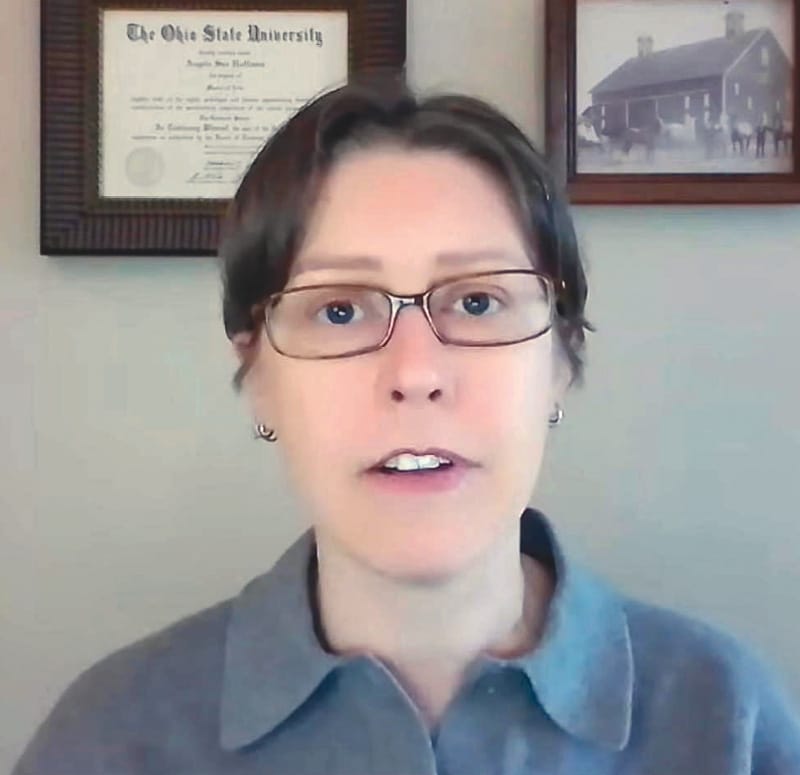
Thank you all for having me. I appreciate the kind words, and really appreciate the chance to join you all today.
Your network, in particular, Bob Baker, has been an incredible resource to us, as well to inform our thinking. So, thanks for having me. I’m Angela Huffman, president of Farm Action, and I come to you all from farm country.
I’m in northwest Ohio in the United States, and I’m going to talk a little bit about what this moment in time looks like for America’s farmers and our food system. The main point that I want to make is that these wars are driving up the cost of producing and moving food, and at the same time, monopolies are deciding who pays those costs and who profits. So, right now, family farmers and consumers are paying while powerful corporations are raking in record profits.
Losing Family Farms
The current situation for America’s farms, we’re actually losing in the United States about 67 farms every day right now. That’s not because farmers forgot how to farm. It’s because we have built a system where farmers take on the risk, corporations take on the profit, and taxpayers are then asked to clean up the damage.
And one way that we can see this is through the bailout cycle. So, in about a year, the last year, the U.S. government has delivered three major rounds of farm aid, totaling about $87 billion.
Farmers don’t want bailouts. They want fair markets. They want to be paid enough to stay on the land. But right now, a bailout check can keep the farm alive for another season, and that really matters.
But these bailouts are not fixing the reason that farmers need help in the first place. Too often, that bailout money flows straight through farmers to the people that they owe: the lenders, the landlords, fertilizer companies, seed, chemical companies, fuel suppliers, equipment dealers. So, the farmer might get temporary relief there, but the system stays the same.
War Hits on Top of a Bad System
I say all that just to show you, really, the dire state that our farmers are in right now, and all these bailouts are kind of a window into how bad it is. But right now, on top of it, that fragile system is being hit by war. The war in Iran, the fastest way that has shown up in our food system, is fuel. Diesel fuel runs agriculture. It powers tractors, combines, irrigation, grain trucks, freight rail, ships, the trucks that move food to grocery stores. Farmers can sometimes plan around other costs, but fuel is something that can’t wait. It’s something we need on an ongoing basis. If it’s time to plant, if it’s time to harvest, or haul grain or move food, any of those steps in the food supply, we need diesel. That means that when oil prices rise, farmers feel it quickly, and so do food distributors, and so do consumers.
But here’s the kicker. While farmers and families are paying more, major energy companies are profiting from this disruption. I just saw the news yesterday that Shell Oil reported nearly $7 billion in adjusted profit [for the quarter].
That’s more than double what they reported this quarter last year, and that’s while oil prices are surging during the war. This is a familiar pattern, where a crisis hits, farmers get squeezed, consumers pay more, and then the largest corporations find a way to profit off of it.
Megafirms Control Fertilizer
We see the same thing happening right now in fertilizer. Fertilizer is one of the largest costs for many crop farmers, especially corn and wheat farmers. But the real problem isn’t just that fertilizer prices rise. The problem is that the fertilizer market is controlled by a handful of corporations, and when they control an essential input like fertilizer, farmers have almost no bargaining power.
During the last fertilizer spike, which was during the start of the Russia-Ukraine conflict, prices for fertilizer immediately went way up, far beyond what could be explained by costs alone. At the same time, fertilizer companies expanded their margins. One major firm increased its gross manufacturing margin by hundreds of percentage points, while their cost rose far less. So, farmers are left paying more in the middle of these crises, while dominant corporations are using that same crisis to increase their profits.
Globally, we’re seeing that countries around the world are vulnerable when food production depends on a handful of companies or markets for fertilizer, fuel, shipping, and grain. A war or trade disruption can quickly become a food security crisis.
It’s a Structural Problem, Not a Trade Issue
I’ll give you one last example here, what we saw with soybeans and the trade war with China. For decades, U.S. farm policy has pushed farmers to grow more and more corn and soybeans. The government is subsidizing farmers to grow those crops, and much of that is for livestock feed and export markets. It’s not to feed our citizens.
Soybeans have become our top agricultural export, and China became the dominant buyer of those. So, when China stopped buying U.S. soybeans last year, the whole system fell apart. Grain bins filled up, prices crashed, and farmers were left exposed.
So, with these issues, they’re not just trade problems, it’s really a structural problem here in the United States. We have a farm system that’s built around overproduction, dependence on exports, and corporate control of that system—and corporate control of our government policies that shape the system. So, then when something goes wrong, we call it an emergency and send another bailout to farmers. But it’s really not an emergency anymore, when it keeps happening over and over. It’s the system just working the way that it was designed.
To wrap up here, I’ll kind of lay out the problem, try to end on a more positive note: My organization, Farm Action, what do we do about this? Anastasia mentioned our website; I really appreciate that, if that can be a resource to you all.
Points of Positive Action
But first, from our lens, we need to stop pretending that more emergency bailout checks are enough. Those are needed in the short term to keep farms afloat, but that’s not real reform.
Secondly, we need to really address monopoly power in agriculture. That means stronger antitrust enforcement, and it means real action to break up these dominant companies in this market concentration in fertilizer, seeds, chemicals, grain trading, meatpacking, food processing. That whole supply chain is completely dominated by a handful of corporations.
Third, we would love to see price-gouging protections for agriculture inputs during crises like these. Farmers shouldn’t be left at the mercy of dominant corporations every time there’s a war or a trade fight or a supply shock that’s currently enabling corporations to price gouge.
Fourth, we are really working hard to rebuild regional food systems. Farmers need more local and regional buyers, more local processing and storage and distribution, so that we’re not depending only on these global markets and these giant corporations.
And then finally, we’re calling for the U.S. government to support growing more real food here at home. As I mentioned, we’re so focused on growing corn and soybeans for livestock feed and export, and meanwhile, we’re dependent on importing the food that Americans actually eat, to the point that this year we are expecting a $50 billion agriculture trade deficit. That’s been a pattern over the last several years. By $50 billion, we are relying on other countries to feed us, and we’re using so much of our farmland to grow these other crops for export.
The Issue Is Food Security and Peace
To wrap up, it’s not just an agriculture issue; it’s a food security issue; it’s an economic security issue; it’s a peace issue. The U.S. food system right now is built on dependence and on corporate concentration, and it’s very fragile. And we see it keep breaking every time it’s under pressure. And every time it breaks, ordinary people have to pay for that. Farmers pay through low prices that they are paid and high costs that they have to pay out. Consumers pay through their grocery bills, and taxpayers are paying through bailouts, while corporations just keep raking it in.
So, yes, our farm economy, it’s not failing because farmers forgot how to farm, it’s failing because we built a system where everyone in the supply chain can make money except for the farmer. And until we change that, every single war or trade fight or supply shock is going to bring us right back to the next bailout. So, I’ll wrap it up there.
Thank you so much for the opportunity to share with you all.
Food Security Is a Precondition of Sovereignty
The following exchange took place between Angela Huffman and Helga Zepp-LaRouche, founder of the Schiller Institute, during the discussion period of the May 8 IPC meeting.
Zepp-LaRouche: I want to encourage all people who are watching this video to take into their heart what they have heard. And since I am convinced that the situation will get really rough in the next period, that we really have to mobilize in such a way to cause a change in the paradigm for the good, especially in countries of the West.
I think what that requires—and I would like to say that in particular to you, Angela—but also to everybody else—in a certain sense, what we are doing with the IPC, it’s almost like the elephant and the blind man. Because we have different speakers who bring in the actual picture of whatever crisis is hot, and we try to have a good representation, and people are normally very good at describing how it affects Africa, how it affects Germany, how it affects the farm sector. And they are trying to mobilize and remedy the problem in their area. And if you do that over a longer period of time—and we are in this period of a fight for some decades—one can say, you realize that there’s a hot issue for several years, and then it shifts, and then even returns. [She described the situation in Lebanon as an example—ed.]
I think we have to come to the recognition that we absolutely have to look at the solution from the top. In other words, we have reached a point in history, where I am convinced that there is no longer a remedy for individual problems, but only so, if we go at it from the top, which in my view is this idea of a new security and development architecture.
I have put forward Ten Principles on how to think about it, and the first principle is that there must be sovereignty, and that is for a reason: because without sovereignty, you can forget it—there’s no participation of the individual in government, because all super-national structures are imperialist by nature. Food security is a precondition of sovereignty. Energy security is a precondition of sovereignty.
I think what we have to do, is, we have to get people to think strategically, to think in terms of statecraft. You have to think, where is the one shift that would remedy the situation?
The only thing that I can think of is that you have to have a security and development architecture that explicitly takes into account the interest of every people, every person, every nation. Only if you set up such an architecture, do you have any chance to solve the problems which are in front of us.
So, I would really appeal to people to think through … in this great hour of mankind: We have to make the conceptual step of thinking of the One Humanity first. Because only then can you settle all the problems that are in affinity to that.
Huffman: I’m processing what you said, which is really insightful. I think that these crises, they give us an opportunity to rally around a certain moment and build momentum and apply pressure. And I also recognize, it’s like a whack-a-mole, hitting these problems as they come up; it doesn’t always address the larger structural concerns.
So, yes, I think that’s a really good point to think about. From our lens, we noticed a lot of the efforts in the United States in the farm sector where we work. For example, I talked about bailouts. The majority of our policy makers and a lot of our farm organizations, they want to just keep issuing bailout after bailout. And that’s just a Band-Aid on this larger problem that I see in U.S. agriculture, which is market consolidation and government policies that favor those large corporations. But I also understand it even beyond that, or issues around finance and banking, and issues around campaign reform and how people are even getting put into office.
So, yes, that’s all to say, I really appreciate what you shared, Helga. And it’s really something to think about how we can confront these urgent issues, and use them to apply pressure, but also by keeping our eye on the higher-level structural problems that ultimately need to be addressed in the end.