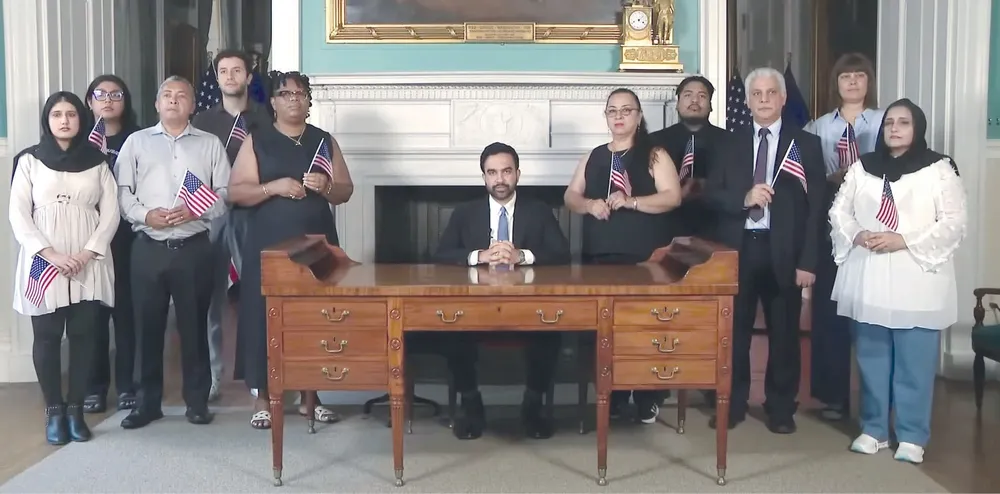
The following are excerpts from remarks as prepared by New York City’s Mayor Zohran Mamdani as a July 3 address marking America’s 250th Birthday. Mayor Mamdani delivered his remarks from the New York City Mayor’s Office while seated behind the desk that George Washington used at Federal Hall in Lower Manhattan while serving as the nation’s first President.
Tomorrow, our nation marks 250 years since we declared our independence, 250 years of a grand experiment in self-governance, an experiment so audacious that some in 1776 doubted it would last more than a few years, let alone a quarter of a millennium. From Lexington to Los Angeles, Selma to Seneca Falls, Mauritania to Midwood, Americans will come together for a day, just as we do each year. Families will gather around the grill; fireworks will fill the night sky.
This will be no ordinary day of celebration. Two hundred and fifty years presents a rare opportunity for more than 340 million people to turn together, both towards one another and towards ourselves, to take measure of who we are as a nation. When we look at America, what do we see?
Here at City Hall, as I sit behind George Washington’s desk alongside new Americans who came to this country, I cannot see all of America, but like so many who came before, I can see New York City.
The City Washington Once Knew
The city I see today looks very different than the one that greeted George Washington. In July of 1776, our city simmered under the yoke of oppression. The British had imposed a colonial rule so repressive that 250 years ago, 80 miles south, a small group of newspaper editors, farmers, and soldiers signed their names on a document declaring truths that feel self-evident now, but were revolutionary then, establishing the ideals our nation still strives to fulfill.
The British did not take it well. War broke out. And that August, as the largest battle of the Revolutionary War unfolded in Brooklyn, batteries on Governor’s Island took aim at British ships anchored just offshore. We were outgunned, we were outmanned, and we were soundly defeated. After only a few months, it appeared our fledgling attempt at democracy was on the precipice of collapse.
But that night, with the moon overhead, thousands of our soldiers silently climbed into ferries and flat-bottomed boats and escaped to Manhattan. The Continental Army survived to fight another day. Independence may have been declared in Philadelphia, but it was rescued in New York City.
George Washington was the last to leave Brooklyn. As he waited at the river’s edge, the Sun beginning its rise, he would have looked out over New York City’s waters and seen what so many have seen in the 250 years since, an opportunity to begin anew. Those opportunities, like everything in New York City, are not given, they are won.
In 1838, 11 years after New York outlawed slavery, a recently emancipated black man by the name of James Weeks sought to begin anew as well, and to help hundreds of others do the same. He bought property in Brooklyn, won himself the right to vote, and sold lots to others newly freed. When they landed in New York Harbor, they knew they had something waiting for them that they had never had before, a home.
Weeksville still stands today, a living, breathing testament to what we know America to be, a place each of us has the power to make. The harbor was busy those years, as ships poured in from around the world….
As we mark 250 years, what do we see?
We see a city of contradictions within a nation of contradictions. We see the wealthiest country in the history of the world—one where children go to sleep hungry while the world’s first trillionaire hungers for more. We see monopolies that dominate every industry and oligarchs who buy elections. We see masked agents terrorizing our streets, eating food cooked by our undocumented neighbors before spiriting them away in unmarked vans. We see a nation whose immense wealth has been built by those with calloused, dirt-streaked hands—those who toil on factory floors and chisel into stone—and we see a nation that has allowed so much of that wealth to be held instead in the soft hands of a precious few….
Yes, we see America when we spend our tax dollars on bombs and bailouts, when we sell our elections to the highest bidder. Yet we see it just as clearly in every American who still believes this country belongs to we, the people.
We see America each time neighbors link arms with neighbors—without asking how long they have lived here, or what papers they have—as ICE [U.S. Immigration and Customs Enforcement] invades our neighborhoods.
We see America each time those young and old stand in the beating rain or the stifling heat to cast their ballots.
We see America each time working people demand more—not just for themselves, but for their fellow Americans.
There are some who respond to those who ask for more from America with a simple refrain: “Love it or leave it,” they say. But patriotism has never been about pretending our nation is without flaws. Patriotism is every act of righteous dissent, it is every march led under the heavy Sun, it is every protest held a decade before its time. It is precisely because we love this nation that we will not leave it. After all, who loves America more than those who have sacrificed so much to make it free?
Today, I think not only of the Fourth of July. I think, too, of the Ninth of July. Five days after the Declaration of Independence was signed, it arrived here in our New York City. Redcoats had disembarked on Staten Island. More than a hundred British ships loomed just offshore. Across this city, the Continental Army prepared for an invasion. George Washington commanded his brigades to assemble just a few feet from this building. It was known then as the Commons. Today, we call it City Hall Park. There, within range of British guns, Washington ordered his generals to read the Declaration aloud.
And with the world’s mightiest empire poised to attack, Washington told the people of New York City what we will celebrate tomorrow, that we had declared our independence, that freedom was within reach. That evening, danger loomed. Conflict was not a question, but a certainty. And yet when those early New Yorkers marched toward the statue of King George III that stood in the Bowling Green, a statue they would melt down into bullets for their young army, they walked in unison, grounded not in the pursuit of plunder, but an ideal that for the first time had a name: America….
