The Lead
‘Concentrate on That Point, and Enlarge It’
by Jason Ross (EIRNS) — Jul. 25, 2026
Asked once how he saw the future, Celso Amorim painted an image. “If you are in a room which is almost totally obscure, dark, you can’t be only focused on that. If there is a small split… a brecha, a small leak through which you see some light, you should concentrate on that point and then try to enlarge it.”
Brazil’s Special Advisor to President Lula—twice foreign minister, once defense minister—was speaking this week to EIR's Dennis Small, and he identified the darkness precisely. The money spent on war, he said, is not drawn from some spare account: it is “taken away from development cooperation.” The price of oil. The price of fertilizer. Food for Africa. The termination of USAID and what that has done to South Africa’s health institutions. And, he added, this holds even when the war is between third countries. Everyone pays.
Before we get to the brecha, consider the dark room:
Washington and London are convening a meeting to assemble warships, minesweepers and drones to force open the Strait of Hormuz—having first destroyed the memorandum of understanding that had opened it. A European diplomat’s summary: “The Americans are looking for a way out and they want our help.” The Houthis struck Saudi Aramco facilities at Yanbu and Jizan; Saudi jets struck Hodeidah; oil touched $100 with the Red Sea chokepoint now a factor. In Ukraine, a five-week deep-strike campaign aims to wear down the Russian population. And the Pentagon’s public count of American dead in the Iran war fell this week from eighteen to fourteen—four men subtracted on the reasoning that they died after a ceasefire had been declared. The spokesman called it a “temporary data disruption.” It has not been corrected.
And now the cracks of light, of which there are several:
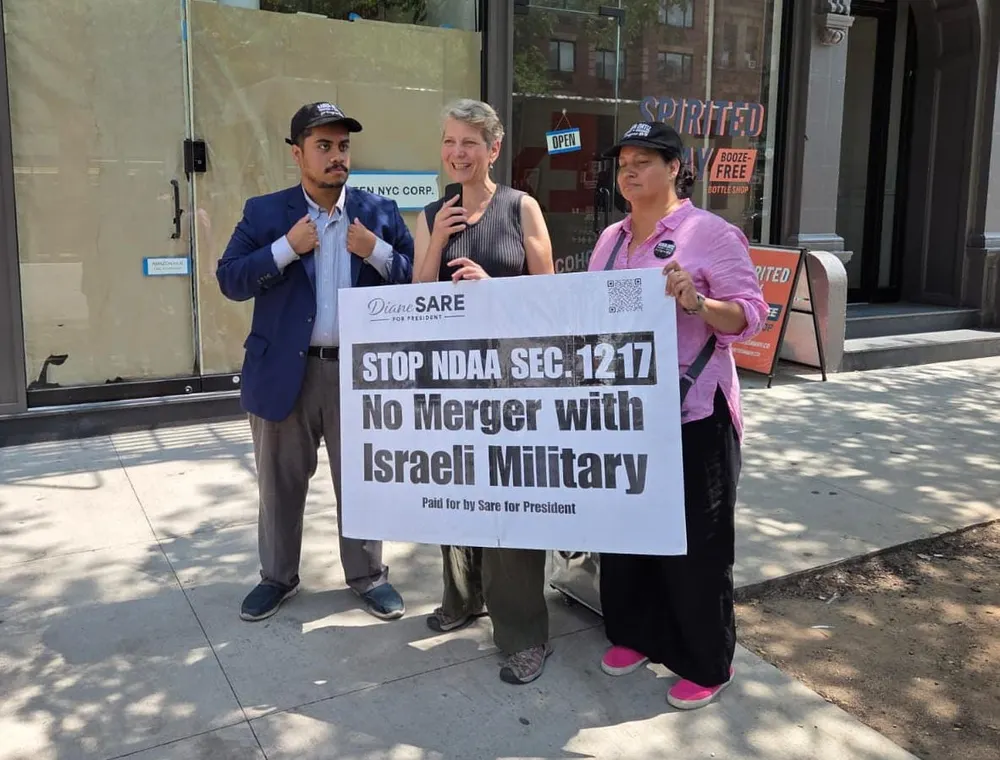
Thirty-three nations of the Americas met at Cusco and declined Washington’s demand that they treat organized crime as terrorism and raise their military budgets toward the NATO standard. A former CIA Russia chief and a former chairman of NATO’s Military Committee both said, independently, that this is 1914 rather than 1939—and applying a deterrence mindset in a 1914 situation will promote the war it claims to prevent. And in Manhattan, four organizing teams from the presidential campaign of Diane Sare and the congressional campaign of Jose Vega, joined by Karen Ortiz, organized on New York City street corners on the Upper West Side, the Upper East Side and Chelsea, signing up 75 people and putting hundreds of leaflets into hands—on the NDAA provision that would merge the American military permanently with a foreign state’s. New Yorkers stopped to argue. A striking number were connecting the economic wreckage around them to the war policy driving it.
That is what enlarging a brecha looks like: expanding the source of light.
Amorim also described what the light looks like when it widens. South America, he argues, must accomplish in this century what North America did in the nineteenth—"a real link, an actually usable link between the Atlantic and the Pacific.” He recalled Roosevelt and Vargas, two pragmatic men who agreed that the United States would finance Brazil’s first great steel mill at Volta Redonda—a state-run enterprise, built because both understood that a developed neighbor is worth more than a dependent one. On nuclear weapons Amorim was principled: Brazil renounced them in its own constitution, and while he agrees Iran should not have one, “no country should have nuclear weapons,” and those that do owe the world a reliable commitment to disarmament.
Pope Paul VI called development the new name for peace. Amorim says peace is also the new name of development—each is the condition of the other. That is the proposition EIR and the International Peace Coalition will put on the table this coming Friday, July 31, at the Emergency Roundtable, “Solve the Immigration Crisis with Development: What You Need to Know About the Strategic Significance of Pope Leo’s Encyclical.” People flee where the means of life have been destroyed. No wall, and no open borders address that; only development does.
“If you don’t believe in the future, what’s the point of life?” asked Amorim. “Our children, our grandchildren and the grandchildren of other people, have to have a good life.”
Come Friday. And bring someone who has stopped believing in the future.
Contents
LaRouche movement
- Sare, Vega Campaigns Take the U.S.-Israel NDAA Merger Fight to The Streets of Manhattan (↓)
- Brazil Presidential Advisor Amorim: ‘The Money for Wars Is Taken from Development’ (↓)
- EIR’s Amorim Interview Covered by Popular Brazilian News Site (↓)
Strategic War Danger
- Former CIA Russia Chief: This Is 1914, Not 1939, and the West Has The Wrong Diagnosis (↓)
- Houthis Strike Saudi Aramco Facilities (↓)
- US, UK Said to Be Planning 'High Level Meeting' on Security in Strait of Hormuz (↓)
- U.S. Pauses Strikes Against Iran (↓)
Science and Technology
Collapsing Imperial System
- Israeli Settlers Kill Four Palestinians in West Bank (↓)
- Cuban Foreign Minister Says New Sanctions Prove U.S.'s 'Genocidal Intentions' (↓)
Support our work 🙏
Support our work directly with a tip or donation — as a reader-supported publication, we rely on readers like you to keep this work going!