Aug. 1—On July 31, 2026, diplomats, scholars, and activists met online to examine the causes and solutions for the massive waves of forced migration that are occurring around the world. The EIR Roundtable: Solve the Immigration Crisis with Development built on the momentum of 164 consecutive online meetings of the International Peace Coalition (IPC). It had become increasingly clear to all concerned that the growing insolvency of the London-dominated “casino economy” was driving both the rush to war, and the crisis of forced migration, as the Anglophile powers reverted more and more to naked colonialism in a last-ditch effort to prop up their dying empire. The policies of colonialism are familiar: the grab for raw materials combined with bone-crushing austerity for the compliant nations, and “regime change” or bombs for those who are reluctant to comply. Either option produces waves of migrants making a desperate effort to survive. But as Helga Zepp-LaRouche, founder of the Schiller Institute and initiator of the IPC, has emphasized time and again, the 500-year era of colonialism has reached the end of its rope, and no matter how many nations those powers bomb, nothing will save their empire.
Panel 1: A Dialogue of Civilizations: Development or World War III
Moderator Dennis Speed set the tone for the meeting by presenting a video of Lyndon LaRouche speaking from Brazil on June 11, 2002, commenting presciently on the predicament that now faces the planet due to misbegotten or downright criminal policies.
EIR Editor-in-Chief Helga Zepp-LaRouche began her presentation by showing a video of a wave of some 50,000 or more desperate migrants entering Ceuta, the Spanish exclave bordering Morocco across from Gibraltar. She reviewed similar situations in the United States, then described the President Donald Trump administration’s draconian response. She went on to review aspects of how the Ukraine and Iran wars are steadily merging into a general world war which dramatically increases the possibility of the use of nuclear weapons. She examined the economic underpinnings of the war danger, including the “completely unnecessary” hunger crisis around the planet, and warned that the present attacks on free speech and human rights within the Anglosphere are being carried out in anticipation of a rapidly worsening economic collapse that will engender social unrest. She also recalled the radical Malthusianism which the oligarchy has expressed through its chosen spokesmen, such as Bertrand Russell, contrasting this to the view of the LaRouche movement, that “every newborn child is potentially a genius.” She ended by reviewing the required infrastructure for the near future of Africa, where the population is still growing, and described how it should be integrated with a global infrastructure net; this is a real war-avoidance strategy.
Liu Chang, spokesman for the Embassy of China in the United States, reviewed some of the contributions China has made toward solving the food crisis and promoting peace through development. He cited China’s Global Security Initiative from 2022 to make clear what China’s intentions are.
The Hon. Rostam Adabinia, Counselor at the Embassy of Iran in Mexico, began by reviewing the relationship of bad and unfair economic policies to the migrant crisis of “forced migration.” “Developed countries have the ethical responsibility” to promote development, he said, which is actually mutually beneficial.
Richard Falk, professor emeritus of international law at Princeton University, opened by saying, “It’s a great tribute to the Schiller Institute and EIR for convening this round table at this time of crisis and great danger.” We need a “politics of transition” because “we can’t afford that patience” that would be required for a slow, organic change to a non-colonial world. There needs to be a confrontation with “structural dominance.” Pope Leo XIV’s encyclical Magnifica Humanitas is an important illustration of what is required. The opposing policy to ours believes that the use of military power is the principal agency of historical change. This mentality must be defeated. This is what is causing the migrant crisis, and it brings out the worst aspects of ethnocentrism in the developed nations of the North.
Rémi Lebrun of the Schiller Institute in France presented his video, made with artificial intelligence (AI), that conveys the essence of Lyndon LaRouche’s Oasis Plan for development of Southwest Asia.
Timothy Ninsiima of Uganda spoke on the importance of the Schiller Institute’s youth organizing for the goal of economic justice, asserting that development is the right of every nation.
Jack Gilroy of Veterans for Peace and Pax Christi stated, “Diplomacy does work, at times, but getting diplomacy started, as we all know, can be extremely difficult.” He reviewed the story of how Norman Cousins and others persuaded Pope John XXIII to intervene to defuse the Cuban Missile Crisis, and described his organization’s open letter to Archbishop John Wester of Santa Fe, New Mexico.
Fr. Harry Bury, a frequent participant at the weekly International Peace Coalition meetings, represents Twin Cities Nonviolent and is a member of the U.S. Catholic Priests Association. He endorsed the efforts of Pope Leo XIV, the Schiller Institute, and the BRICS to confront the danger of war. The threats to development, he said, come not from Russia and China, but from billionaires, oligarchs, and the Epstein class. Those factions encourage war, starvation, and disease for Malthusian reasons.
Zepp-LaRouche praised Fr. Bury for his capacity for Empfindungsvermögen, which translates loosely to “empathy.”

In closing remarks, Liu Chang reiterated his nation’s willingness to assist countries all over the world in development. Prof. Falk pointed out that there had been no discussion of the UN, which was founded to promote peace and justice, but has been undermined by the dominant powers. Restoring institutional support for peace and development is what he intended when he spoke of a “politics of transition.”
Panel 2: Does Mankind Have the Moral Fitness To Survive?
Moderator Anastasia Battle observed that representatives of 14 countries were participating in the roundtable discussion.
Dennis Small, Ibero-America director for EIR, began by reviewing Lyndon LaRouche’s concept of potential relative population-density as a true measure of what has been called the “carrying capacity” for human beings in a given territory. “It is the collapse of that potential relative population-density which is the proximate cause of what you call the ‘migrant crisis,’ among many other things, and that is the only area in which there is a solution,” he said. He described how the Trump administration is pursuing the agenda announced by Malthusian genocidalist William Paddock in the 1970s, an agenda of intentionally lowering the potential relative population-density of nations through famine, war, and disease. Small proposed an alternative policy that would involve major development projects to make the nations to our south livable, and enable people to remain in their homelands. He cited the example of how China has lifted 850 million people out of poverty, over a 40 to 45 year period, as an example of a package of policies which are intended to increase potential relative population-density. He concluded with an excerpt from a video interview he had recently conducted with Special Advisor to the Brazilian Presidency Celso Amorim. (Transcript available elsewhere in this issue—editor.)
Western Hemisphere
Mário Maurici, Member and First Secretary of the São Paulo State Legislature in Brazil, described the damage being done to his country by the punitive tariffs being imposed by the United States. Brazil will respond by diversifying its markets. The BRICS-Plus organization now represents 46% of the world’s population and 28% of global GDP, and the New Development Bank of the BRICS represents a potential but not yet fully realized response to the economic warfare typified by the tariffs. There are internal conflicts within the organization which represent an impediment to a successful coordinated defense. Maurici held up Alexander Hamilton, Franklin Roosevelt, and Getúlio Vargas as exemplars of competent leaders whose economic policies enabled development.
Donald Ramotar, former President of Guyana (2011-2015), opened by saying that the imperial system which has characterized the past few centuries has outlived its usefulness, become an obstacle to development, and threatens humanity itself. He called attention to the U.S. assault on Cuba, which he characterized as “genocidal.” He reported that 7,000 containers of food and medical aid are being blocked by the United States from entering Cuba. He listed the impressive achievements of the Cuban nation, which he said was under attack, not because it threatens the U.S., but because it offers an alternative to the model preferred by Washington. He added that China is being criticized and attacked by the U.S., because China is the only nation that is actively assisting the development of the nations of the South. International institutions like the UN are being deliberately destroyed if they don’t promote the policies preferred by the United States.
Former Mexican Congresswoman María de los Ángeles Huerta del Río warned that the Mexican migrant community in the United States faces an institutional onslaught that has no historical precedent. She asserted that humanity does have the moral fitness to survive, but the country’s state agencies are stifling that capacity by prioritizing the legal order over human dignity. In U.S. Immigration and Customs Enforcement (ICE) detention centers, the right to health and the right to life are suspended, based on a person’s migratory status. She added that migrants are being denied access to their bank accounts, in an effort to erase them from society. This is institutional cruelty. “The migration crisis is the mirror in which humanity views itself and discovers its true face … a system which jails children, which denies water in the desert, which criminalizes honest work, is an empire which is on its deathbed.”
Diane Sare, independent candidate for President of the United States, reviewed the migrant crisis in the U.S. and expressed particular outrage at the revocation of the Temporary Protected Status of as many as half a million Haitians and Syrians. She insisted that we must “recruit the United States back to the better angels of our nature.” She reminded the participants that Lyndon LaRouche had always framed the problem as being the choice between two opposing images of man: Is man a brute, a beast of burden, or is man defined by an invisible, internal capacity for creativity in the image and likeness of the Creator? The former is the choice of a class of billionaire oligarchs who arrogate to themselves the authority to “cull the herd.” The United States declared its independence 250 years ago, explicitly to defeat this faction and its outlook. She reviewed case histories from America’s past where we actually assisted other nations in the development of critical infrastructure, and she set forward an agenda of projects for the future where U.S. participation can be of crucial importance.
Africa
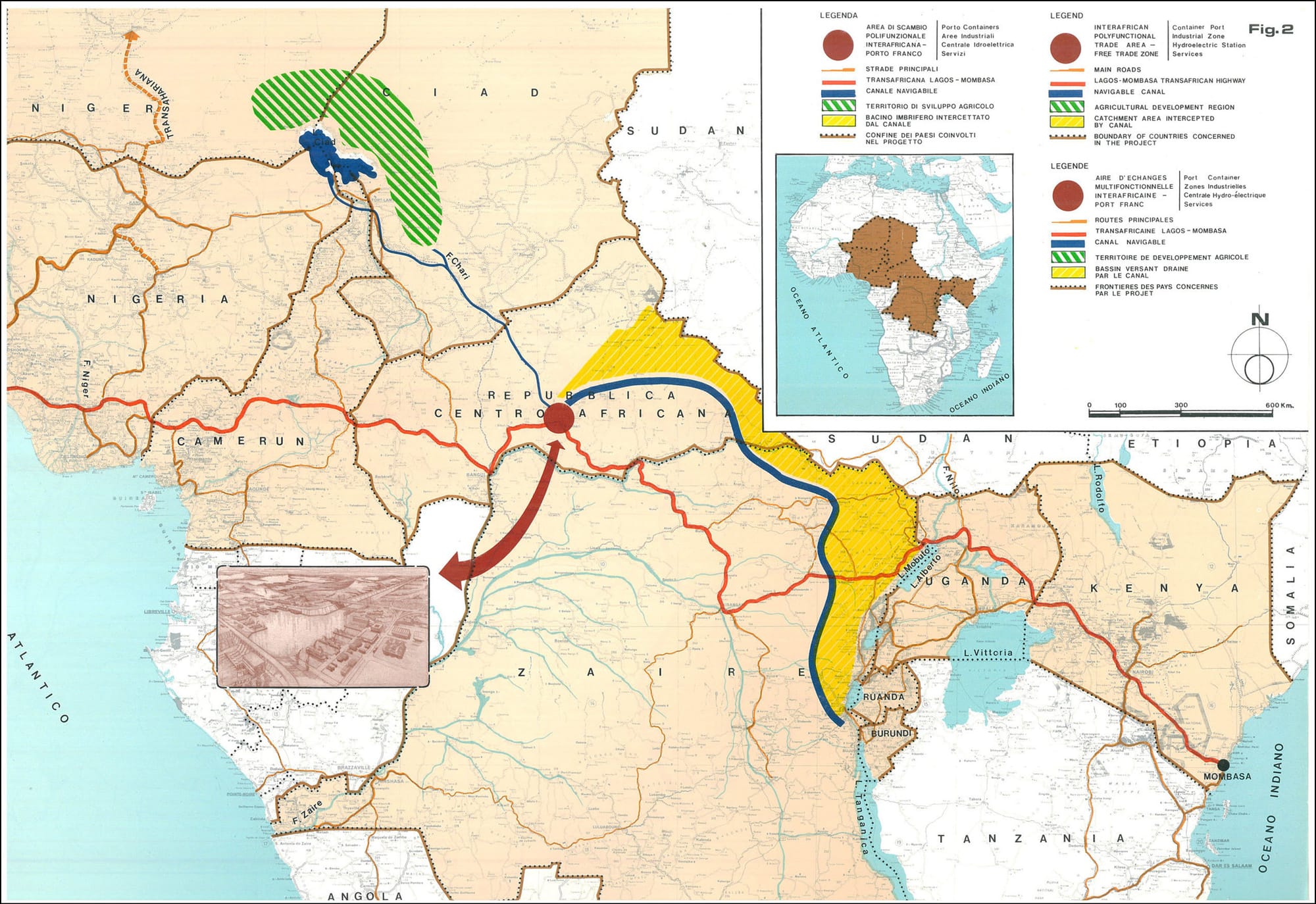
A series of speakers who focused on the situation on the continent of Africa followed. Claudio Celani, co-editor of the EIR Strategic Alert Service, announced his intention to speak about “the terrible injustice done by nature, which mankind is called upon to remedy.” By this he meant the unequal distribution of water in the African continent. He went on to describe in detail the Transaqua project, which would do much to solve this problem.
Josef Abissalah, Ambassador Extraordinary and Plenipotentiary of the Republic of Chad to the Federal Republic of Germany, provided a detailed description of the migration problem in Africa, and called for a Marshall Plan to address the problem through economic development.
Adama Coulibaly is former Chief of Staff to the Ministry of Communication for the nation of Burkina Faso. He echoed the description of the problem as presented by his colleague from Chad, and described some of the obstacles to a solution, including the corruption of some leaders.
Discussion
Dennis Small returned to emphasize that a Malthusian policy drives much of the migration crisis; that the calamitous situation is not due to a failure of well-intentioned policy, but rather to the success of a malicious policy.
Josef Abissalah stressed that African nations must work with their neighbors to generate a solution from within the continent. The IMF and World Bank, he said, won’t solve the problem.
Claudio Celani offered a refutation to the Malthusian/environmentalist contention that man is an alien life-form that threatens to upset the “balance” in nature. He observed that leaving nature to its own devices often results in calamities.
Diane Sare observed that each of the speakers from various nations represents a community that, when pulled together with the others, “vastly outnumbers this billionaire Anglo-Epstein class, which is running this horrible racket…. Evil is not intelligent, it’s not creative…. They are operating out of weakness, and the knowledge that they are very few.”
Join Us!
At the end of the first panel, Helga Zepp-LaRouche exhorted everyone around the world to become active in this effort:
I’m asking everybody who is listening: Join us. Offer some of your time; we need people who will help this process.
I can only say, if you think about the incredible tension between, on the one side, the potential annihilation of everything this beautiful human race ever created—all the music, the compositions of Beethoven, the poems in all the languages of the world—all of that could disappear, because there would be nobody left to even investigate why it collapsed.
On the other side, if we now get our act together, I can see that we could eliminate hunger in half a year. If all the nations would put their minds and acts together, we could put crash crops—we could have a mass mobilization to produce a lot of food; we could end this poverty in five years; we could have reasonable living conditions for every human being on the planet in less than one generation, much less than one generation. And if we then would reach the next scientific breakthroughs, like getting thermonuclear fusion as a source of energy, we would have energy security for tens of thousands of years, if not more, and one big cause of war would disappear.
The billionaires could stay in their houses—we would give them the right to survive, but they could not rule the world anymore. So, I think that it is definitely something which we absolutely— If you have any fiber of humanity in you, help us and help yourself now. It is the biggest battle of civilization ever.