On August 4, Ukraine’s Security Service (SBU) announced the conclusion of the much-vaunted 40-day ‘influence’ campaign, declared by Ukraine’s acting president Volodymyr Zelensky in late June. Besides the announced purpose of ‘influencing’ Russia to “end the war,” i.e., give up, the campaign was clearly designed to convince the West that the tide of war had turned in Ukraine’s favor.
Highlights of the 40 days included attempts to cut off all fuel and other supplies to Crimea, destroy Russian shipping through the Sea of Azov and the Black Sea, continue to disrupt Russia’s domestic fuel supplies by drone attacks on refineries, and, most recently, destroy warehouses of Wildberries, Russia’s version of Amazon.com, apparently to sow discontent amongst Russians.
Further, there is mounting evidence that a failed Aug. 1 assassination attempt in Moscow on Russia’s Aerospace Forces Commander Gen.-Col. Alexander Chayko was part of the package. It has now been confirmed that his son-in-law was one of the five people killed in that restaurant bombing, while this week there have also been two funerals of senior military officers close to Chayko, without explanation of their deaths.
On July 13, touring an exhibition of Russian drone technologies, President Vladimir Putin said that Russia’s response to Ukrainian attacks would be “mirror-like,” but “several times more powerful.” That promise has been born out in the demolition of Ukraine’s logistics, as Russia during the 40 days crippled Ukraine’s key ports in Odessa Region, destroyed hundreds of gas stations in eastern Ukraine, damaged or destroyed 100 to 200 railroad locomotives, and, in addition to military warehouses, began to hit warehouses comparable to those of Wildberries.
The SBU claimed that they hit “more than 100 strategic objects behind enemy lines,” including military airfields, but over the same 40 days, Ukraine has exhausted its ability to defend against Russian missiles. And the campaign seems to have ‘influenced’ Russia in a different fashion.
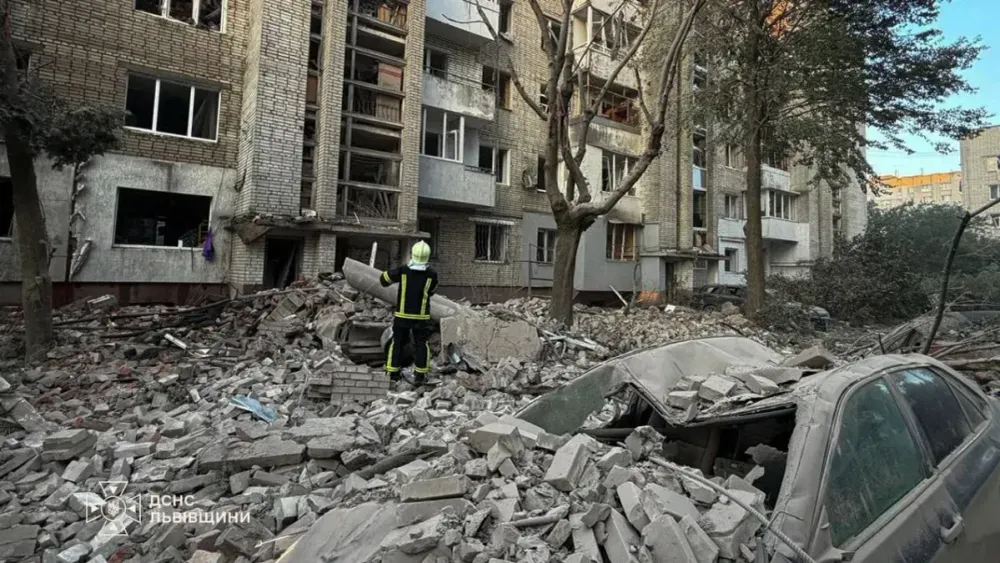
Within hours of the SBU posting, Russia hit Kiev with 24 ballistic and 4 hypersonic missiles, launched at industrial sites and warehouses in Kiev on the night of August 4-5. The Ukrainian Air Force confirmed that they were unable to bring down any of the 28 missiles - a new record. One can see, among other things, the massive, fiery destruction of Kiev’s warehouse district on the western side of the Dnieper River. In addition, the Black Sea ports in and around Odessa, along with three ships in the western Black Sea, were hit once again, as part of Russia’s denial of access to Ukraine of Black Sea shipping.
Then yesterday, Zelensky met with the National Security and Defense Council, to whom he complained that “partners” are failing to provide anti-missile interceptors. Last night, on the presidential website, he reported that he “emphasized that since the beginning of 2026, Ukraine has been receiving nearly three times fewer anti-ballistic missiles than before.” So, “the Ministry of Foreign Affairs and the Ministry of Defense must do everything possible to increase supplies of interceptor missiles.” Zelensky followed up with urgent phone calls to President Alexander Stubb of Finland, NATO Secretary General Rutte, and the new UK Minister of Defense Wes Streeting.
Yet there is no more reason to believe that such interceptors will come to the rescue than there has been to believe Kiev’s public relations campaigns, disguised as military strategy and accompanied by huge losses, were reality-based— not just the latest '40-day influencer,’ but earlier versions, such as the August 2024 invasion of Russia’s Kursk Region, or the infamous June 2023 “counteroffensive” in Zaporozhye Region.