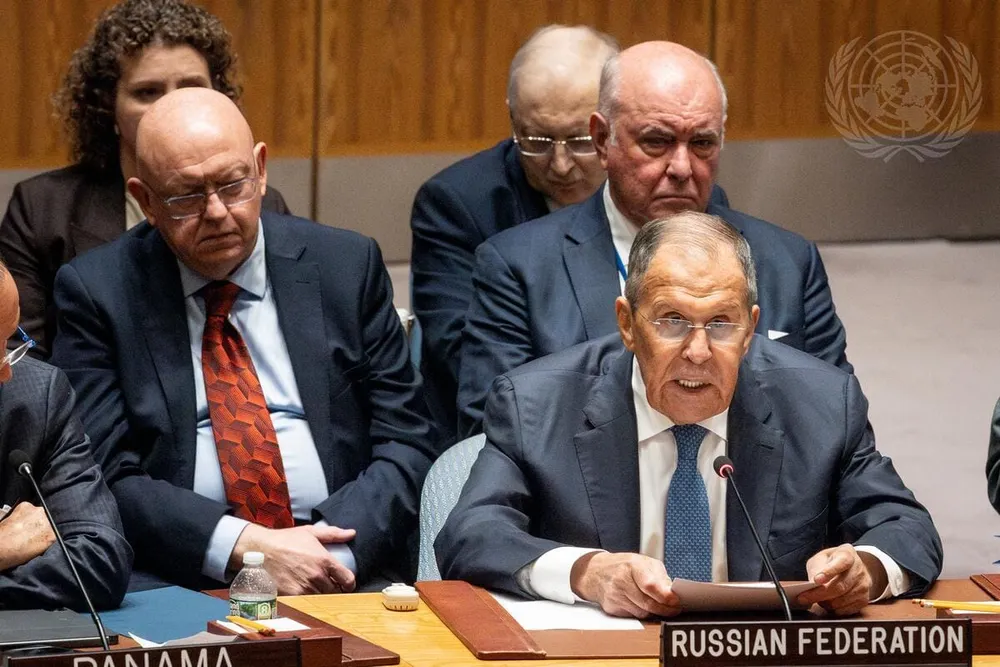
Foreign Minister Sergey Lavrov won’t deliver Russia’s speech before the UN General Assembly until Saturday, Sept.26, but in the meantime he has a “maximally packed” schedule of 30 meetings, spokeswoman Maria Zakharova told the press today, with representatives from Algeria, Brazil, India, Iran, Cuba, the OSCE, IAEA, the UN General Assembly President, and U.S. Secretary of State Marco Rubio.
Zakharova explained that “against the backdrop of such a complex geopolitical situation, the Russian side is focusing and will continue to focus the work on such important issues as strengthening the foundations of multipolarity, building an architecture of equal and indivisible security in Eurasia, countering colonialism in all its forms and manifestations, the fair reform of the global financial architecture, the consolidation of international efforts in the fight against terrorism, preventing the erosion of existing agreements and developing new ones in the field of disarmament, and strengthening equal cooperation in the area of human rights protection.”
Zakharova also said the UN remains “an indispensable and most representative universal platform for multilateral diplomacy.”
The Lavrov-Rubio meeting occurred today on the sidelines of the UNGA, but little can be gleaned about their discussion from the respective readouts. “The Secretary discussed the Russia-Ukraine war and the U.S.-Russia bilateral relationship,” was the full extent of the State Department notice. The Russian Foreign Ministry’s readout was somewhat longer, emphasizing that Lavrov “drew attention to the close coordination between the Kiev regime and its European sponsors,” including Kiev’s actions “leading to the destabilization of global energy markets.”
Prior to the Lavrov-Rubio meeting, the Foreign Ministry had issued a statement which was careful to point out that “our main disagreements are arising not with the Americans, but with the Europeans, who continue to take radical and ideologized positions in line with the general political policy of Brussels.”
