HARLEY SCHLANGER: Hello and welcome to our weekly dialogue with Helga Zepp-LaRouche. She’s the founder of the Schiller Institute and the initiator of the weekly Zoom call of the International Peace Coalition every Friday at 11AM Eastern Time. Today is September 2nd, 2026. I’m Harley Schlanger and I’ll be your host. You can send her your questions and comments via email to questions@schillerinstitute.org or post them on the YouTube chat page.
We’re in the midst this week, Helga, of a real showdown between the two leading opposing forces in the world. The Global Majority is meeting in Bishkek, Kyrgyzstan under the auspices of the Shanghai Cooperation Organization and also in Vladivostok is the Far Eastern Economic Review, while the financial and technical teams of the G20 are meeting in North Carolina. The backdrop to these meetings is the new round of military strikes and counter-strikes around the Strait of Hormuz, while the U.S. is using the G20 summit to rally support for the Trump-Bessent Operation Economic Outcast, the new round of economic sanctions aimed at crippling Iran. Reports today show that Iran has hit marine barracks in Jordan, made drone strikes on U.S. bases in Bahrain and Kuwait, and Trump is threatening to escalate and once again say hit the hardest ever.
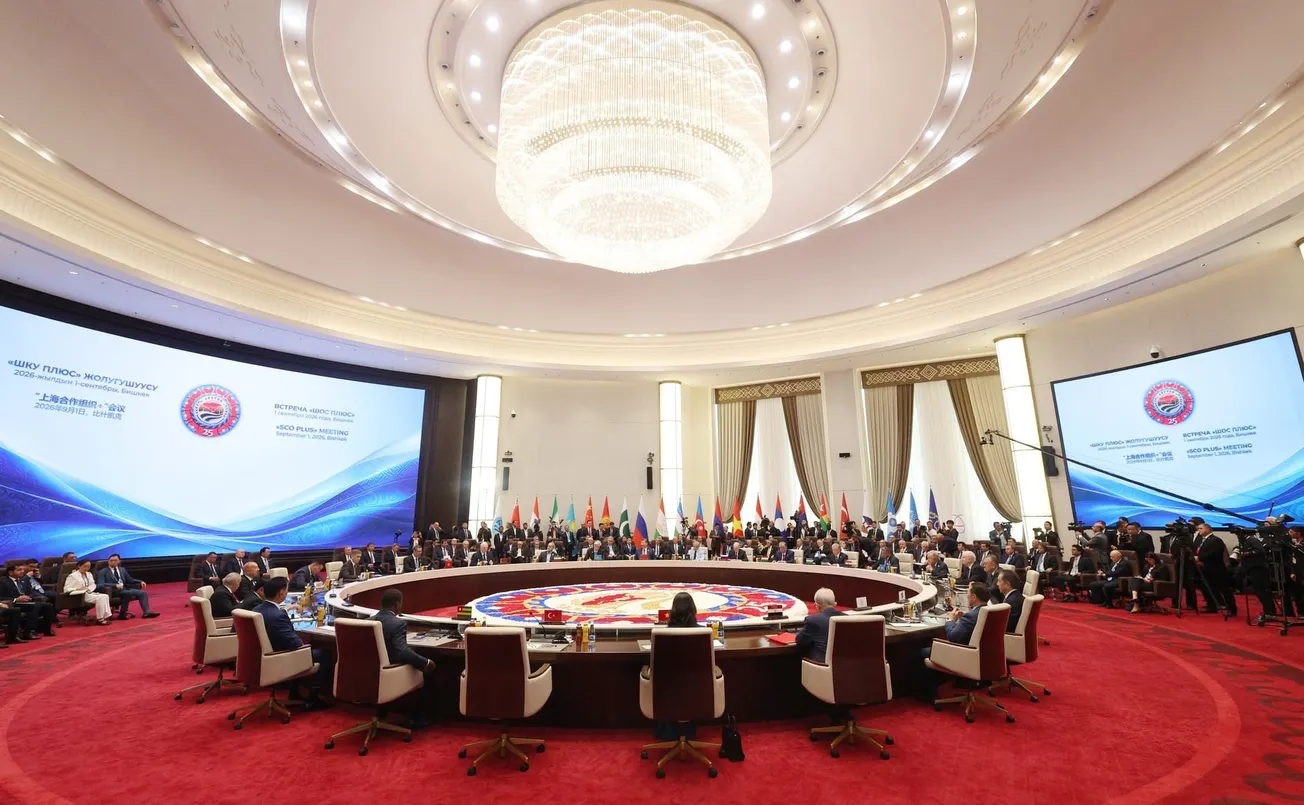
So let’s begin, though, with the Shanghai Cooperation Organization, which was addressed by Presidents Putin and Xi Jinping, among others. Very visible there was Iran’s president, Pezeshkian. What’s been on the agenda there and what do you know of the official communique, the so-called Bishkek Declaration?
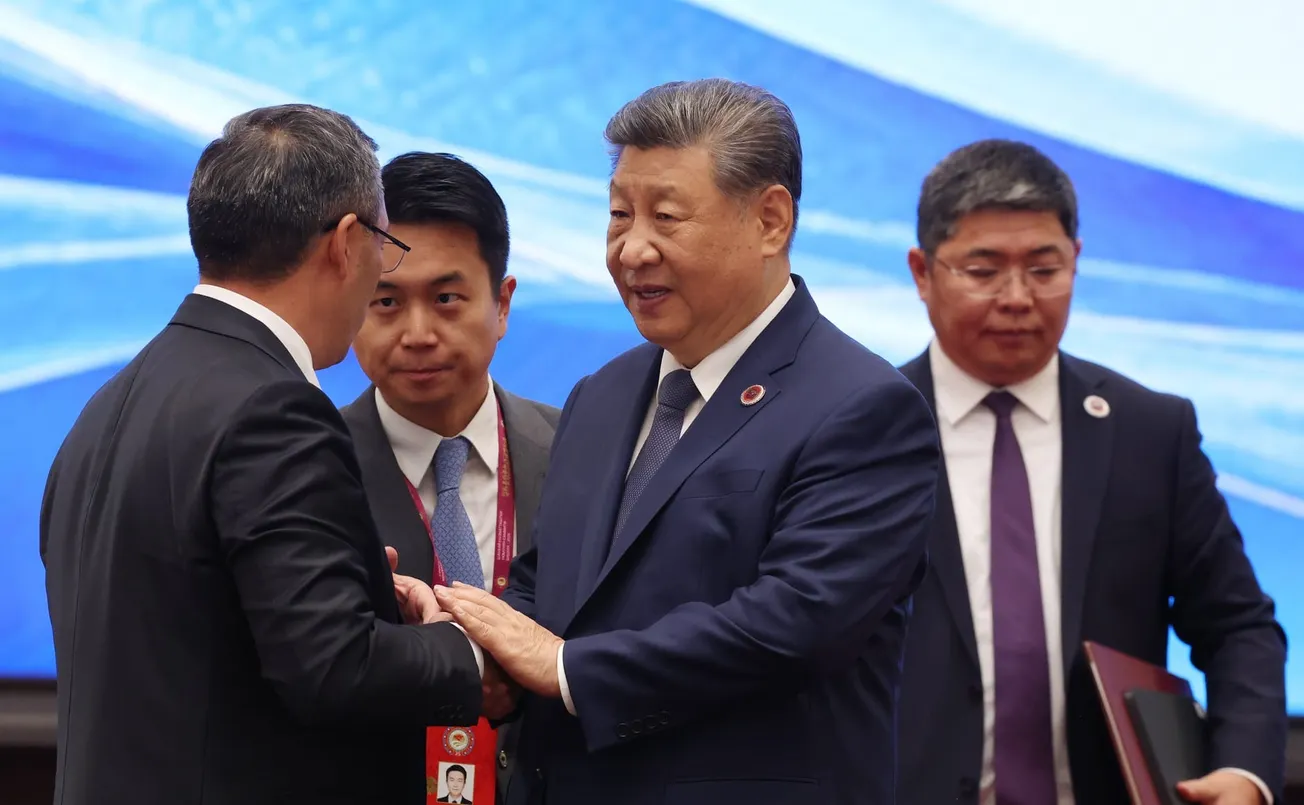
HELGA ZEPP-LAROUCHE: Well, I think the world has to recognize that the majority of the world is moving in the direction of peaceful cooperation for the mutual benefit of all participating nations. Because in Bishkek, there were 10 member states of the Shanghai Cooperation Organization, plus 15 observers who are basically countries aspiring to become members. And as Putin stated in a press conference, this combination of people represents 42% of the world population, that’s almost half, and one third of the GDP, and I think also about one third of the landmass territory. So since these countries basically agreed with their principles to be in a mutually beneficial relationship to each other, discussing any conflicts through mutual discussion and negotiations, diplomacy, it’s a new model of cooperation. And in combination with the BRICS, it is a new form of world system, where one country is not dominant and the other ones are colonial subjects, like you have in the West, but it is a new model of cooperation. And I think this is the future.
I think that the Bishkek Declaration, which is very long and very detailed and enumerates many areas of cooperation, but all of it is guided by the spirit of friendship and cooperation. So I think anybody who thinks Iran is isolated better wake up to the fact that some of the most powerful countries of the world are backing up Iran. And in the Bishkek Declaration there was a very strong condemnation of the attack on Iran, the expression of condolences for the assassination of the Supreme Leader Khamenei. And so I think that Iran is very well integrated into that new emerged bloc of nations.
So this is then carried on in the Vladivostok Eastern Economic Forum, where 5,000 participants are there from 70 countries, and I think the title of it is “The Far East: Development for the Benefit of the People.” So I think that that continuation of strong economic power and the wish to continuously go in the direction where the other Asian countries have been moving for the last several years, where the only growth rates actually have been in Asia; I think this is a momentum the West is completely ignoring, even if it’s very hard to ignore because it is the most powerful development. But nevertheless, the ideological blindfolds of many media and politicians in the West just ignore that that is where the momentum of the world is.
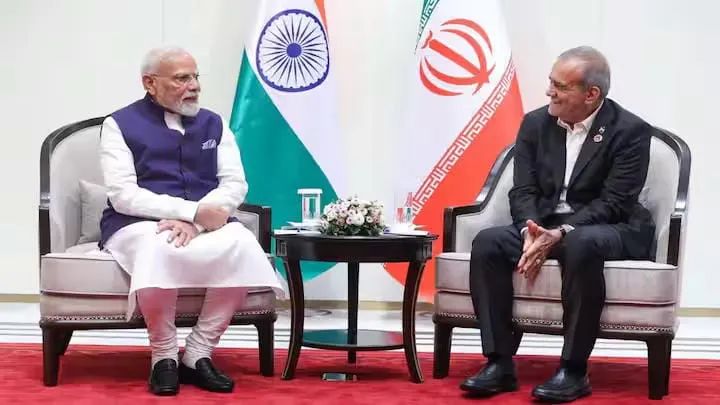
This will, in one way or another, be continued at the BRICS conference, the BRICS summit in New Delhi. I think it will be the 14th and the 15th of September. And it is also quite important that Prime Minister Modi participated in the Bishkek meeting. You could see pictures of him, with Putin and Xi Jinping. So I think the signs are that all the efforts to divide the BRICS countries and run operations against them individually are not really playing out well. And I think that the momentum of the future of the world, provided that the insane elements in the West are not ruining everything with nuclear war; I think that is the future and it is a model of how countries can cooperate. And if the European countries and even the United States would just get reasonable and say we should stop the effort to smash this and rather reach out and say let’s cooperate for the common good of humanity, all problems could be solved relatively easily. But I don’t see that reason dawning yet.
SCHLANGER: It was also reported that Putin gave a battlefield report on Ukraine, which was relatively optimistic that the Russian forces are moving. And that was one of the elements of the side discussions.
Now, in contrast, there was the Bessent press conference. I had a chance to watch this. And from the clips I saw, he seemed strangely confident that the economic warfare will succeed, though it appears that the dollar crisis, the U.S. bond markets are taking the biggest hits and the U.S. interest rates continue to climb. What’s your assessment of where the situation is going in terms of the U.S. side of this?
ZEPP-LAROUCHE: I have not seen the optimistic outlook of Mr. Bessent, but the reality of the situation speaks a different language. Despite this enormous buyback of Treasuries by the United States, the yields are going up again following the renewed attacks in Southwest Asia. So I think this is all built on sand. And I think the admission by Bessent earlier that by imposing such sanctions, he does not want to ruin the world economy, is a short-term wish because he is ruining the world economy. And I think we are going to see an explosion not very far in the future.
SCHLANGER: Well, there are some delusional supporters of President Trump who insist that Bessent is a proponent of the American System. And they seem to be confused as they’re hailing one of George Soros’s leading hitmen as an economic nationalist. But what is the continuing effect of his policies on the U.S. economy?
ZEPP-LAROUCHE: Bessent is a monetarist, if you ever have seen one. I mean, he is a pupil, you can say, of George Soros and another fellow called Druckenmüller, who became famous for having organized the attack on the Pound Sterling at the beginning of the ’90s. So, I have no confidence that Bessent has learned anything in addition since then.
So I think this is a complete disaster because the effect of it is that the American economy, the European economies, the countries of the developing sector, the Global South, are suffering tremendously from the effects of this Iran war. And, these are effects which cannot be remedied in the short term, like the impact of food not being planted, fertilizer being expensive, etc. So I think we will go into a very harsh fall and winter for the whole world.
SCHLANGER: Now, there’s continuing discussion from the U.S. in particular, but also from the British, of the use of nuclear weapons, the development of a tactical nuclear weapon capability. And this is coming from the usual circles of U.S. war hawks and neo-cons. You’re involved in a collaboration with people who are opposed to this approach. And part of this initiative is the appeal to Pope Leo XIV to convene a conference of world leaders to address this otherwise insane proposal to use nuclear weapons. How is that fight going? Are we continuing to get signers on that? And is it being circulated widely?
ZEPP-LAROUCHE: I think it’s moving very well. Obviously, we need to escalate it because the statements coming from such people as Elbridge Colby, the so-called Under-Secretary of War for Policy of the Pentagon, that he wants to have the use of tactical nuclear weapons as one of the options available for the President; as if that would be just some little thing. We are talking about something which inevitably will lead to a global nuclear war and the annihilation of the human species.
I fully agree with people like Professor Ted Postol and Stephen Starr, two eminent nuclear scientists, also rocket scientists, who have demonstrated that there is no such thing as a tactical nuclear war. It is the logic of nuclear weapons that once you use one, you are in an escalation spiral, which according to Postol means that within five days you have a global nuclear war. Now, that such a debate has erupted is making headlines, at least among certain circles in the United States. There was a very important broadcast by Tucker Carlson, who concluded his description of this debate in the Pentagon with a demand for the impeachment of President Trump. Apparently also Marjorie Taylor Greene and other people who used to be in the MAGA movement are now blasting this discussion about nuclear war and the use of nuclear weapons. But amazingly, I was looking in the European media to see if there is a debate about this occurring inside the United States? And the only thing I found, for example, in the German media, was two little side sentences, but not at all evaluating what that means. Even though if it ever comes to that, there will be nothing left of Germany, nothing left of Europe.
So I think that the non-reporting about this debate in Europe should alarm everybody about the state of the so-called free media. I mean, you would think that if somebody proposes the use of tactical nuclear weapons in a conflict with Russia and China in a regional crisis, that this would be a debate, you know, that you would have commentaries, think tanks, politicians, experts, all discussing the fall-out of such a policy for their own country. Nothing of that happens. So that means that the NATO disinformation cognitive warfare policy is fully operational because they give the truth in small portions to the population, not to inform them, but to nudge them, as [inaudible name 14:26] had written about it a while ago, to nudge them into a specific perception and to manipulate the axioms of the thinking of the population so that they become numb and don’t realize the danger anymore.
I find this absolutely horrifying, and this is why this initiative is so absolutely crucial, because the actual text of the appeal to Pope Leo XIV is a fair summary of all the different people who have been warning of this; Naryshkin and Tulsi Gabbard, the two intelligence chiefs of both the United States and Russia and many others. So the appeal as such is already a pedagogical for people to get a sense of what real insiders are concerned with. So then the number of people signing it also has grown quite impressively. But I’m really calling on all of you, our present listeners and watchers, to help to distribute this appeal as wide as you can. Sign it, but not only that, give it to your neighbors, to your colleagues, friends, and use it on social media. This is an appeal to Pope Leo XIV to convene an international conference to return to diplomacy and avoid a catastrophe. So it’s probably the most important thing you can presently do to help to spread this letter.
SCHLANGER: And you can find the appeal on the schillerinstitute.com website. You can sign it and circulate it as widely as possible. We’re speaking with Helga Zepp-LaRouche of the Schiller Institute.
Helga, I would say the one place there’s coverage of the nuclear debate is in the British press; where it’s a very one-sided story of the need to modernize the nuclear force and to extend the nuclear umbrella over France and Germany.
Now, one other area, I just saw this today, there seems to be some growing disgruntlement or quarreling within the so-called Department of War. The Secretary of the Army resigned and supposedly was in a fight with Hegseth. Do you know anything about that?
ZEPP-LAROUCHE: Yes, I think he’s reported to be close to JD Vance and reluctant on some of these war policies; as apparently some other top generals are, who recognize clearly that the war with Iran has been lost. The reason why Trump did not continue it a little while ago was because the U.S. is running out of missiles and interceptors. Many areas of the world, the Pacific, Ukraine, are getting less and less ammunition, which has become a point of concern. So even from a strict military standpoint, the policies of Hegseth obviously have completely failed. And whoever briefed Trump a while ago, before the wars restarted on February 28th, apparently on the pressure of Netanyahu, who has claimed in the meantime that it was him who got President Trump to go for this war.
If you look at it, it is a strategic disaster of the first order. None of the war aims have been accomplished. There has been no regime change. The nuclear program of Iran is fully intact. As a consequence, now the Strait of Hormuz, which was open before, is blocked, leading to horrible consequences for the world economy. And the entire security architecture in Southwest Asia is collapsing because the United States was unable or unwilling or both to defend the U.S. bases in the countries of the Gulf cooperation countries. So these countries are also moving to form their own system in the Mecca alliance, which is Pakistan, Saudi Arabia, and Turkiye, and other countries are now applying for membership there as well.
So from the standpoint of the U.S., this war was a complete and utter disaster, which has completely diminished the status of the United States as a military power in the world. So that is obviously a big debate, and the departure of the Army Secretary is one reflection of it. But there are also signs that Hegseth may not be in office for very long. And I was just told by a colleague of mine that if you go for a machine, a machine transcription of an audio and you say Hegseth, it does not spell it the way it’s normally spelled, but it spells H-E-X-E-D, hexed. I find it quite funny, and maybe Nomen ist Omen.
SCHLANGER: Well, if I’m not mistaken, isn’t Hexe the word for witch in German?
ZEPP-LAROUCHE: Yes.
SCHLANGER: Okay.
Now, yesterday, going back to the economy, you presided over a seminar which addressed the free fall of the German economy, and how to reverse it. There are reports in the media today that Volkswagen has plans for another 50,000 layoffs, which may bring the total up to over 100,000. What happened to the German auto sector, which in the past had been the driver of technological and manufacturing advance, not just in Germany, but for all of Europe? Now it appears to be the driver of the collapse of the manufacturing sector.
ZEPP-LAROUCHE: Well, I think the auto sector is just one area where obviously there were some significant mistakes by the management of the large auto corporations. But I think that is just one element of many. Another reason the German economy is collapsing is naturally the energy price. Furthermore, the Great Reset policy, the Green New Deal, are all leading the European economies in a completely wrong direction. But especially the energy price is really driving it; it’s not just auto, it’s chemistry, it’s all energy-intensive industries which are either closing down or going abroad, if they can. And it’s just insane because Putin at this press conference in Bishkek again reiterated that Germany could have access to cheap gas immediately; just a button would have to be pushed, and the still functioning Nord Stream Pipeline No. 1 could immediately deliver gas.
Now, what does the German government do instead? It goes absolutely crazy. Four weeks ago, there was a drone found at the Leipzig airport. A drone which was found accidentally by a bus driver taking some guests or tourists around on the airfields and he found the drone and he kicked it down with his foot. So it cannot have been such a terrible drone because otherwise he could not have done that. Now after four weeks of mooting who may be behind that, yesterday the German government in the presence of Dobrindt, the Interior Minister, and Wadephul, the Foreign Minister, said that they now have evidence that this was done by Moscow. Naturally they did not produce any evidence, they just said the pattern of how it was functioning was very like other similar patterns, very vague. They did not present hard facts. And now they do. They say we have to take the following measures: They closed down the last Russian consulate in Bonn. They closed down the Russia House in Berlin, which is a cultural house. And they threaten further measures, knowing already that this will almost 100% lead to countermeasures such as Russia probably closing the consulate in St. Petersburg, closing down the Goethe Institute, which is one of the few places in Russia where people still can learn German. So who is hurt by that? It’s Germany; German interest.
And naturally one argument is, what would the interest of Russia be to place this drone? First of all, it’s a low-level technology. It’s a very primitive drone. If Russia wanted to send a signal, I think they would send an Oreshnik to one of the production places of the Taurus missiles, the Storm Shadow missiles, or some other place. But they will not tamper with a little drone, which, I mean it’s just completely out of proportion; staged. Many people are asking themselves what could that be? Could it be a false flag operation, maybe by the Ukrainians? Who has an interest to poison the relationship between Germany and Russia even more? It’s for sure not Russia. Russia will act, if they do, in a powerful way to really send a message, but not to have an incompetently placed drone. Sahra Wagenknecht made the other argument, which I think is also reasonable. She said, even if the drone would have been a Russian drone, would you want to risk the relationship with Russia and completely poison it in a way which could eventually lead to a war between Germany and Russia? It just does not make sense. And I can only hope that these people are voted out of office as soon as there is an opportunity with an election. One of them is this coming Sunday, the election in one of the states of East Germany, Sachsen-Anhalt, which could already be the beginning of a change of the German government.
SCHLANGER: Well, in answer to your question of who has the vested interest in seeing Germany fail, I just was writing something the last couple of days about the policy after World War II of NATO under Baron Hastings Ismay, a former aide to Churchill, who defined the purpose of NATO as keeping the Americans in, the Soviets out, and the Germans down. And at least on that level, it seems as though they had some success.
Now, Helga, you’ve been extremely busy recently. You’ve got another initiative coming up this Friday, an Executive Intelligence Review roundtable discussion on the alternative to war and looting of the Americas. What do the viewers need to know about this upcoming event? And as I say, it’s this Friday. How can they register for it?
ZEPP-LAROUCHE: Well, you can register on the EIR larouchepub.com site. It’s a very high-level Zoom conference featuring the future of cooperation in Latin America around the Bioceanic Railway, which is planned and being built between the Atlantic and the Pacific, connecting the Chancay deep-water seaport from Peru to Brazil. And it will be an economic corridor, which is one of the economic transport arteries, which will open up the entire interior of all of Latin America. And naturally, if you look at the connection on the map, it will connect the Latin American continent directly with Asia, and therefore with this kind of powerful economic group we were talking about in the context of the SCO meeting, because it would immediately open up Latin America for such cooperation. And therefore, it is the way for Latin America to develop and have a powerful economic future.
Naturally, we want the United States and China to cooperate. We do not want a fight where either the U.S. regards Latin America as their backyard, which right now seems to be the policy with the U.S. Security Strategy, which does claim dominance over Latin America—the so-called “Don-roe Doctrine.” That is not what most of the countries of Latin America want. They want to have a right to economic development, and they want to do it with China because China has offered these kinds of projects. And the best thing would be that the United States cooperates with China to this purpose. This would help to solve the migrant crisis in a completely different way; namely to keep the people in their country and have them build up their own economies to have a future. So the reason why they are running to the United States as refugees would be overcome. So that will be the topic. We will have top-level speakers. We will have a top speaker from China, Professor Zhang Weiwei. We will have the former science minister of Brazil, Mr. Amaral, and many other top generals and scientists and top economists from Latin America.
So if you want to know where the future of the world will go in that part of the world, absolutely tune in on Friday and become part of this effort.
SCHLANGER: It’s Friday at 5 p.m. Central Europe time, 11 a.m. Eastern time. Now one other event coming up, Helga—and I said it’s a very busy schedule—is the September 11th Schiller Institute concert commemorating the terrorist attack on 9-11-2001. And it will be featuring Beethoven’s Ninth Symphony tuned to the classical Verdi tuning. And that was, of course, part of a campaign that was initiated by your late husband.
So tell us a little bit about the concert, and I’d like you also just to discuss your emphasis on the importance of reviving real Classical culture. When the Schiller Institute was founded in 1984, it had a strategic side to it, but equally important to the strategic side, I know in your mind, was the importance of reviving real Classical culture and the need to create a more literate population. And of course, I think things have gotten much worse since then. So just if you could talk a little bit about the importance of the concert and the overall cultural policy for a new renaissance of the Schiller Institute.
ZEPP-LAROUCHE: Well, obviously, the Ninth Symphony of Beethoven is one of the absolutely top compositions ever created. One could argue that it may be even the best one, because it does combine the beauty of Schiller’s Ode to Joy with the very famous All men become brethren, meaning all men will become, you know, allied on the highest level, and there is a good Father, meaning a Creator.
So it’s a very optimistic, beautiful, beautiful piece of music. And in a certain sense, this is the most urgent thing; because what is our society suffering from? Tremendous decadence, a tremendous collapse into barbarism. If you look at the violence in our culture, both in the United States and increasingly in Europe, the degraded so-called popular taste, pop music, popular culture, movie industry, violence, school shootings. It’s just a completely depraved collapse, like in ancient Rome when the end-phase of the Roman Empire developed, you had a similar collapse into barbarism. And to counter that, you have to go to the highest ideals of mankind with a beautiful image of man. Man as a genius, as a beautiful soul, as a creative being. And that is what this music celebrates.
And obviously that is the message, both for the 250th anniversary of the United States, that it should go back to its origins and what the Founding Fathers intended the United States to be—a republic. And also the idea that what happened on 9-11 was really the end of that republic by turning it into increasingly a police state and an empire; and that that needs to be reversed. So for the 25th anniversary of 9-11, I think that is the powerful message. Also what Diane Sare, as a Presidential candidate, wants to turn the United States back into. So you should absolutely register and be part of it because it will give you some hope for the future because the United States must not end as a collapsing empire, but it must find its way back to its roots. And that’s the place where you can find out about that.
SCHLANGER: Well, as I said, it’s a very busy schedule. You can find most of the information on the schillerinstitute.com website.
So Helga, thank you for taking the time to brief us today. And we’ll hopefully see you on Friday and I’ll talk with you later.
ZEPP-LAROUCHE: OK, ‘til then.