
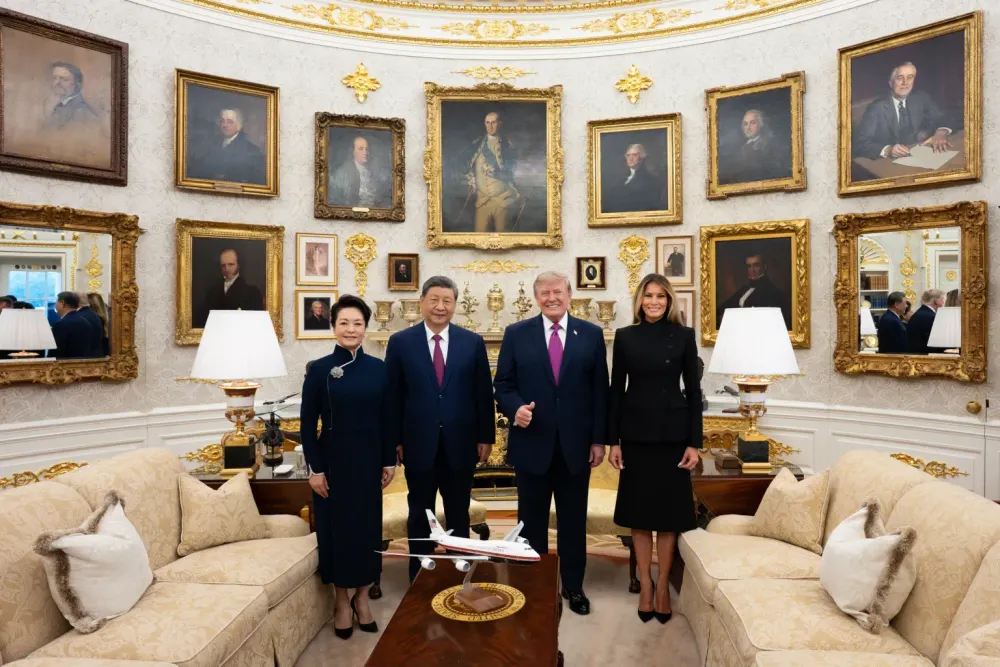
Chinese President Xi Jinping’s three-day state visit to Washington, his first since 2015, ended today with tea in the Red Room of the White House and a visit to the National Archives. President Trump wrote afterward that “the meeting was one of Friendship, Strength, and Success, for both China and the U.S.A.,” and that the two leaders will meet again in November at the APEC summit in Shenzhen and in December at the G20 in Miami.
The American public saw little of it. The White House had revoked the credentials of CNN, MS NOW and Politico on Sept. 21, and the television networks suspended live filming of presidential events in protest. A federal judge ordered the White House to restore the outlets’ access on Sept. 24, the day of the state dinner. Friday morning’s tea was the first television pool coverage of the visit. A Chinese leader who is a fixture of hostile commentary on both left and right was thus kept off American screens for most of the three days he was here.
Trump met Xi’s plane at Joint Base Andrews on Sept. 23 — the first president to meet a visiting political leader there since Kennedy greeted Harold Macmillan in 1962 — and gave him a tour of the White House and its construction projects, including a look inside Marine One. In a written message published by CCTV on his arrival, Xi said the two countries “should be partners, not rivals.” At the White House arrival ceremony the next morning he said that “the Thucydides Trap can be overcome,” that the two countries “shoulder a historic responsibility of advancing human development and progress,” and that they have “the capability and responsibility” to “ensure that the development of AI is always under human control.” He invited 100,000 young Americans to China over the next five years, double the pledge he made in San Francisco in 2023. The two leaders met privately for about 90 minutes on Sept. 24 and discussed Taiwan, Iran, Ukraine and artificial intelligence. Agreements reported so far include an AI dialogue and “hotline,” more regular military-to-military communication, and extension of the trade truce from Nov. 10 to Jan. 10.
The comity between the two leaders was really unprecedented, with Trump listening intently to the translation of Xi’s comments. It appears as if President Trump might not totally be averse to China and the U.S. becoming partners, rather than rivals, even making comments in that direction. There were two meetings on Thursday and a tea meeting on Friday morning. At the meeting with the cabinet, Hegseth, who usually sits on the couch near the President, was relegated to a chair next to the couch. As a result, the Secretary of War did not appear in the White House group photo of that meeting.