Dr. Duško Dimitrijević, professorial fellow at the Institute of International Politics and Economics (IIPE) in Belgrade, Serbia, wrote the following reflection in response to the international EIR roundtable, “Solve the Immigration Crisis with Development,” held on July 31, 2026. Prof. Dimitrijević was the director of the IIPE from 2009 to 2014, which was founded in 1947 in Belgrade and is the oldest state scientific institute in the field of international relations in Europe. He is also the author of many articles and research papers. In 2018, he addressed a Schiller Institute conference in Germany on the topic, “New Silk Road—Achievements and Prospects of Serbia-China Economic Cooperation.”

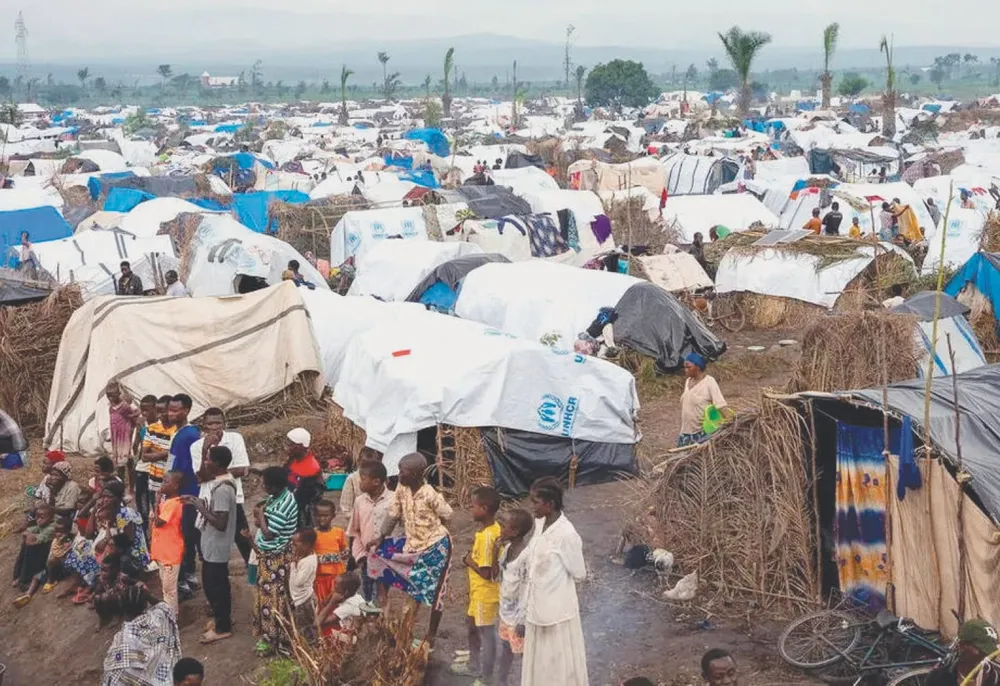
Tens of thousands of Congolese refugees have fled to Burundi in recent months, putting humanitarian resources under immense strain. Pictured here is the Busuma refugee camp in Burundi, which hosts over 65,000 people.
Tens of thousands of Congolese refugees have fled to Burundi in recent months, putting humanitarian resources under immense strain. Pictured here is the Busuma refugee camp in Burundi, which hosts over 65,000 people. Credit: © UNHCR/Arnold Temple

Aug. 3—The global security landscape is undergoing a profound transformation. There is therefore legitimate concern about the increasing and diverse threats to international peace and security, including armed aggression, which increase the risks of nuclear war that could pose an existential threat to humanity. However, despite this, the majority of the international community expresses a genuine commitment to the establishment of a just and lasting peace and reaffirms that it will act in accordance with international law, including the UN Charter and its purposes and principles, and that the obligations it has accepted will be fulfilled in good faith. The progressive part of the world yearns for full respect for the sovereign equality of all states, for respect for the principles of equal rights and self-determination of peoples, with the obligation to refrain from the threat or use of force against the territorial integrity or political independence of any state. Commitment to resolving international disputes by peaceful means also presupposes resolving the current migrant crisis, which is one of the priority topics of contemporary international relations.

This is confirmed by the numerous discussions and activities that have been taking place at the global and regional levels in recent years (for example, in the United Nations Economic and Social Council (ECOSOC), in the United Nations High Commission for Refugees (UNHCR), in the International Organization for Migration (IOM), in the Global Forum on Migration and Development (GFMD), in the G20 forum of the world’s most developed countries, as well as in the European Union, which monitors and supervises current migration flows from the Middle East, Asia, North and Sub-Saharan Africa). The concrete results of these activities are reflected in legal acts and political agendas in which the international community has determined the ways and directions of action to overcome the negative effects of the migrant crisis on the social, economic and legal levels.

‘Migrant Tsunami’ in Ceuta

However, despite these actions, the demographic imbalance between the poor and the rich, continues to result in ever-increasing waves of migration. This is evidenced by the latest disturbing news about the “migrant tsunami” in Ceuta—the Spanish exclave in North Africa. Despite the legal acts and political agendas of the European Union on overcoming the migrant crisis, this case indicates the inappropriate reactions of some member states toward Spain. The proposal for its expulsion from the Schengen system indicates geopolitical shifts within the Union itself. This is all the more so because Spain, adhering to the principles of the UN, openly speaks about the war events in the Middle East, not hesitating to say that the actions of the “allies” are directly in contradiction with positive international law.

What exactly is behind such large-scale migration of the African population to the territory of the Spanish exclave is difficult to assess at this time, given the small amount of reliable information. However, what is certain is that these illegal migration movements are caused by social and security upheavals, primarily by unbearable and inhumane living conditions. The explosive growth of the African population, coupled with the uncontrolled exploitation of natural resources, and the generally widening gap in living standards between the countries of the Global South and the rich Global North, point to the increasing dehumanization of the world and to regressive movements caused by the increasingly aggressive political and military actions of the leading countries of the West, motivated by the values and logic of neoliberal capitalism.

The widespread chaos in various regions of the world has prompted millions of poor, displaced, disenfranchised and vulnerable people to leave their home countries in search of better and safer living conditions. For this reason, the increased number of migrants is considered to seriously undermine the security of European countries, which is why state authorities classify them as a direct threat to national security, as migrant crises are increasingly being instrumentalized and managed from certain centers of power (both in the West and the East). Geopolitical conflicts between great powers are going so far that they are increasingly manifesting themselves in the political reality of weaker states.

For example, great powers are increasingly modelling changes in political power and activating long-frozen conflicts, while strengthening religious and national extremism. In this process, the influx of migrants cannot be prevented by the use of violent means (physically closing borders), but by building a global strategic approach to the economic and institutional development of the countries from which these migrations come. Since illegal migration has enormous security repercussions for countries on migration routes, as well as for countries of final destination, Europe, but also the entire world, must strengthen international mechanisms for the fight against migrant smuggling and human trafficking. Effective protection against the risks that illegal migration brings with it requires consistent application of international law (especially in the areas of refugee law, human rights law and humanitarian law).

Ad Hoc Financial Solutions Won’t Work

Attempts to address the migrant crisis with ad hoc financial solutions allow for the acquisition of benefits by local political elites, but do not solve crucial problems. This was most clearly demonstrated in the example of the Western Balkan countries, where the migrant crisis from the Middle East and Ukraine was transposed in such a way that these countries became “reservoirs for the reception” of the population from war-torn areas. This situation pointed to the inconsistency of the European Union’s migrant policy, the insufficiently effective capacities of the NATO pact to control this process, but also to the hypocritical behavior of informal centers of power that manage the security situation in this part of the world through migrants. Essentially, this movement leads to the long-term political destabilization of these countries, to a change in the value system, to the reduction of their religious and national structure, which ultimately prevents their economic and political progress.

Hence, the proposal to achieve humane solutions “for a better tomorrow” comes at the last minute with the encyclical Magnifica Humanitas of Pope Leo XIV. His call for humanity to act as one in its common goal of seeking peace and development coincides with the efforts of the UN, which in 2024 promoted the “Pact for the Future.” By adopting this document, the UN member states agreed to undertake a series of activities to contribute to solving the accumulated world problems, from preserving international peace and security to promoting sustainable development, human rights and caring for future generations. Achieving these goals is not possible without truly eradicating poverty, hunger, eliminating food insecurity, taking global measures against climate change for the purpose of sustainable use of the environment, reducing the gap in developing countries, ensuring the multilateral trading system as an engine of sustainable development, strengthening trust, social and cultural cohesion, building a peaceful, just and inclusive world society, with full respect for human rights and fundamental freedoms.

Whether the planned goals will actually be achieved and thus fulfil to some extent the instructions from the encyclical Magnifica Humanitas of Pope Leo XIV, is a matter for future consideration. However, what is quite certain now is that the progressive forces in the world should close their ranks and direct their efforts toward solving the most important international problems, which include the reform of international economic institutions, the establishment of an alternative international financial system, the progressive development and consolidation of international law, and the reaffirmation of the role of the United Nations in the sphere of collective security.