The following is an edited transcript of remarks by Sara Madueño de Vásquez to Panel 2 of the Sept. 4, 2026 EIR-IPC Roundtable, “An Alternative to War and Looting in the Americas.” Madueño is an architect, head of the EIR office in Lima, Peru, and founding member, together with her husband Luis Vásquez, of the LaRouche movement in Peru. Subheads have been added. The video is available here.
Good afternoon, everyone. First, I would like to thank Lyndon LaRouche for everything he taught us—for showing us the method of development, for uncovering from history how this method works, and for bringing it into the present.
I would like to begin my presentation by recalling Pope Leo XIV’s appeal to us at the World Food Program this past June. Hunger, the Pope told us, “erodes social cohesion, heightens the risk of conflict and fuels forced migration.” He reiterated that it is urgent for all to participate, through “genuine international dialogue and cooperation oriented toward the common good. Such an approach requires a firm political will capable of transcending short-term perspectives and investing in global public goods.” Investing in global public goods. This goal can only be achieved through the convergence of effective policies and the coordinated implementation of interventions. The Pope had already called on us to make a real contribution to a much more just world.
And that really is what it is all about, isn’t it? When the Pope speaks to us about global public goods, he is speaking, in a certain sense, about what the Chancay Port represents, about what development corridors represent—which are public goods that will promote the progress of nations.
I would like to point out, by the way, that in 2025, on the occasion of the inauguration of the first phase of the Chancay Port—an event attended by Chinese President Xi Jinping—he reminded us of the importance of Chancay. Xi told us—and I quote—“Chancay becomes a new starting point for the Inca Trail in a new era. From Chancay to Shanghai, the corridor that will connect the Inca Trail with the 21st-Century Maritime Silk Road will open a path to shared prosperity and happiness for Peru and other countries in Latin America and the Caribbean.”
Very true. The Inca Trail that Xi was referring to is none other than the famous Qhapaq Ñan, the road that connected the entire southern part of the South American continent—a route spanning nearly 4,000 kilometers. What is interesting, and where Xi’s reference comes in, is that this road—which, by the way, has been deeply rooted in Andean communities for millennia, not just since the time of the Incas—operated on the basis of a very important concept: the concept of Andean reciprocity. This was the trail route through which this concept of reciprocity spread throughout the entire Andean region.
What does Andean reciprocity mean? Well, it means mutual aid, and its motto was that what you give receives an equivalent return: exactly the concept of win-win, where everyone wins. The symbolism is very beautiful.
Aside from the economic benefits of the Chancay Port per se, such as cost reductions, shorter transit times, and so on, connecting Brazil to both the Atlantic and Pacific Oceans via a bi-oceanic corridor and the fact that Chancay has already become a major coastal port for countries in North and South America, will most certainly boost productivity in Peru, and throughout the region.
But I believe the most important factor will not only be that it will drive industrialization in strategic sectors of the economy, such as agribusiness, construction, steel, energy and electronics, heavy machinery, transportation, services, metalworking, and so on. There are thousands of areas in which the economy will receive an exponential boost, but most importantly, this will create thousands of jobs. And in this way, we will have begun to combat poverty and hunger. Our young people will no longer have to wander the streets labeled as “NINIS.” NINIS is the Spanish term used for children and young people who neither work nor study. [Sometimes known as NEET in English—ed.] In the future, with Chancay and all the projects planned in connection with it, they will be able to have decent jobs.
Chancay and the ‘Donroe Doctrine’
But unfortunately, as some of those who spoke before me have already pointed out, Chancay has become a security issue for the United States. At least, that is what they say. But the paradox is, that they were never interested in the Chancay Port, just as they are never interested in the development of any potential project in our region or anywhere else in the world. But when the Chancay Port began taking shape, U.S. officials immediately began traveling across the entire continent, arguing that Chancay Port could be used as a “dual-use” facility, because, given that it is a deep-water port, China could eventually use it in the event of a conflict. But, as I said, any development project is a perceived threat to U.S. security. And in their famous security strategy—or what is now called the “Donroe Doctrine”—they never tire of saying that we are their strategic reserve, their backyard; that our resources are their resources; in other words, that they own us.
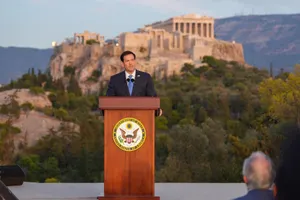
U.S. Secretary of State Marco Rubio, in remarks he made last January, warned: “This is where we live, and we will not allow the Western Hemisphere to be a base of operations for adversaries, rivals, and competitors of the United States.” How about that? What do you think of that!
But what a contrast with China! Take note that in China’s policy toward Latin America and the Caribbean, also published recently, the Chinese tell us—and I quote—that “intergovernmental cooperation in scientific and technological innovation” is an imperative. We must, they say, actively explore broadening cooperation in high-tech areas such as information technology, artificial intelligence, aviation, the aerospace industry, new energy sources, new materials, biomedicine, and integrated circuits.
By the way, Chinese companies and the Chinese government are signing agreements with Peruvian universities, such as the University of San Marcos and the University of Engineering, where I studied. They have already established schools of railway engineering, of artificial intelligence, and so on. In other words, the Chinese proceed under the concept that infrastructure is fine, but without education, it is not development, which I think is important. But the point is that—and this is the key issue—this is the philosophy guiding China’s involvement in all the Belt and Road projects. And in that sense, initiatives like the BRICS, the Shanghai Cooperation Organization, and so on, are meant to put us in an optimistic frame of mind, because the world is definitely not coming to an end; history is beginning to be written in the Global South in a bold way. So let us look at things with optimism. Because the imperialists, the one-worlders—all they seek is to destroy the possibility of development so they can control everything. And their best weapon, as we can see in modern times, is war.
The American System in South America
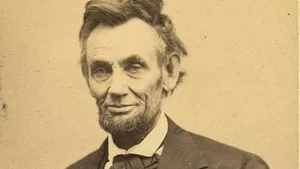
They have been very successful on some occasions using that tool. That is also true in the case of Peru. It was the British who instigated the Peru-Chile War precisely to prevent—as Dennis Small said—the expansion of the American System of Economics in the Americas, in South America. This project to expand the American System in South America found a Peruvian president, President Manuel Pardo, a close friend of Henry Carey and an admirer of Lincoln, who shared their vision of encircling the world with a “steel corridor,” a “belt of steel.” And indeed, while Pardo was President [1872-1876], he began to bring that project to life, starting to build what would become the main transportation corridor connecting all of the Americas.
Let me read the following decree-law which was passed by the Peruvian Congress in 1868. This is truly tremendous. It states:
“The nation declares the construction of railroads—and especially those connecting the coast to the interior of the country—to be of the highest interest, both for the country’s moral and political future and for its material prosperity.”
That’s exactly what Pardo did. Pardo had promoted the law, and spearheaded its passage. When he became President four years later, Pardo explained:
“If these three lines were connected along the coast by a stretch of railroad tracks … well, in ten years, a revolution would have taken place in Peru—a revolution that is both physical and moral—because the locomotive, which transforms the landscape of the country through which it passes, also civilizes it; and that is perhaps its greatest advantage: the communities it brings into contact are not merely civilized, but educated.”
The level of statesmanship we see in Peru right now, unfortunately, is on par with the level of statesmanship we’re observing throughout the West.
But this Chancay project is quite inspiring in many ways, because now that Peru is part of the Belt and Road Initiative—in which, by the way, 22 countries in the Americas participate—Chancay becomes the gateway connecting South America to the Asia-Pacific region, which is currently the epicenter of global trade.
LaRouche’s Influence on Peru
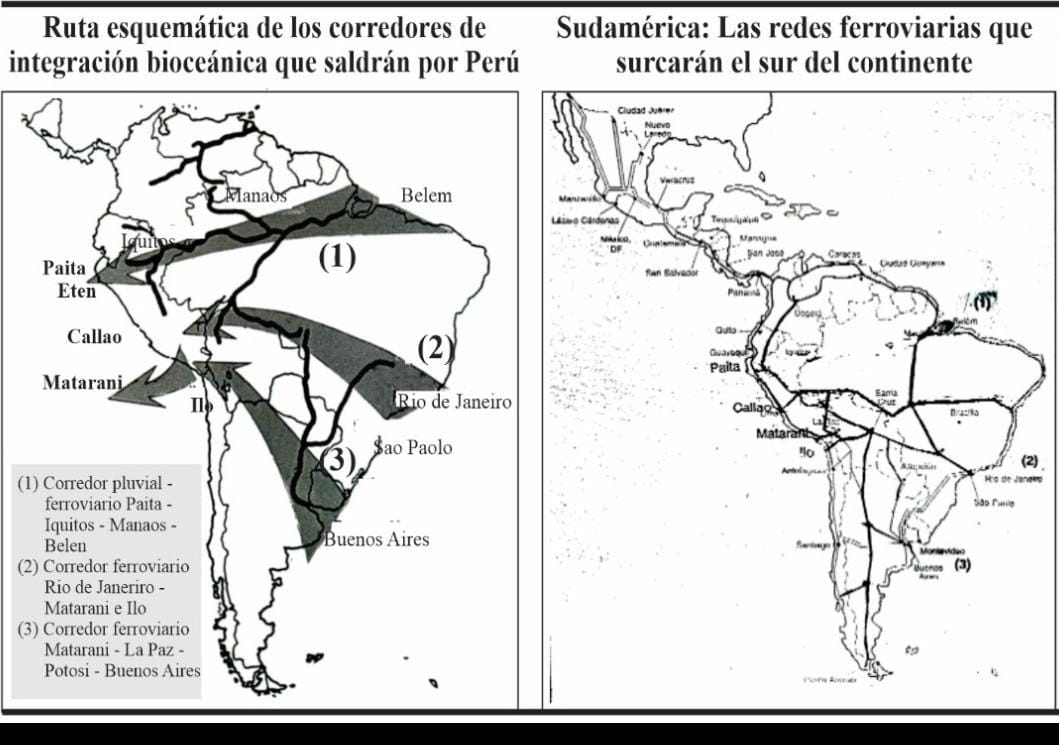
The idea that Peru is—or could be—South America’s gateway to the Pacific basin was conceived as early as 1990, thanks in large part to Lyndon LaRouche, who revived the concept of physical economy and passed it on to us. Luis Vázquez of the Schiller Institute proposed at that time that Peru would become South America’s gateway to the Pacific basin and presented a series of three bioceanic corridor routes—you can see the bioceanic corridors in Figure 1—routes that, in a certain sense, are part of Peru’s and Brazil’s agenda today, with obviously significant variations over time. What’s interesting about this proposal is that it was part of the program of government presented in 1990 by the Solidaridad movement associated with Lyndon LaRouche in Peru. It was a complete novelty; many people did not understand it.
Here we see the plan for the construction of rail corridors through to the year 2050 released by Peru’s Ministry of Transport and Communications presented at the end of last year. Figure 2 highlights the rail corridor running from Lima, to Cerro de Pasco, to Pucallpa. This corridor is the corridor that would be connected to the Cruceiro do Sul corridor coming from Brazil.
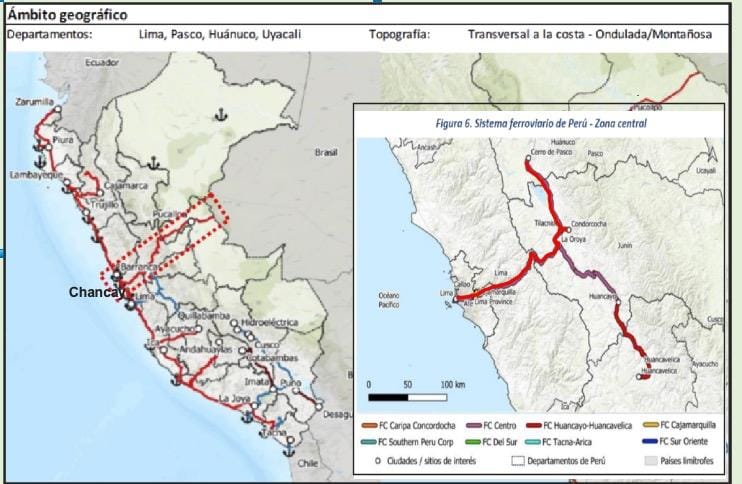
So, here we are, with the prospect of a bio-oceanic corridor already on the agenda. What is interesting is that, in February of this year, the government—specifically, the Ministry of Transportation—approved and awarded a concession for the construction of the section which runs from Chancay to Cerro de Pascua, which you can see in the map on the right of Figure 2. The company that won the bid is China Power Corporation, a highly reputable firm, because it is the leading construction company in the Belt and Road Initiative. This company has taken charge of the construction of the Chancay–Cerro de Pascua route, which passes through a series of very rich polymetallic mining centers. The challenge here is that it crosses the Andes Mountain range, an extremely difficult terrain. At one point, when Peru’s Central Railroad crossed the Andes, it was considered the highest railroad line in the world. Now, thanks to Chinese technology, constructing this will be a piece of cake. (This company, by the way, has worked on and has extensive experience in building in the high mountains of Central Asia, the Amazon, and so on.) This is now on the agenda.
In February of this year, Brazil officially presented its proposal for bio-oceanic corridors, which you can see in Figures 3a and 3b. The corridors which enter Peru from the north and the south are rail corridors. Most of these corridors heading towards the southern part of the continent are highway corridors. And as we can see here, this line extends to Cruzeiro do Sul, where it connects with Pucallpa, which means the Bioceanic Highway will be complete. So, this is very interesting. I won’t go into the details of each route on the map, because it is, after all, just a map, and the geography is complex.
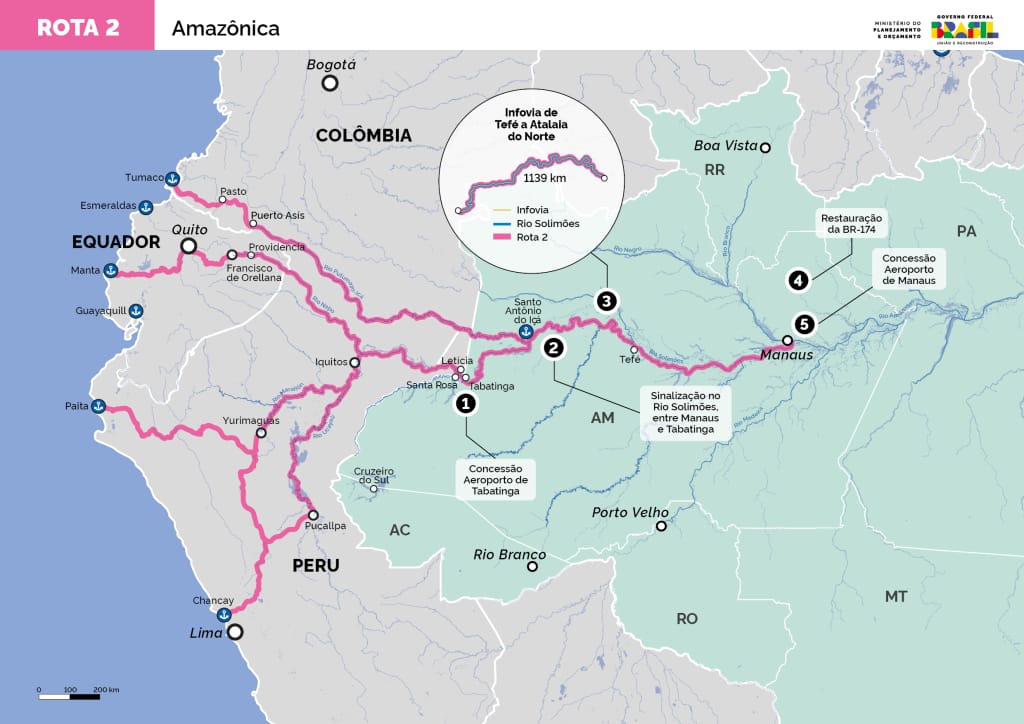
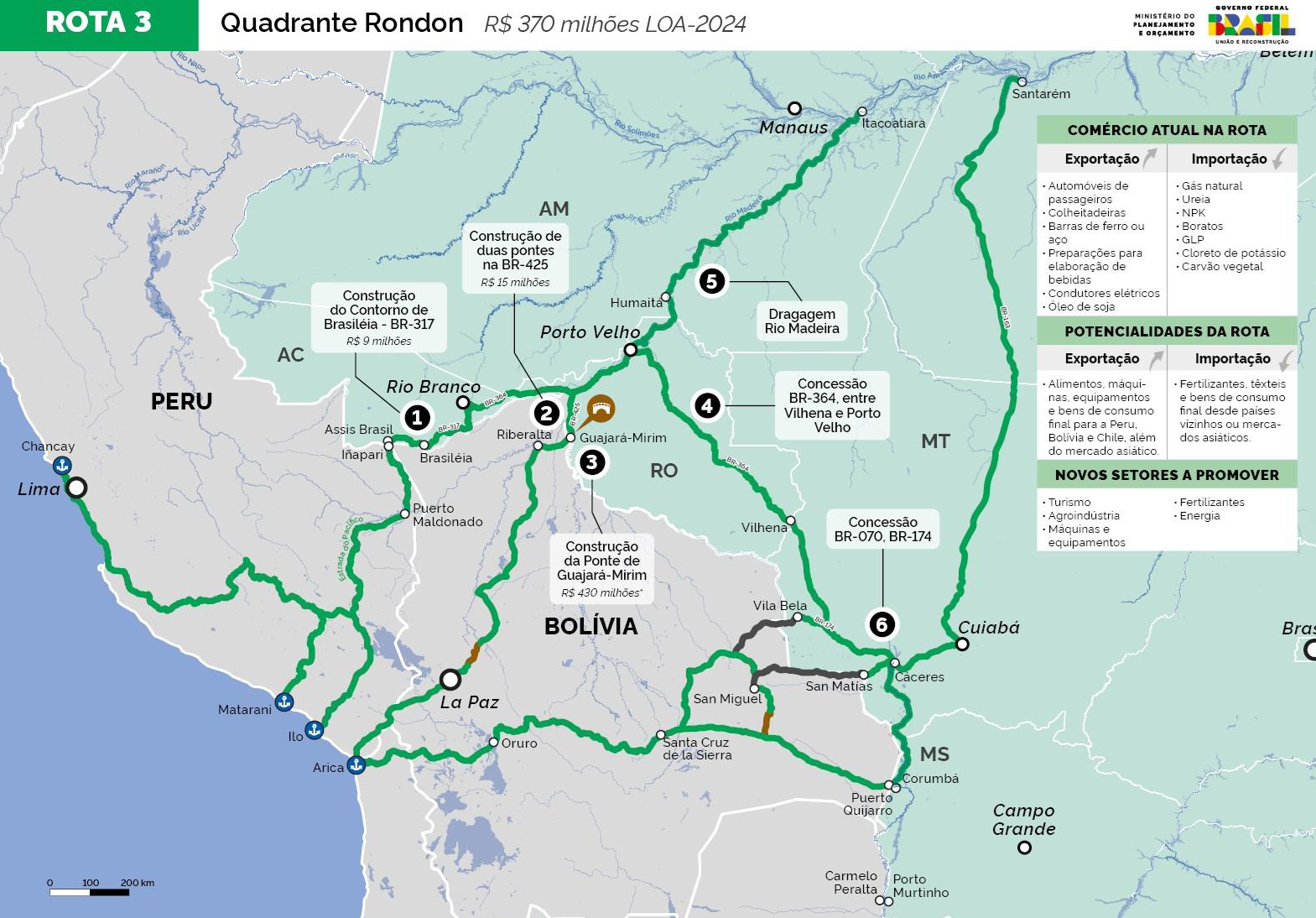
Figure 3a, Figure 3b: The maps of Routes 2 and 3 of the five South American Integration Routes prepared by Brazil’s Ministry of Planning, Budget and Management. Route 2 (Figure 3a) depicts a multimodal route crossing the Amazon region, which enters Peru at the Loreto Region’s Ramon Castilla Province, heads to Pucallpa in the Ucayali Region, then onto Cerro de Pasco, from where it heads to Chancay. Route 3 (Figure 3b) the Rondonia Quadrant, crosses the three Brazilian states of Acre (which borders Ucayali in Peru), Rondonia and the state of Amazonas, and then divides into two: one route heading north (pending entry into Peru, passing through Pucallpa, and then heading to Chancay). To the south, the route enters Peru at Iñapari in Madre de Dios, from where it heads south, passing through Puerto Maldonado and then dropping down to Abancay in Apurimac, where it splits into two branches, one which ends at Matarani and the other at Ilo, both ports on the Pacific. Credit: Ministério do Planejamento e Orçamento
President Pardo’s Wise Words
Compare it to the previous map (Figure 2). All this great potential which lies before us offers a very optimistic future, especially for our young people. It is the responsibility of our governments to move these efforts forward. But there is one point I think is essential to emphasize: that infrastructure alone does not equal development. That requires infrastructure, education, raising the standard of living of the population, eliminating hunger, creating jobs, and eliminating poverty. Pardo used to tell us—and let’s remember what Pardo said—that great projects educate and generate optimism. This optimism stems from the fact that our young people will be part of building their own future. So, this is very, very interesting.
I would like to read to you a quote from the speech Lyndon LaRouche gave in 1987 before 500 young people at the Colegio de San Agustín, at a conference organized by the Schiller Institute in collaboration with that St. Augustine School. Incidentally, this conference was held in commemoration of the famous [papal] encyclical, Populorum Progressio. Remember that it was Paul VI who articulated the concept that “development is the new name for peace.” A concept which, by the way, Leo XIV reiterates whenever he can, at every opportunity. It is the message he consistently emphasizes when speaking about world peace.
What did LaRouche say to these young people? Educational and research institutions will play an important role in this process. But he also told them—and this is very important:
“Never think of yourself as a person from a poor country. I have asked you to turn your eyes up to the stars, to see, with pride and confidence, what your mind is capable of enabling you to accomplish. Your dreaming that dream of the stars, is your nation’s potential; your nation’s potential is its future reality.”
This means we must focus on increasing the country’s physical production. And that is the way, that is the method of making development the key to peace. Thank you.