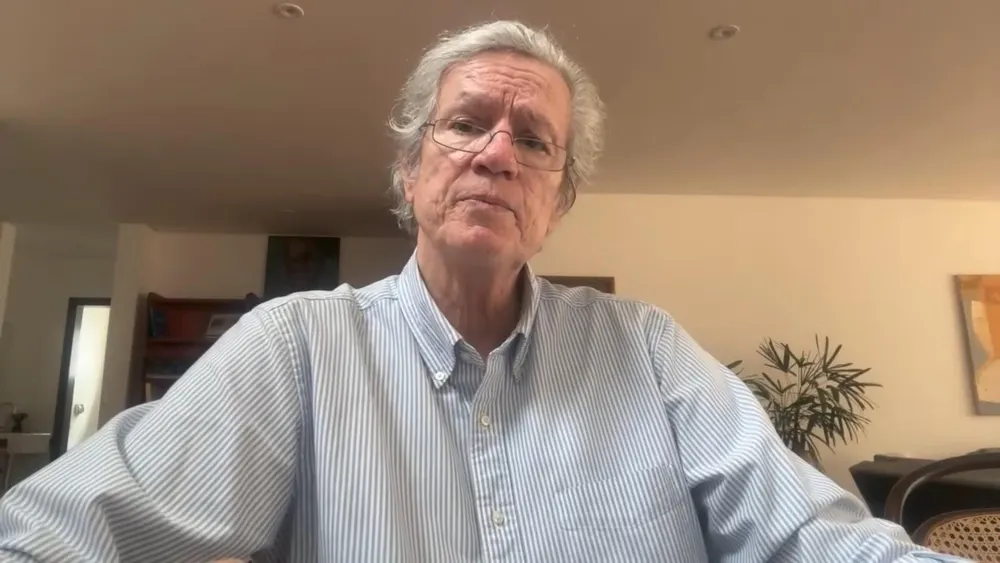
The following is an edited transcript of remarks by Paulo Nogueira Batista, Jr. to Panel 1 of the Sept. 4, 2026 EIR-IPC Roundtable, “An Alternative to War and Looting in the Americas.” Mr. Batista is the former executive director of the International Monetary Fund for Brazil and 10 other countries in Washington, D.C., and co-founder and vice president of the New Development Bank established by the BRICS. Subheads have been added. The video is available here.
Good morning, good afternoon. Thank you very much for the invitation. It’s a pleasure to be here on this panel organized by the Executive Intelligence Review.
Well, the New Monroe Doctrine has been set out quite clearly, quite explicitly in public statements by the U.S. authorities and also in two official documents from late last year and the beginning of this year, in the U.S. National Defense Strategy and the U.S. National Security Strategy. These two documents can be summarized in the following manner, perhaps.
U.S. Attempts Hegemony in the Western Hemisphere
The United States does not give up its attempt to sustain a global hegemony, but it now wants to focus more, and in a different manner, on the Western Hemisphere, understood very broadly, meaning not only Latin America and the Caribbean, but also Canada and Greenland. The Western Hemisphere from Greenland all the way to Patagonia is supposed to be the uncontested area, the area where there is uncontested U.S. hegemony. Well, it’s not only documents. It’s not only public statements. Actions have occurred, and that’s the most important thing. The United States is acting according to its new precepts. So, we have had notably the military intervention in Venezuela with the kidnapping of the President of the country, Nicolás Maduro. We’ve had the intensification of the blockade against Cuba. And there’s been an intensification of economic conflicts with Canada recently, and also with Europe over Greenland since President Donald Trump came in.
Venezuela is the main concern, because not only has the President been kidnapped, but the regime that has been put in place is effectively allowing the country to become a protectorate of the United States, as has already been mentioned here by previous speakers. Let me tell you, it’s important to keep in mind, in my opinion, that there’s no precedent for a military action in South America since the early 20th Century, more than 100 years ago. In Central America and the Caribbean, military interventions by the U.S. are more frequent, but in South America they are much rarer. And the last one was, I believe, the intervention against Colombia to guarantee the secession of Panama in 1904. Since then, no military operations have occurred. The Brazilian governments often refer to South America as a region of peace.
That is no longer valid. We are no longer an assured region of peace. And if we want to keep peace, we must follow the Roman lemma, which is: If you want peace, prepare for war. That’s a fundamental requirement for all countries, I think. Let’s say, for all countries in South America and Latin America that want to preserve their self-determination, to use the term that Minister Roberto Amaral just recalled.
U.S. Strategic Errors
What’s going on? Not everything is negative for us. Let me give you one or two examples. The United States, the superpower, commits enormous strategic errors in this early 21st Century. The first one was to open three fronts of battle, of war, against Russia, through Ukraine; against Iran directly; and against China in economic and political terms. Now, what has that produced for the United States? It has produced a difficult situation where it has to spread out its resources on three fronts. And it has brought together these three countries, Russia, Iran, and China, like never before. So, unite your enemies—that’s the dilemma that the United States has been following since President Joe Biden, at least.
The second blunder now under Trump is the fragmentation by the United States of the Western bloc: hostility against Canada, hostility against Europe, hostility against the UK, including hostility against Japan. Everyone who was seen, and saw themselves, as U.S. allies are being treated, let’s say, as near enemies. And this is, of course, making the international situation more difficult for the United States. Unite your enemies and disunite your allies, or break away from your allies. That’s what the United States is trying to do. So, the blunders committed by the superpower help us a lot, because they reduce the efficacy of international action by the United States, the aggressive international action of the United States.
So, what else can we say in our favor? Well, the obvious: Iran, and to a lesser degree Ukraine, have shown the possibilities of what is being called asymmetric warfare by a smaller country, a middle-sized power, against an aggressive superpower. Cheap military equipment—missiles, drones—is sufficient to inflict major damage and destroy very expensive equipment and deter action. So, the news for us here is that Iran, especially Iran, has proved that deterrence, the capacity to resist aggression, does not depend on nuclear deterrence, necessarily. So, this is a very important point, because we must draw the line.
What We Latin Americans Must Do
Now, remember that we Latin Americans are often under certain delusions. Some of us think, “Oh, well, in the end, we have our allies across the world. They will come to our aid in case the United States attacks.” I think, again, the Venezuelan experience has shown that this is false, or dubious, to say the least. I would say that every indication we have suggests that China and Russia will not intervene in the case of military aggression upon any of our countries by the United States. So, we need to count on our own forces.
This means building, as quickly as possible, a national defense strategy and preparing for the worst: hoping for the best, preparing for the worst. And this preparing for the worst includes, for example, military cooperation. So, we need to be especially realistic. No illusions should be entertained, because we’re living in a very difficult world, and we need to take some practical steps.
Now, this is not easy for countries like Brazil, because we’re used to peace. The last time we suffered any aggression in our territory was during the Paraguayan War, back in 1864-1870. So, contrary to the experience of Russia, China, and Iran, we are spoiled. We think peace is guaranteed, and it is not. It no longer is.
The question posed by Lyndon LaRouche—whether we can survive—is even more relevant now than when he stated that. We’re living in a world of hyper-imperialism, as some have called it; and against force, only force will prevail. No diplomatic means, soft power—all this is important, but it is ultimately not sufficient. And we need to rely, of course, on cooperation in the military field, and this is certainly possible with some countries, say, Turkey, France, other European countries, India, and also China, Russia, and Iran, although this is a complicated process politically.
But in the end, national defense is our responsibility, and I think we need to realize, as has been shown now, that we are facing an existential threat in the new circumstances created by hyper-imperialism.
That’s what I have to say. Thank you very much.